Protocols for Professional Conversations:
A User’s Guide
The Project Zero Classroom
Cameron Paterson
cpaterson@shore.nsw.edu.au
Twitter: @cpaterso
Understanding Goals
• What are protocols?
• How can protocols help us to deepen
our understanding of teaching and
learning?
• How can protocols be used to improve
our skill and focus in working with
students and colleagues?
Spirit in which you participate
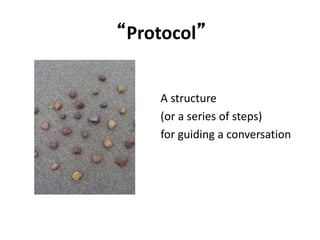
“Protocol”
A structure
(or a series of steps)
for guiding a conversation
Your questions……
Why did you choose this mini-course?
What do you hope to learn?
The Question(s):
Think of the professional conversation in which you
learned the most.
 What did you learn in the course of the
conversation?
 What made it powerful?
What was the least productive professional
conversation you’ve ever had?
 What made it so difficult?
Microlab Protocol
Purpose:
To address a specific sequence of questions in a
structured format with small groups, using
active listening skills
What’s Examined and Discussed:
Usually a question or text.
Essential Qualities of a Professional
Learning Conversation
• CLARITY of purpose
• SAFETY that supports trust and risk taking
• EQUITY for all participants
• (LEVITY—because joy is important, too!)
Protocols can help with these . . . .
Tina Blythe, 2016
Essential Opportunities of a
Professional Learning Conversation
• Attending
• Reflecting
• Connecting
• Questioning
• Extending
Protocols can help with these, too . . .
Tina Blythe, 2016
Features of Protocols
• Roles
• Norms
• Purpose
• Steps
• Facilitation
• Reflection
Tina Blythe, 2016
Collaborative Assessment Conference
A structure by which teachers come together to look
at a piece of work, first to determine what it reveals
about the student and the issues she/he cares about,
and then to consider how the student's issues and
concerns relate to the teacher's goals for the student.
The last part of the conversation the - discussion of
classroom practice - grows out of these initial
considerations.
Tuning Protocol
Widely used and adapted for looking at
both student and adult work in and among
schools across the country
The Consultancy Protocol
- A protocol for allowing a group to analyze a
dilemma that an individual or the group is
experiencing in order to understand the dilemma
more deeply.
- Exploring a dilemma – not solving it!
- Understanding it in a different way opens up new
ways of moving forward.
5 Minute
Stretch
Break
For presenting your dilemma
Using Protocols
 They are tools for the work of supporting teacher
and student learning (not the work itself).
 They must be chosen with a specific purpose in
mind.
 It takes some practice before they can be used
most effectively.
How do protocols help?
 Help create opportunities for and allocate time to
essential conversations about teaching and
learning.
 Provide routines and structures to scaffold
collaborative analysis and planning.
 Support interactions that enable us to develop and
demonstrate our understanding of and respect for
the variety of perspectives and experiences by our
colleagues.
Protocols
(Almost) all protocols will enhance:
Clarity (making the purpose explicit)
Safety (creating clear expectations for roles and participation)
Equity (enabling/encouraging everyone to participate)
Some Protocols Do More
Especially protocols that emphasise…
 Observing
 Listening
 Asking questions about what one observes and
hears
 Using conditional language (wondering,
considering)
 Question-finding and question-refining (as
opposed to problem-solving)
 Learning (as opposed to task accomplishment)
Challenges of Using Protocols Well
 Weathering the “learning curve.”
 Deciding when to use a protocol.
 Choosing the appropriate protocols for the
purposes.
 Resisting the impulse to problem-solve (at least for
a time)
 Documenting learning and building on previous
discussions.
 Facilitation.
 Time, time, time.
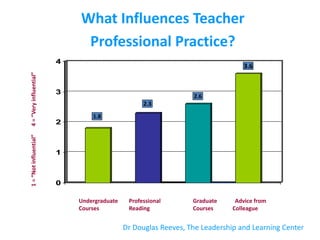
Undergraduate Professional Graduate Advice from
Courses Reading Courses Colleague
What Influences Teacher
Professional Practice?
1=“Notinfluential”4=“Veryinfluential”
1.8
2.3
2.6
3.6
0
1
2
3
4
Dr Douglas Reeves, The Leadership and Learning Center
The extent of trust among adults in schools strongly predicts positive student learning
outcomes (Bryk, 2002).
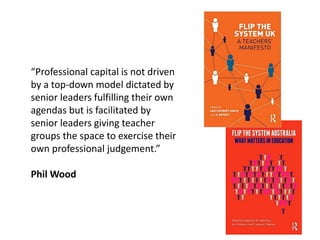
“Professional capital is not driven
by a top-down model dictated by
senior leaders fulfilling their own
agendas but is facilitated by
senior leaders giving teacher
groups the space to exercise their
own professional judgement.”
Phil Wood
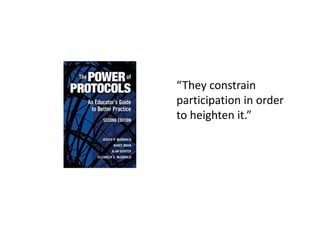
“They constrain
participation in order
to heighten it.”
Credit:
Tina Blythe
Return to
questions
Final whip reflections
Final written reflections
Protocols for Professional Conversations:
A User’s Guide
The Project Zero Classroom
Cameron Paterson
cpaterson@shore.nsw.edu.au
Twitter: @cpaterso

Protocols for Professional Conversations 2019

  • 1.
    Protocols for ProfessionalConversations: A User’s Guide The Project Zero Classroom Cameron Paterson cpaterson@shore.nsw.edu.au Twitter: @cpaterso
  • 3.
    Understanding Goals • Whatare protocols? • How can protocols help us to deepen our understanding of teaching and learning? • How can protocols be used to improve our skill and focus in working with students and colleagues?
  • 5.
    Spirit in whichyou participate
  • 6.
    “Protocol” A structure (or aseries of steps) for guiding a conversation
  • 7.
    Your questions…… Why didyou choose this mini-course? What do you hope to learn?
  • 8.
    The Question(s): Think ofthe professional conversation in which you learned the most.  What did you learn in the course of the conversation?  What made it powerful? What was the least productive professional conversation you’ve ever had?  What made it so difficult?
  • 9.
    Microlab Protocol Purpose: To addressa specific sequence of questions in a structured format with small groups, using active listening skills What’s Examined and Discussed: Usually a question or text.
  • 10.
    Essential Qualities ofa Professional Learning Conversation • CLARITY of purpose • SAFETY that supports trust and risk taking • EQUITY for all participants • (LEVITY—because joy is important, too!) Protocols can help with these . . . . Tina Blythe, 2016
  • 11.
    Essential Opportunities ofa Professional Learning Conversation • Attending • Reflecting • Connecting • Questioning • Extending Protocols can help with these, too . . . Tina Blythe, 2016
  • 12.
    Features of Protocols •Roles • Norms • Purpose • Steps • Facilitation • Reflection Tina Blythe, 2016
  • 13.
    Collaborative Assessment Conference Astructure by which teachers come together to look at a piece of work, first to determine what it reveals about the student and the issues she/he cares about, and then to consider how the student's issues and concerns relate to the teacher's goals for the student. The last part of the conversation the - discussion of classroom practice - grows out of these initial considerations.
  • 14.
    Tuning Protocol Widely usedand adapted for looking at both student and adult work in and among schools across the country
  • 15.
    The Consultancy Protocol -A protocol for allowing a group to analyze a dilemma that an individual or the group is experiencing in order to understand the dilemma more deeply. - Exploring a dilemma – not solving it! - Understanding it in a different way opens up new ways of moving forward.
  • 16.
  • 17.
  • 19.
    Using Protocols  Theyare tools for the work of supporting teacher and student learning (not the work itself).  They must be chosen with a specific purpose in mind.  It takes some practice before they can be used most effectively.
  • 20.
    How do protocolshelp?  Help create opportunities for and allocate time to essential conversations about teaching and learning.  Provide routines and structures to scaffold collaborative analysis and planning.  Support interactions that enable us to develop and demonstrate our understanding of and respect for the variety of perspectives and experiences by our colleagues.
  • 21.
    Protocols (Almost) all protocolswill enhance: Clarity (making the purpose explicit) Safety (creating clear expectations for roles and participation) Equity (enabling/encouraging everyone to participate)
  • 22.
    Some Protocols DoMore Especially protocols that emphasise…  Observing  Listening  Asking questions about what one observes and hears  Using conditional language (wondering, considering)  Question-finding and question-refining (as opposed to problem-solving)  Learning (as opposed to task accomplishment)
  • 23.
    Challenges of UsingProtocols Well  Weathering the “learning curve.”  Deciding when to use a protocol.  Choosing the appropriate protocols for the purposes.  Resisting the impulse to problem-solve (at least for a time)  Documenting learning and building on previous discussions.  Facilitation.  Time, time, time.
  • 24.
    Undergraduate Professional GraduateAdvice from Courses Reading Courses Colleague What Influences Teacher Professional Practice? 1=“Notinfluential”4=“Veryinfluential” 1.8 2.3 2.6 3.6 0 1 2 3 4 Dr Douglas Reeves, The Leadership and Learning Center
  • 25.
    The extent oftrust among adults in schools strongly predicts positive student learning outcomes (Bryk, 2002).
  • 26.
    “Professional capital isnot driven by a top-down model dictated by senior leaders fulfilling their own agendas but is facilitated by senior leaders giving teacher groups the space to exercise their own professional judgement.” Phil Wood
  • 28.
    “They constrain participation inorder to heighten it.”
  • 29.
  • 30.
  • 31.
  • 33.
  • 34.
    Protocols for ProfessionalConversations: A User’s Guide The Project Zero Classroom Cameron Paterson cpaterson@shore.nsw.edu.au Twitter: @cpaterso