Assessment Literacy Series
Quick Start ©

-Orientation Module1
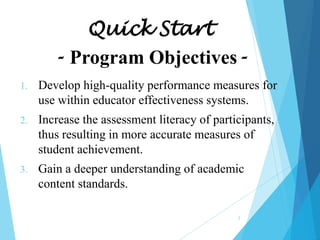
Quick Start
- Program Objectives1.

Develop high-quality performance measures for
use within educator effectiveness systems.

2.

Increase the assessment literacy of participants,
thus resulting in more accurate measures of
student achievement.

3.

Gain a deeper understanding of academic
content standards.
2
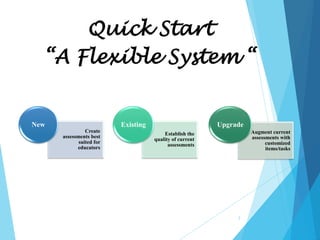
Quick Start
“A Flexible System “

New

Existing
Create
assessments best
suited for
educators

Upgrade
Augment current
assessments with
customized
items/tasks

Establish the
quality of current
assessments

3
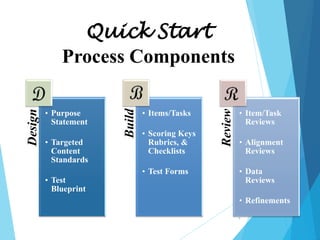
• Targeted
Content
Standards
• Test
Blueprint

• Items/Tasks
• Scoring Keys
Rubrics, &
Checklists
• Test Forms

Review

• Purpose
Statement

Build

Design

Quick Start
Process Components
• Item/Task
Reviews
• Alignment
Reviews
• Data
Reviews
• Refinements
4
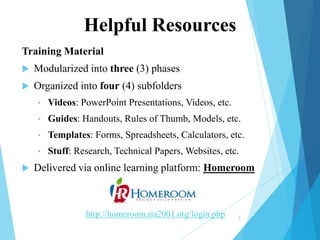
Helpful Resources
Training Material


Modularized into three (3) phases



Organized into four (4) subfolders
•
•

Guides: Handouts, Rules of Thumb, Models, etc.

•

Templates: Forms, Spreadsheets, Calculators, etc.

•



Videos: PowerPoint Presentations, Videos, etc.

Stuff: Research, Technical Papers, Websites, etc.

Delivered via online learning platform: Homeroom

http://homeroom.ria2001.org/login.php

5
What is Assessment Literacy?
The skills, knowledge, and concepts
associated with sound assessment
practices, including the critical review
of quality evidence.

6
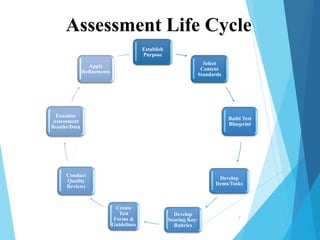
Assessment Life Cycle
Establish
Purpose
Select
Content
Standards

Apply
Refinements

Examine
Assessment
Results/Data

Build Test
Blueprint

Conduct
Quality
Reviews

Develop
Items/Tasks

Create
Test
Forms &
Guidelines

Develop
Scoring KeyRubrics

7
Principles of Well-developed
Measures
Measures must:
• Be built to achieve the designated purpose.

• Produce results that are used for the intended purpose.
• Align to targeted content standards.
• Contain a balance between depth and breadth of targeted
content.
• Be standardized, rigorous, and objective.
• Be sensitive to time constraints and standards of
fairness.
• Be valid and reliable.
8
Assessment Life Cycle
-Procedural StepsSTEP #1-Purpose Statement
•

Explain the measure’s intent, what they will measure, and how
the results will be used.

STEP #2-Targeted Content Standards
•

Select content standards associated with each performance
measure.

STEP #3-Test Blueprints

•

Identify the number of items assigned to each targeted content
standard and the distribution of cognitive levels.
9
Procedural Steps (cont.)
STEP #4-Item/Task Development
•

Create questions/tasks for test-takers in order to ascertain test
takers knowledge, skills, and concept mastery of the targeted
content standards.

STEP #5-Scoring Keys & Rubrics
•

Provide answers for multiple choice items and detailed scoring
rubrics or checklists for constructed response tasks.

STEP #6-Test Forms
•

Organize and sequence items/tasks, add item tags, and develop
administration guidelines that provide detailed instructions for
how to prepare, administer, and collect results.
10
Procedural Steps (cont.)
STEP #7-Item/Task Reviews
•

Review operational forms, scoring key, rubric, checklist, and
administration guidelines to ensure pre-established quality
expectations have been met.

STEP #8-Alignment Reviews
•

Determine the overall rigor and alignment at the item/tasklevel and for the overall operational form.

STEP #9-Data Reviews
•

Review data to evaluate items/tasks and overall assessment
performance.
11
Procedural Steps (cont.)
STEP #10-Refinements
•

Use data to improve the assessment’s technical quality,
alignment characteristics and performance level
expectations.

•

Identify items/tasks needing replacement or refinement
based upon student results, teacher feedback, etc.

•

Establish the number of replacement items/tasks and the
number of new items to “field test.”

•

Correct shortcomings identified in the Performance Measure
Rubric.
12
Program Summary


Quick Start program meets the foundational needs
of educators by using performance measure data to
guide instruction and educator effectiveness systems.



Quick Start program provides a step-by-step
framework to guide educators in either creating new
assessments or refining existing assessments that better
match classroom instruction.

13

M0-Orientation-JAN2014-Final

  • 1.
    Assessment Literacy Series QuickStart © -Orientation Module1
  • 2.
    Quick Start - ProgramObjectives1. Develop high-quality performance measures for use within educator effectiveness systems. 2. Increase the assessment literacy of participants, thus resulting in more accurate measures of student achievement. 3. Gain a deeper understanding of academic content standards. 2
  • 3.
    Quick Start “A FlexibleSystem “ New Existing Create assessments best suited for educators Upgrade Augment current assessments with customized items/tasks Establish the quality of current assessments 3
  • 4.
    • Targeted Content Standards • Test Blueprint •Items/Tasks • Scoring Keys Rubrics, & Checklists • Test Forms Review • Purpose Statement Build Design Quick Start Process Components • Item/Task Reviews • Alignment Reviews • Data Reviews • Refinements 4
  • 5.
    Helpful Resources Training Material  Modularizedinto three (3) phases  Organized into four (4) subfolders • • Guides: Handouts, Rules of Thumb, Models, etc. • Templates: Forms, Spreadsheets, Calculators, etc. •  Videos: PowerPoint Presentations, Videos, etc. Stuff: Research, Technical Papers, Websites, etc. Delivered via online learning platform: Homeroom http://homeroom.ria2001.org/login.php 5
  • 6.
    What is AssessmentLiteracy? The skills, knowledge, and concepts associated with sound assessment practices, including the critical review of quality evidence. 6
  • 7.
    Assessment Life Cycle Establish Purpose Select Content Standards Apply Refinements Examine Assessment Results/Data BuildTest Blueprint Conduct Quality Reviews Develop Items/Tasks Create Test Forms & Guidelines Develop Scoring KeyRubrics 7
  • 8.
    Principles of Well-developed Measures Measuresmust: • Be built to achieve the designated purpose. • Produce results that are used for the intended purpose. • Align to targeted content standards. • Contain a balance between depth and breadth of targeted content. • Be standardized, rigorous, and objective. • Be sensitive to time constraints and standards of fairness. • Be valid and reliable. 8
  • 9.
    Assessment Life Cycle -ProceduralStepsSTEP #1-Purpose Statement • Explain the measure’s intent, what they will measure, and how the results will be used. STEP #2-Targeted Content Standards • Select content standards associated with each performance measure. STEP #3-Test Blueprints • Identify the number of items assigned to each targeted content standard and the distribution of cognitive levels. 9
  • 10.
    Procedural Steps (cont.) STEP#4-Item/Task Development • Create questions/tasks for test-takers in order to ascertain test takers knowledge, skills, and concept mastery of the targeted content standards. STEP #5-Scoring Keys & Rubrics • Provide answers for multiple choice items and detailed scoring rubrics or checklists for constructed response tasks. STEP #6-Test Forms • Organize and sequence items/tasks, add item tags, and develop administration guidelines that provide detailed instructions for how to prepare, administer, and collect results. 10
  • 11.
    Procedural Steps (cont.) STEP#7-Item/Task Reviews • Review operational forms, scoring key, rubric, checklist, and administration guidelines to ensure pre-established quality expectations have been met. STEP #8-Alignment Reviews • Determine the overall rigor and alignment at the item/tasklevel and for the overall operational form. STEP #9-Data Reviews • Review data to evaluate items/tasks and overall assessment performance. 11
  • 12.
    Procedural Steps (cont.) STEP#10-Refinements • Use data to improve the assessment’s technical quality, alignment characteristics and performance level expectations. • Identify items/tasks needing replacement or refinement based upon student results, teacher feedback, etc. • Establish the number of replacement items/tasks and the number of new items to “field test.” • Correct shortcomings identified in the Performance Measure Rubric. 12
  • 13.
    Program Summary  Quick Startprogram meets the foundational needs of educators by using performance measure data to guide instruction and educator effectiveness systems.  Quick Start program provides a step-by-step framework to guide educators in either creating new assessments or refining existing assessments that better match classroom instruction. 13