GLOBALSOFT TECHNOLOGIES 
IEEE PROJECTS & SOFTWARE DEVELOPMENTS 
IEEE FINAL YEAR PROJECTS|IEEE ENGINEERING PROJECTS|IEEE STUDENTS PROJECTS|IEEE 
BULK PROJECTS|BE/BTECH/ME/MTECH/MS/MCA PROJECTS|CSE/IT/ECE/EEE PROJECTS 
IEEE FINAL YEAR PROJECTS|IEEE ENGINEERING PROJECTS|IEEE STUDENTS PROJECTS|IEEE 
BULK PROJECTS|BE/BTECH/ME/MTECH/MS/MCA PROJECTS|CSE/IT/ECE/EEE PROJECTS 
CELL: +91 98495 39085, +91 99662 35788, +91 98495 57908, +91 97014 40401 
Visit: www.finalyearprojects.org Mail to:ieeefinalsemprojects@gmail.com 
m-Privacy for Collaborative Data Publishing 
Abstract: 
we consider the collaborative data publishing problem for anonymizing horizontally 
partitioned data at multiple data providers. We consider a new type of “insider attack” by 
colluding data providers who may use their own data records (a subset of the overall data) in 
addition to the external background knowledge to infer the data records contributed by other data 
providers. The paper addresses this new threat and makes several contributions. First, we 
introduce the notion of m-privacy, which guarantees that the anonymized data satisfies a given 
privacy constraint against any group of up to m colluding data providers. Second, we present 
heuristic algorithms exploiting the equivalence group monotonicity of pri-vacy constraints and 
adaptive ordering techniques for efficiently checking m-privacy given a set of records. Finally, 
we present a data provider-aware anonymization algorithm with adaptive m-privacy checking 
strategies to ensure high utility and m-privacy of anonymized data with efficiency. Experiments 
on real-life datasets suggest that our approach achieves better or comparable utility and 
efficiency than existing and baseline algorithms while providing m-privacy guarantee.
Architecture 1: 
Architecture 2:
Existing System: 
We assume the data providers are semi-honest , commonly used in distributed 
computation setting. They can attempt to infer additional information about data coming from 
other providers by analyzing the data received during the anonymization. A data recipient, e.g. 
P0, could be an attacker and attempts to infer additional information about the records using the 
published data (T∗) and some background knowl- edge (BK) such as publicly available external 
data. 
Proposed System: 
We consider the collaborative data pub-lishing setting (Figure 1B) with 
horizontally partitioned data across multiple data providers, each contributing a subset of records 
Ti. As a special case, a data provider could be the data owner itself who is contributing its own 
records. This is a very common scenario in social networking and recommendation systems. Our
goal is to publish an anonymized view of the integrated data such that a data recipient including 
the data providers will not be able to compromise the privacy of the individual records provided 
by other parties. 
Modules : 
1. Patient Registration 
2. Attacks by External Data Recipient Using Anonymized Data 
3. Attacks by Data Providers Using Anonymized Data and Their Own Data 
4. Doctor Login 
5. Admin Login 
Modules Description 
Patient Registration: 
In this module if a patient have to take treatment,he/she should register 
their details like Name,Age,Disease they get affected,Email etc.These details are maintained in a 
Database by the Hospital management.Only Doctors can see all their details.Patient can only see 
his own record. 
BASED ON THIS PAPER: 
When the data are distributed among multiple data providers or data owners, two main settings 
are used for anonymization . One approach is for each provider to anonymize the data 
independently (anonymize-and-aggregate,Figure 1A), which results in potential loss of
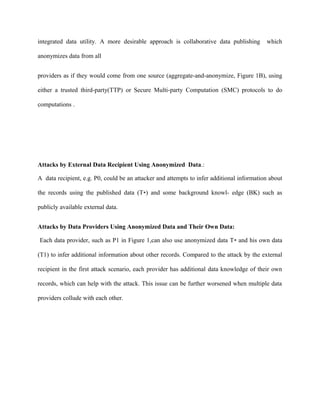
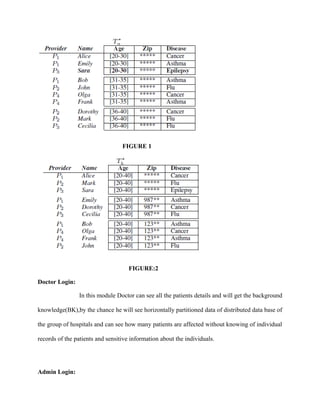
integrated data utility. A more desirable approach is collaborative data publishing which 
anonymizes data from all 
providers as if they would come from one source (aggregate-and-anonymize, Figure 1B), using 
either a trusted third-party(TTP) or Secure Multi-party Computation (SMC) protocols to do 
computations . 
Attacks by External Data Recipient Using Anonymized Data.: 
A data recipient, e.g. P0, could be an attacker and attempts to infer additional information about 
the records using the published data (T∗) and some background knowl- edge (BK) such as 
publicly available external data. 
Attacks by Data Providers Using Anonymized Data and Their Own Data: 
Each data provider, such as P1 in Figure 1,can also use anonymized data T∗ and his own data 
(T1) to infer additional information about other records. Compared to the attack by the external 
recipient in the first attack scenario, each provider has additional data knowledge of their own 
records, which can help with the attack. This issue can be further worsened when multiple data 
providers collude with each other.
FIGURE 1 
FIGURE:2 
Doctor Login: 
In this module Doctor can see all the patients details and will get the background 
knowledge(BK),by the chance he will see horizontally partitioned data of distributed data base of 
the group of hospitals and can see how many patients are affected without knowing of individual 
records of the patients and sensitive information about the individuals. 
Admin Login:
In this module Admin acts as Trusted Third Party(TTP).He can see all individual 
records and their sensitive information among the overall hospital distributed data 
base.Anonymation can be done by this people.He/She collected informations from various 
hospitals and grouped into each other and make them as an anonymised data. 
System Configuration:- 
H/W System Configuration:- 
Processor - Pentium –III 
Speed - 1.1 GHz 
RAM - 256 MB (min) 
Hard Disk - 20 GB 
Floppy Drive - 1.44 MB 
Key Board - Standard Windows Keyboard 
Mouse - Two or Three Button Mouse 
Monitor - SVGA
S/W System Configuration:- 
 Operating System :Windows95/98/2000/XP 
 Application Server : Tomcat5.0/6.X 
 Front End : HTML, Java, Jsp 
 Scripts : JavaScript. 
 Server side Script : Java Server Pages. 
 Database : My sql 
 Database Connectivity : JDBC. 
Conclusion: 
In this paper, we considered a new type of potential at-tackers in collaborative data 
publishing – a coalition of data providers, called m-adversary. To prevent privacy disclosure by 
any m-adversary we showed that guaranteeing m-privacy is enough. We presented heuristic 
algorithms exploiting equiv-alence group monotonicity of privacy constraints and adaptive 
ordering techniques for efficiently checking m-privacy. We introduced also a provider-aware 
anonymization algorithm with adaptive m-privacy checking strategies to ensure high utility and
m-privacy of anonymized data. Our experiments confirmed that our approach achieves better or 
comparable utility than existing algorithms while ensuring m-privacy efficiently. There are many 
remaining research questions. Defining a proper privacy fitness score for different privacy 
constraints is one of them. It also remains a question to address and model the data knowledge of 
data providers when data are distributed in a vertical or ad-hoc fashion. It would be also 
interesting to verify if our methods can be adapted to other kinds of data such as set-valued data.
m-privacy of anonymized data. Our experiments confirmed that our approach achieves better or 
comparable utility than existing algorithms while ensuring m-privacy efficiently. There are many 
remaining research questions. Defining a proper privacy fitness score for different privacy 
constraints is one of them. It also remains a question to address and model the data knowledge of 
data providers when data are distributed in a vertical or ad-hoc fashion. It would be also 
interesting to verify if our methods can be adapted to other kinds of data such as set-valued data.

IEEE 2014 JAVA DATA MINING PROJECTS M privacy for collaborative data publishing

  • 1.
    GLOBALSOFT TECHNOLOGIES IEEEPROJECTS & SOFTWARE DEVELOPMENTS IEEE PROJECTS & SOFTWARE DEVELOPMENTS IEEE FINAL YEAR PROJECTS|IEEE ENGINEERING PROJECTS|IEEE STUDENTS PROJECTS|IEEE BULK PROJECTS|BE/BTECH/ME/MTECH/MS/MCA PROJECTS|CSE/IT/ECE/EEE PROJECTS IEEE FINAL YEAR PROJECTS|IEEE ENGINEERING PROJECTS|IEEE STUDENTS PROJECTS|IEEE BULK PROJECTS|BE/BTECH/ME/MTECH/MS/MCA PROJECTS|CSE/IT/ECE/EEE PROJECTS CELL: +91 98495 39085, +91 99662 35788, +91 98495 57908, +91 97014 40401 CELL: +91 98495 39085, +91 99662 35788, +91 98495 57908, +91 97014 40401 Visit: www.finalyearprojects.org Mail to:ieeefinalsemprojects@gmail.com Visit: www.finalyearprojects.org Mail to:ieeefinalsemprojects@gmail.com m-Privacy for Collaborative Data Publishing Abstract: we consider the collaborative data publishing problem for anonymizing horizontally partitioned data at multiple data providers. We consider a new type of “insider attack” by colluding data providers who may use their own data records (a subset of the overall data) in addition to the external background knowledge to infer the data records contributed by other data providers. The paper addresses this new threat and makes several contributions. First, we introduce the notion of m-privacy, which guarantees that the anonymized data satisfies a given privacy constraint against any group of up to m colluding data providers. Second, we present heuristic algorithms exploiting the equivalence group monotonicity of pri-vacy constraints and adaptive ordering techniques for efficiently checking m-privacy given a set of records. Finally, we present a data provider-aware anonymization algorithm with adaptive m-privacy checking strategies to ensure high utility and m-privacy of anonymized data with efficiency. Experiments on real-life datasets suggest that our approach achieves better or comparable utility and efficiency than existing and baseline algorithms while providing m-privacy guarantee.
  • 2.
  • 3.
    Existing System: Weassume the data providers are semi-honest , commonly used in distributed computation setting. They can attempt to infer additional information about data coming from other providers by analyzing the data received during the anonymization. A data recipient, e.g. P0, could be an attacker and attempts to infer additional information about the records using the published data (T∗) and some background knowl- edge (BK) such as publicly available external data. Proposed System: We consider the collaborative data pub-lishing setting (Figure 1B) with horizontally partitioned data across multiple data providers, each contributing a subset of records Ti. As a special case, a data provider could be the data owner itself who is contributing its own records. This is a very common scenario in social networking and recommendation systems. Our
  • 4.
    goal is topublish an anonymized view of the integrated data such that a data recipient including the data providers will not be able to compromise the privacy of the individual records provided by other parties. Modules : 1. Patient Registration 2. Attacks by External Data Recipient Using Anonymized Data 3. Attacks by Data Providers Using Anonymized Data and Their Own Data 4. Doctor Login 5. Admin Login Modules Description Patient Registration: In this module if a patient have to take treatment,he/she should register their details like Name,Age,Disease they get affected,Email etc.These details are maintained in a Database by the Hospital management.Only Doctors can see all their details.Patient can only see his own record. BASED ON THIS PAPER: When the data are distributed among multiple data providers or data owners, two main settings are used for anonymization . One approach is for each provider to anonymize the data independently (anonymize-and-aggregate,Figure 1A), which results in potential loss of
  • 5.
    integrated data utility.A more desirable approach is collaborative data publishing which anonymizes data from all providers as if they would come from one source (aggregate-and-anonymize, Figure 1B), using either a trusted third-party(TTP) or Secure Multi-party Computation (SMC) protocols to do computations . Attacks by External Data Recipient Using Anonymized Data.: A data recipient, e.g. P0, could be an attacker and attempts to infer additional information about the records using the published data (T∗) and some background knowl- edge (BK) such as publicly available external data. Attacks by Data Providers Using Anonymized Data and Their Own Data: Each data provider, such as P1 in Figure 1,can also use anonymized data T∗ and his own data (T1) to infer additional information about other records. Compared to the attack by the external recipient in the first attack scenario, each provider has additional data knowledge of their own records, which can help with the attack. This issue can be further worsened when multiple data providers collude with each other.
  • 6.
    FIGURE 1 FIGURE:2 Doctor Login: In this module Doctor can see all the patients details and will get the background knowledge(BK),by the chance he will see horizontally partitioned data of distributed data base of the group of hospitals and can see how many patients are affected without knowing of individual records of the patients and sensitive information about the individuals. Admin Login:
  • 7.
    In this moduleAdmin acts as Trusted Third Party(TTP).He can see all individual records and their sensitive information among the overall hospital distributed data base.Anonymation can be done by this people.He/She collected informations from various hospitals and grouped into each other and make them as an anonymised data. System Configuration:- H/W System Configuration:- Processor - Pentium –III Speed - 1.1 GHz RAM - 256 MB (min) Hard Disk - 20 GB Floppy Drive - 1.44 MB Key Board - Standard Windows Keyboard Mouse - Two or Three Button Mouse Monitor - SVGA
  • 8.
    S/W System Configuration:-  Operating System :Windows95/98/2000/XP  Application Server : Tomcat5.0/6.X  Front End : HTML, Java, Jsp  Scripts : JavaScript.  Server side Script : Java Server Pages.  Database : My sql  Database Connectivity : JDBC. Conclusion: In this paper, we considered a new type of potential at-tackers in collaborative data publishing – a coalition of data providers, called m-adversary. To prevent privacy disclosure by any m-adversary we showed that guaranteeing m-privacy is enough. We presented heuristic algorithms exploiting equiv-alence group monotonicity of privacy constraints and adaptive ordering techniques for efficiently checking m-privacy. We introduced also a provider-aware anonymization algorithm with adaptive m-privacy checking strategies to ensure high utility and
  • 9.
    m-privacy of anonymizeddata. Our experiments confirmed that our approach achieves better or comparable utility than existing algorithms while ensuring m-privacy efficiently. There are many remaining research questions. Defining a proper privacy fitness score for different privacy constraints is one of them. It also remains a question to address and model the data knowledge of data providers when data are distributed in a vertical or ad-hoc fashion. It would be also interesting to verify if our methods can be adapted to other kinds of data such as set-valued data.
  • 10.
    m-privacy of anonymizeddata. Our experiments confirmed that our approach achieves better or comparable utility than existing algorithms while ensuring m-privacy efficiently. There are many remaining research questions. Defining a proper privacy fitness score for different privacy constraints is one of them. It also remains a question to address and model the data knowledge of data providers when data are distributed in a vertical or ad-hoc fashion. It would be also interesting to verify if our methods can be adapted to other kinds of data such as set-valued data.