GLOBALSOFT TECHNOLOGIES 
IEEE PROJECTS & SOFTWARE DEVELOPMENTS 
IEEE FINAL YEAR PROJECTS|IEEE ENGINEERING PROJECTS|IEEE STUDENTS PROJECTS|IEEE 
BULK PROJECTS|BE/BTECH/ME/MTECH/MS/MCA PROJECTS|CSE/IT/ECE/EEE PROJECTS 
CELL: +91 98495 39085, +91 99662 35788, +91 98495 57908, +91 97014 40401 
Visit: www.finalyearprojects.org Mail to:ieeefinalsemprojects@gmail.com 
Privacy-Enhanced Web Service Composition 
ABSTRACT: 
Data as a Service (DaaS) builds on service-oriented technologies to enable fast 
access to data resources on the Web. However, this paradigm raises several new 
privacy concerns that traditional privacy models do not handle. In addition, DaaS 
composition may reveal privacy-sensitive information. In this paper, we propose a 
formal privacy model in order to extend DaaS descriptions with privacy 
capabilities. The privacy model allows a service to define a privacy policy and a 
set of privacy requirements. We also propose a privacy-preserving DaaS 
composition approach allowing to verify the compatibility between privacy 
requirements and policies in DaaS composition. We propose a negotiation 
mechanism that makes it possible to dynamically reconcile the privacy capabilities 
of services when incompatibilities arise in a composition. We validate the 
applicability of our proposal through a prototype implementation and a set of 
experiments. 
EXISTING SYSTEM: 
A typical example of modeling privacy is the Platform for Privacy Preferences 
(P3P). However, the major focus of P3P is to enable only Web sites to convey their
privacy policies. In privacy only takes into account a limited set of data fields and 
rights. Data providers specify how to use the service (mandatory and optional data 
for querying the service), while individuals specify the type of access for each part 
of their personal data contained in the service: free, limited, or not given using a 
DAML-S ontology. 
DISADVANTAGES OF EXISTING SYSTEM: 
Two factors exacerbate the problem of privacy in DaaS. First, DaaS services 
collect and store a large amount of private information about users. Second, DaaS 
services are able to share this information with other entities. Besides, the 
emergence of analysis tools makes it easier to analyze and synthesize huge 
volumes of information, hence increasing the risk of privacy violation. In the 
following, we use our epidemiological scenario to illustrate the privacy challenges 
during service composition. 
Challenge 1: Privacy Specification. 
Challenge 2: Privacy within compositions. 
Challenge 3: Dealing with incompatible privacy policies in compositions. 
PROPOSED SYSTEM: 
We describe a formal privacy model for Web Services that goes beyond traditional 
data-oriented models. It deals with privacy not only at the data level (i.e., inputs 
and outputs) but also service level (i.e., service invocation). In this paper, we build 
upon this model two other extensions to address privacy issues during DaaS 
composition. The privacy model described in this paper is based on the model 
initially proposed
ADVANTAGES OF PROPOSED SYSTEM: 
 Privacy-aware Service Composition: We propose a compatibility matching 
algorithm to check privacy compatibility between component services within a 
composition. 
 Negotiating Privacy in Service Composition: In the case when any 
composition plan will be incompatible in terms of privacy, we introduce a novel 
approach based on negotiation to reach compatibility of concerned services 
(i.e., services that participate in a composition which are incompatible). 
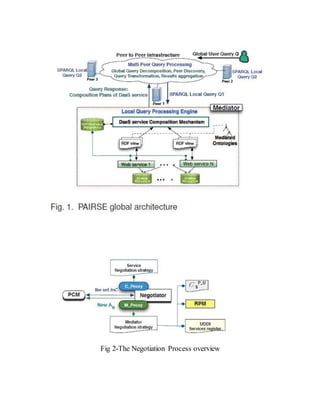
SYSTEM ARCHITECTURE:
Fig 2-The Negotiation Process overview
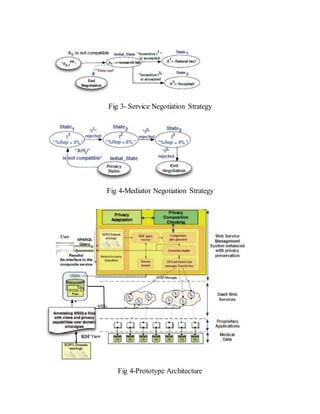
Fig 3- Service Negotiation Strategy 
Fig 4-Mediator Negotiation Strategy 
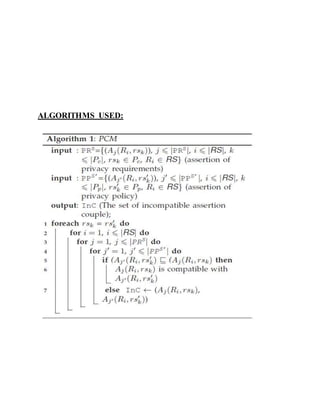
Fig 4-Prototype Architecture
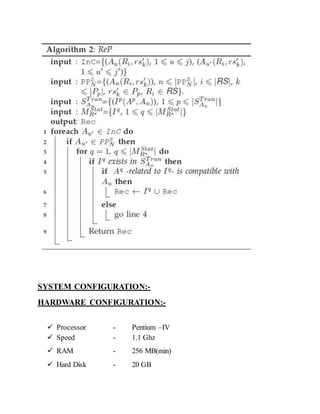
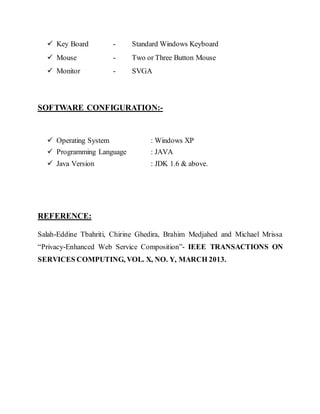
ALGORITHMS USED:
SYSTEM CONFIGURATION:- 
HARDWARE CONFIGURATION:- 
 Processor - Pentium –IV 
 Speed - 1.1 Ghz 
 RAM - 256 MB(min) 
 Hard Disk - 20 GB
 Key Board - Standard Windows Keyboard 
 Mouse - Two or Three Button Mouse 
 Monitor - SVGA 
SOFTWARE CONFIGURATION:- 
 Operating System : Windows XP 
 Programming Language : JAVA 
 Java Version : JDK 1.6 & above. 
REFERENCE: 
Salah-Eddine Tbahriti, Chirine Ghedira, Brahim Medjahed and Michael Mrissa 
“Privacy-Enhanced Web Service Composition”- IEEE TRANSACTIONS ON 
SERVICES COMPUTING, VOL. X, NO. Y, MARCH 2013.

IEEE 2014 JAVA SERVICE COMPUTING PROJECTS Privacy enhanced web service composition

  • 1.
    GLOBALSOFT TECHNOLOGIES IEEEPROJECTS & SOFTWARE DEVELOPMENTS IEEE FINAL YEAR PROJECTS|IEEE ENGINEERING PROJECTS|IEEE STUDENTS PROJECTS|IEEE BULK PROJECTS|BE/BTECH/ME/MTECH/MS/MCA PROJECTS|CSE/IT/ECE/EEE PROJECTS CELL: +91 98495 39085, +91 99662 35788, +91 98495 57908, +91 97014 40401 Visit: www.finalyearprojects.org Mail to:ieeefinalsemprojects@gmail.com Privacy-Enhanced Web Service Composition ABSTRACT: Data as a Service (DaaS) builds on service-oriented technologies to enable fast access to data resources on the Web. However, this paradigm raises several new privacy concerns that traditional privacy models do not handle. In addition, DaaS composition may reveal privacy-sensitive information. In this paper, we propose a formal privacy model in order to extend DaaS descriptions with privacy capabilities. The privacy model allows a service to define a privacy policy and a set of privacy requirements. We also propose a privacy-preserving DaaS composition approach allowing to verify the compatibility between privacy requirements and policies in DaaS composition. We propose a negotiation mechanism that makes it possible to dynamically reconcile the privacy capabilities of services when incompatibilities arise in a composition. We validate the applicability of our proposal through a prototype implementation and a set of experiments. EXISTING SYSTEM: A typical example of modeling privacy is the Platform for Privacy Preferences (P3P). However, the major focus of P3P is to enable only Web sites to convey their
  • 2.
    privacy policies. Inprivacy only takes into account a limited set of data fields and rights. Data providers specify how to use the service (mandatory and optional data for querying the service), while individuals specify the type of access for each part of their personal data contained in the service: free, limited, or not given using a DAML-S ontology. DISADVANTAGES OF EXISTING SYSTEM: Two factors exacerbate the problem of privacy in DaaS. First, DaaS services collect and store a large amount of private information about users. Second, DaaS services are able to share this information with other entities. Besides, the emergence of analysis tools makes it easier to analyze and synthesize huge volumes of information, hence increasing the risk of privacy violation. In the following, we use our epidemiological scenario to illustrate the privacy challenges during service composition. Challenge 1: Privacy Specification. Challenge 2: Privacy within compositions. Challenge 3: Dealing with incompatible privacy policies in compositions. PROPOSED SYSTEM: We describe a formal privacy model for Web Services that goes beyond traditional data-oriented models. It deals with privacy not only at the data level (i.e., inputs and outputs) but also service level (i.e., service invocation). In this paper, we build upon this model two other extensions to address privacy issues during DaaS composition. The privacy model described in this paper is based on the model initially proposed
  • 3.
    ADVANTAGES OF PROPOSEDSYSTEM:  Privacy-aware Service Composition: We propose a compatibility matching algorithm to check privacy compatibility between component services within a composition.  Negotiating Privacy in Service Composition: In the case when any composition plan will be incompatible in terms of privacy, we introduce a novel approach based on negotiation to reach compatibility of concerned services (i.e., services that participate in a composition which are incompatible). SYSTEM ARCHITECTURE:
  • 4.
    Fig 2-The NegotiationProcess overview
  • 5.
    Fig 3- ServiceNegotiation Strategy Fig 4-Mediator Negotiation Strategy Fig 4-Prototype Architecture
  • 6.
  • 7.
    SYSTEM CONFIGURATION:- HARDWARECONFIGURATION:-  Processor - Pentium –IV  Speed - 1.1 Ghz  RAM - 256 MB(min)  Hard Disk - 20 GB
  • 8.
     Key Board- Standard Windows Keyboard  Mouse - Two or Three Button Mouse  Monitor - SVGA SOFTWARE CONFIGURATION:-  Operating System : Windows XP  Programming Language : JAVA  Java Version : JDK 1.6 & above. REFERENCE: Salah-Eddine Tbahriti, Chirine Ghedira, Brahim Medjahed and Michael Mrissa “Privacy-Enhanced Web Service Composition”- IEEE TRANSACTIONS ON SERVICES COMPUTING, VOL. X, NO. Y, MARCH 2013.