GLOBALSOFT TECHNOLOGIES 
IEEE PROJECTS & SOFTWARE DEVELOPMENTS 
IEEE FINAL YEAR PROJECTS|IEEE ENGINEERING PROJECTS|IEEE STUDENTS PROJECTS|IEEE 
BULK PROJECTS|BE/BTECH/ME/MTECH/MS/MCA PROJECTS|CSE/IT/ECE/EEE PROJECTS 
CELL: +91 98495 39085, +91 99662 35788, +91 98495 57908, +91 97014 40401 
Visit: www.finalyearprojects.org Mail to:ieeefinalsemprojects@gmail.com 
Click Prediction for Web Image Reranking Using 
Multimodal Sparse Coding 
ABSTRACT: 
Image reranking is effective for improving the performance of a text-based image 
search. However, existing reranking algorithms are limited for two main reasons: 
1) the textual meta-data associated with images is often mismatched with their 
actual visual content and 2) the extracted visual features do not accurately describe 
the semantic similarities between images. Recently, user click information has 
been used in image reranking, because clicks have been shown to more accurately 
describe the relevance of retrieved images to search queries. However, a critical 
problem for click-based methods is the lack of click data, since only a small 
number of web images have actually been clicked on by users. Therefore, we aim 
to solve this problem by predicting image clicks. We propose a multimodal 
hypergraph learning-based sparse coding method for image click prediction, and 
apply the obtained click data to the reranking of images. We adopt a hypergraph to 
build a group of manifolds, which explore the complementarity of different 
features through a group of weights. Unlike a graph that has an edge between two 
vertices, a hyperedge in a hypergraph connects a set of vertices, and helps preserve
the local smoothness of the constructed sparse codes. An alternating optimization 
procedure is then performed, and the weights of different modalities and the sparse 
codes are simultaneously obtained. Finally, a voting strategy is used to describe the 
predicted click as a binary event (click or no click), from the images’ 
corresponding sparse codes. Thorough empirical studies on a large-scale database 
including nearly 330K images demonstrate the effectiveness of our approach for 
click prediction when compared with several other methods. Additional image re-ranking 
experiments on real world data show the use of click prediction is 
beneficial to improving the performance of prominent graph-based image re-ranking 
algorithms. 
EXISTING SYSTEM: 
Most existing re-ranking methods use a tool known as pseudo-relevance feedback 
(PRF), where a proportion of the top-ranked images are assumed to be relevant, 
and subsequently used to build a model for re-ranking. This is in contrast to 
relevance feedback, where users explicitly provide feedback by labeling the top 
results as positive or negative. In the classification-based PRF method, the top-ranked 
images are regarded as pseudo-positive, and low-ranked images regarded as 
pseudo-negative examples to train a classifier, and then re-rank. Hsu et al. also 
adopt this pseudo-positive and pseudo-negative image method to develop a 
clustering-based re-ranking algorithm. 
DISADVANTAGES OF EXISTING SYSTEM:
 One major problem impacting performance is the mismatches between the 
actual content of image and the textual data on the web page. 
 The problem with these methods is the reliability of the obtained pseudo-positive 
and pseudo-negative images is not guaranteed. 
PROPOSED SYSTEM: 
In this paper we propose a novel method named multimodal hyper graph learning-based 
sparse coding for click prediction, and apply the predicted clicks to re-rank 
web images. Both strategies of early and late fusion of multiple features are used in 
this method through three main steps. 
 We construct a web image base with associated click annotation, collected 
from a commercial search engine. The search engine has recorded clicks for 
each image. Indicate that the images with high clicks are strongly relevant 
to the queries, while present non-relevant images with zero clicks. These two 
components form the image bases. 
 We consider both early and late fusion in the proposed objective function. 
The early fusion is realized by directly concatenating multiple visual 
features, and is applied in the sparse coding term. Late fusion is 
accomplished in the manifold learning term. For web images without clicks, 
we implement hyper graph learning to construct a group of manifolds, which 
preserves local smoothness using hyper edges. Unlike a graph that has an 
edge between two vertices, a set of vertices are connected by the hyper edge
in a hyper graph. Common graph-based learning methods usually only 
consider the pair wise relationship between two vertices, ignoring the 
higher-order relationship among three or more vertices. Using this term can 
help the proposed method preserve the local smoothness of the constructed 
sparse codes. 
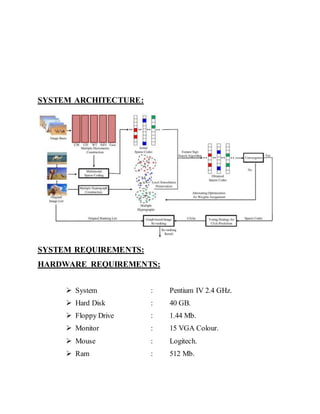
 Finally, an alternating optimization procedure is conducted to explore the 
complementary nature of different modalities. The weights of different 
modalities and the sparse codes are simultaneously obtained using this 
optimization strategy. A voting strategy is then adopted to predict if an input 
image will be clicked or not, based on its sparse code. 
ADVANTAGES OF PROPOSED SYSTEM: 
 We effectively utilize search engine derived images annotated with c licks, 
and successfully predict the clicks for new input images without clicks. 
Based on the obtained clicks, we re-rank the images, a strategy which could 
be beneficial for improving commercial image searching. 
 Second, we propose a novel method named mult imodal hyper graph 
learning-based sparse coding. This method uses both early and late fusion in 
multimodal learning. By simultaneously learning the sparse codes and the 
weights of different hyper graphs, the performance of sparse coding 
performs significantly.
SYSTEM ARCHITECTURE: 
SYSTEM REQUIREMENTS: 
HARDWARE REQUIREMENTS: 
 System : Pentium IV 2.4 GHz. 
 Hard Disk : 40 GB. 
 Floppy Drive : 1.44 Mb. 
 Monitor : 15 VGA Colour. 
 Mouse : Logitech. 
 Ram : 512 Mb.
SOFTWARE REQUIREMENTS: 
 Operating system : Windows XP/7. 
 Coding Language : ASP.net, C#.net 
 Tool : Visual Studio 2010 
 Database : SQL SERVER 2008 
REFERENCE: 
Jun Yu, Member, IEEE, Yong Rui, Fellow, IEEE, and Dacheng Tao, Senior 
Member, IEEE “Click Prediction for Web Image Reranking Using Multimodal 
Sparse Coding” IEEE TRANSACTIONS ON IMAGE PROCESSING, VOL. 23, 
NO. 5, MAY 2014

IEEE 2014 JAVA IMAGE PROCESSING PROJECTS Click prediction-for-web-image-reranking-using-multimodal-sparse-coding

  • 1.
    GLOBALSOFT TECHNOLOGIES IEEEPROJECTS & SOFTWARE DEVELOPMENTS IEEE FINAL YEAR PROJECTS|IEEE ENGINEERING PROJECTS|IEEE STUDENTS PROJECTS|IEEE BULK PROJECTS|BE/BTECH/ME/MTECH/MS/MCA PROJECTS|CSE/IT/ECE/EEE PROJECTS CELL: +91 98495 39085, +91 99662 35788, +91 98495 57908, +91 97014 40401 Visit: www.finalyearprojects.org Mail to:ieeefinalsemprojects@gmail.com Click Prediction for Web Image Reranking Using Multimodal Sparse Coding ABSTRACT: Image reranking is effective for improving the performance of a text-based image search. However, existing reranking algorithms are limited for two main reasons: 1) the textual meta-data associated with images is often mismatched with their actual visual content and 2) the extracted visual features do not accurately describe the semantic similarities between images. Recently, user click information has been used in image reranking, because clicks have been shown to more accurately describe the relevance of retrieved images to search queries. However, a critical problem for click-based methods is the lack of click data, since only a small number of web images have actually been clicked on by users. Therefore, we aim to solve this problem by predicting image clicks. We propose a multimodal hypergraph learning-based sparse coding method for image click prediction, and apply the obtained click data to the reranking of images. We adopt a hypergraph to build a group of manifolds, which explore the complementarity of different features through a group of weights. Unlike a graph that has an edge between two vertices, a hyperedge in a hypergraph connects a set of vertices, and helps preserve
  • 2.
    the local smoothnessof the constructed sparse codes. An alternating optimization procedure is then performed, and the weights of different modalities and the sparse codes are simultaneously obtained. Finally, a voting strategy is used to describe the predicted click as a binary event (click or no click), from the images’ corresponding sparse codes. Thorough empirical studies on a large-scale database including nearly 330K images demonstrate the effectiveness of our approach for click prediction when compared with several other methods. Additional image re-ranking experiments on real world data show the use of click prediction is beneficial to improving the performance of prominent graph-based image re-ranking algorithms. EXISTING SYSTEM: Most existing re-ranking methods use a tool known as pseudo-relevance feedback (PRF), where a proportion of the top-ranked images are assumed to be relevant, and subsequently used to build a model for re-ranking. This is in contrast to relevance feedback, where users explicitly provide feedback by labeling the top results as positive or negative. In the classification-based PRF method, the top-ranked images are regarded as pseudo-positive, and low-ranked images regarded as pseudo-negative examples to train a classifier, and then re-rank. Hsu et al. also adopt this pseudo-positive and pseudo-negative image method to develop a clustering-based re-ranking algorithm. DISADVANTAGES OF EXISTING SYSTEM:
  • 3.
     One majorproblem impacting performance is the mismatches between the actual content of image and the textual data on the web page.  The problem with these methods is the reliability of the obtained pseudo-positive and pseudo-negative images is not guaranteed. PROPOSED SYSTEM: In this paper we propose a novel method named multimodal hyper graph learning-based sparse coding for click prediction, and apply the predicted clicks to re-rank web images. Both strategies of early and late fusion of multiple features are used in this method through three main steps.  We construct a web image base with associated click annotation, collected from a commercial search engine. The search engine has recorded clicks for each image. Indicate that the images with high clicks are strongly relevant to the queries, while present non-relevant images with zero clicks. These two components form the image bases.  We consider both early and late fusion in the proposed objective function. The early fusion is realized by directly concatenating multiple visual features, and is applied in the sparse coding term. Late fusion is accomplished in the manifold learning term. For web images without clicks, we implement hyper graph learning to construct a group of manifolds, which preserves local smoothness using hyper edges. Unlike a graph that has an edge between two vertices, a set of vertices are connected by the hyper edge
  • 4.
    in a hypergraph. Common graph-based learning methods usually only consider the pair wise relationship between two vertices, ignoring the higher-order relationship among three or more vertices. Using this term can help the proposed method preserve the local smoothness of the constructed sparse codes.  Finally, an alternating optimization procedure is conducted to explore the complementary nature of different modalities. The weights of different modalities and the sparse codes are simultaneously obtained using this optimization strategy. A voting strategy is then adopted to predict if an input image will be clicked or not, based on its sparse code. ADVANTAGES OF PROPOSED SYSTEM:  We effectively utilize search engine derived images annotated with c licks, and successfully predict the clicks for new input images without clicks. Based on the obtained clicks, we re-rank the images, a strategy which could be beneficial for improving commercial image searching.  Second, we propose a novel method named mult imodal hyper graph learning-based sparse coding. This method uses both early and late fusion in multimodal learning. By simultaneously learning the sparse codes and the weights of different hyper graphs, the performance of sparse coding performs significantly.
  • 5.
    SYSTEM ARCHITECTURE: SYSTEMREQUIREMENTS: HARDWARE REQUIREMENTS:  System : Pentium IV 2.4 GHz.  Hard Disk : 40 GB.  Floppy Drive : 1.44 Mb.  Monitor : 15 VGA Colour.  Mouse : Logitech.  Ram : 512 Mb.
  • 6.
    SOFTWARE REQUIREMENTS: Operating system : Windows XP/7.  Coding Language : ASP.net, C#.net  Tool : Visual Studio 2010  Database : SQL SERVER 2008 REFERENCE: Jun Yu, Member, IEEE, Yong Rui, Fellow, IEEE, and Dacheng Tao, Senior Member, IEEE “Click Prediction for Web Image Reranking Using Multimodal Sparse Coding” IEEE TRANSACTIONS ON IMAGE PROCESSING, VOL. 23, NO. 5, MAY 2014