COMPENSATING EMPLOYEES
SEMESTER RECAP Context SHRM Legal environment International Procuring Planning Recruiting Selection Utilizing & Maximizing Training Appraisal
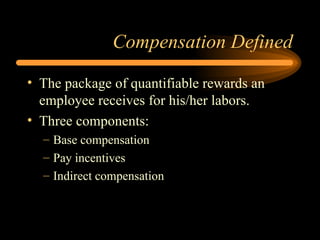
Compensation Defined The package of quantifiable rewards an employee receives for his/her labors. Three components: Base compensation Pay incentives Indirect compensation
TODAY’S TOPIC Compensation
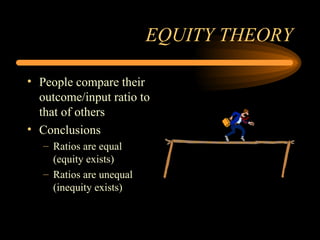
EQUITY THEORY People compare their outcome/input ratio to that of others Conclusions Ratios are equal (equity exists) Ratios are unequal (inequity exists)
RESPONSES TO EQUITY/INEQUITY Equity: Maintenance
RESPONSES TO EQUITY/INEQUITY Equity: Maintenance Inequity: Change Inputs Change Outcomes Quit
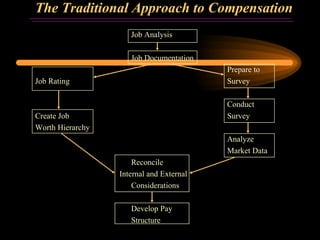
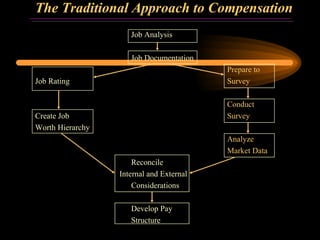
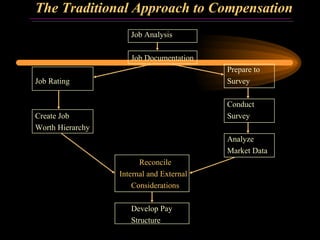
Traditional Approach to Compensation Objective of traditional approaches to compensation is to achieve both internal & external equity  Internal equity is accomplished through  job evaluation Systematic process of assessing the value of each job in relation to other jobs in the organization Results in a hierarchy of jobs ranked in order of their relative worth External equity through  market analysis
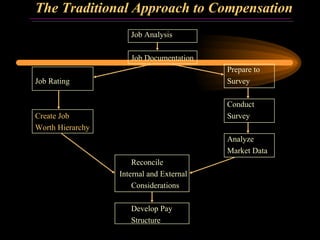
The Traditional Approach to Compensation Job Analysis Job Documentation Prepare to Job Rating Survey Conduct Create Job Survey Worth Hierarchy Analyze  Market Data Reconcile   Internal and External Considerations Develop Pay Structure
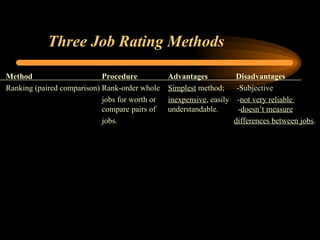
Three Job Rating Methods Method Procedure  Advantages   Disadvantages Ranking (paired comparison) Rank-order whole  Simplest  method;  -Subjective jobs for worth or  inexpensive , easily  - not very reliable  compare pairs of   understandable.   - doesn’t measure jobs.   differences between jobs .
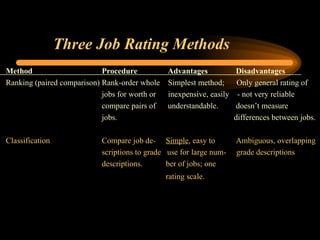
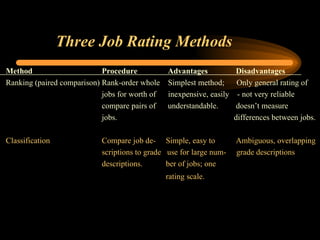
Three Job Rating Methods Method Procedure  Advantages   Disadvantages Ranking (paired comparison) Rank-order whole  Simplest method;  Only general rating of jobs for worth or  inexpensive, easily  - not very reliable  compare pairs of   understandable.   doesn’t measure jobs.   differences between jobs. Classification Compare job de- Simple , easy to    Ambiguous, overlapping scriptions to grade  use for large num-  grade descriptions descriptions. ber of jobs; one rating scale.
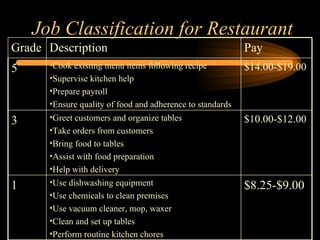
Job Classification for Restaurant $8.25-$9.00 Use dishwashing equipment Use chemicals to clean premises Use vacuum cleaner, mop, waxer  Clean and set up tables Perform routine kitchen chores 1 $10.00-$12.00 Greet customers and organize tables Take orders from customers Bring food to tables Assist with food preparation Help with delivery 3 $14.00-$19.00 Cook existing menu items following recipe Supervise kitchen help Prepare payroll Ensure quality of food and adherence to standards 5 Pay Description Grade
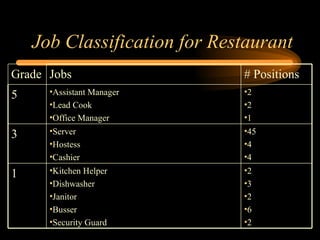
Job Classification for Restaurant 2 3 2 6 2 Kitchen Helper Dishwasher Janitor Busser Security Guard 1 45 4 4 Server Hostess Cashier 3 2 2 1 Assistant Manager Lead Cook Office Manager 5 # Positions Jobs Grade
Three Job Rating Methods Method Procedure  Advantages   Disadvantages Ranking (paired comparison) Rank-order whole  Simplest method;  Only general rating of jobs for worth of  inexpensive, easily  - not very reliable  compare pairs of   understandable.   doesn’t measure jobs.   differences between jobs. Classification Compare job de- Simple, easy to    Ambiguous, overlapping scriptions to grade  use for large num-  grade descriptions descriptions. ber of jobs; one rating scale.
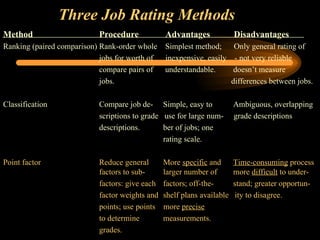
Three Job Rating Methods Method Procedure  Advantages   Disadvantages Ranking (paired comparison) Rank-order whole  Simplest method;  Only general rating of jobs for worth of  inexpensive, easily  - not very reliable  compare pairs of   understandable.   doesn’t measure jobs.   differences between jobs. Classification Compare job de- Simple, easy to    Ambiguous, overlapping scriptions to grade  use for large num-  grade descriptions descriptions. ber of jobs; one rating scale.  Point factor Reduce general More  specific  and   Time-consuming  process factors to sub- larger number of    more  difficult  to under- factors: give each factors; off-the-   stand; greater opportun- factor weights and shelf plans available  ity to disagree. points; use points  more  precise   to determine  measurements. grades.
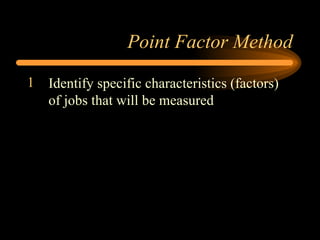
Point Factor Method Identify specific characteristics (factors) of jobs that will be measured
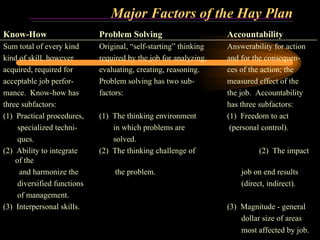
Major Factors of the Hay Plan Know-How Problem Solving Accountability Sum total of every kind  Original, “self-starting” thinking Answerability for action kind of skill, however  required by the job for analyzing, and for the consequen- acquired, required for  evaluating, creating, reasoning. ces of the action; the  acceptable job perfor- Problem solving has two sub- measured effect of the mance.  Know-how has factors: the job.  Accountability three subfactors: has three subfactors: (1)  Practical procedures, (1)  The thinking environment (1)  Freedom to act specialized techni-   in which problems are     (personal control). ques.     solved. (2)  Ability to integrate (2)  The thinking challenge of (2)  The impact of the   and harmonize the  the problem.   job on end results diversified functions    (direct, indirect). of management. (3)  Interpersonal skills. (3)  Magnitude - general   dollar size of areas   most affected by job.
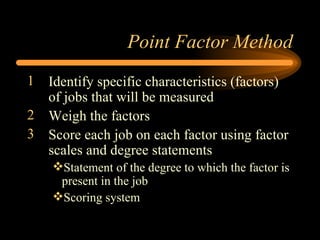
Point Factor Method Identify specific characteristics (factors) of jobs that will be measured Weigh the factors Score each job on each factor using factor scales and degree statements Statement of the degree to which the factor is present in the job  Scoring system
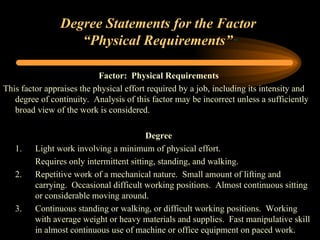
Degree Statements for the Factor  “Physical Requirements” ” Factor:  Physical Requirements This factor appraises the physical effort required by a job, including its intensity and degree of continuity.  Analysis of this factor may be incorrect unless a sufficiently broad view of the work is considered. Degree 1. Light work involving a minimum of physical effort. Requires only intermittent sitting, standing, and walking. 2. Repetitive work of a mechanical nature.  Small amount of lifting and  carrying.  Occasional difficult working positions.  Almost continuous sitting  or considerable moving around. 3.  Continuous standing or walking, or difficult working positions.  Working  with average weight or heavy materials and supplies.  Fast manipulative skill  in almost continuous use of machine or office equipment on paced work.
The Traditional Approach to Compensation Job Analysis Job Documentation Prepare to Job Rating Survey Conduct Create Job Survey Worth Hierarchy Analyze  Market Data Reconcile   Internal and External Considerations Develop Pay Structure
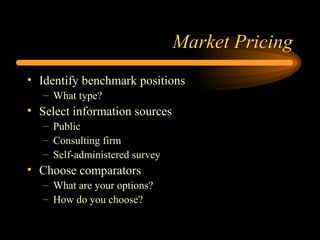
Market Pricing Identify benchmark positions What type? Select information sources Public Consulting firm Self-administered survey Choose comparators What are your options? How do you choose?
The Traditional Approach to Compensation Job Analysis Job Documentation Prepare to Job Rating Survey Conduct Create Job Survey Worth Hierarchy Analyze  Market Data   Reconcile   Internal and External Considerations Develop Pay Structure
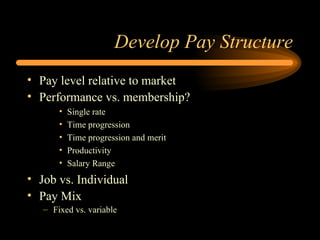
Develop Pay Structure Pay level relative to market Performance vs. membership? Single rate Time progression  Time progression and merit Productivity Salary Range Job vs. Individual  Pay Mix Fixed vs. variable
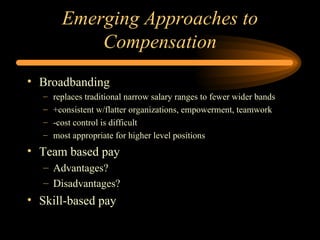
Emerging Approaches to Compensation Broadbanding replaces traditional narrow salary ranges to fewer wider bands +consistent w/flatter organizations, empowerment, teamwork -cost control is difficult most appropriate for higher level positions Team based pay Advantages? Disadvantages? Skill-based pay
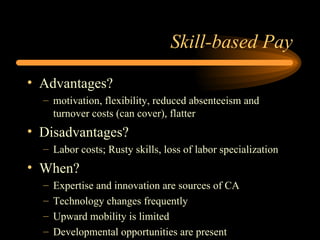
Skill-based Pay Advantages? motivation, flexibility, reduced absenteeism and turnover costs (can cover), flatter Disadvantages? Labor costs; Rusty skills, loss of labor specialization When? Expertise and innovation are sources of CA Technology changes frequently Upward mobility is limited Developmental opportunities are present

M comp

  • 1.
  • 2.
    SEMESTER RECAP ContextSHRM Legal environment International Procuring Planning Recruiting Selection Utilizing & Maximizing Training Appraisal
  • 3.
    Compensation Defined Thepackage of quantifiable rewards an employee receives for his/her labors. Three components: Base compensation Pay incentives Indirect compensation
  • 4.
  • 5.
    EQUITY THEORY Peoplecompare their outcome/input ratio to that of others Conclusions Ratios are equal (equity exists) Ratios are unequal (inequity exists)
  • 6.
    RESPONSES TO EQUITY/INEQUITYEquity: Maintenance
  • 7.
    RESPONSES TO EQUITY/INEQUITYEquity: Maintenance Inequity: Change Inputs Change Outcomes Quit
  • 8.
    Traditional Approach toCompensation Objective of traditional approaches to compensation is to achieve both internal & external equity Internal equity is accomplished through job evaluation Systematic process of assessing the value of each job in relation to other jobs in the organization Results in a hierarchy of jobs ranked in order of their relative worth External equity through market analysis
  • 9.
    The Traditional Approachto Compensation Job Analysis Job Documentation Prepare to Job Rating Survey Conduct Create Job Survey Worth Hierarchy Analyze Market Data Reconcile Internal and External Considerations Develop Pay Structure
  • 10.
    Three Job RatingMethods Method Procedure Advantages Disadvantages Ranking (paired comparison) Rank-order whole Simplest method; -Subjective jobs for worth or inexpensive , easily - not very reliable compare pairs of understandable. - doesn’t measure jobs. differences between jobs .
  • 11.
    Three Job RatingMethods Method Procedure Advantages Disadvantages Ranking (paired comparison) Rank-order whole Simplest method; Only general rating of jobs for worth or inexpensive, easily - not very reliable compare pairs of understandable. doesn’t measure jobs. differences between jobs. Classification Compare job de- Simple , easy to Ambiguous, overlapping scriptions to grade use for large num- grade descriptions descriptions. ber of jobs; one rating scale.
  • 12.
    Job Classification forRestaurant $8.25-$9.00 Use dishwashing equipment Use chemicals to clean premises Use vacuum cleaner, mop, waxer Clean and set up tables Perform routine kitchen chores 1 $10.00-$12.00 Greet customers and organize tables Take orders from customers Bring food to tables Assist with food preparation Help with delivery 3 $14.00-$19.00 Cook existing menu items following recipe Supervise kitchen help Prepare payroll Ensure quality of food and adherence to standards 5 Pay Description Grade
  • 13.
    Job Classification forRestaurant 2 3 2 6 2 Kitchen Helper Dishwasher Janitor Busser Security Guard 1 45 4 4 Server Hostess Cashier 3 2 2 1 Assistant Manager Lead Cook Office Manager 5 # Positions Jobs Grade
  • 14.
    Three Job RatingMethods Method Procedure Advantages Disadvantages Ranking (paired comparison) Rank-order whole Simplest method; Only general rating of jobs for worth of inexpensive, easily - not very reliable compare pairs of understandable. doesn’t measure jobs. differences between jobs. Classification Compare job de- Simple, easy to Ambiguous, overlapping scriptions to grade use for large num- grade descriptions descriptions. ber of jobs; one rating scale.
  • 15.
    Three Job RatingMethods Method Procedure Advantages Disadvantages Ranking (paired comparison) Rank-order whole Simplest method; Only general rating of jobs for worth of inexpensive, easily - not very reliable compare pairs of understandable. doesn’t measure jobs. differences between jobs. Classification Compare job de- Simple, easy to Ambiguous, overlapping scriptions to grade use for large num- grade descriptions descriptions. ber of jobs; one rating scale. Point factor Reduce general More specific and Time-consuming process factors to sub- larger number of more difficult to under- factors: give each factors; off-the- stand; greater opportun- factor weights and shelf plans available ity to disagree. points; use points more precise to determine measurements. grades.
  • 16.
    Point Factor MethodIdentify specific characteristics (factors) of jobs that will be measured
  • 17.
    Major Factors ofthe Hay Plan Know-How Problem Solving Accountability Sum total of every kind Original, “self-starting” thinking Answerability for action kind of skill, however required by the job for analyzing, and for the consequen- acquired, required for evaluating, creating, reasoning. ces of the action; the acceptable job perfor- Problem solving has two sub- measured effect of the mance. Know-how has factors: the job. Accountability three subfactors: has three subfactors: (1) Practical procedures, (1) The thinking environment (1) Freedom to act specialized techni- in which problems are (personal control). ques. solved. (2) Ability to integrate (2) The thinking challenge of (2) The impact of the and harmonize the the problem. job on end results diversified functions (direct, indirect). of management. (3) Interpersonal skills. (3) Magnitude - general dollar size of areas most affected by job.
  • 18.
    Point Factor MethodIdentify specific characteristics (factors) of jobs that will be measured Weigh the factors Score each job on each factor using factor scales and degree statements Statement of the degree to which the factor is present in the job Scoring system
  • 19.
    Degree Statements forthe Factor “Physical Requirements” ” Factor: Physical Requirements This factor appraises the physical effort required by a job, including its intensity and degree of continuity. Analysis of this factor may be incorrect unless a sufficiently broad view of the work is considered. Degree 1. Light work involving a minimum of physical effort. Requires only intermittent sitting, standing, and walking. 2. Repetitive work of a mechanical nature. Small amount of lifting and carrying. Occasional difficult working positions. Almost continuous sitting or considerable moving around. 3. Continuous standing or walking, or difficult working positions. Working with average weight or heavy materials and supplies. Fast manipulative skill in almost continuous use of machine or office equipment on paced work.
  • 20.
    The Traditional Approachto Compensation Job Analysis Job Documentation Prepare to Job Rating Survey Conduct Create Job Survey Worth Hierarchy Analyze Market Data Reconcile Internal and External Considerations Develop Pay Structure
  • 21.
    The Traditional Approachto Compensation Job Analysis Job Documentation Prepare to Job Rating Survey Conduct Create Job Survey Worth Hierarchy Analyze Market Data Reconcile Internal and External Considerations Develop Pay Structure
  • 22.
    Market Pricing Identifybenchmark positions What type? Select information sources Public Consulting firm Self-administered survey Choose comparators What are your options? How do you choose?
  • 23.
    The Traditional Approachto Compensation Job Analysis Job Documentation Prepare to Job Rating Survey Conduct Create Job Survey Worth Hierarchy Analyze Market Data Reconcile Internal and External Considerations Develop Pay Structure
  • 24.
    Develop Pay StructurePay level relative to market Performance vs. membership? Single rate Time progression Time progression and merit Productivity Salary Range Job vs. Individual Pay Mix Fixed vs. variable
  • 25.
    Emerging Approaches toCompensation Broadbanding replaces traditional narrow salary ranges to fewer wider bands +consistent w/flatter organizations, empowerment, teamwork -cost control is difficult most appropriate for higher level positions Team based pay Advantages? Disadvantages? Skill-based pay
  • 26.
    Skill-based Pay Advantages?motivation, flexibility, reduced absenteeism and turnover costs (can cover), flatter Disadvantages? Labor costs; Rusty skills, loss of labor specialization When? Expertise and innovation are sources of CA Technology changes frequently Upward mobility is limited Developmental opportunities are present

Editor's Notes