COMPENSATION MANAGEMENT,JOB EVALUATION,DA
AGENDA Define Compensation . Elements of  Compensation System. CONCEPTS OF WAGE AND DIFFERENT KINDS OF WAGES. Objectives of Compensation System. How  Compensation System is used ? METHOD OF CALCULATING BASIC PAY AND ITS USE IN DESIGNING SALARY STRUCTURE. What are the components of  Compensation  System? Different types of Compensation System. Compensation Plans. Financial and Non Financial Incentive Schemes
BASIC TERMS USED IN HR
  A critical component of both compensation and selection systems, job descriptions define in writing the responsibilities, requirements, functions, duties, location, environment, conditions, and other aspects of jobs. Descriptions may be developed for jobs individually or for entire job families. JOB DESCRIPTION
The process of analysing jobs from which  job descriptions are developed. Job analysis techniques include the use of interviews, questionnaires, and observation. JOB ANALYSIS
A system for comparing jobs for the purpose of determining appropriate compensation levels for individual jobs or job elements.  There are four main techniques:  Ranking  Classification  Factor Comparison  Point Method JOB EVALUATION
JOB EVALUATION METHODS Comparison Method   Analysis Method Entire Job  Job Factors Job Against Scale Job Against Job Classification Point Method Ranking Factor  Comparison
DEFINITION A set of  compensable  factors are identified as determining the worth of jobs. Typically the compensable factors include the major categories of Skill  Responsibilities  Effort  Working Conditions
FACTORE CAN BE FURTHER DEFINED SKILLL Experience  Education  Ability  RESPONSIBILITIES Fiscal  Supervisory
CONT. EFFORT Mental  Physical  WORKING CONDITION Location  Hazards  Extremes in Environment
POINT METHOD Advantages Highly stable over time Perceived as valid by users and employees Likely to be reliable among committee that assesses the jobs Provides good data to prepare a response to an appeal Disadvantages Time, money, and effort required to set up Relies heavily on key (benchmark) jobs, so if key jobs and correct pay rates don’t exist, the point method may not be valid
FACTOR DEGREES AND POINT SYSTEMS
WHAT IS A DEGREE LEVEL? It is a  scale  that reflects differing quantity or quality of the factor It is  used to differentiate jobs  on the factor It is a definition that is  clear and unambiguous It contains explicit language that  spells out the behaviors, skills, or performance expectations  for that factor at different levels of the factor
HOW DO YOU ASSIGN POINT VALUES TO THE ENTIRE SYSTEM? The maximum number of points assigned is a fairly arbitrary judgment (500-3000 is common) The number must be large enough to allow sufficient differentiation among the jobs to be evaluated.  If there is a very wide spread between the current wages of the highest paid job and the lowest paid job, the maximum number of points will need to be higher If you choose more than one pay system, the number of points or the actual factors themselves do not have to be the same in each one. SUGGESTION FOR YOUR PROJECT:  Have no fewer than 1000 points and no more than 2000.
POINT VALUES TO FACTORS ALONG A SCALE Point values for Degrees   Total Factor 1 2 3 4  Skill 45 90 135 180   450 Physical effort    25 50 75 100    250 Mental effort 35 70 105 150   360 Responsibility 25 50 75 100   250 Working conditions 20 40 60 80   200 Maximum total points of all factors depending on their importance to job=1510
RESPONSIBILITY Each employee is responsible for conserving the company’s equipment and material. Level-1 Employee reports malfunctioning of equipment or defective materials to the immediate superior. Level-2 Employee maintain the appearance of equipment or order of material and has responsibility for the security of such equipment or material Level-3 Employee perform preventive maintenance and minor repairs on equipment or corrects minor defects in material Level-4 Employee perform major maintenance or overhauls of equipment or responsible for deciding type, quality and quantity of material to be used.
Job Evaluation - Concept This potential to blend internal forces and external market forces is both a strength and a opportunity to job evaluation system.
Job Evaluation - Objectives Job evaluation is used to determine the relative value of each job in relation to all jobs within the organization.  Immediate objective:  to obtain internal and external consistency in wages and salaries. Ultimate objective:  employee and employer satisfaction with wages and salaries paid.
HISTORY:- 1865 - Karl Marx wrote in  Das Kapital  that the value of goods and services is based on the amount of labor that goes into them 1885 - Frederick Winslow Taylor stated that the content of labor in labor determines the price of labor 1935 - Edward Hay developed the Hay point factor system 1963 - The Equal Pay Act prohibited discrimination on the basis of sex…for equal work on jobs, the performance of which requires equal skill, effort, and responsibility and which are performed under similar working conditions.  The EPA formalized non-market based pay plans
1 Thus, Ranking each job relative to all other jobs, usually based on some overall factor. Steps in job ranking: Obtain job information. Select and group jobs. Select compensable factors. Rank jobs. Combine ratings . Common Methods of Job Evaluations Ranking method: the grade consists of all jobs that fall within two or three ranks .
Importance of job evolution 1 > To involve the people occupying the positions under evaluation. This is especially so if you think your organizations job descriptions are poorly written or out of date. The people in positions and their immediate supervisors have the best idea of what the job is really about. 2 >Job evaluation is most effective as a participative exercise and this in itself can improve employment relations. It is therefore recommended that  job evaluation is introduced or revised jointly by allowing management and employee representatives to discuss relevant issues initially in a non-negotiating forum  3>T o ensure  integration of internal fairness and external competitiveness .
Up to date, accurate job descriptions are absolutely essential and should be reviewed for accuracy with the current incumbent before evaluation. More complex job evaluation techniques require more information and often the primary source of this is job descriptions, so the more complex the job evaluation scheme, the more detailed the job description needs to be. . Keep accurate records of decisions taken, to ensure openness, and transparency.  Build confidence in the process and outcomes by briefing people Many organizations choose to engage consultants to manage parts or the entire process. These consultants often have access to the expensive but comprehensive data bases containing detailed information about remuneration levels in different sectors. job evaluation methods are not to be  confused with performance management or appraisal, where the primary concern is with how well a job is performed . \ Aspects of job evolution
The 4 major factors on which this method are measured/ based are: Company size Strategic level Impact  Complexity and Problem Solving
Managerial Jobs: Characteristics Communication Teamwork/motivation Liaison/networking Service delivery Decision making Planning & organising Initiative & problem solving Analytical & research skills Sensory & physical demands Work environment Pastoral care Team development Teaching & learning Knowledge & experience
Job evaluation process The major objectivity of job evaluation process is to establish satisfactory wage and salary differentials, so job analysis should precede the actual programme of evaluation.  Objective of job evaluation Job description Job analysis Job evaluation Job specification Wage survey Employee classification
Job Evaluation Methods Job Ranking Method Examines job description and arrange jobs according to value to company e.g. highest to lowest. Job Classification Method Classes or grades are defined to describe a group of jobs e.g. government organisations. Point Method Breaking down jobs on identifiable criteria and the degree to which these criteria exist on the job.
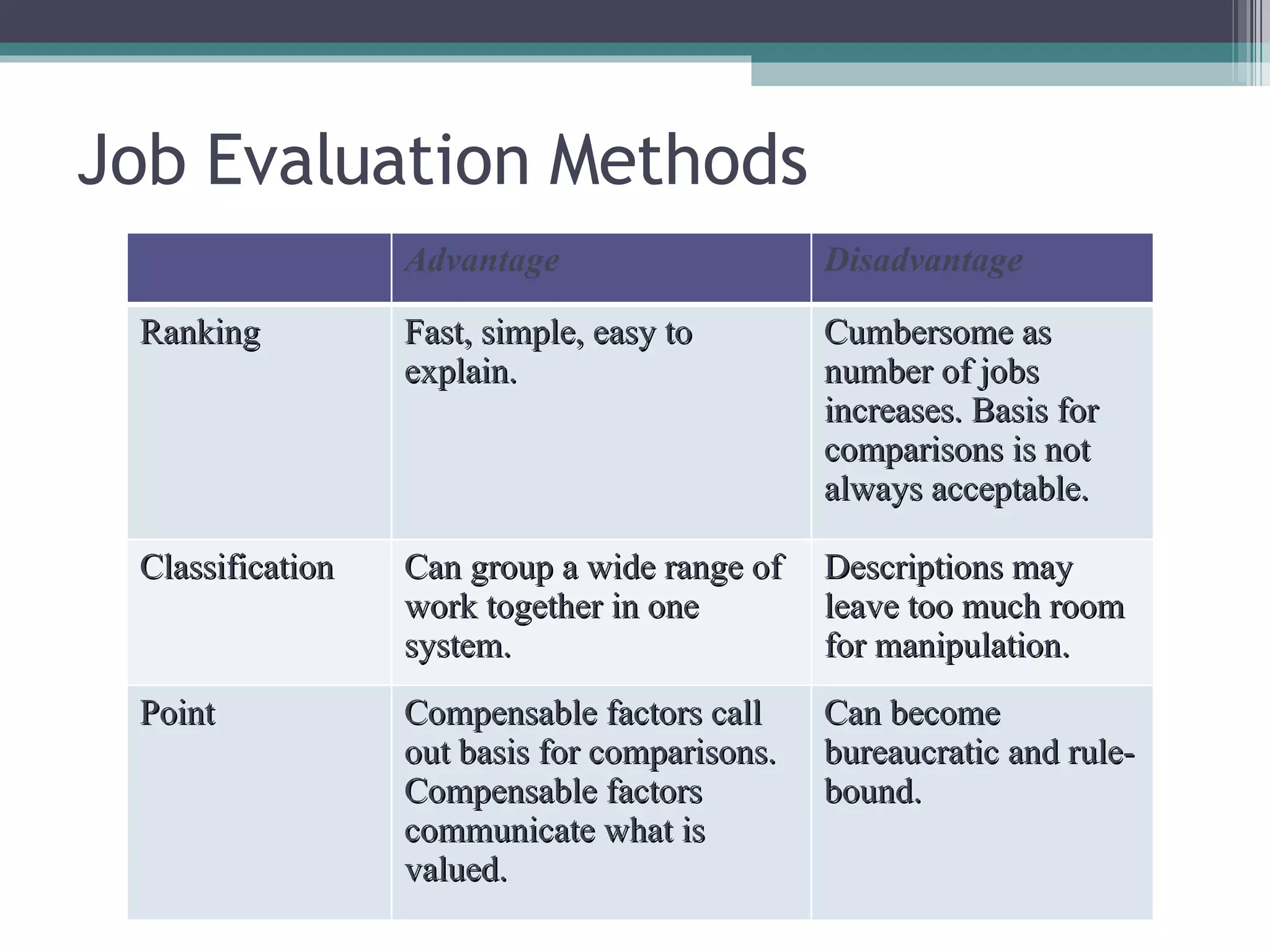
Job Evaluation Methods 1/5/2008 Advantage Disadvantage Ranking Fast, simple, easy to explain. Cumbersome as number of jobs increases. Basis for comparisons is not always acceptable. Classification Can group a wide range of work together in one system. Descriptions may leave too much room for manipulation. Point Compensable factors call out basis for comparisons. Compensable factors  communicate what is valued. Can become bureaucratic and rule-bound.
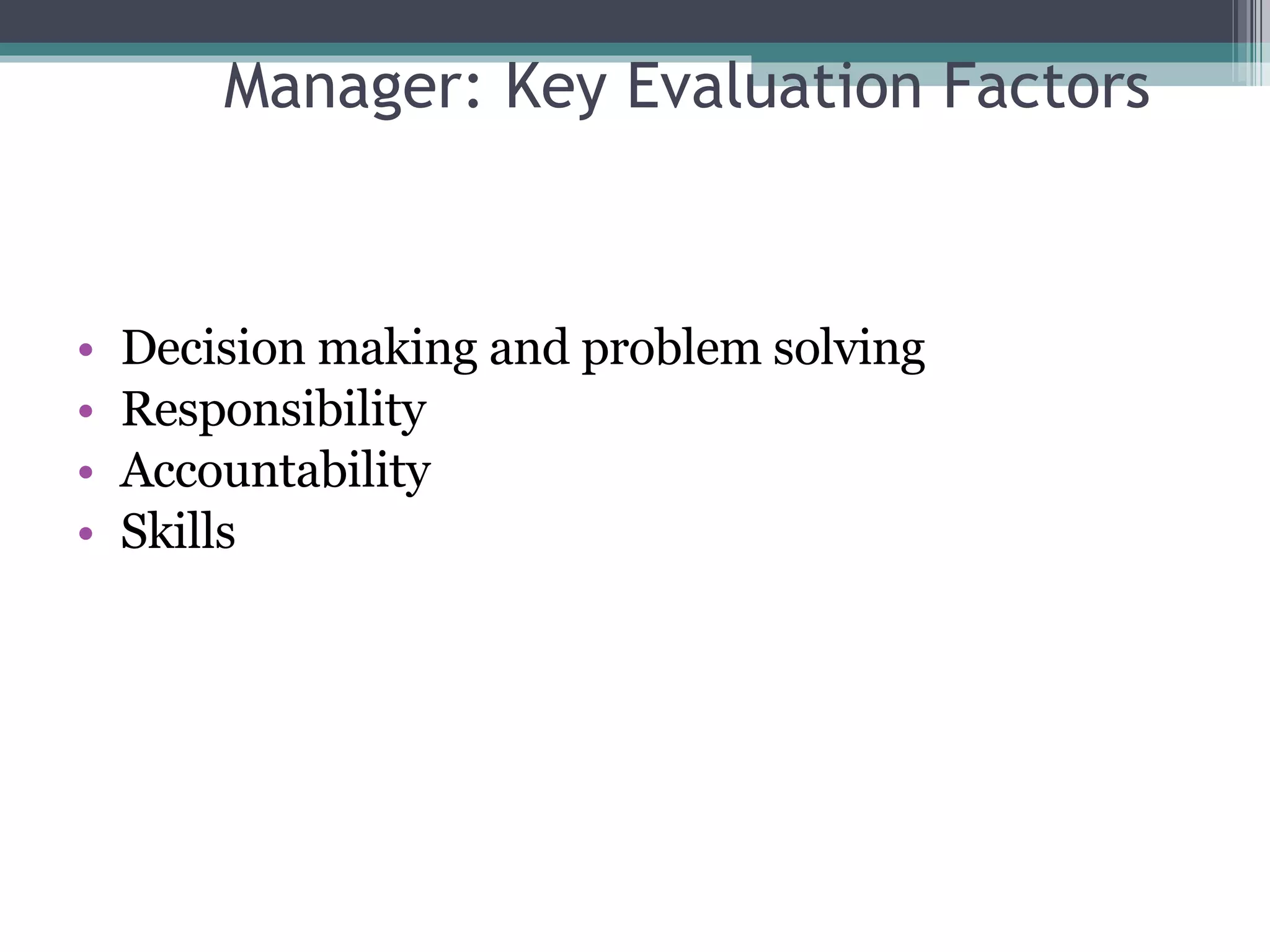
Manager: Key Evaluation Factors Decision making and problem solving Responsibility Accountability Skills
Hay’s Method – 3 Factors Jobs exist to achieve an end result Accountability Accountability Therefore, the job holder requires a level of knowledge and experience commensurate with the scale and complexity of the result Problem Solving To achieve this end result, job holders must address problems, create, analyse and apply judgement 1 3 2 Accountability Problem Solving Know-How
Hay’s Method - Process Depth & Range of Know-How Planning & Organising Communicating & Influencing Freedom to Act Nature of  Impact Area of Impact (Magnitude) Thinking Environment Thinking Challenge KNOW- HOW PROBLEM SOLVING ACCOUNTABILITY + + = Job  Size
Compensation Plan of Executives Broad banding  – paying executives at preset levels based on their level of competency. Golden parachute  – a financial protection plan for top executives in case they are severed from the organisation.
Implications Purpose of evaluation should be clearly defined Adoption of appropriate technique Allocation of sufficient resources
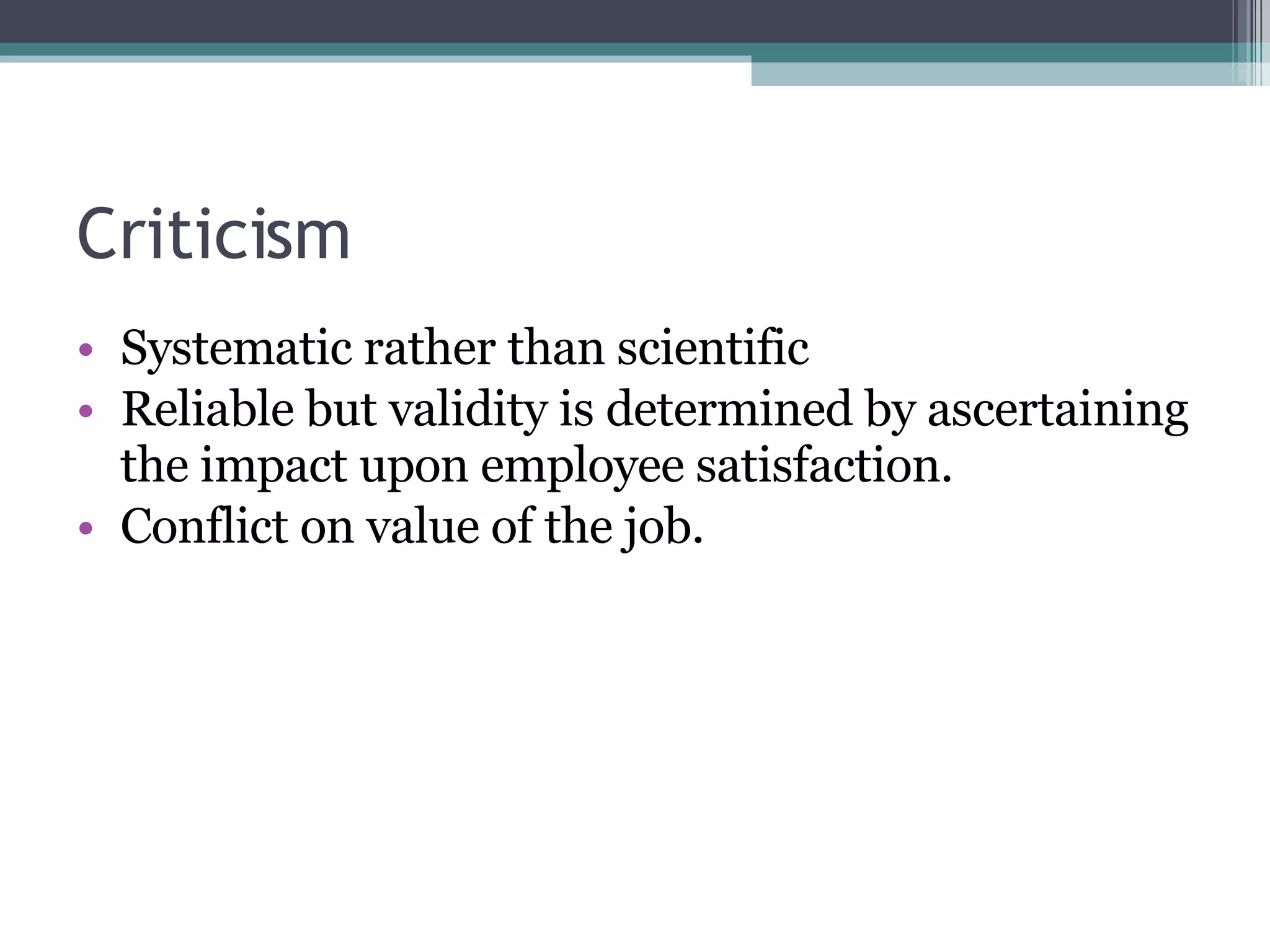
Criticism Systematic rather than scientific Reliable but validity is determined by ascertaining the impact upon employee satisfaction. Conflict on value of the job.
Useful for standardizing compensation practices. Most pay structures include several grades with each grade containing a minimum salary/wage and either step increments or grade range. Pay for each job is pre-determined through collective bargaining. PAY STRUCTURE
Contd… Sources of  Compensation. Compensation Methods. Compensation Structure. Administration Of compensation Financial and Non Financial Incentives Wages Act N.H.P.C. Conclusion References
What is Compensation System? Compensation is a systematic approach.  Compensation is a tool. Compensation System is flexible.
ELEMENTS OF A COMPENSATION SYSTEM
Objectives of compensation system Acquire qualified personnel Retain present employees Ensure equity Reward desired behavior Control costs Comply with legal regulations Facilitate understanding Further administration efficiency
How Compensation System is used Compensation is  used to:  Recruit and retain qualified employees.  Increase or maintain morale/satisfaction.  Reward and encourage peak performance.  Achieve internal and external equity.  Reduce turnover and encourage company loyalty.  Modify (through negotiations) practices of unions.
Components of compensation system Job Descriptions :- define in writing the responsibilities, requirements, functions, duties, location, environment, conditions, and other aspects of jobs 1. Job Analysis :- The process of analyzing jobs from  which  job descriptions  are developed. 2. Job evaluation :- for comparing jobs for the  purpose of determining appropriate  compensation levels for individual jobs or job  elements
Continue… Pay Structures :- based on several grades pay structure is determined through collective bargaining (unions) Salary Surveys :- May include average salaries, inflation indicators, cost of living indicators, salary budget averages.
Different types of compensation system Base Pay  Commissions  Overtime Pay  Bonuses, Profit Sharing, Merit Pay  Stock Options  Travel/Meal/Housing Allowance  Benefits including: dental, insurance, medical, vacation, leaves, retirement, taxes...
Compensation Plans Develop a program outline.  Designate an individual to oversee designing the compensation program.  Develop a compensation philosophy.  Conduct a job analysis of all positions.  Evaluate jobs.  Determine grades.  Establish grade pricing and salary range.
Continue………. Determine an appropriate salary structure.  Develop a salary administration policy.  Obtain top executives' approval of the basic salary program.  Communicate the final program to employees and managers. Monitor the program.
Sources of Compensation Data Labour Employer  Information Employer Association Professional Association
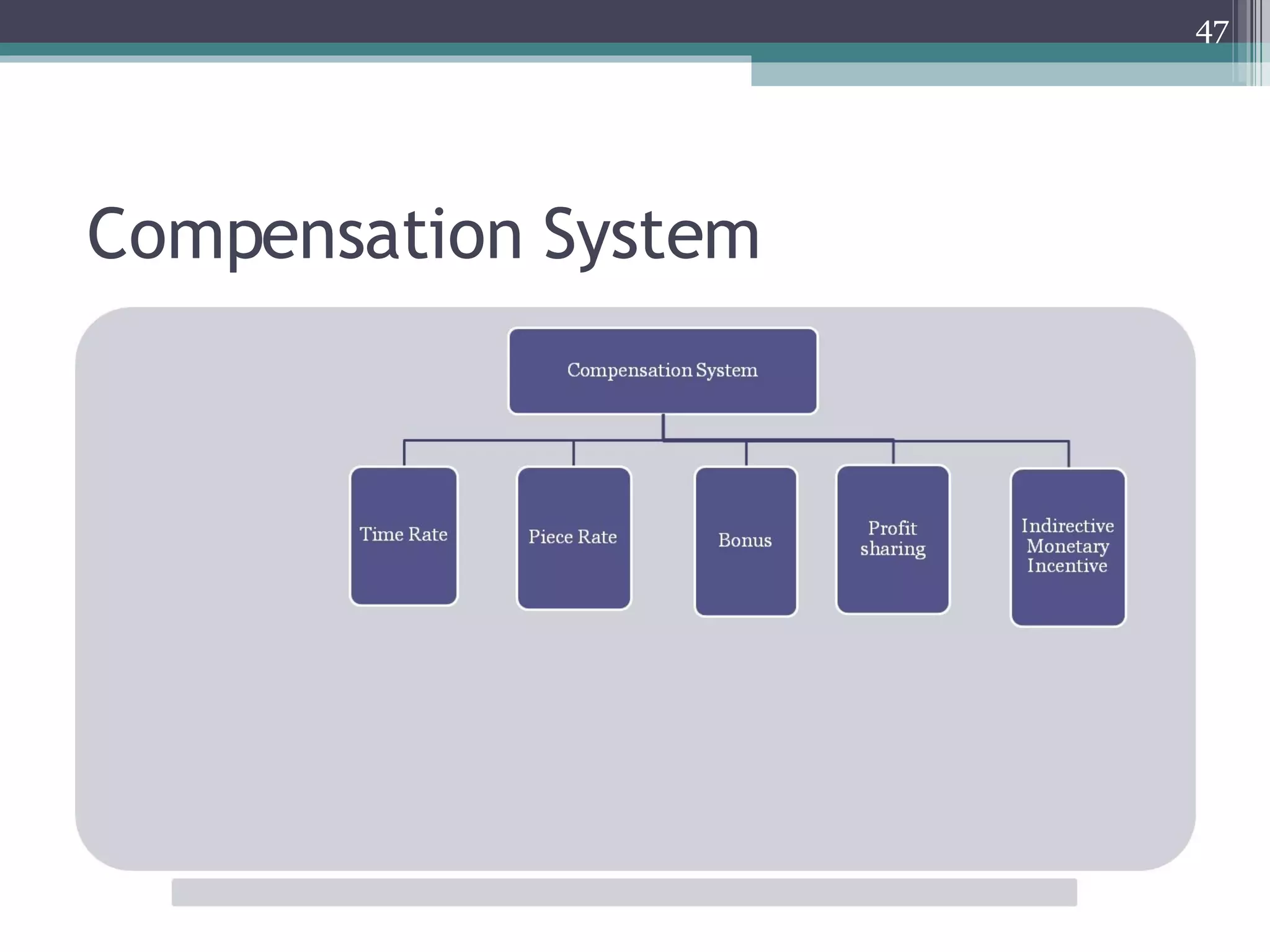
Compensation Methods There are basically two compensation system viz. Basis Time Rate and Piece Rate. Its is meant for making payment, which should  adequate compensate the worker for his efforts.
Compensation System
Time Rate System
Piece Rate System
Compensation Structure Compensation System Consists  of the following: Salary, Basic Salary or Consolidated Salary: Grade wise flat Allowance: Reimbursements of expenses:  Annual payments: Benefits: Employee stock option schemes : “  Total cost to the Company” concept : Retiral benefits: Performance Bonus   :
Compensation Administration The major functions of an administration consist of the following: Approval  and /or recommendation of management on job evaluation methods and findings. Review and recommendation of basic wage and salary structure. Co-ordination and review of relative departmental rates to ensure conformity. Review of budget estimates for wage and salary adjustments and increases.
Principles of Administration of Compensation There should be a definite plan to ensure that differences in pay for jobs are based upon variations in job requirements. Prompt and correct payments of the dues of the employees. The plan should carefully distinguish between jobs and employees. Equal pay for equal work.
Continue… The wage and salary structure should be flexible. The employees and the trade union, if there is one, should be informed about the procedures used to establish wage rates. The wage should be sufficient to ensure for the worker and his family reasonable standard of living.
Financial and Non Financial Incentives An incentive scheme can offer employees extra pay according to individual or group performance targets. Examples include: profit-related and share option schemes  bonuses  commission
Continue….. Non-financial  Example include: vouchers  extra holidays  gifts  company cars
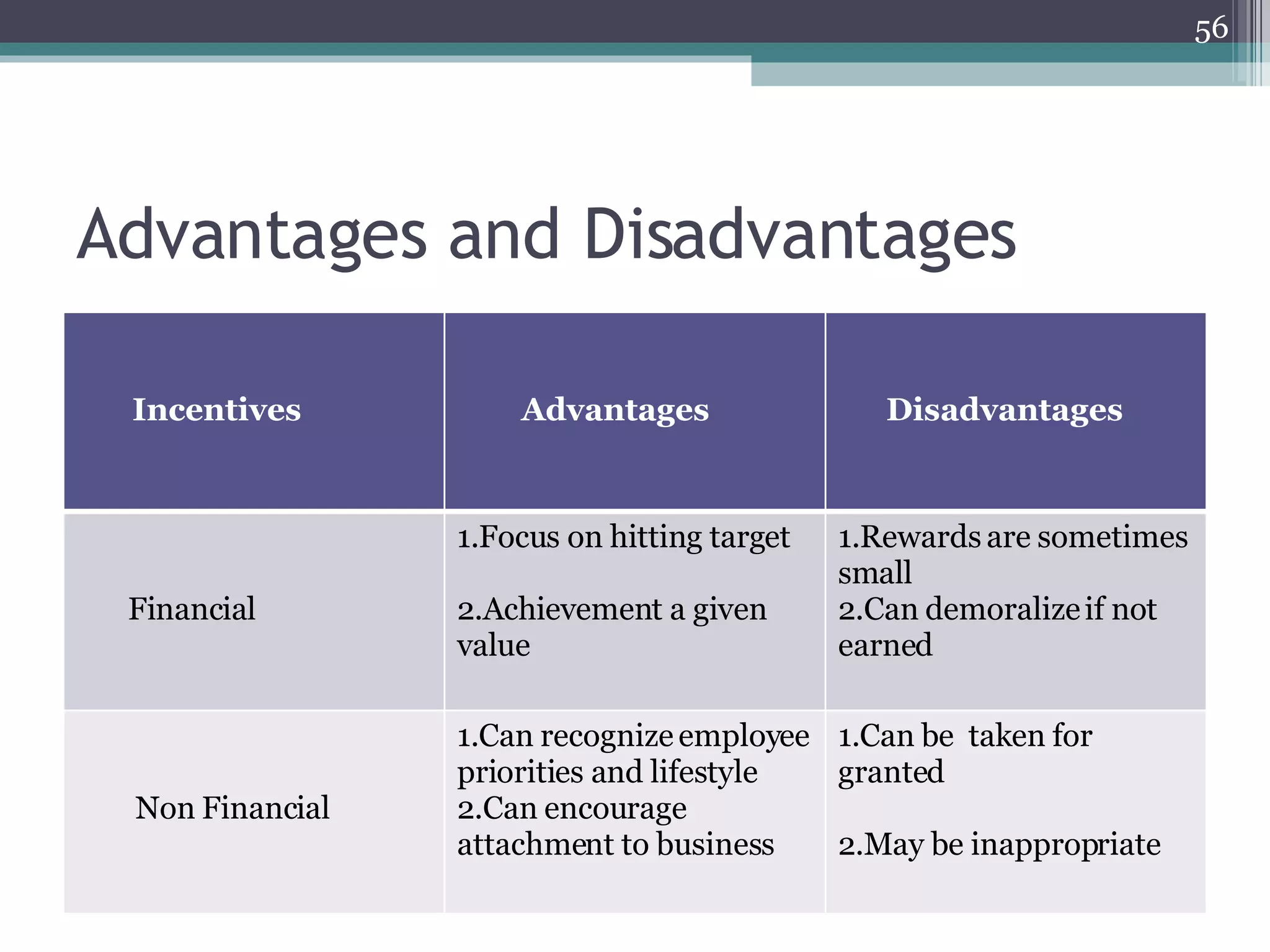
Advantages and Disadvantages Incentives Advantages Disadvantages Financial 1.Focus on hitting target 2.Achievement a given value 1.Rewards are sometimes small 2.Can demoralize if not earned Non Financial 1.Can recognize employee priorities and lifestyle 2.Can encourage attachment to business 1.Can be  taken for granted 2.May be inappropriate
Reasons For Introducing An Incentive Scheme 1. Increase in earnings for employees?  2. Increase in output?  3. Improvement in quality?  4. Better mobility of labour?  5. More efficient methods of working?  6. Improvement in safety?  7. Higher housekeeping standards?  8. Reduction in absenteeism?  9. Reduction in labour turnover?  10.Reduction in overtime working?
What Type Of Work Needs An Incentive Scheme? Does the work necessitate skilled, semi-skilled or unskilled labour?  Can individual skill be fully applied when manipulating machines etc. or is the employee’s quantity and quality of output regulated to a large extent by factors outside his/her control?  Does the level of output remain steady throughout the year or is it subject to seasonal variations?
Continue…. Is production organized on a process, flow line, batch or jobbing basis?  Have your current production methods been recently reviewed for maximum efficiency?  Is any new machinery or plant, to be introduced in the near future, likely to upset the standard upon which an incentive scheme might be based?
ACT’S GOVERNING WAGE ADMINISTRATION IN INDIA The Wages Act determines the legal regulation of the remuneration of persons who work under an employment contract, the grant of guarantees and payment of compensation relating to remuneration.
PAYMENT OF WAGES ACT(1936) The Payment of Wages Act, 1936 is a central legislation which applies to the persons employed in the factories and to persons employed in industrial or other establishments specified in sub-clauses (a) to (g) of clause ) of section 2 of this Act  This Act does not apply on workers whose wages payable in respect of a wage period average Rs. 1600/- a month or more.
SALIENT FEATURES:-   This Act has been enacted with the intention of ensuring timely payment of wages to the workers and for payment of wages without unauthorized deductions  The salary in factories/establishments employing less than 1000 workers is required to be paid by 7th of every month and in other cases by 10th day of every month.
Continue…. A worker, who either has not been paid wages in time or an unauthorized deductions have been made from his/her wages, can file a Claim either directly or through a Trade Union or through an Inspector under this Act, before with the Authority appointed under the Payment of Wages Act
MINIMUM WAGES ACT(1948) This act provides for fixing minimum rates of wages in certain employment. The inspectorate staff of the Labour Department takes action on complaints received from workmen/Unions, Suo moto action can also be taken.
Continue…. Apart from the action by the Inspectorate in the Department, if a worker gets less payment, he can also file a claim before the Competent Authority appointed under the Act, which are Deputy Labour Commissioners for the respective districts. The authority can impose penalty up to 10 times the difference in minimum wages that was due and paid.
  Payment of Gratuity Act, 1972 Gratuity is a lump sum payment made by the employer as a mark of recognition of the service rendered by the employee when he retires or leaves service.  The Act is applicable to every factory, shop or an establishment, in which ten or more persons are employed, or were employed on any day of the proceeding twelve months.  An employee is eligible for receiving gratuity payment only after he has completed five years of continuous service.
N.H.P.C. – National Hydroelectric Power Corporation N.H.P.C. was incorporated under the Company's Act 1956 in November 1975. A Central Government Enterprise with the initial authorised share capital of Rs. 2000 million for hydro power development in Central Sector.
Compensation structure Basic salary :  Savings  :- CPF, LIC, PPF, NSC, MIS Bonus  Arrears Medical allowance Education allowance Price Stocks Salary of an employee
Methods of compensation system Time rate System Ordinary level High wage level Graduated time rate Contracts Yearly  Monthly Quarterly
Administration of compensation Entrusted to job executives Supported by the advice of technical staff Final approval by top executives Performance appraisal by various managers Final decision by Chairman.
Executive plans for compensation Level of individual performance. Level of company performance. Performance effectiveness. Complete information on the relationship between bonus and performance. Satisfaction and motivational effect.
DIFFERENT TYPES OF COMPENSATION PLANS Base Pay Commissions Overtime Pay  Bonuses, Profit Sharing, Merit Pay Stock Options  Travel/Meal/Housing Allowance  Benefits including: dental, insurance, medical, vacation, leaves, retirement, taxes...
PROCESS OF DESIGNING A COMPENSATION PLAN Develop a program outline.  Designate an individual to oversee designing the compensation program.  Develop a compensation philosophy.  Conduct a job analysis of all positions.  Evaluate jobs.  Determine grades.  Establish grade pricing and salary range.  Determine an appropriate salary structure.  Develop a salary administration policy.  Obtain top executives' approval of the basic salary program.  Communicate the final program to employees and managers. Monitor the program.
CRITERIA OF DEVELOPING A COMPENSATION PLAN Internal Vs External Equity : Will the compensation plan be perceived as fair within the company or will it be perceived as fair relative to what other employers are paying for the same type of labor? Fixed Vs Variable Pay:  Will the compensation be made monthly on a fixed basis – through base salaries – or will it fluctuate depending on such pre-established criteria as performance and company profits?
Continued… Performance Vs Membership:  Will the compensation emphasize performance and its pay to individual or group contributions,  or will it emphasize membership in the organization – logging in a prescribed number of hours each week and progressing up the organizational ladder?  Job Vs Individual Pay:  Will compensation be based on how the company values a particular job, or will it be based on how much skill and knowledge an employee brings to that job?
Continued.. Monetary Vs Non-monetary Awards:  Will the compensation plan emphasize motivating employee through monetary awards rewards like pay and stock options, or will it stress nonmonetary rewards such as interesting work and job security?  Open Vs Secret Pay:  Will employees have access to information about other workers compensation levels and how compensation decisions are made (open pay), or will this knowledge be withheld from employees(secret pay)? Centralization Vs Decentralization Of Pay Decisions:  Will compensation decisions be made in a tightly controlled central location, or will  they be delegated to managers of the firm’s unit?
Continued… Egalitarianism Vs Elitism:  Will the compensation plan place most employees under the same compensation system (egalitarianism), or will it establish different plans by organizational level and/or employee group (elitism) ? Below-Market Vs Above-Market Compensation:  Will employees be compensated at below-market levels, at market levels, or at above-market levels?
DETERMINANTS OF COMPENSATION Category of Employees Bargaining power of the employee and his trade union Demand and supply manpower for the specific category of position or job Good payment to the employees Firm’s ability to pay economically viable and healthy corporate citizens The salary of its people productivity, profitability and firm’s financial position
Continued… The Standard of Living The Government Regulations
A Monetary Compensation plan must fulfill four conditions: Should attract and keep appropriate number of people in the organization; Should motivate the people at work to contribute their best toward the company’s objective; Should satisfy the needs of the company’s own people; Should not attract frequent demand and struggle of people for wage enhancement affecting the cordial industrial relations.
ELEMENTS OF TOTAL COMPENSATION Total Compensation Base Compensation Incentive Compensation / Variable compensation  Supplementary compensation paid to large group of employees
A. BASE COMPENSATION Basic pay fixed to various categories of jobs, post or positions –> Basic Pay/ Scale of Pay Paid mostly in monetary terms -> Monetary Compensation Factors considered in the process: Job Content – the job expected to be carried out by the employee and his worth to be on that particular job; Bargaining Power of the trade union, or that of the employee, representing the trade or the job;
Continued… Demand-supply interplay or the specific category of jobs or positions; Remuneration level in the industry, identical firms or the firms in the locality for the specific job; Ability of the firm to pay; Productivity, profitability and financial position of the firm; Cost/Standard of living in the environment of the organization; Government Regulations.
B. INCENTIVE COMPENSATION A good incentive system motivates people to put in their best efforts to perform well. Commonly used to motivate people at work. Steps of the process: Fixation of Performance Standards Fixation of specific Incentive Schemes Linking of performance levels with organizational objective Classification of performance standards
Continued… Periodical feedback Conspicuous Incentive Constitution of a committee for the administration of incentive schemes Linking of HRD programs with incentive schemes Publication of names of recipients Awards  and Promotions Honor of Incentive-takers Incentive scheme and Corporate Policy
Continued… Active involvement of top management Clubbings of incentives with lease compensation Adequate financial allocation Adjustment of performance standard and incentive Acceptance of suggestions from the employees
EXAMPLES: FINANCIAL Profit-related and share option schemes  Bonuses Commission NON-FINANCIAL Vouchers Extra holidays Gifts Company Cars
C. SUPPLEMENTARY COMPENSATION It includes additional annual wage, employee profit sharing (present day bonus), production sharing plans, employee’s equity participation as an additional bonus
ASPECTS TO BE CONSIDERED FOR ACCOMPLISHING EFFECTIVENESS OF THE MONETARY REMUNARATION SYSTEM
Salary and Wage level may be higher than or equal to what is prevailing in the surroundings or in the industry; Monetary remuneration should be adequate to meet the needs; Monetary remuneration system should not be exorbitantly higher or lower; compared with existing standards; It is better to pay the salary a few days in advance before it fails due;
A sound merit-rating and systematic job evaluation may be used as the basis for pay fixation; There should be some scope for pay hikes to offset the inflationary tendencies; Monthly salary may be supported by financial incentive schemes so that there would be scope for every executive to increase his income by increasing his performance.
METHODS OF REMUNARATION Time-Work/Day-Work System Straight Piece-Work System Differential Piece Rate System Group Bonus System Priestman’s Production Bonus Cost-Efficiency Bonus Plan Emerson Efficiency Bonus Halsey Premium Plan Rowan Bonus Plan
FACTORS DETERMINING THE LEVEL OF REMUNERATION Production and the nature of work Use of machines Use of labor Labor supply Wage policy
KINDS OF WAGES MINIMUM WAGE: that wage which is sufficient to cover the bare physical needs of a worker and his family FAIR WAGE: something more than the minimum wage providing mere necessities LIVING WAGE: the normal needs of the average employee, regarded as human beings in a civilized community NEED BASED MINIMUM WAGE: should be ‘need based’; should ensure the satisfaction of the minimum needs of the industrial worker.
Time-Work/Day-Work System Employees are remunerated at pre -determined hourly/daily rates for hours/days they are actually employed in the factory
Advantages: Simple Quality Control and Steady Income Disadvantages: No distinction Go Slow Habits Constant Supervision
Straight Piece-Work System A rate of payment is fixed for each piece of completed production. The wage payment is calculated by multiplying the number of pieces completed by each employee by the piecework rate.
Advantages: Simple Facility of Incentive Advance fixation of labor cost per unit Less Supervision Disadvantages: Quality not maintained Wastage and absenteeism
Differential Piece Rate System Production at different levels of efficiency are paid at different rates so that at higher levels of production, the worker earns a comparatively higher rate per unit. Suitable where the work is of repetitive nature, the methods of equipment are standardized.
Continued… Principle systems that use the principle of differential piece rates: Taylor differential piece rate system Merrick differential piece rate system Gantt task bonus plan
Taylor’s Differential Piece Rate System Introduced by Dr E.W. Taylor as an attempt to increase output of workers whom he considered were working far below their capacity. It provides 2 piece rates, a low piece rate for output below standard and a high piece rate for output above standard Suitable for large-scale industries.
Continued… Advantages: Simple Attraction to efficient workers Strong Incentive Disadvantages: Unprofitable for beginners Unsuitable
Merrick Differential piece-rate system Output Payment Up to 83% Normal Rate 83-100% 10% above the normal rate Over 100% 30% above the normal rate
Gantt task bonus plan Output Payment Output below standard (high task) Time-Rate (guaranteed) Output at standard Bonus  of 20% above the time-rate Output above standard High piece rate
Profit –Sharing American Council of Industries: “ Profit-Sharing is a system where an employer gives to all the workers besides the regular appropriate wages, special  current or postponed amount which is not based human groundwork but is based on the prosperity of the whole business.”
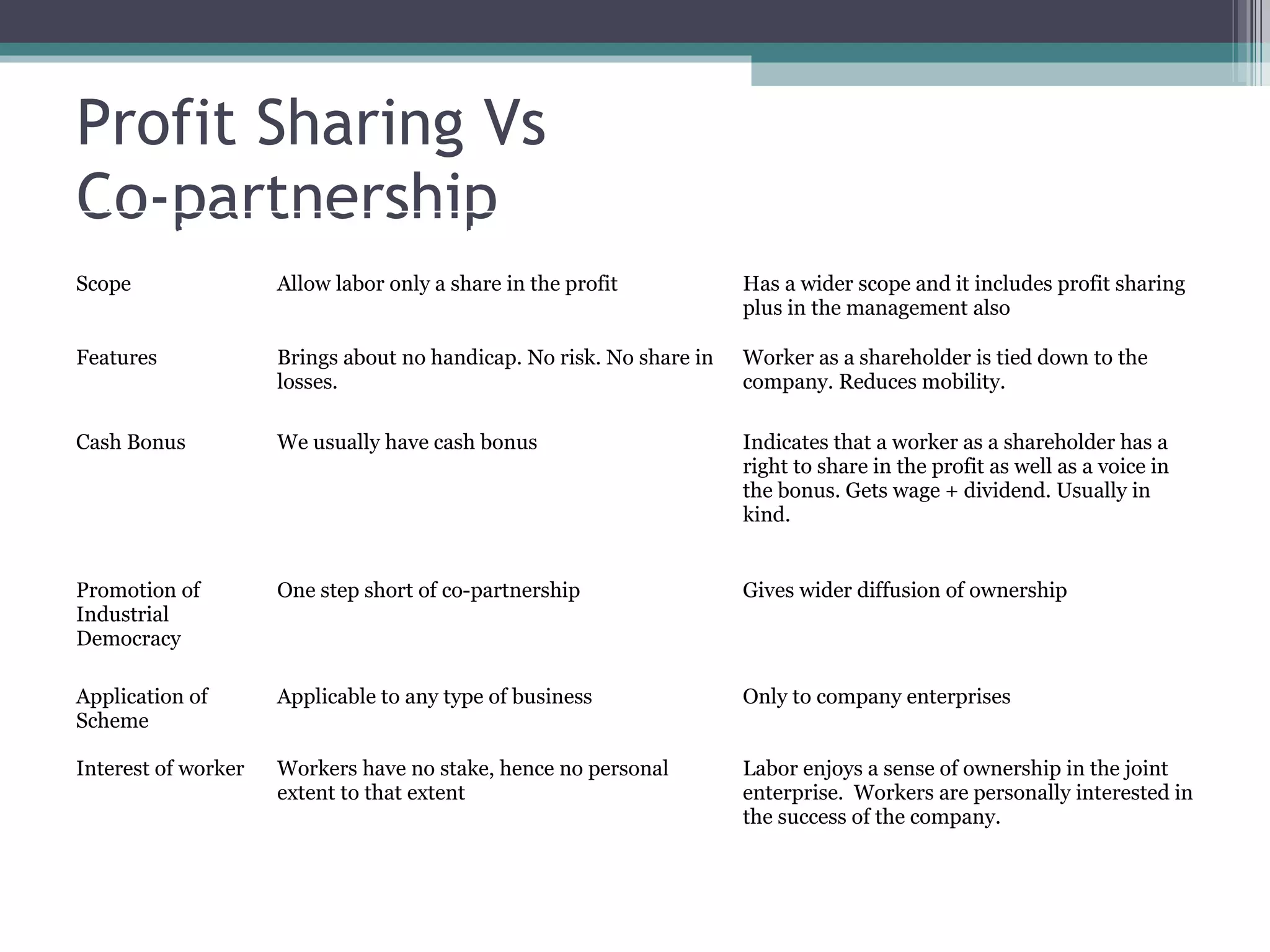
Profit Sharing Vs  Co-partnership Basis Profit Sharing Co-Partnership Scope Allow labor only a share in the profit Has a wider scope and it includes profit sharing plus in the management also Features Brings about no handicap. No risk. No share in losses. Worker as a shareholder is tied down to the company. Reduces mobility. Cash Bonus We usually have cash bonus Indicates that a worker as a shareholder has a right to share in the profit as well as a voice in the bonus. Gets wage + dividend. Usually in kind. Promotion of Industrial Democracy  One step short of co-partnership Gives wider diffusion of ownership Application of Scheme Applicable to any type of business Only to company enterprises Interest of worker Workers have no stake, hence no personal extent to that extent Labor enjoys a sense of ownership in the joint enterprise.  Workers are personally interested in the success of the company.
Profit Sharing Vs Bonus Basis Profit Sharing Bonus Meaning Employer gives to the workers a portion of surplus profit of the business in addition to wages. A bonus to workman beyond their wages. Basis Profit showing is usually based on definite agreement between  the employer and the worker. Payment of bonus depends on the sweet will of the employer or is provided of law. Legal provision No Act has been passed concerning profit sharing. Bonus Act has been passed in the year 1965. Statutory Obligation A voluntary payment although depends on agreement. Was originally , a voluntary payment has become a statutory obligation under the Payment of Bonus Act 1965.
06/02/09
Acquire qualified personnel Retain present employees Ensure equity Reward desired behavior Control costs Comply with legal regulations Facilitate understanding Future administration efficiency  06/02/09
Recruit and retain qualified employees.  Increase or maintain morale/satisfaction.  Reward and encourage peak performance.  Reduce turnover and encourage company loyalty.  06/02/09
Job Descriptions Job Analysis Job Evaluation Pay Structures Salary Surveys Policy and Regulations 06/02/09
Monetary Basic Salary  House Rent Allowance  Conveyance Leave Travel Allowance  Medical Reimbursement  Special Allowance  Bonus PF/Gratuity ESOP’s Overtime Policy Non Monetary Leave Policy Car policy Hospitalization Insurance Leave travel Assistance Limits Retirement Benefits Holiday Homes 06/02/09
Hay MSL method *Knowhow *Problem solving  *Accountability 06/02/09
Salary. Grade wise flat Allowance. Reimbursements of expenses. Annual payments. Benefits. Employee stock option schemes. Retirement benefits. Performance Bonus. 06/02/09
Approval and Recommendation of management on job evaluation methods and findings. Review and recommendation of basic  salary structure. Co-ordination and review of relative departmental rates to ensure conformity. Review of budget estimates for salary adjustments and increases. 06/02/09
There should be a definite plan to ensure that differences in pay for jobs are based upon variations in job requirements. Prompt and correct payments of the dues of the employees. The plan should carefully distinguish between jobs and employees. Equal pay for equal work. 06/02/09
Financial incentives: Profit-related and share option schemes Bonus Commission Non Financial incentives: Extra holidays Gifts Company cars  Vouchers  06/02/09
06/02/09
 
Concept: The payment of dearness allowance facilitates employees and workers to face the price increase or inflation of  prices of goods and services consumed by him. The onslaught of price increase has a major bearing on the living conditions of the labour.
Definition “ Dearness Allowance is a kind of Allowance given to worker to bear the cost of living due to inflation, so that he she can at least live his life in "some comfort” “ The amount which is given to increase in the cost of living is called as DA.”
History: Originated in India after First World War “ Dear Food Allowance” Increase  in Cost of Living Index in  1933-34 Increase in DA at rate of 1.75 pies per day (1939) Origin of RMMS in 1946 “ Old Textile Allowance” (1947) “ Revised Textile allowance”(1953)
METHODS OF DA CALCULATION In India,  Dearness allowance  (D.A.) is part of a person's salary. D.A. is calculated as a percent of the basic salary. This amount is then added to the basic salary along with house rent allowance to get the total salary. 1. Flat  Rate 2. Graduated Scale 3. Cost of Living and Consumer Price Index No.
Contd…
Contd…. Cost of Living and Consumer Price Index Number: a.  Price Index Number is system of linking DA with the   Cost of Living Index b.  DA  is calculated on the no. of points by  which  the consumer price index has risen above the base index. Advantage:  “Low-paid category of workers securing a much larger quantum of relief than High-paid workers.”
Importance: Protecting  the value of Basic Salary Structure  Increase  in cost of living

Compensation Management 1

  • 1.
  • 2.
    AGENDA Define Compensation. Elements of Compensation System. CONCEPTS OF WAGE AND DIFFERENT KINDS OF WAGES. Objectives of Compensation System. How Compensation System is used ? METHOD OF CALCULATING BASIC PAY AND ITS USE IN DESIGNING SALARY STRUCTURE. What are the components of Compensation System? Different types of Compensation System. Compensation Plans. Financial and Non Financial Incentive Schemes
  • 3.
  • 4.
    Acritical component of both compensation and selection systems, job descriptions define in writing the responsibilities, requirements, functions, duties, location, environment, conditions, and other aspects of jobs. Descriptions may be developed for jobs individually or for entire job families. JOB DESCRIPTION
  • 5.
    The process ofanalysing jobs from which job descriptions are developed. Job analysis techniques include the use of interviews, questionnaires, and observation. JOB ANALYSIS
  • 6.
    A system forcomparing jobs for the purpose of determining appropriate compensation levels for individual jobs or job elements. There are four main techniques: Ranking Classification Factor Comparison Point Method JOB EVALUATION
  • 7.
    JOB EVALUATION METHODSComparison Method Analysis Method Entire Job Job Factors Job Against Scale Job Against Job Classification Point Method Ranking Factor Comparison
  • 8.
    DEFINITION A setof compensable factors are identified as determining the worth of jobs. Typically the compensable factors include the major categories of Skill Responsibilities Effort Working Conditions
  • 9.
    FACTORE CAN BEFURTHER DEFINED SKILLL Experience Education Ability RESPONSIBILITIES Fiscal Supervisory
  • 10.
    CONT. EFFORT Mental Physical WORKING CONDITION Location Hazards Extremes in Environment
  • 11.
    POINT METHOD AdvantagesHighly stable over time Perceived as valid by users and employees Likely to be reliable among committee that assesses the jobs Provides good data to prepare a response to an appeal Disadvantages Time, money, and effort required to set up Relies heavily on key (benchmark) jobs, so if key jobs and correct pay rates don’t exist, the point method may not be valid
  • 12.
    FACTOR DEGREES ANDPOINT SYSTEMS
  • 13.
    WHAT IS ADEGREE LEVEL? It is a scale that reflects differing quantity or quality of the factor It is used to differentiate jobs on the factor It is a definition that is clear and unambiguous It contains explicit language that spells out the behaviors, skills, or performance expectations for that factor at different levels of the factor
  • 14.
    HOW DO YOUASSIGN POINT VALUES TO THE ENTIRE SYSTEM? The maximum number of points assigned is a fairly arbitrary judgment (500-3000 is common) The number must be large enough to allow sufficient differentiation among the jobs to be evaluated.  If there is a very wide spread between the current wages of the highest paid job and the lowest paid job, the maximum number of points will need to be higher If you choose more than one pay system, the number of points or the actual factors themselves do not have to be the same in each one. SUGGESTION FOR YOUR PROJECT: Have no fewer than 1000 points and no more than 2000.
  • 15.
    POINT VALUES TOFACTORS ALONG A SCALE Point values for Degrees Total Factor 1 2 3 4 Skill 45 90 135 180 450 Physical effort 25 50 75 100 250 Mental effort 35 70 105 150 360 Responsibility 25 50 75 100 250 Working conditions 20 40 60 80 200 Maximum total points of all factors depending on their importance to job=1510
  • 16.
    RESPONSIBILITY Each employeeis responsible for conserving the company’s equipment and material. Level-1 Employee reports malfunctioning of equipment or defective materials to the immediate superior. Level-2 Employee maintain the appearance of equipment or order of material and has responsibility for the security of such equipment or material Level-3 Employee perform preventive maintenance and minor repairs on equipment or corrects minor defects in material Level-4 Employee perform major maintenance or overhauls of equipment or responsible for deciding type, quality and quantity of material to be used.
  • 17.
    Job Evaluation -Concept This potential to blend internal forces and external market forces is both a strength and a opportunity to job evaluation system.
  • 18.
    Job Evaluation -Objectives Job evaluation is used to determine the relative value of each job in relation to all jobs within the organization. Immediate objective: to obtain internal and external consistency in wages and salaries. Ultimate objective: employee and employer satisfaction with wages and salaries paid.
  • 19.
    HISTORY:- 1865 -Karl Marx wrote in Das Kapital that the value of goods and services is based on the amount of labor that goes into them 1885 - Frederick Winslow Taylor stated that the content of labor in labor determines the price of labor 1935 - Edward Hay developed the Hay point factor system 1963 - The Equal Pay Act prohibited discrimination on the basis of sex…for equal work on jobs, the performance of which requires equal skill, effort, and responsibility and which are performed under similar working conditions. The EPA formalized non-market based pay plans
  • 20.
    1 Thus, Rankingeach job relative to all other jobs, usually based on some overall factor. Steps in job ranking: Obtain job information. Select and group jobs. Select compensable factors. Rank jobs. Combine ratings . Common Methods of Job Evaluations Ranking method: the grade consists of all jobs that fall within two or three ranks .
  • 21.
    Importance of jobevolution 1 > To involve the people occupying the positions under evaluation. This is especially so if you think your organizations job descriptions are poorly written or out of date. The people in positions and their immediate supervisors have the best idea of what the job is really about. 2 >Job evaluation is most effective as a participative exercise and this in itself can improve employment relations. It is therefore recommended that job evaluation is introduced or revised jointly by allowing management and employee representatives to discuss relevant issues initially in a non-negotiating forum 3>T o ensure integration of internal fairness and external competitiveness .
  • 22.
    Up to date,accurate job descriptions are absolutely essential and should be reviewed for accuracy with the current incumbent before evaluation. More complex job evaluation techniques require more information and often the primary source of this is job descriptions, so the more complex the job evaluation scheme, the more detailed the job description needs to be. . Keep accurate records of decisions taken, to ensure openness, and transparency. Build confidence in the process and outcomes by briefing people Many organizations choose to engage consultants to manage parts or the entire process. These consultants often have access to the expensive but comprehensive data bases containing detailed information about remuneration levels in different sectors. job evaluation methods are not to be confused with performance management or appraisal, where the primary concern is with how well a job is performed . \ Aspects of job evolution
  • 23.
    The 4 majorfactors on which this method are measured/ based are: Company size Strategic level Impact Complexity and Problem Solving
  • 24.
    Managerial Jobs: CharacteristicsCommunication Teamwork/motivation Liaison/networking Service delivery Decision making Planning & organising Initiative & problem solving Analytical & research skills Sensory & physical demands Work environment Pastoral care Team development Teaching & learning Knowledge & experience
  • 25.
    Job evaluation processThe major objectivity of job evaluation process is to establish satisfactory wage and salary differentials, so job analysis should precede the actual programme of evaluation. Objective of job evaluation Job description Job analysis Job evaluation Job specification Wage survey Employee classification
  • 26.
    Job Evaluation MethodsJob Ranking Method Examines job description and arrange jobs according to value to company e.g. highest to lowest. Job Classification Method Classes or grades are defined to describe a group of jobs e.g. government organisations. Point Method Breaking down jobs on identifiable criteria and the degree to which these criteria exist on the job.
  • 27.
    Job Evaluation Methods1/5/2008 Advantage Disadvantage Ranking Fast, simple, easy to explain. Cumbersome as number of jobs increases. Basis for comparisons is not always acceptable. Classification Can group a wide range of work together in one system. Descriptions may leave too much room for manipulation. Point Compensable factors call out basis for comparisons. Compensable factors communicate what is valued. Can become bureaucratic and rule-bound.
  • 28.
    Manager: Key EvaluationFactors Decision making and problem solving Responsibility Accountability Skills
  • 29.
    Hay’s Method –3 Factors Jobs exist to achieve an end result Accountability Accountability Therefore, the job holder requires a level of knowledge and experience commensurate with the scale and complexity of the result Problem Solving To achieve this end result, job holders must address problems, create, analyse and apply judgement 1 3 2 Accountability Problem Solving Know-How
  • 30.
    Hay’s Method -Process Depth & Range of Know-How Planning & Organising Communicating & Influencing Freedom to Act Nature of Impact Area of Impact (Magnitude) Thinking Environment Thinking Challenge KNOW- HOW PROBLEM SOLVING ACCOUNTABILITY + + = Job Size
  • 31.
    Compensation Plan ofExecutives Broad banding – paying executives at preset levels based on their level of competency. Golden parachute – a financial protection plan for top executives in case they are severed from the organisation.
  • 32.
    Implications Purpose ofevaluation should be clearly defined Adoption of appropriate technique Allocation of sufficient resources
  • 33.
    Criticism Systematic ratherthan scientific Reliable but validity is determined by ascertaining the impact upon employee satisfaction. Conflict on value of the job.
  • 34.
    Useful for standardizingcompensation practices. Most pay structures include several grades with each grade containing a minimum salary/wage and either step increments or grade range. Pay for each job is pre-determined through collective bargaining. PAY STRUCTURE
  • 35.
    Contd… Sources of Compensation. Compensation Methods. Compensation Structure. Administration Of compensation Financial and Non Financial Incentives Wages Act N.H.P.C. Conclusion References
  • 36.
    What is CompensationSystem? Compensation is a systematic approach. Compensation is a tool. Compensation System is flexible.
  • 37.
    ELEMENTS OF ACOMPENSATION SYSTEM
  • 38.
    Objectives of compensationsystem Acquire qualified personnel Retain present employees Ensure equity Reward desired behavior Control costs Comply with legal regulations Facilitate understanding Further administration efficiency
  • 39.
    How Compensation Systemis used Compensation is used to: Recruit and retain qualified employees. Increase or maintain morale/satisfaction. Reward and encourage peak performance. Achieve internal and external equity. Reduce turnover and encourage company loyalty. Modify (through negotiations) practices of unions.
  • 40.
    Components of compensationsystem Job Descriptions :- define in writing the responsibilities, requirements, functions, duties, location, environment, conditions, and other aspects of jobs 1. Job Analysis :- The process of analyzing jobs from which job descriptions are developed. 2. Job evaluation :- for comparing jobs for the purpose of determining appropriate compensation levels for individual jobs or job elements
  • 41.
    Continue… Pay Structures:- based on several grades pay structure is determined through collective bargaining (unions) Salary Surveys :- May include average salaries, inflation indicators, cost of living indicators, salary budget averages.
  • 42.
    Different types ofcompensation system Base Pay Commissions Overtime Pay Bonuses, Profit Sharing, Merit Pay Stock Options Travel/Meal/Housing Allowance Benefits including: dental, insurance, medical, vacation, leaves, retirement, taxes...
  • 43.
    Compensation Plans Developa program outline. Designate an individual to oversee designing the compensation program. Develop a compensation philosophy. Conduct a job analysis of all positions. Evaluate jobs. Determine grades. Establish grade pricing and salary range.
  • 44.
    Continue………. Determine anappropriate salary structure. Develop a salary administration policy. Obtain top executives' approval of the basic salary program. Communicate the final program to employees and managers. Monitor the program.
  • 45.
    Sources of CompensationData Labour Employer Information Employer Association Professional Association
  • 46.
    Compensation Methods Thereare basically two compensation system viz. Basis Time Rate and Piece Rate. Its is meant for making payment, which should adequate compensate the worker for his efforts.
  • 47.
  • 48.
  • 49.
  • 50.
    Compensation Structure CompensationSystem Consists of the following: Salary, Basic Salary or Consolidated Salary: Grade wise flat Allowance: Reimbursements of expenses: Annual payments: Benefits: Employee stock option schemes : “ Total cost to the Company” concept : Retiral benefits: Performance Bonus :
  • 51.
    Compensation Administration Themajor functions of an administration consist of the following: Approval and /or recommendation of management on job evaluation methods and findings. Review and recommendation of basic wage and salary structure. Co-ordination and review of relative departmental rates to ensure conformity. Review of budget estimates for wage and salary adjustments and increases.
  • 52.
    Principles of Administrationof Compensation There should be a definite plan to ensure that differences in pay for jobs are based upon variations in job requirements. Prompt and correct payments of the dues of the employees. The plan should carefully distinguish between jobs and employees. Equal pay for equal work.
  • 53.
    Continue… The wageand salary structure should be flexible. The employees and the trade union, if there is one, should be informed about the procedures used to establish wage rates. The wage should be sufficient to ensure for the worker and his family reasonable standard of living.
  • 54.
    Financial and NonFinancial Incentives An incentive scheme can offer employees extra pay according to individual or group performance targets. Examples include: profit-related and share option schemes bonuses commission
  • 55.
    Continue….. Non-financial Example include: vouchers extra holidays gifts company cars
  • 56.
    Advantages and DisadvantagesIncentives Advantages Disadvantages Financial 1.Focus on hitting target 2.Achievement a given value 1.Rewards are sometimes small 2.Can demoralize if not earned Non Financial 1.Can recognize employee priorities and lifestyle 2.Can encourage attachment to business 1.Can be taken for granted 2.May be inappropriate
  • 57.
    Reasons For IntroducingAn Incentive Scheme 1. Increase in earnings for employees? 2. Increase in output? 3. Improvement in quality? 4. Better mobility of labour? 5. More efficient methods of working? 6. Improvement in safety? 7. Higher housekeeping standards? 8. Reduction in absenteeism? 9. Reduction in labour turnover? 10.Reduction in overtime working?
  • 58.
    What Type OfWork Needs An Incentive Scheme? Does the work necessitate skilled, semi-skilled or unskilled labour? Can individual skill be fully applied when manipulating machines etc. or is the employee’s quantity and quality of output regulated to a large extent by factors outside his/her control? Does the level of output remain steady throughout the year or is it subject to seasonal variations?
  • 59.
    Continue…. Is productionorganized on a process, flow line, batch or jobbing basis? Have your current production methods been recently reviewed for maximum efficiency? Is any new machinery or plant, to be introduced in the near future, likely to upset the standard upon which an incentive scheme might be based?
  • 60.
    ACT’S GOVERNING WAGEADMINISTRATION IN INDIA The Wages Act determines the legal regulation of the remuneration of persons who work under an employment contract, the grant of guarantees and payment of compensation relating to remuneration.
  • 61.
    PAYMENT OF WAGESACT(1936) The Payment of Wages Act, 1936 is a central legislation which applies to the persons employed in the factories and to persons employed in industrial or other establishments specified in sub-clauses (a) to (g) of clause ) of section 2 of this Act This Act does not apply on workers whose wages payable in respect of a wage period average Rs. 1600/- a month or more.
  • 62.
    SALIENT FEATURES:- This Act has been enacted with the intention of ensuring timely payment of wages to the workers and for payment of wages without unauthorized deductions The salary in factories/establishments employing less than 1000 workers is required to be paid by 7th of every month and in other cases by 10th day of every month.
  • 63.
    Continue…. A worker,who either has not been paid wages in time or an unauthorized deductions have been made from his/her wages, can file a Claim either directly or through a Trade Union or through an Inspector under this Act, before with the Authority appointed under the Payment of Wages Act
  • 64.
    MINIMUM WAGES ACT(1948)This act provides for fixing minimum rates of wages in certain employment. The inspectorate staff of the Labour Department takes action on complaints received from workmen/Unions, Suo moto action can also be taken.
  • 65.
    Continue…. Apart fromthe action by the Inspectorate in the Department, if a worker gets less payment, he can also file a claim before the Competent Authority appointed under the Act, which are Deputy Labour Commissioners for the respective districts. The authority can impose penalty up to 10 times the difference in minimum wages that was due and paid.
  • 66.
    Paymentof Gratuity Act, 1972 Gratuity is a lump sum payment made by the employer as a mark of recognition of the service rendered by the employee when he retires or leaves service. The Act is applicable to every factory, shop or an establishment, in which ten or more persons are employed, or were employed on any day of the proceeding twelve months. An employee is eligible for receiving gratuity payment only after he has completed five years of continuous service.
  • 67.
    N.H.P.C. – NationalHydroelectric Power Corporation N.H.P.C. was incorporated under the Company's Act 1956 in November 1975. A Central Government Enterprise with the initial authorised share capital of Rs. 2000 million for hydro power development in Central Sector.
  • 68.
    Compensation structure Basicsalary : Savings :- CPF, LIC, PPF, NSC, MIS Bonus Arrears Medical allowance Education allowance Price Stocks Salary of an employee
  • 69.
    Methods of compensationsystem Time rate System Ordinary level High wage level Graduated time rate Contracts Yearly Monthly Quarterly
  • 70.
    Administration of compensationEntrusted to job executives Supported by the advice of technical staff Final approval by top executives Performance appraisal by various managers Final decision by Chairman.
  • 71.
    Executive plans forcompensation Level of individual performance. Level of company performance. Performance effectiveness. Complete information on the relationship between bonus and performance. Satisfaction and motivational effect.
  • 72.
    DIFFERENT TYPES OFCOMPENSATION PLANS Base Pay Commissions Overtime Pay Bonuses, Profit Sharing, Merit Pay Stock Options Travel/Meal/Housing Allowance Benefits including: dental, insurance, medical, vacation, leaves, retirement, taxes...
  • 73.
    PROCESS OF DESIGNINGA COMPENSATION PLAN Develop a program outline. Designate an individual to oversee designing the compensation program. Develop a compensation philosophy. Conduct a job analysis of all positions. Evaluate jobs. Determine grades. Establish grade pricing and salary range. Determine an appropriate salary structure. Develop a salary administration policy. Obtain top executives' approval of the basic salary program. Communicate the final program to employees and managers. Monitor the program.
  • 74.
    CRITERIA OF DEVELOPINGA COMPENSATION PLAN Internal Vs External Equity : Will the compensation plan be perceived as fair within the company or will it be perceived as fair relative to what other employers are paying for the same type of labor? Fixed Vs Variable Pay: Will the compensation be made monthly on a fixed basis – through base salaries – or will it fluctuate depending on such pre-established criteria as performance and company profits?
  • 75.
    Continued… Performance VsMembership: Will the compensation emphasize performance and its pay to individual or group contributions, or will it emphasize membership in the organization – logging in a prescribed number of hours each week and progressing up the organizational ladder? Job Vs Individual Pay: Will compensation be based on how the company values a particular job, or will it be based on how much skill and knowledge an employee brings to that job?
  • 76.
    Continued.. Monetary VsNon-monetary Awards: Will the compensation plan emphasize motivating employee through monetary awards rewards like pay and stock options, or will it stress nonmonetary rewards such as interesting work and job security? Open Vs Secret Pay: Will employees have access to information about other workers compensation levels and how compensation decisions are made (open pay), or will this knowledge be withheld from employees(secret pay)? Centralization Vs Decentralization Of Pay Decisions: Will compensation decisions be made in a tightly controlled central location, or will they be delegated to managers of the firm’s unit?
  • 77.
    Continued… Egalitarianism VsElitism: Will the compensation plan place most employees under the same compensation system (egalitarianism), or will it establish different plans by organizational level and/or employee group (elitism) ? Below-Market Vs Above-Market Compensation: Will employees be compensated at below-market levels, at market levels, or at above-market levels?
  • 78.
    DETERMINANTS OF COMPENSATIONCategory of Employees Bargaining power of the employee and his trade union Demand and supply manpower for the specific category of position or job Good payment to the employees Firm’s ability to pay economically viable and healthy corporate citizens The salary of its people productivity, profitability and firm’s financial position
  • 79.
    Continued… The Standardof Living The Government Regulations
  • 80.
    A Monetary Compensationplan must fulfill four conditions: Should attract and keep appropriate number of people in the organization; Should motivate the people at work to contribute their best toward the company’s objective; Should satisfy the needs of the company’s own people; Should not attract frequent demand and struggle of people for wage enhancement affecting the cordial industrial relations.
  • 81.
    ELEMENTS OF TOTALCOMPENSATION Total Compensation Base Compensation Incentive Compensation / Variable compensation Supplementary compensation paid to large group of employees
  • 82.
    A. BASE COMPENSATIONBasic pay fixed to various categories of jobs, post or positions –> Basic Pay/ Scale of Pay Paid mostly in monetary terms -> Monetary Compensation Factors considered in the process: Job Content – the job expected to be carried out by the employee and his worth to be on that particular job; Bargaining Power of the trade union, or that of the employee, representing the trade or the job;
  • 83.
    Continued… Demand-supply interplayor the specific category of jobs or positions; Remuneration level in the industry, identical firms or the firms in the locality for the specific job; Ability of the firm to pay; Productivity, profitability and financial position of the firm; Cost/Standard of living in the environment of the organization; Government Regulations.
  • 84.
    B. INCENTIVE COMPENSATIONA good incentive system motivates people to put in their best efforts to perform well. Commonly used to motivate people at work. Steps of the process: Fixation of Performance Standards Fixation of specific Incentive Schemes Linking of performance levels with organizational objective Classification of performance standards
  • 85.
    Continued… Periodical feedbackConspicuous Incentive Constitution of a committee for the administration of incentive schemes Linking of HRD programs with incentive schemes Publication of names of recipients Awards and Promotions Honor of Incentive-takers Incentive scheme and Corporate Policy
  • 86.
    Continued… Active involvementof top management Clubbings of incentives with lease compensation Adequate financial allocation Adjustment of performance standard and incentive Acceptance of suggestions from the employees
  • 87.
    EXAMPLES: FINANCIAL Profit-relatedand share option schemes Bonuses Commission NON-FINANCIAL Vouchers Extra holidays Gifts Company Cars
  • 88.
    C. SUPPLEMENTARY COMPENSATIONIt includes additional annual wage, employee profit sharing (present day bonus), production sharing plans, employee’s equity participation as an additional bonus
  • 89.
    ASPECTS TO BECONSIDERED FOR ACCOMPLISHING EFFECTIVENESS OF THE MONETARY REMUNARATION SYSTEM
  • 90.
    Salary and Wagelevel may be higher than or equal to what is prevailing in the surroundings or in the industry; Monetary remuneration should be adequate to meet the needs; Monetary remuneration system should not be exorbitantly higher or lower; compared with existing standards; It is better to pay the salary a few days in advance before it fails due;
  • 91.
    A sound merit-ratingand systematic job evaluation may be used as the basis for pay fixation; There should be some scope for pay hikes to offset the inflationary tendencies; Monthly salary may be supported by financial incentive schemes so that there would be scope for every executive to increase his income by increasing his performance.
  • 92.
    METHODS OF REMUNARATIONTime-Work/Day-Work System Straight Piece-Work System Differential Piece Rate System Group Bonus System Priestman’s Production Bonus Cost-Efficiency Bonus Plan Emerson Efficiency Bonus Halsey Premium Plan Rowan Bonus Plan
  • 93.
    FACTORS DETERMINING THELEVEL OF REMUNERATION Production and the nature of work Use of machines Use of labor Labor supply Wage policy
  • 94.
    KINDS OF WAGESMINIMUM WAGE: that wage which is sufficient to cover the bare physical needs of a worker and his family FAIR WAGE: something more than the minimum wage providing mere necessities LIVING WAGE: the normal needs of the average employee, regarded as human beings in a civilized community NEED BASED MINIMUM WAGE: should be ‘need based’; should ensure the satisfaction of the minimum needs of the industrial worker.
  • 95.
    Time-Work/Day-Work System Employeesare remunerated at pre -determined hourly/daily rates for hours/days they are actually employed in the factory
  • 96.
    Advantages: Simple QualityControl and Steady Income Disadvantages: No distinction Go Slow Habits Constant Supervision
  • 97.
    Straight Piece-Work SystemA rate of payment is fixed for each piece of completed production. The wage payment is calculated by multiplying the number of pieces completed by each employee by the piecework rate.
  • 98.
    Advantages: Simple Facilityof Incentive Advance fixation of labor cost per unit Less Supervision Disadvantages: Quality not maintained Wastage and absenteeism
  • 99.
    Differential Piece RateSystem Production at different levels of efficiency are paid at different rates so that at higher levels of production, the worker earns a comparatively higher rate per unit. Suitable where the work is of repetitive nature, the methods of equipment are standardized.
  • 100.
    Continued… Principle systemsthat use the principle of differential piece rates: Taylor differential piece rate system Merrick differential piece rate system Gantt task bonus plan
  • 101.
    Taylor’s Differential PieceRate System Introduced by Dr E.W. Taylor as an attempt to increase output of workers whom he considered were working far below their capacity. It provides 2 piece rates, a low piece rate for output below standard and a high piece rate for output above standard Suitable for large-scale industries.
  • 102.
    Continued… Advantages: SimpleAttraction to efficient workers Strong Incentive Disadvantages: Unprofitable for beginners Unsuitable
  • 103.
    Merrick Differential piece-ratesystem Output Payment Up to 83% Normal Rate 83-100% 10% above the normal rate Over 100% 30% above the normal rate
  • 104.
    Gantt task bonusplan Output Payment Output below standard (high task) Time-Rate (guaranteed) Output at standard Bonus of 20% above the time-rate Output above standard High piece rate
  • 105.
    Profit –Sharing AmericanCouncil of Industries: “ Profit-Sharing is a system where an employer gives to all the workers besides the regular appropriate wages, special current or postponed amount which is not based human groundwork but is based on the prosperity of the whole business.”
  • 106.
    Profit Sharing Vs Co-partnership Basis Profit Sharing Co-Partnership Scope Allow labor only a share in the profit Has a wider scope and it includes profit sharing plus in the management also Features Brings about no handicap. No risk. No share in losses. Worker as a shareholder is tied down to the company. Reduces mobility. Cash Bonus We usually have cash bonus Indicates that a worker as a shareholder has a right to share in the profit as well as a voice in the bonus. Gets wage + dividend. Usually in kind. Promotion of Industrial Democracy One step short of co-partnership Gives wider diffusion of ownership Application of Scheme Applicable to any type of business Only to company enterprises Interest of worker Workers have no stake, hence no personal extent to that extent Labor enjoys a sense of ownership in the joint enterprise. Workers are personally interested in the success of the company.
  • 107.
    Profit Sharing VsBonus Basis Profit Sharing Bonus Meaning Employer gives to the workers a portion of surplus profit of the business in addition to wages. A bonus to workman beyond their wages. Basis Profit showing is usually based on definite agreement between the employer and the worker. Payment of bonus depends on the sweet will of the employer or is provided of law. Legal provision No Act has been passed concerning profit sharing. Bonus Act has been passed in the year 1965. Statutory Obligation A voluntary payment although depends on agreement. Was originally , a voluntary payment has become a statutory obligation under the Payment of Bonus Act 1965.
  • 108.
  • 109.
    Acquire qualified personnelRetain present employees Ensure equity Reward desired behavior Control costs Comply with legal regulations Facilitate understanding Future administration efficiency 06/02/09
  • 110.
    Recruit and retainqualified employees. Increase or maintain morale/satisfaction. Reward and encourage peak performance. Reduce turnover and encourage company loyalty. 06/02/09
  • 111.
    Job Descriptions JobAnalysis Job Evaluation Pay Structures Salary Surveys Policy and Regulations 06/02/09
  • 112.
    Monetary Basic Salary House Rent Allowance Conveyance Leave Travel Allowance Medical Reimbursement Special Allowance Bonus PF/Gratuity ESOP’s Overtime Policy Non Monetary Leave Policy Car policy Hospitalization Insurance Leave travel Assistance Limits Retirement Benefits Holiday Homes 06/02/09
  • 113.
    Hay MSL method*Knowhow *Problem solving *Accountability 06/02/09
  • 114.
    Salary. Grade wiseflat Allowance. Reimbursements of expenses. Annual payments. Benefits. Employee stock option schemes. Retirement benefits. Performance Bonus. 06/02/09
  • 115.
    Approval and Recommendationof management on job evaluation methods and findings. Review and recommendation of basic salary structure. Co-ordination and review of relative departmental rates to ensure conformity. Review of budget estimates for salary adjustments and increases. 06/02/09
  • 116.
    There should bea definite plan to ensure that differences in pay for jobs are based upon variations in job requirements. Prompt and correct payments of the dues of the employees. The plan should carefully distinguish between jobs and employees. Equal pay for equal work. 06/02/09
  • 117.
    Financial incentives: Profit-relatedand share option schemes Bonus Commission Non Financial incentives: Extra holidays Gifts Company cars Vouchers 06/02/09
  • 118.
  • 119.
  • 120.
    Concept: The paymentof dearness allowance facilitates employees and workers to face the price increase or inflation of  prices of goods and services consumed by him. The onslaught of price increase has a major bearing on the living conditions of the labour.
  • 121.
    Definition “ DearnessAllowance is a kind of Allowance given to worker to bear the cost of living due to inflation, so that he she can at least live his life in "some comfort” “ The amount which is given to increase in the cost of living is called as DA.”
  • 122.
    History: Originated inIndia after First World War “ Dear Food Allowance” Increase in Cost of Living Index in 1933-34 Increase in DA at rate of 1.75 pies per day (1939) Origin of RMMS in 1946 “ Old Textile Allowance” (1947) “ Revised Textile allowance”(1953)
  • 123.
    METHODS OF DACALCULATION In India, Dearness allowance (D.A.) is part of a person's salary. D.A. is calculated as a percent of the basic salary. This amount is then added to the basic salary along with house rent allowance to get the total salary. 1. Flat Rate 2. Graduated Scale 3. Cost of Living and Consumer Price Index No.
  • 124.
  • 125.
    Contd…. Cost ofLiving and Consumer Price Index Number: a. Price Index Number is system of linking DA with the Cost of Living Index b. DA is calculated on the no. of points by which the consumer price index has risen above the base index. Advantage: “Low-paid category of workers securing a much larger quantum of relief than High-paid workers.”
  • 126.
    Importance: Protecting the value of Basic Salary Structure Increase in cost of living