Job Evaluation
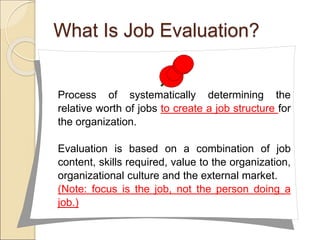
Process of systematically determining the
relative worth of jobs to create a job structure for
the organization.
Evaluation is based on a combination of job
content, skills required, value to the organization,
organizational culture and the external market.
(Note: focus is the job, not the person doing a
job.)
What Is Job Evaluation?
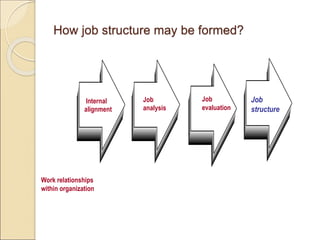
How job structure may be formed?
Internal
alignment
Job
analysis
Job
evaluation
Job
structure
Work relationships
within organization
Page 4 of 15
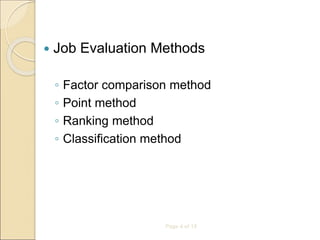
 Job Evaluation Methods
◦ Factor comparison method
◦ Point method
◦ Ranking method
◦ Classification method
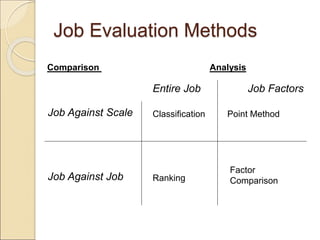
Job Evaluation Methods
Comparison Analysis
Entire Job Job Factors
Job Against Scale
Job Against Job
Classification Point Method
Ranking
Factor
Comparison
Page 6 of 15
Method Input Process Output
Factor
Comparison
Method
A set of
compensable
factors; wages
for a group of
benchmark jobs
Rank benchmark jobs on each
factor; Allocate benchmark
wages across factors; Compare
factor and wage allocation
ranks; Construct the job
comparison scale; Apply the
scale
Non-
benchmarked
Job positioned
in the job
comparison
scale
Point Method Compensation
factors
Establish factor scales and factor
weights; Calculate the weighted
sum
Job points
Ranking Method Predetermined
value or
contribution
Order the jobs from highest to
lowest according to the
predetermined value or contribution
Job ranking
Classification
Method
Jobs Create a set of job categories; Sort
jobs into categories
Jobs sorted
into categories
Job Evaluation Methods (1 of 4)
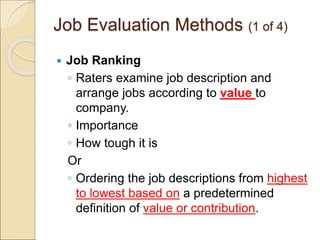
 Job Ranking
◦ Raters examine job description and
arrange jobs according to value to
company.
◦ Importance
◦ How tough it is
Or
◦ Ordering the job descriptions from highest
to lowest based on a predetermined
definition of value or contribution.
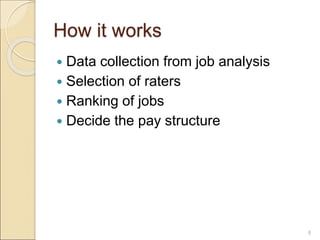
How it works
 Data collection from job analysis
 Selection of raters
 Ranking of jobs
 Decide the pay structure
8
Page 9 of 15
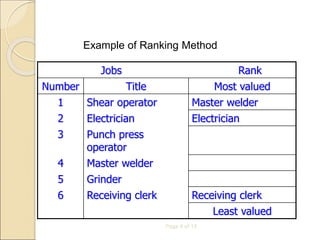
Jobs Rank
Number Title Most valued
1 Shear operator Master welder
2 Electrician Electrician
3 Punch press
operator
4 Master welder
5 Grinder
6 Receiving clerk Receiving clerk
Least valued
Example of Ranking Method
Ranking of Academic Institution
Jobs
Ranking order Pay Scale
Professors / Registrar /
Librarian
BDT 56,500 to 74,400
Readers / Deputy
Registrar / Deputy
Librarian
BDT 43,000 to 69,850
Lecturer/Asst. Registrar
/Asst. Librarian
BDT 22,000 to 53,060
10
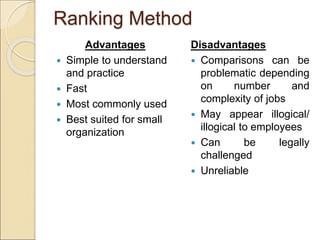
Ranking Method
Advantages
 Simple to understand
and practice
 Fast
 Most commonly used
 Best suited for small
organization
Disadvantages
 Comparisons can be
problematic depending
on number and
complexity of jobs
 May appear illogical/
illogical to employees
 Can be legally
challenged
 Unreliable
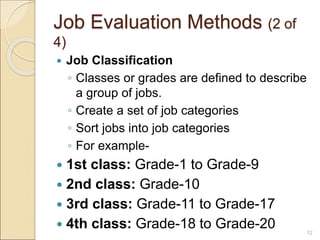
Job Evaluation Methods (2 of
4)
 Job Classification
◦ Classes or grades are defined to describe
a group of jobs.
◦ Create a set of job categories
◦ Sort jobs into job categories
◦ For example-
 1st class: Grade-1 to Grade-9
 2nd class: Grade-10
 3rd class: Grade-11 to Grade-17
 4th class: Grade-18 to Grade-20 12
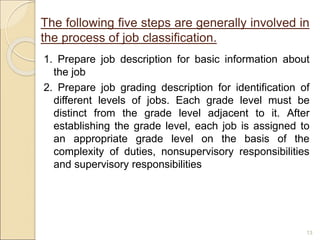
The following five steps are generally involved in
the process of job classification.
1. Prepare job description for basic information about
the job
2. Prepare job grading description for identification of
different levels of jobs. Each grade level must be
distinct from the grade level adjacent to it. After
establishing the grade level, each job is assigned to
an appropriate grade level on the basis of the
complexity of duties, nonsupervisory responsibilities
and supervisory responsibilities
13
3. Select grades and key jobs about 10 to 20 jobs, which
include all the major departments and functions and
cover all the grades
4. Grade the key jobs. Key jobs are assigned to an
appropriate grade level and their relationship to each
other studied.
5. Classify all the jobs on the basis of grade definitions.
All the jobs in the same grade receive the same wage
or range of rate. For instance, managers may be put
into one class; clerks in another; junior officers in a
higher class; and the tope executives in the top class.
14
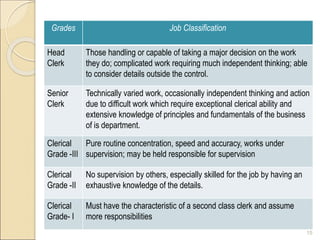
Grades Job Classification
Head
Clerk
Those handling or capable of taking a major decision on the work
they do; complicated work requiring much independent thinking; able
to consider details outside the control.
Senior
Clerk
Technically varied work, occasionally independent thinking and action
due to difficult work which require exceptional clerical ability and
extensive knowledge of principles and fundamentals of the business
of is department.
Clerical
Grade -III
Pure routine concentration, speed and accuracy, works under
supervision; may be held responsible for supervision
Clerical
Grade -II
No supervision by others, especially skilled for the job by having an
exhaustive knowledge of the details.
Clerical
Grade- I
Must have the characteristic of a second class clerk and assume
more responsibilities
15
Classification Method
Advantages
 Uses job
families/groups
instead of individual
jobs
 May produce same
results as Point
Method, but is less
costly
Disadvantages
 Not useful when
jobs are very
different from each
other
 May be confusing
to employees
about why jobs are
included in a class
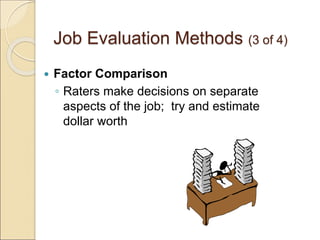
Job Evaluation Methods (3 of 4)
 Factor Comparison
◦ Raters make decisions on separate
aspects of the job; try and estimate
dollar worth
Page 18 of 15
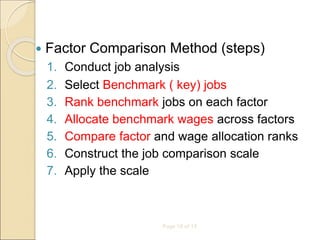
 Factor Comparison Method (steps)
1. Conduct job analysis
2. Select Benchmark ( key) jobs
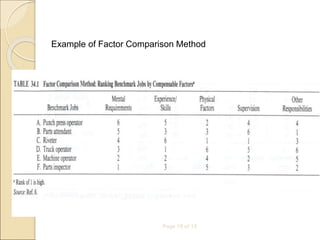
3. Rank benchmark jobs on each factor
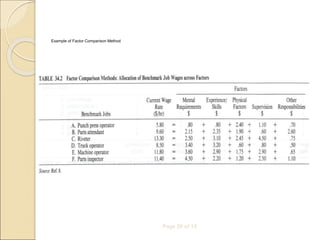
4. Allocate benchmark wages across factors
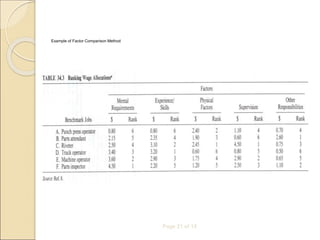
5. Compare factor and wage allocation ranks
6. Construct the job comparison scale
7. Apply the scale
Page 19 of 15
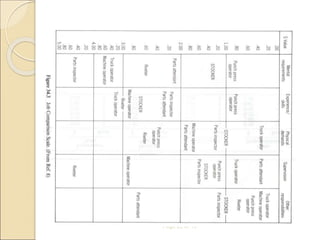
Example of Factor Comparison Method
Page 20 of 15
Example of Factor Comparison Method
Page 21 of 15
Example of Factor Comparison Method
Page 22 of 15
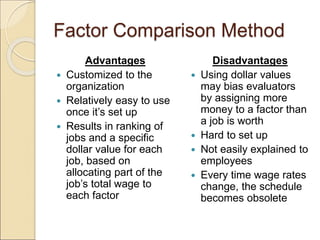
Factor Comparison Method
Advantages
 Customized to the
organization
 Relatively easy to use
once it’s set up
 Results in ranking of
jobs and a specific
dollar value for each
job, based on
allocating part of the
job’s total wage to
each factor
Disadvantages
 Using dollar values
may bias evaluators
by assigning more
money to a factor than
a job is worth
 Hard to set up
 Not easily explained to
employees
 Every time wage rates
change, the schedule
becomes obsolete
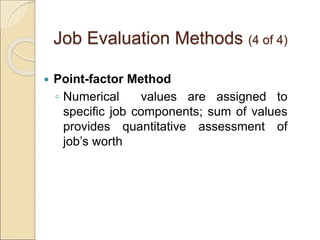
Job Evaluation Methods (4 of 4)
 Point-factor Method
◦ Numerical values are assigned to
specific job components; sum of values
provides quantitative assessment of
job’s worth
Page 25 of 15
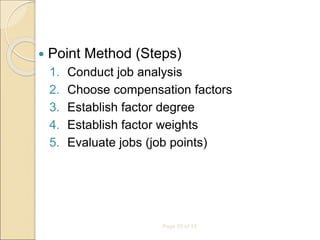
 Point Method (Steps)
1. Conduct job analysis
2. Choose compensation factors
3. Establish factor degree
4. Establish factor weights
5. Evaluate jobs (job points)
Page 26 of 15
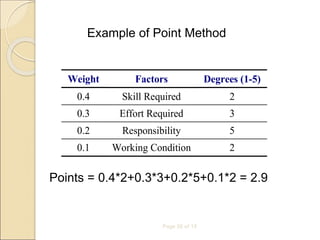
Points = 0.4*2+0.3*3+0.2*5+0.1*2 = 2.9
Weight Factors Degrees (1-5)
0.4 Skill Required 2
0.3 Effort Required 3
0.2 Responsibility 5
0.1 Working Condition 2
Example of Point Method
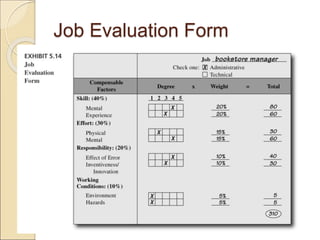
Job Evaluation Form
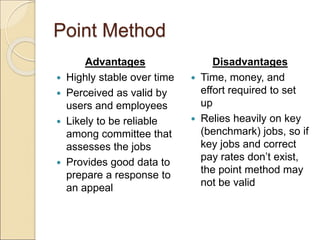
Point Method
Advantages
 Highly stable over time
 Perceived as valid by
users and employees
 Likely to be reliable
among committee that
assesses the jobs
 Provides good data to
prepare a response to
an appeal
Disadvantages
 Time, money, and
effort required to set
up
 Relies heavily on key
(benchmark) jobs, so if
key jobs and correct
pay rates don’t exist,
the point method may
not be valid
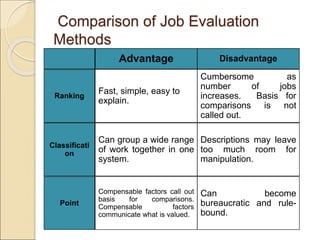
Comparison of Job Evaluation
Methods
Advantage Disadvantage
Ranking
Fast, simple, easy to
explain.
Cumbersome as
number of jobs
increases. Basis for
comparisons is not
called out.
Classificati
on
Can group a wide range
of work together in one
system.
Descriptions may leave
too much room for
manipulation.
Point
Compensable factors call out
basis for comparisons.
Compensable factors
communicate what is valued.
Can become
bureaucratic and rule-
bound.
Thanks a lot
for
attending this session
30

job evaluation methods-Ch-04.pptx

  • 1.
  • 2.
    Process of systematicallydetermining the relative worth of jobs to create a job structure for the organization. Evaluation is based on a combination of job content, skills required, value to the organization, organizational culture and the external market. (Note: focus is the job, not the person doing a job.) What Is Job Evaluation?
  • 3.
    How job structuremay be formed? Internal alignment Job analysis Job evaluation Job structure Work relationships within organization
  • 4.
    Page 4 of15  Job Evaluation Methods ◦ Factor comparison method ◦ Point method ◦ Ranking method ◦ Classification method
  • 5.
    Job Evaluation Methods ComparisonAnalysis Entire Job Job Factors Job Against Scale Job Against Job Classification Point Method Ranking Factor Comparison
  • 6.
    Page 6 of15 Method Input Process Output Factor Comparison Method A set of compensable factors; wages for a group of benchmark jobs Rank benchmark jobs on each factor; Allocate benchmark wages across factors; Compare factor and wage allocation ranks; Construct the job comparison scale; Apply the scale Non- benchmarked Job positioned in the job comparison scale Point Method Compensation factors Establish factor scales and factor weights; Calculate the weighted sum Job points Ranking Method Predetermined value or contribution Order the jobs from highest to lowest according to the predetermined value or contribution Job ranking Classification Method Jobs Create a set of job categories; Sort jobs into categories Jobs sorted into categories
  • 7.
    Job Evaluation Methods(1 of 4)  Job Ranking ◦ Raters examine job description and arrange jobs according to value to company. ◦ Importance ◦ How tough it is Or ◦ Ordering the job descriptions from highest to lowest based on a predetermined definition of value or contribution.
  • 8.
    How it works Data collection from job analysis  Selection of raters  Ranking of jobs  Decide the pay structure 8
  • 9.
    Page 9 of15 Jobs Rank Number Title Most valued 1 Shear operator Master welder 2 Electrician Electrician 3 Punch press operator 4 Master welder 5 Grinder 6 Receiving clerk Receiving clerk Least valued Example of Ranking Method
  • 10.
    Ranking of AcademicInstitution Jobs Ranking order Pay Scale Professors / Registrar / Librarian BDT 56,500 to 74,400 Readers / Deputy Registrar / Deputy Librarian BDT 43,000 to 69,850 Lecturer/Asst. Registrar /Asst. Librarian BDT 22,000 to 53,060 10
  • 11.
    Ranking Method Advantages  Simpleto understand and practice  Fast  Most commonly used  Best suited for small organization Disadvantages  Comparisons can be problematic depending on number and complexity of jobs  May appear illogical/ illogical to employees  Can be legally challenged  Unreliable
  • 12.
    Job Evaluation Methods(2 of 4)  Job Classification ◦ Classes or grades are defined to describe a group of jobs. ◦ Create a set of job categories ◦ Sort jobs into job categories ◦ For example-  1st class: Grade-1 to Grade-9  2nd class: Grade-10  3rd class: Grade-11 to Grade-17  4th class: Grade-18 to Grade-20 12
  • 13.
    The following fivesteps are generally involved in the process of job classification. 1. Prepare job description for basic information about the job 2. Prepare job grading description for identification of different levels of jobs. Each grade level must be distinct from the grade level adjacent to it. After establishing the grade level, each job is assigned to an appropriate grade level on the basis of the complexity of duties, nonsupervisory responsibilities and supervisory responsibilities 13
  • 14.
    3. Select gradesand key jobs about 10 to 20 jobs, which include all the major departments and functions and cover all the grades 4. Grade the key jobs. Key jobs are assigned to an appropriate grade level and their relationship to each other studied. 5. Classify all the jobs on the basis of grade definitions. All the jobs in the same grade receive the same wage or range of rate. For instance, managers may be put into one class; clerks in another; junior officers in a higher class; and the tope executives in the top class. 14
  • 15.
    Grades Job Classification Head Clerk Thosehandling or capable of taking a major decision on the work they do; complicated work requiring much independent thinking; able to consider details outside the control. Senior Clerk Technically varied work, occasionally independent thinking and action due to difficult work which require exceptional clerical ability and extensive knowledge of principles and fundamentals of the business of is department. Clerical Grade -III Pure routine concentration, speed and accuracy, works under supervision; may be held responsible for supervision Clerical Grade -II No supervision by others, especially skilled for the job by having an exhaustive knowledge of the details. Clerical Grade- I Must have the characteristic of a second class clerk and assume more responsibilities 15
  • 16.
    Classification Method Advantages  Usesjob families/groups instead of individual jobs  May produce same results as Point Method, but is less costly Disadvantages  Not useful when jobs are very different from each other  May be confusing to employees about why jobs are included in a class
  • 17.
    Job Evaluation Methods(3 of 4)  Factor Comparison ◦ Raters make decisions on separate aspects of the job; try and estimate dollar worth
  • 18.
    Page 18 of15  Factor Comparison Method (steps) 1. Conduct job analysis 2. Select Benchmark ( key) jobs 3. Rank benchmark jobs on each factor 4. Allocate benchmark wages across factors 5. Compare factor and wage allocation ranks 6. Construct the job comparison scale 7. Apply the scale
  • 19.
    Page 19 of15 Example of Factor Comparison Method
  • 20.
    Page 20 of15 Example of Factor Comparison Method
  • 21.
    Page 21 of15 Example of Factor Comparison Method
  • 22.
  • 23.
    Factor Comparison Method Advantages Customized to the organization  Relatively easy to use once it’s set up  Results in ranking of jobs and a specific dollar value for each job, based on allocating part of the job’s total wage to each factor Disadvantages  Using dollar values may bias evaluators by assigning more money to a factor than a job is worth  Hard to set up  Not easily explained to employees  Every time wage rates change, the schedule becomes obsolete
  • 24.
    Job Evaluation Methods(4 of 4)  Point-factor Method ◦ Numerical values are assigned to specific job components; sum of values provides quantitative assessment of job’s worth
  • 25.
    Page 25 of15  Point Method (Steps) 1. Conduct job analysis 2. Choose compensation factors 3. Establish factor degree 4. Establish factor weights 5. Evaluate jobs (job points)
  • 26.
    Page 26 of15 Points = 0.4*2+0.3*3+0.2*5+0.1*2 = 2.9 Weight Factors Degrees (1-5) 0.4 Skill Required 2 0.3 Effort Required 3 0.2 Responsibility 5 0.1 Working Condition 2 Example of Point Method
  • 27.
  • 28.
    Point Method Advantages  Highlystable over time  Perceived as valid by users and employees  Likely to be reliable among committee that assesses the jobs  Provides good data to prepare a response to an appeal Disadvantages  Time, money, and effort required to set up  Relies heavily on key (benchmark) jobs, so if key jobs and correct pay rates don’t exist, the point method may not be valid
  • 29.
    Comparison of JobEvaluation Methods Advantage Disadvantage Ranking Fast, simple, easy to explain. Cumbersome as number of jobs increases. Basis for comparisons is not called out. Classificati on Can group a wide range of work together in one system. Descriptions may leave too much room for manipulation. Point Compensable factors call out basis for comparisons. Compensable factors communicate what is valued. Can become bureaucratic and rule- bound.
  • 30.