JOB EVALUATION
Ms. Harmanpreet Kaur
Assistant Professor
Department of Commerce
Shivaji College
BASIC CONCEPTS
• For good industrial relations, each employee should
i. Receive sufficient wages or salaries to sustain himself and his dependents
ii. Feel satisfied with the relationship between his wages and the wages of other people
performing the same type of work in some other organization
• Primary objective of wage and salary administration program is that each employee
should be equitably compensated for the services rendered by him to the enterprise
on the basis of:
i. Nature of job
ii. Present worth of that type of job
iii. Effectiveness with which individual performs the job
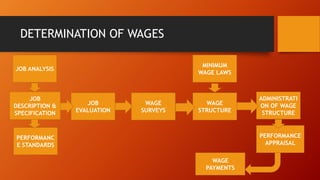
DETERMINATION OF WAGES
JOB ANALYSIS
JOB
DESCRIPTION &
SPECIFICATION
PERFORMANC
E STANDARDS
PERFORMANCE
APPRAISAL
ADMINISTRATI
ON OF WAGE
STRUCTURE
WAGE
STRUCTURE
WAGE
SURVEYS
JOB
EVALUATION
WAGE
PAYMENTS
MINIMUM
WAGE LAWS
CONCEPT OF JOB EVALUATION
• In simple worlds, job evaluation is the rating of jobs in an organization. This is
the process establishing the value or worth of jobs in a job hierarchy and
compares the relative intrinsic value or worth of jobs within an organization.
• Formal system of determining the base compensation of jobs.
• According to the International Labour Organization (ILO), “job evaluation is
an attempt to determine and compare the demands which the normal
performance of a particular job makes on normal workers, without taking into
account the individual abilities or performance of the workers concerned”.
CONCEPT OF JOB EVALUATION
• The British Institute of Management defines “job evaluation as the process of
analysis and assessment of jobs to ascertain reliably their relative worth using
the assessment as the basis for a balanced wages structure”.
• Edwin B.Flippo defines job evaluation as “a systematic and orderly process of
determining the worth of a job in relation to other jobs”.
OBJECTIVES OF JOB EVALUATION
• equitable wage for a job and reasonable wage differentials between different jobs
in a hierarchical organization
• Consistent wage policy
• Eliminate wage inequalities
• Rational basis for incentive and bonus schemes
• Framework for periodic review and revision of wage rates
• Reduce grievances and labour turnover
• Basis for wage negotiations with employee union
• Guage and control payroll costs
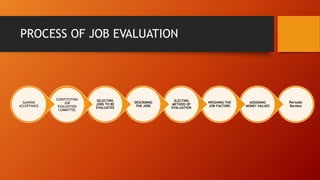
PROCESS OF JOB EVALUATION
Periodic
Review
ASSIGNING
MONEY VALUES
WEIGHING THE
JOB FACTORS
SLECTING
METHOD OF
EVALUATION
DESCRIBING
THE JOBS
SELECTING
JOBS TO BE
EVALUATED
CONSTITUTING
JOB
EVALUATION
COMMITTEE
GAINING
ACCEPTANCE
PRINCIPLES OF JOB EVALUATION
• Consideration of Job
• Clarity of Job Information
• Pooling of knowledge
• Grouping of Jobs
• ADVANTAGES • LIMITATIONS
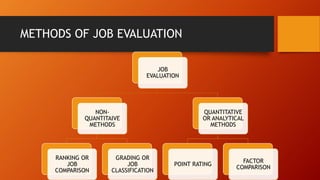
METHODS OF JOB EVALUATION
JOB
EVALUATION
NON-
QUANTITAIVE
METHODS
RANKING OR
JOB
COMPARISON
GRADING OR
JOB
CLASSIFICATION
QUANTITATIVE
OR ANALYTICAL
METHODS
POINT RATING
FACTOR
COMPARISON
RANKING METHOD
• Simplest method
• List the jobs in order from highest to lowest worth to the company
• Jobs are not split up into component parts
• Comparison is made on the basis of whole jobs
RANKING METHOD - TECHNIQUES
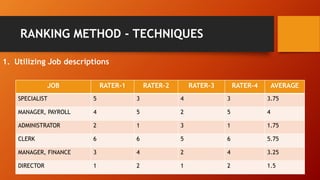
1. Utilizing Job descriptions
• Evaluating and analyzing Job descriptions
• Differences in jobs are noted with respect to duties, skills, responsibilities etc.
• Each job is ranked as per its relative significance
• Each rater ranks the job independently
• Final rank is calculated on the basis of majority vote or average
RANKING METHOD - TECHNIQUES
1. Utilizing Job descriptions
JOB RATER-1 RATER-2 RATER-3 RATER-4 AVERAGE
SPECIALIST 5 3 4 3 3.75
MANAGER, PAYROLL 4 5 2 5 4
ADMINISTRATOR 2 1 3 1 1.75
CLERK 6 6 5 6 5.75
MANAGER, FINANCE 3 4 2 4 3.25
DIRECTOR 1 2 1 2 1.5
RANKING METHOD - TECHNIQUES
1. Utilizing Job descriptions
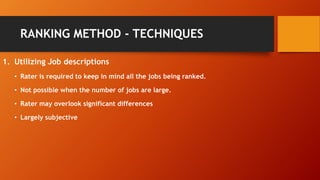
• Rater is required to keep in mind all the jobs being ranked.
• Not possible when the number of jobs are large.
• Rater may overlook significant differences
• Largely subjective
RANKING METHOD - TECHNIQUES
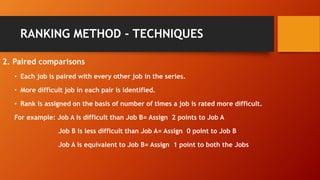
2. Paired comparisons
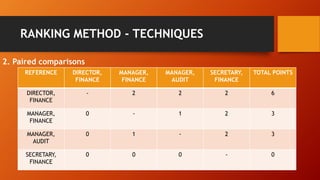
• Each job is paired with every other job in the series.
• More difficult job in each pair is identified.
• Rank is assigned on the basis of number of times a job is rated more difficult.
For example: Job A is difficult than Job B= Assign 2 points to Job A
Job B is less difficult than Job A= Assign 0 point to Job B
Job A is equivalent to Job B= Assign 1 point to both the Jobs
RANKING METHOD - TECHNIQUES
2. Paired comparisons
REFERENCE DIRECTOR,
FINANCE
MANAGER,
FINANCE
MANAGER,
AUDIT
SECRETARY,
FINANCE
TOTAL POINTS
DIRECTOR,
FINANCE
- 2 2 2 6
MANAGER,
FINANCE
0 - 1 2 3
MANAGER,
AUDIT
0 1 - 2 3
SECRETARY,
FINANCE
0 0 0 - 0
RANKING METHOD - TECHNIQUES
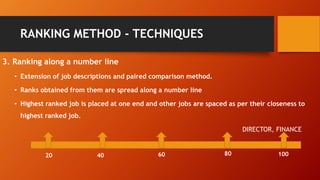
3. Ranking along a number line
• Extension of job descriptions and paired comparison method.
• Ranks obtained from them are spread along a number line
• Highest ranked job is placed at one end and other jobs are spaced as per their closeness to
highest ranked job.
DIRECTOR, FINANCE
20 80
60
40 100
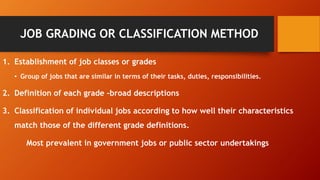
JOB GRADING OR CLASSIFICATION METHOD
1. Establishment of job classes or grades
• Group of jobs that are similar in terms of their tasks, duties, responsibilities.
2. Definition of each grade –broad descriptions
3. Classification of individual jobs according to how well their characteristics
match those of the different grade definitions.
Most prevalent in government jobs or public sector undertakings
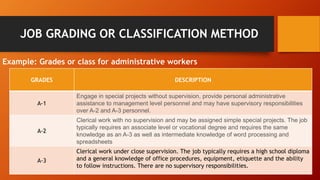
JOB GRADING OR CLASSIFICATION METHOD
Example: Grades or class for administrative workers
GRADES DESCRIPTION
A-1
Engage in special projects without supervision, provide personal administrative
assistance to management level personnel and may have supervisory responsibilities
over A-2 and A-3 personnel.
A-2
Clerical work with no supervision and may be assigned simple special projects. The job
typically requires an associate level or vocational degree and requires the same
knowledge as an A-3 as well as intermediate knowledge of word processing and
spreadsheets
A-3
Clerical work under close supervision. The job typically requires a high school diploma
and a general knowledge of office procedures, equipment, etiquette and the ability
to follow instructions. There are no supervisory responsibilities.
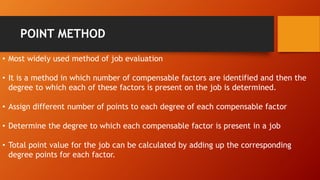
POINT METHOD
• Most widely used method of job evaluation
• It is a method in which number of compensable factors are identified and then the
degree to which each of these factors is present on the job is determined.
• Assign different number of points to each degree of each compensable factor
• Determine the degree to which each compensable factor is present in a job
• Total point value for the job can be calculated by adding up the corresponding
degree points for each factor.
POINT METHOD- STEPS
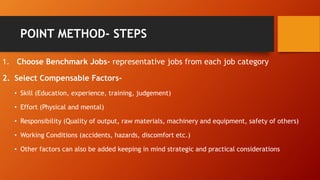
1. Choose Benchmark Jobs- representative jobs from each job category
2. Select Compensable Factors-
• Skill (Education, experience, training, judgement)
• Effort (Physical and mental)
• Responsibility (Quality of output, raw materials, machinery and equipment, safety of others)
• Working Conditions (accidents, hazards, discomfort etc.)
• Other factors can also be added keeping in mind strategic and practical considerations
POINT METHOD- STEPS
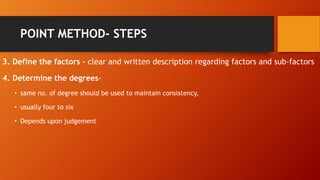
3. Define the factors – clear and written description regarding factors and sub-factors
4. Determine the degrees-
• same no. of degree should be used to maintain consistency,
• usually four to six
• Depends upon judgement
POINT METHOD- STEPS
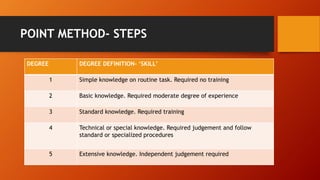
DEGREE DEGREE DEFINITION- ‘SKILL’
1 Simple knowledge on routine task. Required no training
2 Basic knowledge. Required moderate degree of experience
3 Standard knowledge. Required training
4 Technical or special knowledge. Required judgement and follow
standard or specialized procedures
5 Extensive knowledge. Independent judgement required
POINT METHOD- STEPS
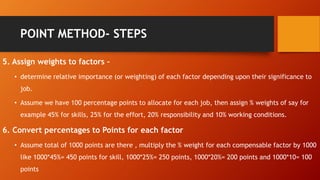
5. Assign weights to factors –
• determine relative importance (or weighting) of each factor depending upon their significance to
job.
• Assume we have 100 percentage points to allocate for each job, then assign % weights of say for
example 45% for skills, 25% for the effort, 20% responsibility and 10% working conditions.
6. Convert percentages to Points for each factor
• Assume total of 1000 points are there , multiply the % weight for each compensable factor by 1000
like 1000*45%= 450 points for skill, 1000*25%= 250 points, 1000*20%= 200 points and 1000*10= 100
points
POINT METHOD- STEPS
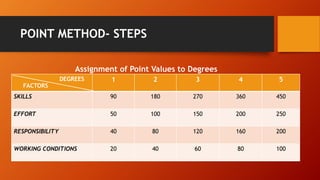
7. Assign point value to Degrees- assign point values to each degree of each
compensable factor
For example we have 5 possible degrees of skill and skill factor have 450 points
maximum. Point values may be decided on the basis of arithmetic progression.
POINT METHOD- STEPS
1 2 3 4 5
SKILLS 90 180 270 360 450
EFFORT 50 100 150 200 250
RESPONSIBILITY 40 80 120 160 200
WORKING CONDITIONS 20 40 60 80 100
FACTORS
DEGREES
Assignment of Point Values to Degrees
POINT METHOD- STEPS
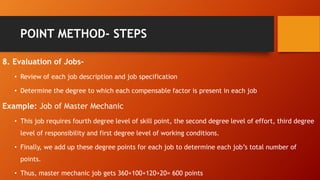
8. Evaluation of Jobs-
• Review of each job description and job specification
• Determine the degree to which each compensable factor is present in each job
Example: Job of Master Mechanic
• This job requires fourth degree level of skill point, the second degree level of effort, third degree
level of responsibility and first degree level of working conditions.
• Finally, we add up these degree points for each job to determine each job’s total number of
points.
• Thus, master mechanic job gets 360+100+120+20= 600 points
POINT METHOD- STEPS
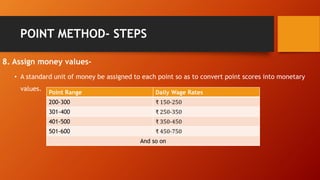
8. Assign money values-
• A standard unit of money be assigned to each point so as to convert point scores into monetary
values.
Point Range Daily Wage Rates
200-300 ₹ 150-250
301-400 ₹ 250-350
401-500 ₹ 350-450
501-600 ₹ 450-750
And so on
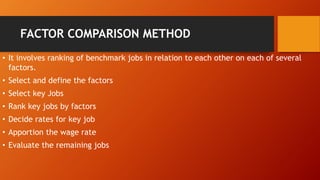
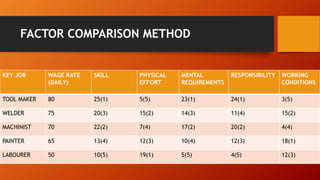
FACTOR COMPARISON METHOD
• It involves ranking of benchmark jobs in relation to each other on each of several
factors.
• Select and define the factors
• Select key Jobs
• Rank key jobs by factors
• Decide rates for key job
• Apportion the wage rate
• Evaluate the remaining jobs
FACTOR COMPARISON METHOD
KEY JOB WAGE RATE
(DAILY)
SKILL PHYSICAL
EFFORT
MENTAL
REQUIREMENTS
RESPONSIBILITY WORKING
CONDITIONS
TOOL MAKER 80 25(1) 5(5) 23(1) 24(1) 3(5)
WELDER 75 20(3) 15(2) 14(3) 11(4) 15(2)
MACHINIST 70 22(2) 7(4) 17(2) 20(2) 4(4)
PAINTER 65 13(4) 12(3) 10(4) 12(3) 18(1)
LABOURER 50 10(5) 19(1) 5(5) 4(5) 12(3)

job Analysis project report in Human Resource

  • 1.
    JOB EVALUATION Ms. HarmanpreetKaur Assistant Professor Department of Commerce Shivaji College
  • 2.
    BASIC CONCEPTS • Forgood industrial relations, each employee should i. Receive sufficient wages or salaries to sustain himself and his dependents ii. Feel satisfied with the relationship between his wages and the wages of other people performing the same type of work in some other organization • Primary objective of wage and salary administration program is that each employee should be equitably compensated for the services rendered by him to the enterprise on the basis of: i. Nature of job ii. Present worth of that type of job iii. Effectiveness with which individual performs the job
  • 3.
    DETERMINATION OF WAGES JOBANALYSIS JOB DESCRIPTION & SPECIFICATION PERFORMANC E STANDARDS PERFORMANCE APPRAISAL ADMINISTRATI ON OF WAGE STRUCTURE WAGE STRUCTURE WAGE SURVEYS JOB EVALUATION WAGE PAYMENTS MINIMUM WAGE LAWS
  • 4.
    CONCEPT OF JOBEVALUATION • In simple worlds, job evaluation is the rating of jobs in an organization. This is the process establishing the value or worth of jobs in a job hierarchy and compares the relative intrinsic value or worth of jobs within an organization. • Formal system of determining the base compensation of jobs. • According to the International Labour Organization (ILO), “job evaluation is an attempt to determine and compare the demands which the normal performance of a particular job makes on normal workers, without taking into account the individual abilities or performance of the workers concerned”.
  • 5.
    CONCEPT OF JOBEVALUATION • The British Institute of Management defines “job evaluation as the process of analysis and assessment of jobs to ascertain reliably their relative worth using the assessment as the basis for a balanced wages structure”. • Edwin B.Flippo defines job evaluation as “a systematic and orderly process of determining the worth of a job in relation to other jobs”.
  • 6.
    OBJECTIVES OF JOBEVALUATION • equitable wage for a job and reasonable wage differentials between different jobs in a hierarchical organization • Consistent wage policy • Eliminate wage inequalities • Rational basis for incentive and bonus schemes • Framework for periodic review and revision of wage rates • Reduce grievances and labour turnover • Basis for wage negotiations with employee union • Guage and control payroll costs
  • 7.
    PROCESS OF JOBEVALUATION Periodic Review ASSIGNING MONEY VALUES WEIGHING THE JOB FACTORS SLECTING METHOD OF EVALUATION DESCRIBING THE JOBS SELECTING JOBS TO BE EVALUATED CONSTITUTING JOB EVALUATION COMMITTEE GAINING ACCEPTANCE
  • 8.
    PRINCIPLES OF JOBEVALUATION • Consideration of Job • Clarity of Job Information • Pooling of knowledge • Grouping of Jobs
  • 9.
    • ADVANTAGES •LIMITATIONS
  • 10.
    METHODS OF JOBEVALUATION JOB EVALUATION NON- QUANTITAIVE METHODS RANKING OR JOB COMPARISON GRADING OR JOB CLASSIFICATION QUANTITATIVE OR ANALYTICAL METHODS POINT RATING FACTOR COMPARISON
  • 11.
    RANKING METHOD • Simplestmethod • List the jobs in order from highest to lowest worth to the company • Jobs are not split up into component parts • Comparison is made on the basis of whole jobs
  • 12.
    RANKING METHOD -TECHNIQUES 1. Utilizing Job descriptions • Evaluating and analyzing Job descriptions • Differences in jobs are noted with respect to duties, skills, responsibilities etc. • Each job is ranked as per its relative significance • Each rater ranks the job independently • Final rank is calculated on the basis of majority vote or average
  • 13.
    RANKING METHOD -TECHNIQUES 1. Utilizing Job descriptions JOB RATER-1 RATER-2 RATER-3 RATER-4 AVERAGE SPECIALIST 5 3 4 3 3.75 MANAGER, PAYROLL 4 5 2 5 4 ADMINISTRATOR 2 1 3 1 1.75 CLERK 6 6 5 6 5.75 MANAGER, FINANCE 3 4 2 4 3.25 DIRECTOR 1 2 1 2 1.5
  • 14.
    RANKING METHOD -TECHNIQUES 1. Utilizing Job descriptions • Rater is required to keep in mind all the jobs being ranked. • Not possible when the number of jobs are large. • Rater may overlook significant differences • Largely subjective
  • 15.
    RANKING METHOD -TECHNIQUES 2. Paired comparisons • Each job is paired with every other job in the series. • More difficult job in each pair is identified. • Rank is assigned on the basis of number of times a job is rated more difficult. For example: Job A is difficult than Job B= Assign 2 points to Job A Job B is less difficult than Job A= Assign 0 point to Job B Job A is equivalent to Job B= Assign 1 point to both the Jobs
  • 16.
    RANKING METHOD -TECHNIQUES 2. Paired comparisons REFERENCE DIRECTOR, FINANCE MANAGER, FINANCE MANAGER, AUDIT SECRETARY, FINANCE TOTAL POINTS DIRECTOR, FINANCE - 2 2 2 6 MANAGER, FINANCE 0 - 1 2 3 MANAGER, AUDIT 0 1 - 2 3 SECRETARY, FINANCE 0 0 0 - 0
  • 17.
    RANKING METHOD -TECHNIQUES 3. Ranking along a number line • Extension of job descriptions and paired comparison method. • Ranks obtained from them are spread along a number line • Highest ranked job is placed at one end and other jobs are spaced as per their closeness to highest ranked job. DIRECTOR, FINANCE 20 80 60 40 100
  • 18.
    JOB GRADING ORCLASSIFICATION METHOD 1. Establishment of job classes or grades • Group of jobs that are similar in terms of their tasks, duties, responsibilities. 2. Definition of each grade –broad descriptions 3. Classification of individual jobs according to how well their characteristics match those of the different grade definitions. Most prevalent in government jobs or public sector undertakings
  • 19.
    JOB GRADING ORCLASSIFICATION METHOD Example: Grades or class for administrative workers GRADES DESCRIPTION A-1 Engage in special projects without supervision, provide personal administrative assistance to management level personnel and may have supervisory responsibilities over A-2 and A-3 personnel. A-2 Clerical work with no supervision and may be assigned simple special projects. The job typically requires an associate level or vocational degree and requires the same knowledge as an A-3 as well as intermediate knowledge of word processing and spreadsheets A-3 Clerical work under close supervision. The job typically requires a high school diploma and a general knowledge of office procedures, equipment, etiquette and the ability to follow instructions. There are no supervisory responsibilities.
  • 20.
    POINT METHOD • Mostwidely used method of job evaluation • It is a method in which number of compensable factors are identified and then the degree to which each of these factors is present on the job is determined. • Assign different number of points to each degree of each compensable factor • Determine the degree to which each compensable factor is present in a job • Total point value for the job can be calculated by adding up the corresponding degree points for each factor.
  • 21.
    POINT METHOD- STEPS 1.Choose Benchmark Jobs- representative jobs from each job category 2. Select Compensable Factors- • Skill (Education, experience, training, judgement) • Effort (Physical and mental) • Responsibility (Quality of output, raw materials, machinery and equipment, safety of others) • Working Conditions (accidents, hazards, discomfort etc.) • Other factors can also be added keeping in mind strategic and practical considerations
  • 22.
    POINT METHOD- STEPS 3.Define the factors – clear and written description regarding factors and sub-factors 4. Determine the degrees- • same no. of degree should be used to maintain consistency, • usually four to six • Depends upon judgement
  • 23.
    POINT METHOD- STEPS DEGREEDEGREE DEFINITION- ‘SKILL’ 1 Simple knowledge on routine task. Required no training 2 Basic knowledge. Required moderate degree of experience 3 Standard knowledge. Required training 4 Technical or special knowledge. Required judgement and follow standard or specialized procedures 5 Extensive knowledge. Independent judgement required
  • 24.
    POINT METHOD- STEPS 5.Assign weights to factors – • determine relative importance (or weighting) of each factor depending upon their significance to job. • Assume we have 100 percentage points to allocate for each job, then assign % weights of say for example 45% for skills, 25% for the effort, 20% responsibility and 10% working conditions. 6. Convert percentages to Points for each factor • Assume total of 1000 points are there , multiply the % weight for each compensable factor by 1000 like 1000*45%= 450 points for skill, 1000*25%= 250 points, 1000*20%= 200 points and 1000*10= 100 points
  • 25.
    POINT METHOD- STEPS 7.Assign point value to Degrees- assign point values to each degree of each compensable factor For example we have 5 possible degrees of skill and skill factor have 450 points maximum. Point values may be decided on the basis of arithmetic progression.
  • 26.
    POINT METHOD- STEPS 12 3 4 5 SKILLS 90 180 270 360 450 EFFORT 50 100 150 200 250 RESPONSIBILITY 40 80 120 160 200 WORKING CONDITIONS 20 40 60 80 100 FACTORS DEGREES Assignment of Point Values to Degrees
  • 27.
    POINT METHOD- STEPS 8.Evaluation of Jobs- • Review of each job description and job specification • Determine the degree to which each compensable factor is present in each job Example: Job of Master Mechanic • This job requires fourth degree level of skill point, the second degree level of effort, third degree level of responsibility and first degree level of working conditions. • Finally, we add up these degree points for each job to determine each job’s total number of points. • Thus, master mechanic job gets 360+100+120+20= 600 points
  • 28.
    POINT METHOD- STEPS 8.Assign money values- • A standard unit of money be assigned to each point so as to convert point scores into monetary values. Point Range Daily Wage Rates 200-300 ₹ 150-250 301-400 ₹ 250-350 401-500 ₹ 350-450 501-600 ₹ 450-750 And so on
  • 29.
    FACTOR COMPARISON METHOD •It involves ranking of benchmark jobs in relation to each other on each of several factors. • Select and define the factors • Select key Jobs • Rank key jobs by factors • Decide rates for key job • Apportion the wage rate • Evaluate the remaining jobs
  • 30.
    FACTOR COMPARISON METHOD KEYJOB WAGE RATE (DAILY) SKILL PHYSICAL EFFORT MENTAL REQUIREMENTS RESPONSIBILITY WORKING CONDITIONS TOOL MAKER 80 25(1) 5(5) 23(1) 24(1) 3(5) WELDER 75 20(3) 15(2) 14(3) 11(4) 15(2) MACHINIST 70 22(2) 7(4) 17(2) 20(2) 4(4) PAINTER 65 13(4) 12(3) 10(4) 12(3) 18(1) LABOURER 50 10(5) 19(1) 5(5) 4(5) 12(3)