Topic: Lymph Node Impression Smear Cytology
By: Dr Zaid Wani
Introduction
• Useful tool to identify the underlying cause of
lymphadenopathy.
• Used as a diagnostic technique.
• Helps in distinguishing between Hyperplasia, Lymphoma,
Lymphadenitis, infectious agents, reactive nodes and
metastatic neoplasm.
• Enlargement of any lymph node is indication for
cytological examination.
Technique
• Collect a lymph node.
• Immediate examination is preferred , with accurate
results or it can be stored in refrigerator under suitable
temperature and examined when necessary.
• If taken from refrigerator, Thawing is done first.
• Make a cut section of the lymph node .
• Take a clean slide and touch it over the cut section of the
lymph node, forming a smear.
• Let the smear dry.
Staining
• Cover the slide with Leishman Giemsa stain.
• Keep it for 2 minutes.
• Double dilute with equal amount of water .
• Gently blow air over the slide to mix the stain and water.
• Keep for 20 minutes .
• Wash the slide under running tap water.
• Examine under high power microscope for cytology.
Cells derived from Lymph
Nodes
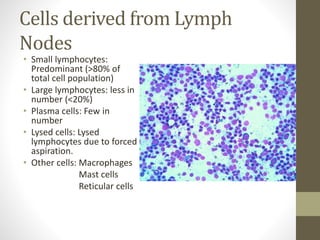
• Small lymphocytes:
Predominant (>80% of
total cell population)
• Large lymphocytes: less in
number (<20%)
• Plasma cells: Few in
number
• Lysed cells: Lysed
lymphocytes due to forced
aspiration.
• Other cells: Macrophages
Mast cells
Reticular cells
Disease Conditions Affecting
Lymph Nodes
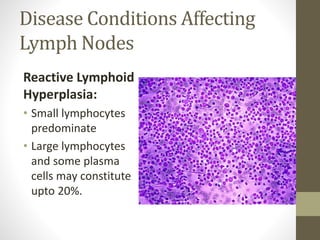
Reactive Lymphoid
Hyperplasia:
• Small lymphocytes
predominate
• Large lymphocytes
and some plasma
cells may constitute
upto 20%.
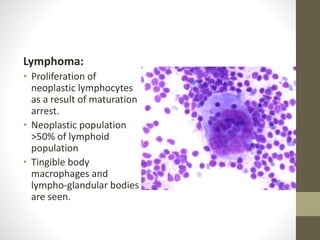
Lymphoma:
• Proliferation of
neoplastic lymphocytes
as a result of maturation
arrest.
• Neoplastic population
>50% of lymphoid
population
• Tingible body
macrophages and
lympho-glandular bodies
are seen.
Lymphadenitis:
• Increased number of
leukocytes
(Neutrophils)
• Characterized by
predominant
inflammatory cell type
• Types:
Suppurative
Granulomatous
Eosinophillic
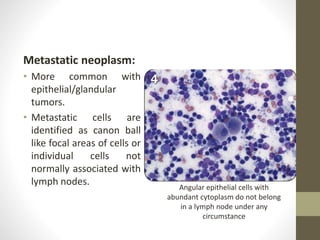
Metastatic neoplasm:
• More common with
epithelial/glandular
tumors.
• Metastatic cells are
identified as canon ball
like focal areas of cells or
individual cells not
normally associated with
lymph nodes. Angular epithelial cells with
abundant cytoplasm do not belong
in a lymph node under any
circumstance
Inference
Sample Species Age (years) Place Result
Mesenteric
Lymph Node Goat
1 Pondicherry
Normal: No
immature or
inflammatory
cells were
observed.
4 Hyderabad
2 Pondicherry
2 Pondicherry
1 Pondicherry
THANK YOU

Lymph Node Impression smear cytology

  • 1.
    Topic: Lymph NodeImpression Smear Cytology By: Dr Zaid Wani
  • 2.
    Introduction • Useful toolto identify the underlying cause of lymphadenopathy. • Used as a diagnostic technique. • Helps in distinguishing between Hyperplasia, Lymphoma, Lymphadenitis, infectious agents, reactive nodes and metastatic neoplasm. • Enlargement of any lymph node is indication for cytological examination.
  • 3.
    Technique • Collect alymph node. • Immediate examination is preferred , with accurate results or it can be stored in refrigerator under suitable temperature and examined when necessary. • If taken from refrigerator, Thawing is done first. • Make a cut section of the lymph node . • Take a clean slide and touch it over the cut section of the lymph node, forming a smear. • Let the smear dry.
  • 4.
    Staining • Cover theslide with Leishman Giemsa stain. • Keep it for 2 minutes. • Double dilute with equal amount of water . • Gently blow air over the slide to mix the stain and water. • Keep for 20 minutes . • Wash the slide under running tap water. • Examine under high power microscope for cytology.
  • 5.
    Cells derived fromLymph Nodes • Small lymphocytes: Predominant (>80% of total cell population) • Large lymphocytes: less in number (<20%) • Plasma cells: Few in number • Lysed cells: Lysed lymphocytes due to forced aspiration. • Other cells: Macrophages Mast cells Reticular cells
  • 6.
    Disease Conditions Affecting LymphNodes Reactive Lymphoid Hyperplasia: • Small lymphocytes predominate • Large lymphocytes and some plasma cells may constitute upto 20%.
  • 7.
    Lymphoma: • Proliferation of neoplasticlymphocytes as a result of maturation arrest. • Neoplastic population >50% of lymphoid population • Tingible body macrophages and lympho-glandular bodies are seen.
  • 8.
    Lymphadenitis: • Increased numberof leukocytes (Neutrophils) • Characterized by predominant inflammatory cell type • Types: Suppurative Granulomatous Eosinophillic
  • 9.
    Metastatic neoplasm: • Morecommon with epithelial/glandular tumors. • Metastatic cells are identified as canon ball like focal areas of cells or individual cells not normally associated with lymph nodes. Angular epithelial cells with abundant cytoplasm do not belong in a lymph node under any circumstance
  • 10.
    Inference Sample Species Age(years) Place Result Mesenteric Lymph Node Goat 1 Pondicherry Normal: No immature or inflammatory cells were observed. 4 Hyderabad 2 Pondicherry 2 Pondicherry 1 Pondicherry
  • 11.