LYMPH NODE PATHOLOGY
Dr. Sonia. J
Junior Resident
Department Of
Pathology
KMCT Medical College
CHAPTER OUTLINE
• Structure of lymph node
• Lymphadenopathy
• Lymphadenitis
• Lymphoid neoplasms
• Non-Hodgkin lymphoma
• Hodgkin lymphoma
• Metastatic carcinoma
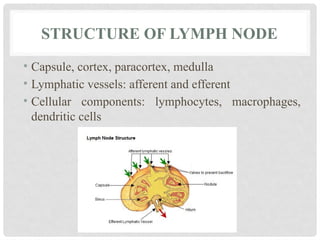
STRUCTURE OF LYMPH NODE
• Capsule, cortex, paracortex, medulla
• Lymphatic vessels: afferent and efferent
• Cellular components: lymphocytes, macrophages,
dendritic cells
CAUSES
• Infectious causes
• Bacterial: Tuberculosis, staphylococcal infections
• Viral: Epstein-Barr virus (EBV), HIV, Cytomegalovirus (CMV)
• Fungal or parasitic infections (e.g., histoplasmosis)
• Malignancies
• Primary lymphoid neoplasms: e.g., lymphoma (Hodgkin or Non-Hodgkin)
• Secondary (metastatic) carcinomas: from breast, lung, gastrointestinal tract, etc.
• Immune or autoimmune disorders
• Rheumatoid arthritis
• Systemic lupus erythematosus (SLE)
• Sarcoidosis
• Miscellaneous
• Drug reactions (e.g., phenytoin)
• Storage diseases
TYPES
1) Localized lymphadenopathy
• Involvement of a single group of lymph nodes.
• Often due to local infections (e.g., bacterial
infection in throat → cervical nodes).
2) Generalized lymphadenopathy
• Involvement of two or more non-contiguous
regions.
• Suggestive of systemic diseases such as viral
infections, autoimmune conditions, or
malignancies.
CLINICAL SIGNIFICANCE
• Important diagnostic clue in many conditions.
• Size, consistency, tenderness, fixation, and mobility
help in clinical assessment:
• Soft, tender, mobile → more likely infectious.
• Firm, rubbery, non-tender → suggestive of
lymphoma.
• Hard, fixed → often indicates metastatic cancer.
• May require biopsy or fine-needle aspiration (FNA)
for definitive diagnosis.
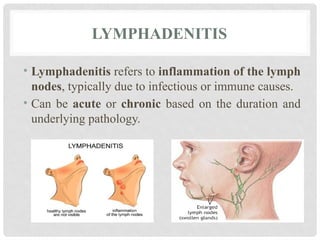
LYMPHADENITIS
• Lymphadenitis refers to inflammation of the lymph
nodes, typically due to infectious or immune causes.
• Can be acute or chronic based on the duration and
underlying pathology.
TYPES
1) Acute Lymphadenitis
• Etiology: Most commonly bacterial infections.
• Clinical Features:
• Sudden onset
• Painful, tender, and enlarged lymph nodes
• Skin over node may be red and warm
• May be associated with fever and systemic symptoms
• Examples:
• Streptococcal or staphylococcal infections in tonsils, skin,
or wounds
2) Chronic Lymphadenitis
• Develops over weeks to months
• Less tender, firmer lymph nodes
• Common causes:
• Tuberculosis: caseating granulomas
• Cat-scratch disease: Bartonella henselae →
suppurative granulomas
• Fungal infections
• Toxoplasmosis
HISTOLOGICAL FEATURES
• Acute:
• Neutrophilic infiltration
• Follicular hyperplasia
• Edema and sinus dilation
• May show abscess formation
• Chronic:
• Granulomatous inflammation (e.g., TB: caseating
granulomas)
• Follicular hyperplasia (e.g., in viral infections)
• Paracortical hyperplasia (e.g., in immune responses)
• Sinus histiocytosis: prominent histiocytes in medullary
sinuses
LYMPHOID NEOPLASMS
• Lymphoid neoplasms are malignant proliferations
of lymphoid cells.
• They originate from clonal expansion of B cells, T
cells, or natural killer (NK) cells at various stages of
differentiation.
CLASSIFICATION
ymphoid neoplasms are broadly classified into:
• Non-Hodgkin Lymphoma (NHL)
• Diverse group of lymphomas involving B or T cells
• Variable behavior: indolent to highly aggressive
• Hodgkin Lymphoma (HL)
• Characterized by Reed–Sternberg cells
• Typically involves contiguous lymph node spread
• Other Lymphoid Malignancies
• Leukemias: Neoplastic lymphoid cells primarily involving blood and
bone marrow
• e.g., Acute Lymphoblastic Leukemia (ALL), Chronic
Lymphocytic Leukemia (CLL)
• Plasma cell neoplasms: e.g., Multiple Myeloma
ORIGIN
• Lymphoid neoplasms arise from:
• B-cell lineage (most common)
• T-cell lineage
• Natural Killer (NK) cell lineage
• Each type reflects the stage of maturation and
function of the cell of origin, leading to different
clinical features, morphology, and prognosis.
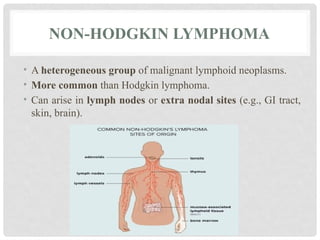
NON-HODGKIN LYMPHOMA
• A heterogeneous group of malignant lymphoid neoplasms.
• More common than Hodgkin lymphoma.
• Can arise in lymph nodes or extra nodal sites (e.g., GI tract,
skin, brain).
CLASSIFICATION
NHL is classified based on:
• Cell of origin:
• B-cell neoplasms (most common)
• T-cell and NK-cell neoplasms
• Grade of aggressiveness:
• Indolent (slow-growing): e.g., Follicular
lymphoma
• Aggressive: e.g., Diffuse large B-cell lymphoma
• Highly aggressive: e.g., Burkitt lymphoma
EXAMPLES
• Diffuse Large B-Cell Lymphoma (DLBCL)
• Most common NHL subtype
• Rapidly growing mass, often in older adults
• Potentially curable with chemotherapy
• Follicular Lymphoma
• Indolent, slow progression
• Originates from germinal center B cells
• Often presents with generalized lymphadenopathy
• Burkitt Lymphoma
• Highly aggressive
• Associated with EBV in endemic forms
• Common in children and young adults
• “Starry sky” appearance on histology
CLINICAL FEATURES
• Painless lymphadenopathy
• B symptoms: fever, weight loss, night sweats
(especially in aggressive types)
• Involvement of extranodal sites
• Variable prognosis depending on type and stage
HODGKIN LYMPHOMA
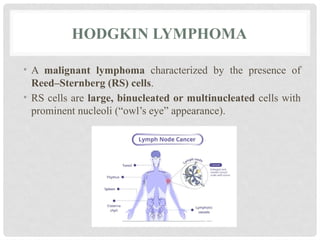
• A malignant lymphoma characterized by the presence of
Reed–Sternberg (RS) cells.
• RS cells are large, binucleated or multinucleated cells with
prominent nucleoli (“owl’s eye” appearance).
KEY FEATURES
• Bimodal age distribution:
• First peak: young adults (15–35 years)
• Second peak: older adults (>55 years)
• Contiguous spread from one lymph node group to
the next (predictable pattern)
• Nodular Sclerosis
• Most common subtype
• Collagen bands divide lymphoid tissue into nodules
• Common in young females
• Mixed Cellularity
• Second most common
• Numerous RS cells with a mixed inflammatory background
• More common in older adults
• Lymphocyte-Rich
• Many reactive lymphocytes, few RS cells
• Best prognosis among subtypes
• Lymphocyte-Depleted
• Few lymphocytes, many abnormal RS cells
• Worst prognosis
• More common in elderly or HIV-positive patients
PROGNOSIS
• Generally good prognosis with appropriate treatment
(chemotherapy ± radiotherapy)
• 5-year survival rates >85% in early-stage disease
COMPARISON – NHL VS HL
• NHL: Non-contiguous spread, B/T cells, All ages,
Variable prognosis.
• HL: Contiguous spread, Reed–Sternberg cells, Young
adults + elderly, Good prognosis.
METASTATIC CARCINOMA IN
LYMPH NODES
• Spread of cancer cells to lymph nodes from primary
site.
• Common sites: Lung, breast, stomach, colon
• Morphology: Enlarged, hard, fixed nodes
• Important for cancer staging and prognosis
SUMMARY
• Reviewed lymph node structure and functions.
• Discussed lymphadenopathy and lymphadenitis.
• Differentiated between NHL and HL.
• Metastasis to lymph nodes and clinical relevance.
REFERENCES
• Ramadas Nayak. Textbook of Pathology for Allied
Health Sciences.

Lymph Node Pathology Presentation

  • 1.
    LYMPH NODE PATHOLOGY Dr.Sonia. J Junior Resident Department Of Pathology KMCT Medical College
  • 2.
    CHAPTER OUTLINE • Structureof lymph node • Lymphadenopathy • Lymphadenitis • Lymphoid neoplasms • Non-Hodgkin lymphoma • Hodgkin lymphoma • Metastatic carcinoma
  • 3.
    STRUCTURE OF LYMPHNODE • Capsule, cortex, paracortex, medulla • Lymphatic vessels: afferent and efferent • Cellular components: lymphocytes, macrophages, dendritic cells
  • 4.
    CAUSES • Infectious causes •Bacterial: Tuberculosis, staphylococcal infections • Viral: Epstein-Barr virus (EBV), HIV, Cytomegalovirus (CMV) • Fungal or parasitic infections (e.g., histoplasmosis) • Malignancies • Primary lymphoid neoplasms: e.g., lymphoma (Hodgkin or Non-Hodgkin) • Secondary (metastatic) carcinomas: from breast, lung, gastrointestinal tract, etc. • Immune or autoimmune disorders • Rheumatoid arthritis • Systemic lupus erythematosus (SLE) • Sarcoidosis • Miscellaneous • Drug reactions (e.g., phenytoin) • Storage diseases
  • 5.
    TYPES 1) Localized lymphadenopathy •Involvement of a single group of lymph nodes. • Often due to local infections (e.g., bacterial infection in throat → cervical nodes). 2) Generalized lymphadenopathy • Involvement of two or more non-contiguous regions. • Suggestive of systemic diseases such as viral infections, autoimmune conditions, or malignancies.
  • 6.
    CLINICAL SIGNIFICANCE • Importantdiagnostic clue in many conditions. • Size, consistency, tenderness, fixation, and mobility help in clinical assessment: • Soft, tender, mobile → more likely infectious. • Firm, rubbery, non-tender → suggestive of lymphoma. • Hard, fixed → often indicates metastatic cancer. • May require biopsy or fine-needle aspiration (FNA) for definitive diagnosis.
  • 7.
    LYMPHADENITIS • Lymphadenitis refersto inflammation of the lymph nodes, typically due to infectious or immune causes. • Can be acute or chronic based on the duration and underlying pathology.
  • 8.
    TYPES 1) Acute Lymphadenitis •Etiology: Most commonly bacterial infections. • Clinical Features: • Sudden onset • Painful, tender, and enlarged lymph nodes • Skin over node may be red and warm • May be associated with fever and systemic symptoms • Examples: • Streptococcal or staphylococcal infections in tonsils, skin, or wounds
  • 9.
    2) Chronic Lymphadenitis •Develops over weeks to months • Less tender, firmer lymph nodes • Common causes: • Tuberculosis: caseating granulomas • Cat-scratch disease: Bartonella henselae → suppurative granulomas • Fungal infections • Toxoplasmosis
  • 10.
    HISTOLOGICAL FEATURES • Acute: •Neutrophilic infiltration • Follicular hyperplasia • Edema and sinus dilation • May show abscess formation • Chronic: • Granulomatous inflammation (e.g., TB: caseating granulomas) • Follicular hyperplasia (e.g., in viral infections) • Paracortical hyperplasia (e.g., in immune responses) • Sinus histiocytosis: prominent histiocytes in medullary sinuses
  • 11.
    LYMPHOID NEOPLASMS • Lymphoidneoplasms are malignant proliferations of lymphoid cells. • They originate from clonal expansion of B cells, T cells, or natural killer (NK) cells at various stages of differentiation.
  • 12.
    CLASSIFICATION ymphoid neoplasms arebroadly classified into: • Non-Hodgkin Lymphoma (NHL) • Diverse group of lymphomas involving B or T cells • Variable behavior: indolent to highly aggressive • Hodgkin Lymphoma (HL) • Characterized by Reed–Sternberg cells • Typically involves contiguous lymph node spread • Other Lymphoid Malignancies • Leukemias: Neoplastic lymphoid cells primarily involving blood and bone marrow • e.g., Acute Lymphoblastic Leukemia (ALL), Chronic Lymphocytic Leukemia (CLL) • Plasma cell neoplasms: e.g., Multiple Myeloma
  • 13.
    ORIGIN • Lymphoid neoplasmsarise from: • B-cell lineage (most common) • T-cell lineage • Natural Killer (NK) cell lineage • Each type reflects the stage of maturation and function of the cell of origin, leading to different clinical features, morphology, and prognosis.
  • 14.
    NON-HODGKIN LYMPHOMA • Aheterogeneous group of malignant lymphoid neoplasms. • More common than Hodgkin lymphoma. • Can arise in lymph nodes or extra nodal sites (e.g., GI tract, skin, brain).
  • 15.
    CLASSIFICATION NHL is classifiedbased on: • Cell of origin: • B-cell neoplasms (most common) • T-cell and NK-cell neoplasms • Grade of aggressiveness: • Indolent (slow-growing): e.g., Follicular lymphoma • Aggressive: e.g., Diffuse large B-cell lymphoma • Highly aggressive: e.g., Burkitt lymphoma
  • 16.
    EXAMPLES • Diffuse LargeB-Cell Lymphoma (DLBCL) • Most common NHL subtype • Rapidly growing mass, often in older adults • Potentially curable with chemotherapy • Follicular Lymphoma • Indolent, slow progression • Originates from germinal center B cells • Often presents with generalized lymphadenopathy • Burkitt Lymphoma • Highly aggressive • Associated with EBV in endemic forms • Common in children and young adults • “Starry sky” appearance on histology
  • 17.
    CLINICAL FEATURES • Painlesslymphadenopathy • B symptoms: fever, weight loss, night sweats (especially in aggressive types) • Involvement of extranodal sites • Variable prognosis depending on type and stage
  • 18.
    HODGKIN LYMPHOMA • Amalignant lymphoma characterized by the presence of Reed–Sternberg (RS) cells. • RS cells are large, binucleated or multinucleated cells with prominent nucleoli (“owl’s eye” appearance).
  • 19.
    KEY FEATURES • Bimodalage distribution: • First peak: young adults (15–35 years) • Second peak: older adults (>55 years) • Contiguous spread from one lymph node group to the next (predictable pattern)
  • 20.
    • Nodular Sclerosis •Most common subtype • Collagen bands divide lymphoid tissue into nodules • Common in young females • Mixed Cellularity • Second most common • Numerous RS cells with a mixed inflammatory background • More common in older adults • Lymphocyte-Rich • Many reactive lymphocytes, few RS cells • Best prognosis among subtypes • Lymphocyte-Depleted • Few lymphocytes, many abnormal RS cells • Worst prognosis • More common in elderly or HIV-positive patients
  • 21.
    PROGNOSIS • Generally goodprognosis with appropriate treatment (chemotherapy ± radiotherapy) • 5-year survival rates >85% in early-stage disease
  • 22.
    COMPARISON – NHLVS HL • NHL: Non-contiguous spread, B/T cells, All ages, Variable prognosis. • HL: Contiguous spread, Reed–Sternberg cells, Young adults + elderly, Good prognosis.
  • 23.
    METASTATIC CARCINOMA IN LYMPHNODES • Spread of cancer cells to lymph nodes from primary site. • Common sites: Lung, breast, stomach, colon • Morphology: Enlarged, hard, fixed nodes • Important for cancer staging and prognosis
  • 24.
    SUMMARY • Reviewed lymphnode structure and functions. • Discussed lymphadenopathy and lymphadenitis. • Differentiated between NHL and HL. • Metastasis to lymph nodes and clinical relevance.
  • 25.
    REFERENCES • Ramadas Nayak.Textbook of Pathology for Allied Health Sciences.