05/19/18 1
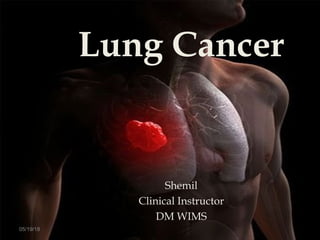
Lung Cancer
Shemil
Clinical Instructor
DM WIMS
05/19/18
05/19/18 2
Lung cancer
05/19/18
Lung cancer is the uncontrolled growth of abnormal
cells that start off in one or both lungs; usually in the
cells that line the air passages. The abnormal cells do
not develop into healthy lung tissue, they divide
rapidly and form tumors
05/19/18 305/19/18
05/19/18 4
Benign Vs Malignant
Tumors can be benign or malignant; Benign tumors
usually can be removed and do not spread to other
parts of the body. Malignant tumors (Cancer), on the
other hand, often grow aggressively locally where
they start, but tumor cells also can enter into the
bloodstream or lymphatic system and then spread to
other sites in the body (metastasis).
05/19/18
05/19/18 5
Metastasis
Lung cancer tends to spread or metastasize very early
after it forms, it is a very life-threatening cancer and one
of the most difficult cancers to treat. While lung cancer
can spread to any organ in the body, certain locations
particularly the adrenal glands, liver, brain, and bones
are the most common sites for lung cancer metastasis.
05/19/18
05/19/18 6
Contd………………
The lung also is a very common site for metastasis
from malignant tumors in other parts of the body.
Tumor metastases are made up of the same types of
cells as the original (primary) tumor. For example,
if prostate cancer spreads via the bloodstream to the
lungs, it is metastatic prostate cancer in the lung and
is not lung cancer.
05/19/18
05/19/18 7
Anatomy
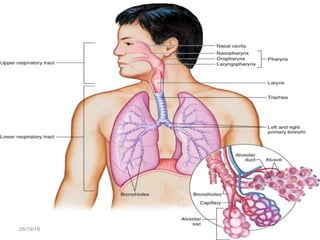
The right lung has three lobes, while the left lung is
divided into two lobes. The major airways entering the
lungs are the bronchi, which arise from the trachea,
which is outside the lungs. The bronchi branch into
progressively smaller airways called bronchioles that
end in tiny sacs known as alveoli where gas exchange
occurs.
The lungs and chest wall are covered with a thin layer of
tissue called the pleura.
05/19/18
05/19/18 805/19/18
05/19/18 9
Incidence
Lung cancers can arise in any part of the lung, but
90%-95% of cancers of the lung are thought to arise
from the epithelial cells, the cells lining the larger
and smaller airways (bronchi and bronchioles); for
this reason, lung cancers are sometimes called
bronchogenic cancers or bronchogenic carcinomas.
 Cancers also can arise from the pleura (called
mesotheliomas) or rarely from supporting tissues
within the lungs, for example, the blood vessels. 
05/19/18
05/19/18 10
Contd…………………
• Lung cancer is the most common cause of death
due to cancer in both men and women
throughout the world.
• It accounts for 13 per cent of all new cancer cases
and 19 per cent of cancer related deaths
worldwide.
• In India, lung cancer constitutes 6.9 per cent of
all new cancer cases and 9.3 per cent of all cancer
related deaths in both sexes.
05/19/18
05/19/18 11
Causes & Risk factors
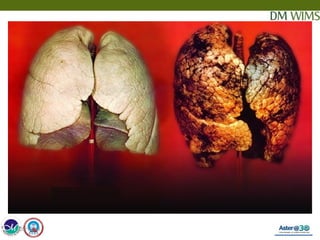
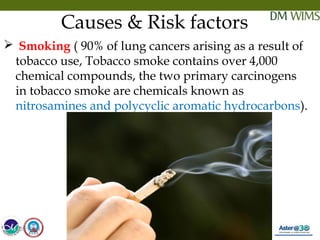
 Smoking ( 90% of lung cancers arising as a result of
tobacco use, Tobacco smoke contains over 4,000
chemical compounds, the two primary carcinogens
in tobacco smoke are chemicals known as
nitrosamines and polycyclic aromatic hydrocarbons).
05/19/18
05/19/18 12
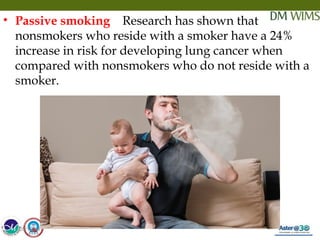
• Passive smoking Research has shown that
nonsmokers who reside with a smoker have a 24%
increase in risk for developing lung cancer when
compared with nonsmokers who do not reside with a
smoker.
05/19/18
05/19/18 13
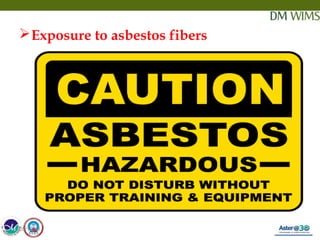
Exposure to asbestos fibers
05/19/18
05/19/18 1405/19/18
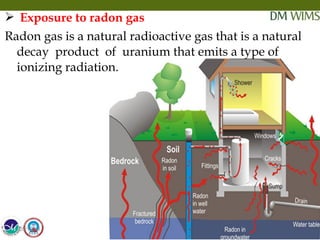
 Exposure to radon gas
Radon gas is a natural radioactive gas that is a natural
decay product of uranium that emits a type of
ionizing radiation.
05/19/18 1505/19/18
 Familial predisposition.
Numerous studies have shown that lung cancer is
more likely to occur in both smoking and
nonsmoking relatives of those who have had
lung cancer than in the general population.
05/19/18 16
 Lung diseases
1. The presence of certain diseases of the lung,
notably chronic obstructive pulmonary disease 
(COPD), is associated with an increased risk (four- to
six-fold the risk of a nonsmoker).
2. Pulmonary fibrosis (scarring of the lung) appears to
increase the risk about seven-fold.
05/19/18
05/19/18 17
 Prior history of lung cancer.
Survivors of lung cancer have a greater risk of
developing a second lung cancer than the general
population has of developing a first lung cancer.
05/19/18
05/19/18 18
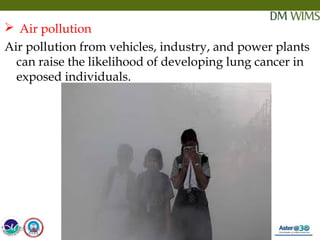
 Air pollution
Air pollution from vehicles, industry, and power plants
can raise the likelihood of developing lung cancer in
exposed individuals.
05/19/18
05/19/18 19
 Exposure to diesel exhaust
Exhaust from diesel engines such as truck drivers, toll
booth workers, heavy machinery operators, miners,
garage workers and mechanics, and some farm
workers are frequently exposed to diesel exhaust.
05/19/18
05/19/18 2005/19/18
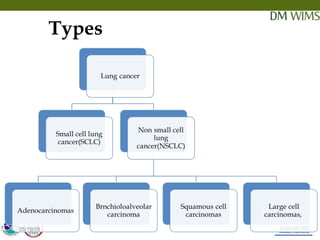
Types
05/19/18 21
Types cntd….
SCLC comprise about 20% of lung cancers and are the
most aggressive and rapidly growing of all lung cancers.
SCLC are strongly related to cigarette smoking, with
only 1% of these tumors occurring in nonsmokers. SCLC
metastasize rapidly to many sites within the body and
are most often discovered after they have spread
extensively
05/19/18
05/19/18 22
NSCLC are the most common lung cancers, accounting
for about 80% of all lung cancers.
Adenocarcinomas  are the most common type of lung
cancer in women and in nonsmokers, adenocarcinoma
forms in the mucus-producing glands of the lungs.
Bronchioalveolar carcinoma’s are rare type of
adenocarcinoma that forms near the lungs' air sacs.
Squamous cell carcinomas or epidermoid carcinoma.
As the most common type of NSCLC and the most
common type of lung cancer in men, squamous cell
carcinoma forms in the lining of the bronchial tubes.
Large cell carcinomas(undifferentiated carcinomas)
carcinomas form near the outer edges or surface of the
lungs.05/19/18
05/19/18 23
Symptoms of lung cancer
 Persistent or intense coughing
 Pain in the chest shoulder, or back from coughing
 Changes in color of the mucus that is coughed up
from the lower airways (sputum)
 Difficulty breathing and swallowing
 Hoarseness of the voice
 Harsh sounds while breathing (stridor)
 Chronic bronchitis or pneumonia
 Coughing up blood, or blood in the sputum
05/19/18
05/19/18 24
If the lung cancer metastasizes additional
symptoms can present
 Swollen or enlarged lymph nodes.
 Brain : Vertigo, headaches, or seizures.
  Liver : Enlarged liver and jaundice.
  Bones : Painful, brittle, and broken.
 Adrenal glands: Hormone level changes.
• Fever
• Fatigue
• Unexplained weight loss
• Problems with brain function and memory
• Swelling in the neck or face
05/19/18 25
Diagnostics
 The history and physical examination (Cyanosis,
clubbing of fingers)
 The chest X-ray .
 CT (computerized tomography) scans may be
performed on the chest, abdomen, and/or brain to
examine for both metastatic and lung tumors.
 Magnetic resonance imaging (MRI) scans may be
appropriate when precise detail about a tumor's
location is required.
 Positron emission tomography (PET
05/19/18
05/19/18 26
 Sputum cytology.
 Bronchoscopy.
 Needle biopsy: Fine-needle aspiration (FNA).
 Thoracentesis.
 Major surgical procedures: If none of the
aforementioned methods yields a diagnosis,
surgical methods must be employed to obtain
tumor tissue for diagnosis.
 Blood tests: While routine blood tests alone
cannot diagnose lung cancer, they may reveal
biochemical or metabolic abnormalities in the
body that accompany cancer
05/19/18
05/19/18 27
Treatment
 Surgery: Surgical removal of the tumor is generally
performed for limited-stage (stage I or sometimes
stage II) . About 10%-35% of lung cancers can be
removed surgically, but removal does not always
result in a cure, since the tumors may already have
spread and can recur at a later time.
 Radiation: It uses high-energy X-rays or other types of
radiation to kill dividing cancer cells. Radiation
therapy may be given as curative therapy, palliative
therapy, it is either delivered externally or internally
through placement of radioactive substances in sealed
containers where the tumor is localized 
05/19/18 28
 Chemotherapy: Both NSCLC and SCLC may be treated
with chemotherapy. Chemotherapy refers to the
administration of drugs that stop the growth of
cancer cells by killing them or preventing them from
dividing.
 Immunotherapy: Immunotherapy may be an effective
option for some patients with advanced lung cancers.
Immunotherapy drugs work by strengthening the
activity of the immune system against tumor cells.
05/19/18
05/19/18 29
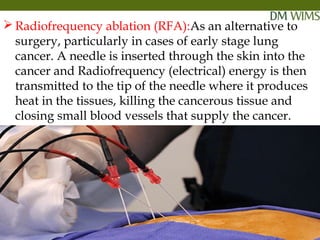
 Radiofrequency ablation (RFA):As an alternative to
surgery, particularly in cases of early stage lung
cancer. A needle is inserted through the skin into the
cancer and Radiofrequency (electrical) energy is then
transmitted to the tip of the needle where it produces
heat in the tissues, killing the cancerous tissue and
closing small blood vessels that supply the cancer.
05/19/18
05/19/18 30
Prevention
Cessation of smoking and eliminating exposure to
tobacco smoke is the most important measure that can
prevent lung cancer. Many products, such
as nicotine gum, nicotine sprays, or nicotine inhalers,
may be helpful to people trying to quit smoking.
Minimizing exposure to passive smoking also is an
effective preventive measure. Using a home radon test
kit can identify and allow correction of increased radon
levels in the home.
05/19/18
05/19/18 31
Nursing Management
 Elevate the head of the bed to ease the work of
breathing and to prevent fluid collection in upper
body.
 Teach breathing retraining exercises to increase
diaphragmatic excursion and reduce work of
breathing.
 Augment the patient’s ability to cough effectively by
splinting the patient’s chest manually.
 Instruct the patient to inspire fully and cough two to
three times in one breath.

05/19/18
05/19/18 32
 Provide humidifier or vaporizer to provide moisture
to loosen secretions.
 Teach relaxation techniques to reduce anxiety
associated with dyspnea.
 Encourage the patient to conserve energy by
decreasing activities.
 Ensure adequate protein intake to promote healing
and prevent edema.
 Advise the patient to eat small amounts of high-
calorie and high-protein foods frequently, rather than
three daily meals.
05/19/18
05/19/18 33
 Change the diet consistency to soft or liquid if patient
has esophagitis from radiation therapy.
 Consider non pharmacological pain control methods.
 Teach the patient to use prescribed medications as
needed for pain without being overly concerned
about addiction.
05/19/18
05/19/18 3405/19/18
05/19/18 3505/19/18

Lung cancer

  • 1.
    05/19/18 1 Lung Cancer Shemil ClinicalInstructor DM WIMS 05/19/18
  • 2.
    05/19/18 2 Lung cancer 05/19/18 Lungcancer is the uncontrolled growth of abnormal cells that start off in one or both lungs; usually in the cells that line the air passages. The abnormal cells do not develop into healthy lung tissue, they divide rapidly and form tumors
  • 3.
  • 4.
    05/19/18 4 Benign VsMalignant Tumors can be benign or malignant; Benign tumors usually can be removed and do not spread to other parts of the body. Malignant tumors (Cancer), on the other hand, often grow aggressively locally where they start, but tumor cells also can enter into the bloodstream or lymphatic system and then spread to other sites in the body (metastasis). 05/19/18
  • 5.
    05/19/18 5 Metastasis Lung cancertends to spread or metastasize very early after it forms, it is a very life-threatening cancer and one of the most difficult cancers to treat. While lung cancer can spread to any organ in the body, certain locations particularly the adrenal glands, liver, brain, and bones are the most common sites for lung cancer metastasis. 05/19/18
  • 6.
    05/19/18 6 Contd……………… The lungalso is a very common site for metastasis from malignant tumors in other parts of the body. Tumor metastases are made up of the same types of cells as the original (primary) tumor. For example, if prostate cancer spreads via the bloodstream to the lungs, it is metastatic prostate cancer in the lung and is not lung cancer. 05/19/18
  • 7.
    05/19/18 7 Anatomy The rightlung has three lobes, while the left lung is divided into two lobes. The major airways entering the lungs are the bronchi, which arise from the trachea, which is outside the lungs. The bronchi branch into progressively smaller airways called bronchioles that end in tiny sacs known as alveoli where gas exchange occurs. The lungs and chest wall are covered with a thin layer of tissue called the pleura. 05/19/18
  • 8.
  • 9.
    05/19/18 9 Incidence Lung cancerscan arise in any part of the lung, but 90%-95% of cancers of the lung are thought to arise from the epithelial cells, the cells lining the larger and smaller airways (bronchi and bronchioles); for this reason, lung cancers are sometimes called bronchogenic cancers or bronchogenic carcinomas.  Cancers also can arise from the pleura (called mesotheliomas) or rarely from supporting tissues within the lungs, for example, the blood vessels.  05/19/18

  • 10.
    05/19/18 10 Contd………………… • Lungcancer is the most common cause of death due to cancer in both men and women throughout the world. • It accounts for 13 per cent of all new cancer cases and 19 per cent of cancer related deaths worldwide. • In India, lung cancer constitutes 6.9 per cent of all new cancer cases and 9.3 per cent of all cancer related deaths in both sexes. 05/19/18
  • 11.
    05/19/18 11 Causes &Risk factors  Smoking ( 90% of lung cancers arising as a result of tobacco use, Tobacco smoke contains over 4,000 chemical compounds, the two primary carcinogens in tobacco smoke are chemicals known as nitrosamines and polycyclic aromatic hydrocarbons). 05/19/18
  • 12.
    05/19/18 12 • Passivesmoking Research has shown that nonsmokers who reside with a smoker have a 24% increase in risk for developing lung cancer when compared with nonsmokers who do not reside with a smoker. 05/19/18
  • 13.
    05/19/18 13 Exposure toasbestos fibers 05/19/18
  • 14.
    05/19/18 1405/19/18  Exposureto radon gas Radon gas is a natural radioactive gas that is a natural decay product of uranium that emits a type of ionizing radiation.
  • 15.
    05/19/18 1505/19/18  Familialpredisposition. Numerous studies have shown that lung cancer is more likely to occur in both smoking and nonsmoking relatives of those who have had lung cancer than in the general population.
  • 16.
    05/19/18 16  Lungdiseases 1. The presence of certain diseases of the lung, notably chronic obstructive pulmonary disease  (COPD), is associated with an increased risk (four- to six-fold the risk of a nonsmoker). 2. Pulmonary fibrosis (scarring of the lung) appears to increase the risk about seven-fold. 05/19/18
  • 17.
    05/19/18 17  Priorhistory of lung cancer. Survivors of lung cancer have a greater risk of developing a second lung cancer than the general population has of developing a first lung cancer. 05/19/18
  • 18.
    05/19/18 18  Airpollution Air pollution from vehicles, industry, and power plants can raise the likelihood of developing lung cancer in exposed individuals. 05/19/18
  • 19.
    05/19/18 19  Exposureto diesel exhaust Exhaust from diesel engines such as truck drivers, toll booth workers, heavy machinery operators, miners, garage workers and mechanics, and some farm workers are frequently exposed to diesel exhaust. 05/19/18
  • 20.
  • 21.
    05/19/18 21 Types cntd…. SCLCcomprise about 20% of lung cancers and are the most aggressive and rapidly growing of all lung cancers. SCLC are strongly related to cigarette smoking, with only 1% of these tumors occurring in nonsmokers. SCLC metastasize rapidly to many sites within the body and are most often discovered after they have spread extensively 05/19/18
  • 22.
    05/19/18 22 NSCLC arethe most common lung cancers, accounting for about 80% of all lung cancers. Adenocarcinomas  are the most common type of lung cancer in women and in nonsmokers, adenocarcinoma forms in the mucus-producing glands of the lungs. Bronchioalveolar carcinoma’s are rare type of adenocarcinoma that forms near the lungs' air sacs. Squamous cell carcinomas or epidermoid carcinoma. As the most common type of NSCLC and the most common type of lung cancer in men, squamous cell carcinoma forms in the lining of the bronchial tubes. Large cell carcinomas(undifferentiated carcinomas) carcinomas form near the outer edges or surface of the lungs.05/19/18
  • 23.
    05/19/18 23 Symptoms oflung cancer  Persistent or intense coughing  Pain in the chest shoulder, or back from coughing  Changes in color of the mucus that is coughed up from the lower airways (sputum)  Difficulty breathing and swallowing  Hoarseness of the voice  Harsh sounds while breathing (stridor)  Chronic bronchitis or pneumonia  Coughing up blood, or blood in the sputum 05/19/18
  • 24.
    05/19/18 24 If thelung cancer metastasizes additional symptoms can present  Swollen or enlarged lymph nodes.  Brain : Vertigo, headaches, or seizures.   Liver : Enlarged liver and jaundice.   Bones : Painful, brittle, and broken.  Adrenal glands: Hormone level changes. • Fever • Fatigue • Unexplained weight loss • Problems with brain function and memory • Swelling in the neck or face
  • 25.
    05/19/18 25 Diagnostics  The historyand physical examination (Cyanosis, clubbing of fingers)  The chest X-ray .  CT (computerized tomography) scans may be performed on the chest, abdomen, and/or brain to examine for both metastatic and lung tumors.  Magnetic resonance imaging (MRI) scans may be appropriate when precise detail about a tumor's location is required.  Positron emission tomography (PET 05/19/18
  • 26.
    05/19/18 26  Sputumcytology.  Bronchoscopy.  Needle biopsy: Fine-needle aspiration (FNA).  Thoracentesis.  Major surgical procedures: If none of the aforementioned methods yields a diagnosis, surgical methods must be employed to obtain tumor tissue for diagnosis.  Blood tests: While routine blood tests alone cannot diagnose lung cancer, they may reveal biochemical or metabolic abnormalities in the body that accompany cancer 05/19/18
  • 27.
    05/19/18 27 Treatment  Surgery:Surgical removal of the tumor is generally performed for limited-stage (stage I or sometimes stage II) . About 10%-35% of lung cancers can be removed surgically, but removal does not always result in a cure, since the tumors may already have spread and can recur at a later time.  Radiation: It uses high-energy X-rays or other types of radiation to kill dividing cancer cells. Radiation therapy may be given as curative therapy, palliative therapy, it is either delivered externally or internally through placement of radioactive substances in sealed containers where the tumor is localized 
  • 28.
    05/19/18 28  Chemotherapy:Both NSCLC and SCLC may be treated with chemotherapy. Chemotherapy refers to the administration of drugs that stop the growth of cancer cells by killing them or preventing them from dividing.  Immunotherapy: Immunotherapy may be an effective option for some patients with advanced lung cancers. Immunotherapy drugs work by strengthening the activity of the immune system against tumor cells. 05/19/18
  • 29.
    05/19/18 29  Radiofrequencyablation (RFA):As an alternative to surgery, particularly in cases of early stage lung cancer. A needle is inserted through the skin into the cancer and Radiofrequency (electrical) energy is then transmitted to the tip of the needle where it produces heat in the tissues, killing the cancerous tissue and closing small blood vessels that supply the cancer. 05/19/18
  • 30.
    05/19/18 30 Prevention Cessation ofsmoking and eliminating exposure to tobacco smoke is the most important measure that can prevent lung cancer. Many products, such as nicotine gum, nicotine sprays, or nicotine inhalers, may be helpful to people trying to quit smoking. Minimizing exposure to passive smoking also is an effective preventive measure. Using a home radon test kit can identify and allow correction of increased radon levels in the home. 05/19/18
  • 31.
    05/19/18 31 Nursing Management Elevate the head of the bed to ease the work of breathing and to prevent fluid collection in upper body.  Teach breathing retraining exercises to increase diaphragmatic excursion and reduce work of breathing.  Augment the patient’s ability to cough effectively by splinting the patient’s chest manually.  Instruct the patient to inspire fully and cough two to three times in one breath. 05/19/18
  • 32.
    05/19/18 32  Providehumidifier or vaporizer to provide moisture to loosen secretions.  Teach relaxation techniques to reduce anxiety associated with dyspnea.  Encourage the patient to conserve energy by decreasing activities.  Ensure adequate protein intake to promote healing and prevent edema.  Advise the patient to eat small amounts of high- calorie and high-protein foods frequently, rather than three daily meals. 05/19/18
  • 33.
    05/19/18 33  Changethe diet consistency to soft or liquid if patient has esophagitis from radiation therapy.  Consider non pharmacological pain control methods.  Teach the patient to use prescribed medications as needed for pain without being overly concerned about addiction. 05/19/18
  • 34.
  • 35.