Lumpy Skin
Disease
Pseudourticaria, Neethling
Virus Disease, Exanthema
Nodularis
Center for Food Security and Public Health
Iowa State University - 2004
Overview
• Organism
• Economic impact
• Epidemiology
• Transmission
• Clinical signs
• Diagnosis and treatment
• Prevention and control
The Organism
Center for Food Security and Public Health
Iowa State University - 2004
Lumpy Skin Disease Virus
• Family Poxviridae
− Genus Capripoxvirus
• Closely related
to sheep and
goat pox
• Cannot be
differentiated
with routine
serology
Importance
Center for Food Security and Public Health
Iowa State University - 2004
History and Geographic
Distribution
• 1929: Southern and eastern Africa
• Disease of cattle
• Experimental
infection
− Oryx, giraffe
and impala
• Virus will replicate in sheep and goats
• 1990’s: Resurgence in Africa
Center for Food Security and Public Health
Iowa State University - 2004
Economic Impact
• Major economic importance due to
loss of production
− Severe emaciation
− Lowered milk production
− Abortion
− Secondary mastitis
− Loss of fertility
− Extensive damage to hides
− Loss of draft from lameness
Epidemiology
Center for Food Security and Public Health
Iowa State University - 2004
Morbidity/ Mortality
• Morbidity
− 3% to 85%
• Mortality
− 1% to 2% usually
− 20% to 85% in
some cases
Transmission
Center for Food Security and Public Health
Iowa State University - 2004
Animal Transmission
• Primary route: Mosquitoes and flies
• Minor route:
− Direct contact via cutaneous lesions,
saliva, nasal discharge, milk, semen,
muscles,
• Virus can survive up to 35 days in
desiccated crusts
• No carrier state
• Spread related to movement of cattle
Animals and
Lumpy Skin
Disease
Center for Food Security and Public Health
Iowa State University - 2004
Clinical Signs
• Incubation period
− 5 days to 5 weeks
• Inapparent to
severe infection
− worse in young
cattle
• Fever
• Decreased milk yield
Center for Food Security and Public Health
Iowa State University - 2004
Clinical Signs
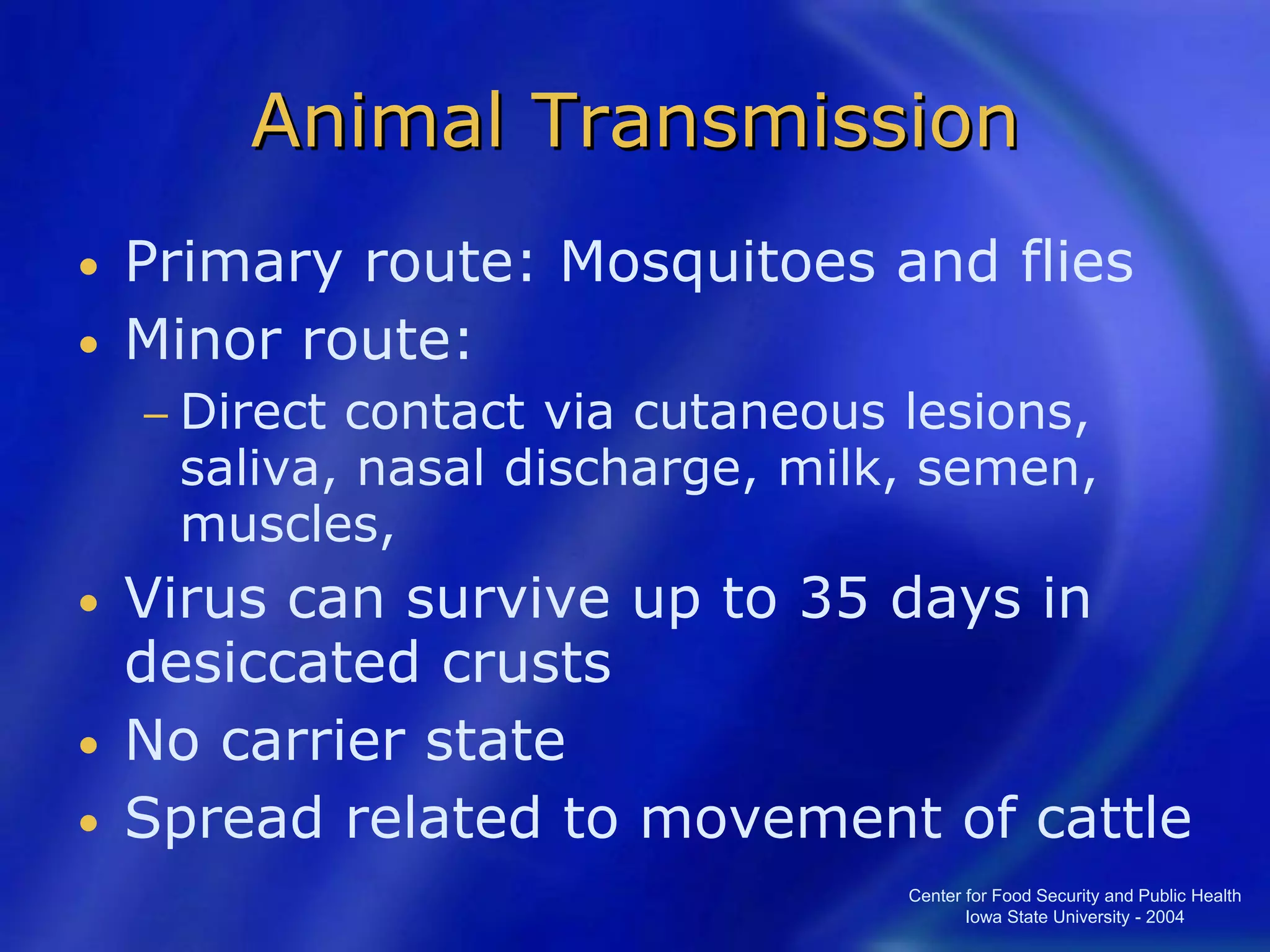
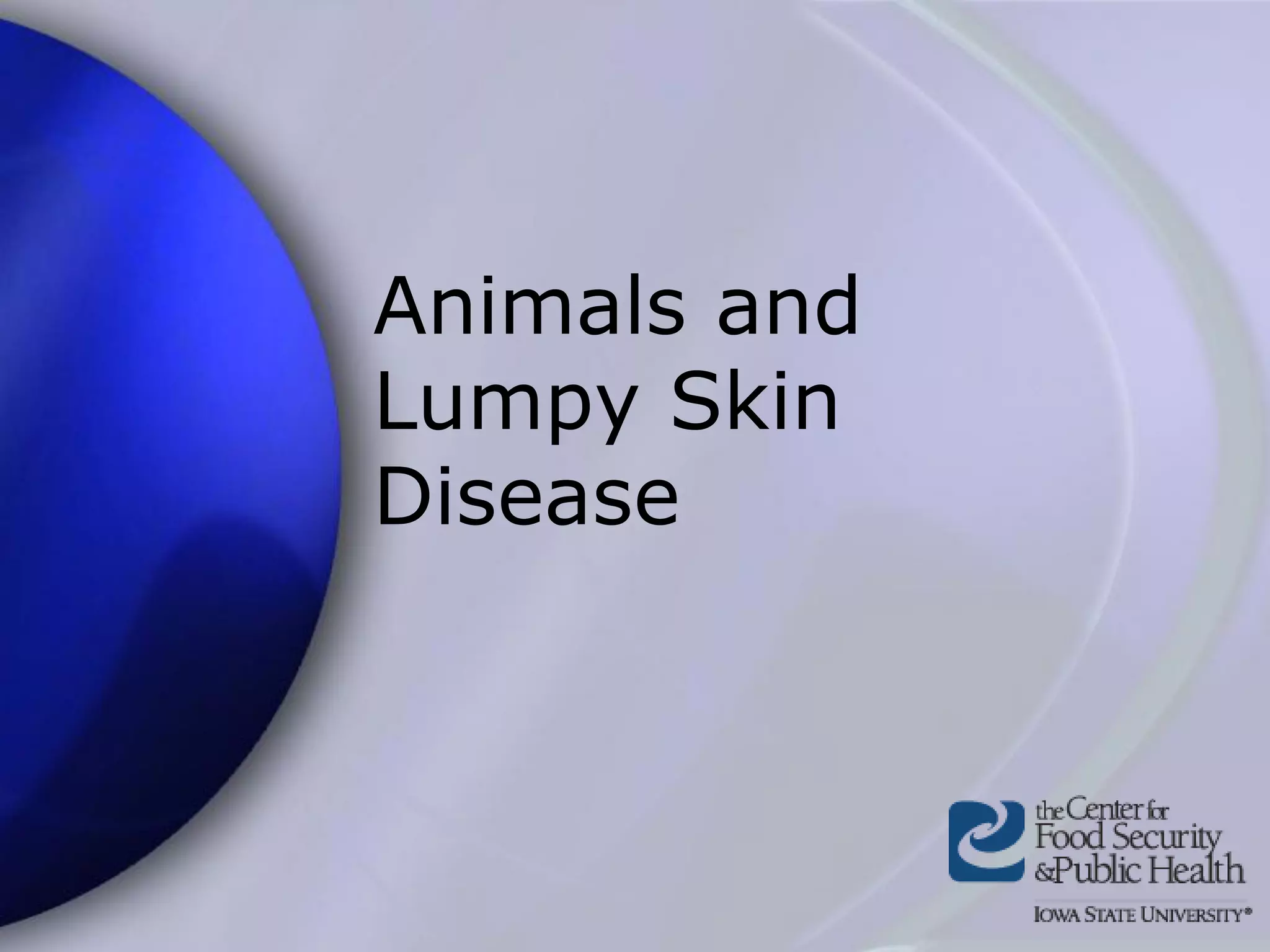
• Raised, circular firm
nodules coalescing into
plaques
− Anywhere on the body
− May harden into “sitfast”
and be shed
• Swollen/tender udder
or testicles
• Tongue, gum and hard
palate lesions
• Abortion and sterility
Center for Food Security and Public Health
Iowa State University - 2004
Post Mortem Lesions
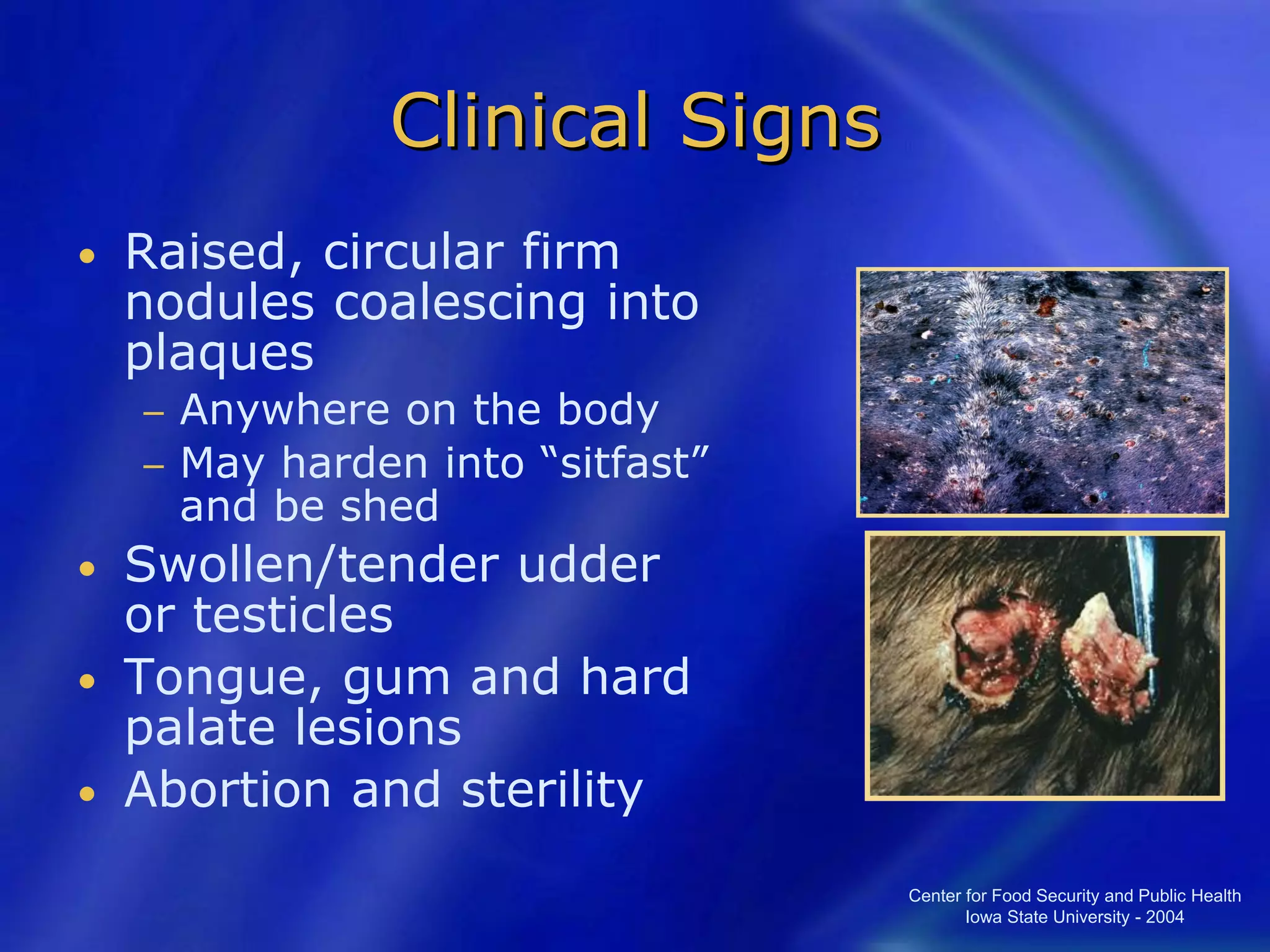
• Characteristic skin
nodules
• Lesions in the mucous
membranes
throughout the GI
tract
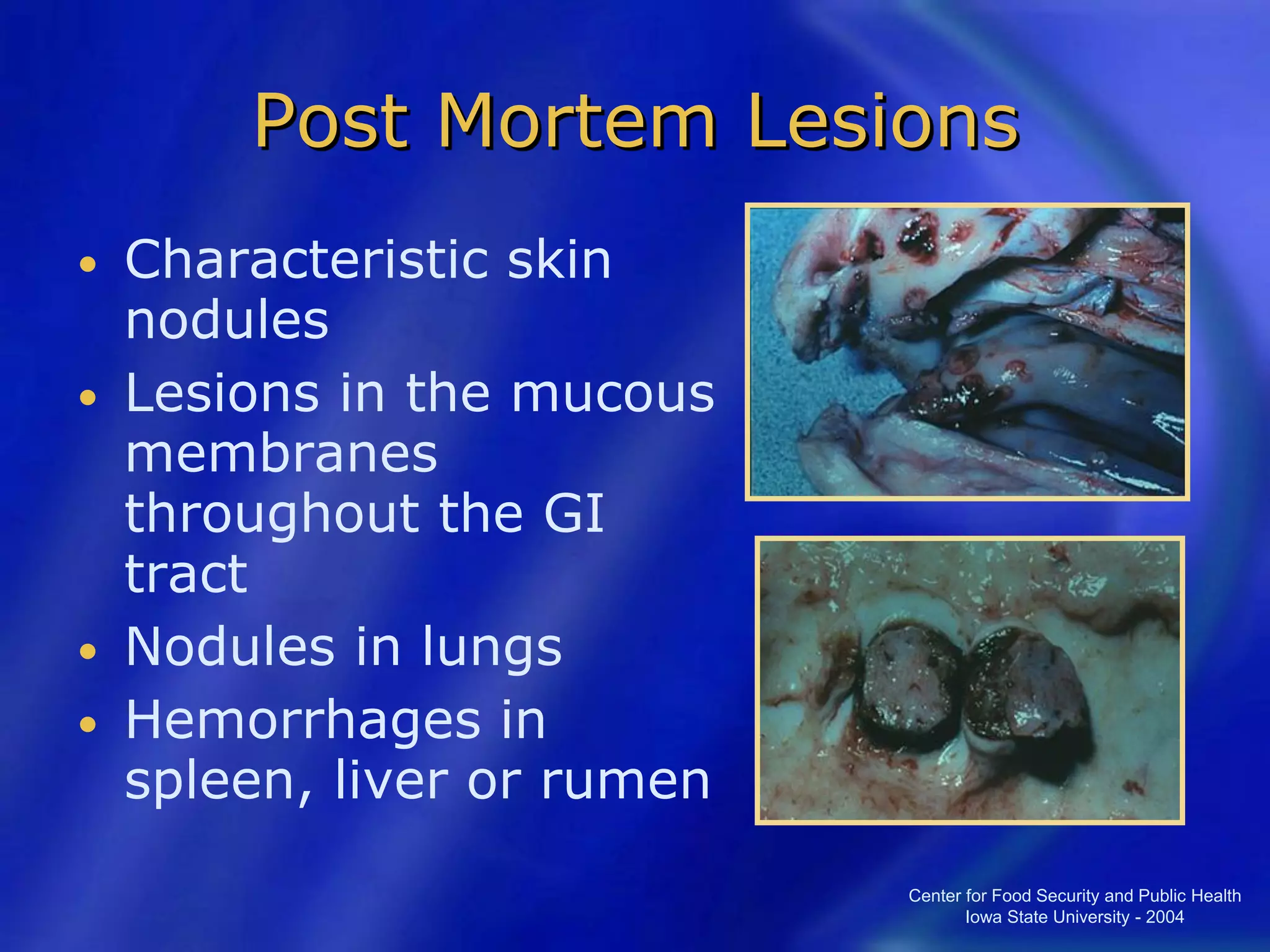
• Nodules in lungs
• Hemorrhages in
spleen, liver or rumen
Center for Food Security and Public Health
Iowa State University - 2004
Differential Diagnosis
• Pseudo-lumpy skin
disease
• Bovine herpes
mammillitis
• Dermatophilosis
• Ringworm
• Insect or tick bites
• Rinderpest
• Demodicosis
• Hypoderma bovis
infection
• Photosensitization
• Bovine papular
stomatitis
• Urticaria
• Cutaneous
tuberculosis
• Onchocercosis
Center for Food Security and Public Health
Iowa State University - 2004
Sampling
• Before collecting or sending any
samples, the proper authorities
should be contacted
• Samples should only be sent under
secure conditions and to authorized
laboratories to prevent the spread of
the disease
Center for Food Security and Public Health
Iowa State University - 2004
Diagnosis
• Clinical
− Suspect with characteristic skin nodules
(“sitfast”), fever and low mortality
• Laboratory Tests
− Virus isolation and identification
− Electron microscopy in combination with
history
− Serology, cross reactions with other
poxviruses may occur
Center for Food Security and Public Health
Iowa State University - 2004
Treatment
• Cold packing
• Non steroidal anti-inflammatoru
• Vinger to contact plaque
• Na Bicarbonate 5% to open plaque
• Antibiotics for secondary infection
• Up to 6 months for severely affected
animals to recover fully
Center for Food Security and Public Health
Iowa State University - 2004
Treatment
• Antibiotics for secondary infection
• Tetracycline L A first aid
• Penicilline streptomycine to open
plaque
• Immuno stimmulant
• Multivitamine
Prevention and
Control
Center for Food Security and Public Health
Iowa State University - 2004
Recommended Actions
• Notification of Authorities
− Federal:
Area Veterinarian in Charge (AVIC)
www.aphis.usda.gov/vs/area_offices.htm
− State veterinarian
www.aphis.usda.gov/vs/sregs/official.htm
• Quarantine
Center for Food Security and Public Health
Iowa State University - 2004
Disinfection
• Susceptible to:
− Ether (20%)
− Chloroform
− Formalin (1%)
− Some detergents
− Phenol (2% for 15 minutes)
• Can survive up to 35 days in the
environment in desiccated scabs
Center for Food Security and Public Health
Iowa State University - 2004
Control and Eradication
• Endemic areas
− Vaccinate cattle
• Non-endemic areas
− Keep free with import restrictions and
proper quarantine
• Insect control
Center for Food Security and Public Health
Iowa State University - 2004
Control and Eradication
• Outbreak in LSD free area: Small scale
− Quarantine, slaughter infected and
exposed, clean and disinfect
− Consider ring vaccination
• Outbreak in LSD free area: Large scale
− Vaccination
− Consider slaughter
• 1989: Israel
− Quarantine, slaughter and ring vaccination
Center for Food Security and Public Health
Iowa State University - 2004
Vaccination
• Successful in endemic areas
• Neethling strain vaccine confers
immunity up to 3 years
• Sheep and goat pox vaccine is used
but may cause local, severe reaction
Additional
Resources
Center for Food Security and Public Health
Iowa State University - 2004
Additional Resources
• World Organization for Animal Health
(OIE) website
− www.oie.int
• USAHA Foreign Animal Diseases –
“The Gray Book”
− www.vet.uga.edu/vpp/gray_book/index
Acknowledgments
Development of this
presentation was funded
by a grant from the
Centers for Disease Control
and Prevention to the
Center for Food Security
and Public Health at Iowa
State University.
Author:
Co-authors:
Reviewer:
Katie Steneroden, DVM
Kristina August, DVM
Radford Davis, DVM, MPH, DACVPM
Bindy Comito Sornsin, BA
Acknowledgments

Lumpy skin disease

  • 1.
  • 2.
    Center for FoodSecurity and Public Health Iowa State University - 2004 Overview • Organism • Economic impact • Epidemiology • Transmission • Clinical signs • Diagnosis and treatment • Prevention and control
  • 3.
  • 4.
    Center for FoodSecurity and Public Health Iowa State University - 2004 Lumpy Skin Disease Virus • Family Poxviridae − Genus Capripoxvirus • Closely related to sheep and goat pox • Cannot be differentiated with routine serology
  • 5.
  • 6.
    Center for FoodSecurity and Public Health Iowa State University - 2004 History and Geographic Distribution • 1929: Southern and eastern Africa • Disease of cattle • Experimental infection − Oryx, giraffe and impala • Virus will replicate in sheep and goats • 1990’s: Resurgence in Africa
  • 7.
    Center for FoodSecurity and Public Health Iowa State University - 2004 Economic Impact • Major economic importance due to loss of production − Severe emaciation − Lowered milk production − Abortion − Secondary mastitis − Loss of fertility − Extensive damage to hides − Loss of draft from lameness
  • 8.
  • 9.
    Center for FoodSecurity and Public Health Iowa State University - 2004 Morbidity/ Mortality • Morbidity − 3% to 85% • Mortality − 1% to 2% usually − 20% to 85% in some cases
  • 10.
  • 11.
    Center for FoodSecurity and Public Health Iowa State University - 2004 Animal Transmission • Primary route: Mosquitoes and flies • Minor route: − Direct contact via cutaneous lesions, saliva, nasal discharge, milk, semen, muscles, • Virus can survive up to 35 days in desiccated crusts • No carrier state • Spread related to movement of cattle
  • 12.
  • 13.
    Center for FoodSecurity and Public Health Iowa State University - 2004 Clinical Signs • Incubation period − 5 days to 5 weeks • Inapparent to severe infection − worse in young cattle • Fever • Decreased milk yield
  • 14.
    Center for FoodSecurity and Public Health Iowa State University - 2004 Clinical Signs • Raised, circular firm nodules coalescing into plaques − Anywhere on the body − May harden into “sitfast” and be shed • Swollen/tender udder or testicles • Tongue, gum and hard palate lesions • Abortion and sterility
  • 15.
    Center for FoodSecurity and Public Health Iowa State University - 2004 Post Mortem Lesions • Characteristic skin nodules • Lesions in the mucous membranes throughout the GI tract • Nodules in lungs • Hemorrhages in spleen, liver or rumen
  • 16.
    Center for FoodSecurity and Public Health Iowa State University - 2004 Differential Diagnosis • Pseudo-lumpy skin disease • Bovine herpes mammillitis • Dermatophilosis • Ringworm • Insect or tick bites • Rinderpest • Demodicosis • Hypoderma bovis infection • Photosensitization • Bovine papular stomatitis • Urticaria • Cutaneous tuberculosis • Onchocercosis
  • 17.
    Center for FoodSecurity and Public Health Iowa State University - 2004 Sampling • Before collecting or sending any samples, the proper authorities should be contacted • Samples should only be sent under secure conditions and to authorized laboratories to prevent the spread of the disease
  • 18.
    Center for FoodSecurity and Public Health Iowa State University - 2004 Diagnosis • Clinical − Suspect with characteristic skin nodules (“sitfast”), fever and low mortality • Laboratory Tests − Virus isolation and identification − Electron microscopy in combination with history − Serology, cross reactions with other poxviruses may occur
  • 19.
    Center for FoodSecurity and Public Health Iowa State University - 2004 Treatment • Cold packing • Non steroidal anti-inflammatoru • Vinger to contact plaque • Na Bicarbonate 5% to open plaque • Antibiotics for secondary infection • Up to 6 months for severely affected animals to recover fully
  • 20.
    Center for FoodSecurity and Public Health Iowa State University - 2004 Treatment • Antibiotics for secondary infection • Tetracycline L A first aid • Penicilline streptomycine to open plaque • Immuno stimmulant • Multivitamine
  • 21.
  • 22.
    Center for FoodSecurity and Public Health Iowa State University - 2004 Recommended Actions • Notification of Authorities − Federal: Area Veterinarian in Charge (AVIC) www.aphis.usda.gov/vs/area_offices.htm − State veterinarian www.aphis.usda.gov/vs/sregs/official.htm • Quarantine
  • 23.
    Center for FoodSecurity and Public Health Iowa State University - 2004 Disinfection • Susceptible to: − Ether (20%) − Chloroform − Formalin (1%) − Some detergents − Phenol (2% for 15 minutes) • Can survive up to 35 days in the environment in desiccated scabs
  • 24.
    Center for FoodSecurity and Public Health Iowa State University - 2004 Control and Eradication • Endemic areas − Vaccinate cattle • Non-endemic areas − Keep free with import restrictions and proper quarantine • Insect control
  • 25.
    Center for FoodSecurity and Public Health Iowa State University - 2004 Control and Eradication • Outbreak in LSD free area: Small scale − Quarantine, slaughter infected and exposed, clean and disinfect − Consider ring vaccination • Outbreak in LSD free area: Large scale − Vaccination − Consider slaughter • 1989: Israel − Quarantine, slaughter and ring vaccination
  • 26.
    Center for FoodSecurity and Public Health Iowa State University - 2004 Vaccination • Successful in endemic areas • Neethling strain vaccine confers immunity up to 3 years • Sheep and goat pox vaccine is used but may cause local, severe reaction
  • 27.
  • 28.
    Center for FoodSecurity and Public Health Iowa State University - 2004 Additional Resources • World Organization for Animal Health (OIE) website − www.oie.int • USAHA Foreign Animal Diseases – “The Gray Book” − www.vet.uga.edu/vpp/gray_book/index
  • 29.
    Acknowledgments Development of this presentationwas funded by a grant from the Centers for Disease Control and Prevention to the Center for Food Security and Public Health at Iowa State University.
  • 30.
    Author: Co-authors: Reviewer: Katie Steneroden, DVM KristinaAugust, DVM Radford Davis, DVM, MPH, DACVPM Bindy Comito Sornsin, BA Acknowledgments