Problem Based Learning:
A Case Study
Presented by: Deana Halonen
Ph.D. Candidate, M.S.W., H.B.S.W
halonen@cc.umanitoba.ca
Agenda
• Problem Based Learning (PBL)
– Characteristics
– Basic Steps
– Advantages
– Limitations
• The Case Study
• Major Findings
• Students Perceptions
Problem Based Learning (PBL)
• Began in 1950’s as a movement to
restructure medical education at
McMaster University (Canada)
• Unlike traditional instruction that
culminates in a problem after basic
instruction on facts and skills (sometimes
in the form of a test or exam), PBL begins
with a problem, teaching facts and skills in
a relevant context
Characteristics of Problem Based
Learning
• Requires students to solve authentic, real-
life open-ended problems with many
correct answers possible
• Authentic problems are those real-life
issues faced by doctors, nurses, social
workers, police officers, lawyers,
engineers, business administrators, pilots,
etc., etc., etc.
Characteristics of PBL
• Emphasizes students’ pre-existing
knowledge; “start with what you know”
• Students actively participate by helping
plan, organize, and evaluate the problem
solving process
• Interdisciplinary connections stressed
• Students undertake authentic roles
Basic Steps of Problem Based
Learning
• Students divided into groups
• Real problem is presented and discussed
• Students identify
– What is known in relation to the problem
– What information is needed
– What strategies or next steps to take in order to
“learn” the information/knowledge/skills needed
• Individuals research different issues, gather
resources
Basic Steps of PBL (con’t)
• Resources evaluated in group and new
information/knowledge/skills shared/taught to
rest of the group
• Cycle repeats until students feel that problem
has been framed adequately and all issues have
been addressed
• Possible actions, recommendations, solutions or
hypotheses are generated
• Tutor groups conduct peer/self assessments
Facilitators and Problem Based
Learning
• Teachers are seen as the “facilitator” and
are key to these learning environments
• Model higher-order process skills
• Probe for student understanding
• Never identify issues or state an opinion
while students are framing the problems
Advantages of Problem Based
Learning
• Greater retention and recall of knowledge
• Interdisciplinary:
– can require accessing and using information from a
variety of subject domains;
– Better integration of knowledge
– Integration of classroom & field
• Development of life-long learning skills
– How to research
– How to communicate in groups
– How to handle problems
Advantages of PBL
• Learning environment that is
– Active
– Cooperative
– Self & peer assessed
– Student centred
– Highly effective
• Learning environment that provides
– Prompt feedback
– Opportunities to account for personal learning
preferences & multiple intelligences
– Opportunities to allow for a variety of levels of
learning
Advantages of PBL
• Learning environment that enhances
critical thinking and problem solving skills
• Greatest strength of PBL is:
– Increased motivation
– Increased student satisfaction
– Increased Student-student interaction
– Increased Student-instructor interaction
Limitations of Problem Based
Learning
• Requires significant pre-planning and
development of
– Authentic problems, cases, situations
– Resources available for students
• Literature
• Resource people
• Professionals in the field
• Requires an authentic commitment and
willingness to honor the knowledge, experience
& skills that students bring to the learning
experience
Limitations of PBL
• Requires a change of Paradigms
– A shift of focus from what faculty teach to
what students learn
– A view of the Instructor as facilitator of the
learning as opposed to “the one expert”
whose role is to “bank knowledge” (Friere)
through lectures or classroom demonstrations
Resources & References
• Problem-based learning, especially in the
context of large classes Available online at
http://www.chemeng.mcmaster.ca/pbl/pbl.htm
• Stepien, Senn & Stepien (2000) The Internet
and Problem-Based Learning: Developing
Solutions through the web
• Rankin (1999) Handbook on Problem-Based
Learning Challis Resource Centre
• Duch, Groh & Allen (2001) The Power of
Problem-based Learning: A practical ‘how to’ for
teaching undergraduate courses in any
discipline
The Problem
• Imagine you are at the end of a phone line with a group
of students who are situated throughout a region,
province, Canada, possibly beyond. It is a 3 hour class
and you know that while students can hear you, they
can’t see you or each other.
• You have no idea if someone is chatting, has gone to
the washroom, is reading the newspaper, making the
weekly shopping list, or even left class for the day.
• You want to ensure that students are connecting with the
material, connecting with you (the Instructor), connecting
with each other and connecting with the institution.
• You know that students report general dissatisfaction
with ‘distance education’ and learning at a distance from
their instructors.
The Case Study
• How does Problem Based Teaching affect
student satisfaction in Social Work
courses delivered through virtual
audioconferenced Distance Education
classrooms?
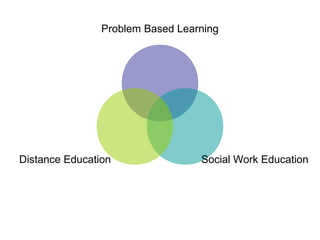
Problem Based Learning
Social Work EducationDistance Education
Methodology
• Within a group of students enrolled in a 2
year dual diploma program,
Instructor/Researcher taught 4 (3 credit
hour) courses:
• 2 for 1st
year students: 1 using PBL & 1
using Lecture Based Teaching
• 2 for 2nd
year student: 1 using PBL & 1
using Lecture Based Teaching
Data
• Throughout the term, all students were
required to maintain a journal and reflect
on:
– What they were learning
– How they were learning it
– How they knew they were learning it
– How would they demonstrate that they were
learning it
Data (2)
• Some classes were audio-taped
• Some classes were video-taped
– In the first ½ of the course
– In the second ½ of the course
• Instructor/Researcher maintained a journal
recording the classroom learning activities that
students engaged in
• Researcher/Instructor maintained a journal
recording students reactions and levels of
participation in the classroom learning activities
Data (3)
• At the beginning of the term, all students were provided
with an explanation about the research and asked to
complete a sheet of paper and indicate whether or not
they would participate in the research project. The sheet
of paper was then placed in a sealed envelope and
mailed to an independent third party
• Since all students filled in the form, no one was able to
tell who chose to participate and who chose not to
participate, including the Instructor/Researcher
• Once all evaluation was completed and Final Grades
were submitted to the Registrar, the Independent third
party released the signed sheets of paper to the
Researcher/Instructor
Data (4)
• One to one or focus group interviews were held
with those students who had consented to
participate in the research project
• Data was gathered on:
– The student’s experience and their perception of:
• Level of learning in PBL & Lecture courses
• Level of satisfaction with PBL & Lecture courses
• Level of participation in PBL & Lecture courses
• What they were doing differently in PBL & Lecture courses
Findings
• The Students
– 59 in 4 courses >19 Year 1 & 22 Year 2 > 14
agreed to participate
– 12 of the sample were female & 2 were male
– Physically located in 8 different communities
• 7 in Northwestern Ontario
• 1 in Northeastern Ontario
– Grade Point Average ranged from 2.96 to 4.0
with average being 3.4
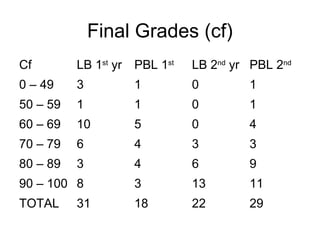
Final Grades (cf)
Cf LB 1st
yr PBL 1st
LB 2nd
yr PBL 2nd
0 – 49 3 1 0 1
50 – 59 1 1 0 1
60 – 69 10 5 0 4
70 – 79 6 4 3 3
80 – 89 3 4 6 9
90 – 100 8 3 13 11
TOTAL 31 18 22 29
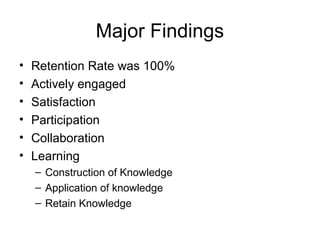
Major Findings
• Retention Rate was 100%
• Actively engaged
• Satisfaction
• Participation
• Collaboration
• Learning
– Construction of Knowledge
– Application of knowledge
– Retain Knowledge
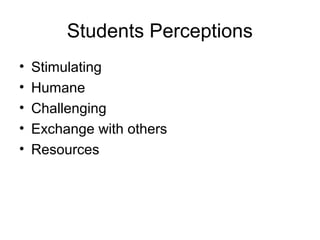
Students Perceptions
• Stimulating
• Humane
• Challenging
• Exchange with others
• Resources
Students Perceptions
• What were they doing differently?

Problem based learning

  • 1.
    Problem Based Learning: ACase Study Presented by: Deana Halonen Ph.D. Candidate, M.S.W., H.B.S.W halonen@cc.umanitoba.ca
  • 2.
    Agenda • Problem BasedLearning (PBL) – Characteristics – Basic Steps – Advantages – Limitations • The Case Study • Major Findings • Students Perceptions
  • 3.
    Problem Based Learning(PBL) • Began in 1950’s as a movement to restructure medical education at McMaster University (Canada) • Unlike traditional instruction that culminates in a problem after basic instruction on facts and skills (sometimes in the form of a test or exam), PBL begins with a problem, teaching facts and skills in a relevant context
  • 4.
    Characteristics of ProblemBased Learning • Requires students to solve authentic, real- life open-ended problems with many correct answers possible • Authentic problems are those real-life issues faced by doctors, nurses, social workers, police officers, lawyers, engineers, business administrators, pilots, etc., etc., etc.
  • 5.
    Characteristics of PBL •Emphasizes students’ pre-existing knowledge; “start with what you know” • Students actively participate by helping plan, organize, and evaluate the problem solving process • Interdisciplinary connections stressed • Students undertake authentic roles
  • 6.
    Basic Steps ofProblem Based Learning • Students divided into groups • Real problem is presented and discussed • Students identify – What is known in relation to the problem – What information is needed – What strategies or next steps to take in order to “learn” the information/knowledge/skills needed • Individuals research different issues, gather resources
  • 7.
    Basic Steps ofPBL (con’t) • Resources evaluated in group and new information/knowledge/skills shared/taught to rest of the group • Cycle repeats until students feel that problem has been framed adequately and all issues have been addressed • Possible actions, recommendations, solutions or hypotheses are generated • Tutor groups conduct peer/self assessments
  • 8.
    Facilitators and ProblemBased Learning • Teachers are seen as the “facilitator” and are key to these learning environments • Model higher-order process skills • Probe for student understanding • Never identify issues or state an opinion while students are framing the problems
  • 9.
    Advantages of ProblemBased Learning • Greater retention and recall of knowledge • Interdisciplinary: – can require accessing and using information from a variety of subject domains; – Better integration of knowledge – Integration of classroom & field • Development of life-long learning skills – How to research – How to communicate in groups – How to handle problems
  • 10.
    Advantages of PBL •Learning environment that is – Active – Cooperative – Self & peer assessed – Student centred – Highly effective • Learning environment that provides – Prompt feedback – Opportunities to account for personal learning preferences & multiple intelligences – Opportunities to allow for a variety of levels of learning
  • 11.
    Advantages of PBL •Learning environment that enhances critical thinking and problem solving skills • Greatest strength of PBL is: – Increased motivation – Increased student satisfaction – Increased Student-student interaction – Increased Student-instructor interaction
  • 12.
    Limitations of ProblemBased Learning • Requires significant pre-planning and development of – Authentic problems, cases, situations – Resources available for students • Literature • Resource people • Professionals in the field • Requires an authentic commitment and willingness to honor the knowledge, experience & skills that students bring to the learning experience
  • 13.
    Limitations of PBL •Requires a change of Paradigms – A shift of focus from what faculty teach to what students learn – A view of the Instructor as facilitator of the learning as opposed to “the one expert” whose role is to “bank knowledge” (Friere) through lectures or classroom demonstrations
  • 14.
    Resources & References •Problem-based learning, especially in the context of large classes Available online at http://www.chemeng.mcmaster.ca/pbl/pbl.htm • Stepien, Senn & Stepien (2000) The Internet and Problem-Based Learning: Developing Solutions through the web • Rankin (1999) Handbook on Problem-Based Learning Challis Resource Centre • Duch, Groh & Allen (2001) The Power of Problem-based Learning: A practical ‘how to’ for teaching undergraduate courses in any discipline
  • 15.
    The Problem • Imagineyou are at the end of a phone line with a group of students who are situated throughout a region, province, Canada, possibly beyond. It is a 3 hour class and you know that while students can hear you, they can’t see you or each other. • You have no idea if someone is chatting, has gone to the washroom, is reading the newspaper, making the weekly shopping list, or even left class for the day. • You want to ensure that students are connecting with the material, connecting with you (the Instructor), connecting with each other and connecting with the institution. • You know that students report general dissatisfaction with ‘distance education’ and learning at a distance from their instructors.
  • 16.
    The Case Study •How does Problem Based Teaching affect student satisfaction in Social Work courses delivered through virtual audioconferenced Distance Education classrooms?
  • 17.
    Problem Based Learning SocialWork EducationDistance Education
  • 18.
    Methodology • Within agroup of students enrolled in a 2 year dual diploma program, Instructor/Researcher taught 4 (3 credit hour) courses: • 2 for 1st year students: 1 using PBL & 1 using Lecture Based Teaching • 2 for 2nd year student: 1 using PBL & 1 using Lecture Based Teaching
  • 19.
    Data • Throughout theterm, all students were required to maintain a journal and reflect on: – What they were learning – How they were learning it – How they knew they were learning it – How would they demonstrate that they were learning it
  • 20.
    Data (2) • Someclasses were audio-taped • Some classes were video-taped – In the first ½ of the course – In the second ½ of the course • Instructor/Researcher maintained a journal recording the classroom learning activities that students engaged in • Researcher/Instructor maintained a journal recording students reactions and levels of participation in the classroom learning activities
  • 21.
    Data (3) • Atthe beginning of the term, all students were provided with an explanation about the research and asked to complete a sheet of paper and indicate whether or not they would participate in the research project. The sheet of paper was then placed in a sealed envelope and mailed to an independent third party • Since all students filled in the form, no one was able to tell who chose to participate and who chose not to participate, including the Instructor/Researcher • Once all evaluation was completed and Final Grades were submitted to the Registrar, the Independent third party released the signed sheets of paper to the Researcher/Instructor
  • 22.
    Data (4) • Oneto one or focus group interviews were held with those students who had consented to participate in the research project • Data was gathered on: – The student’s experience and their perception of: • Level of learning in PBL & Lecture courses • Level of satisfaction with PBL & Lecture courses • Level of participation in PBL & Lecture courses • What they were doing differently in PBL & Lecture courses
  • 23.
    Findings • The Students –59 in 4 courses >19 Year 1 & 22 Year 2 > 14 agreed to participate – 12 of the sample were female & 2 were male – Physically located in 8 different communities • 7 in Northwestern Ontario • 1 in Northeastern Ontario – Grade Point Average ranged from 2.96 to 4.0 with average being 3.4
  • 24.
    Final Grades (cf) CfLB 1st yr PBL 1st LB 2nd yr PBL 2nd 0 – 49 3 1 0 1 50 – 59 1 1 0 1 60 – 69 10 5 0 4 70 – 79 6 4 3 3 80 – 89 3 4 6 9 90 – 100 8 3 13 11 TOTAL 31 18 22 29
  • 25.
    Major Findings • RetentionRate was 100% • Actively engaged • Satisfaction • Participation • Collaboration • Learning – Construction of Knowledge – Application of knowledge – Retain Knowledge
  • 26.
    Students Perceptions • Stimulating •Humane • Challenging • Exchange with others • Resources
  • 27.
    Students Perceptions • Whatwere they doing differently?