PROJECT LEADERSHIP AND
ETHICS
GROUP MEMBERS:
NEELAM PRIYA
UNNATI MATAI
NAMITA KULKARNI
RAKESH JAIN
 Introduction and Definition
 Managing v/s Leading a Project
 Modern Approach to Leadership
 5 practices of Exemplary Leadership
 Leadership styles
 Emotional Intelligence
 Ethics in projects , business
 Ethical Leadership
 Common Ethical Dilemmas
 Challenge to International Projects
 Diversity Wheel
OUTLINE
So what is Project Management?
The planning and organization of an organization's
resources in order to move a specific task, event or
duty toward completion
It is the process of planning, organizing,
coordinating, directing, and controlling the
activities of others
INTRODUCTION
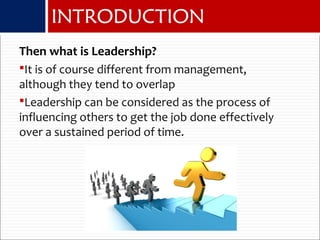
Then what is Leadership?
It is of course different from management,
although they tend to overlap
Leadership can be considered as the process of
influencing others to get the job done effectively
over a sustained period of time.
INTRODUCTION
MANAGING v/s LEADING A PROJECT
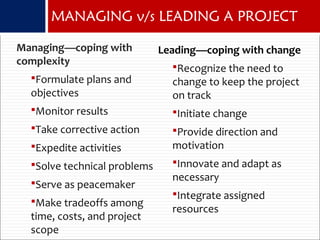
Managing—coping with
complexity
Formulate plans and
objectives
Monitor results
Take corrective action
Expedite activities
Solve technical problems
Serve as peacemaker
Make tradeoffs among
time, costs, and project
scope
Leading—coping with change
Recognize the need to
change to keep the project
on track
Initiate change
Provide direction and
motivation
Innovate and adapt as
necessary
Integrate assigned
resources
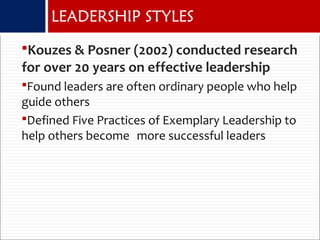
Kouzes & Posner (2002) conducted research
for over 20 years on effective leadership
Found leaders are often ordinary people who help
guide others
Defined Five Practices of Exemplary Leadership to
help others become more successful leaders
MODERN APPROACHES
MODERN APPROACHES
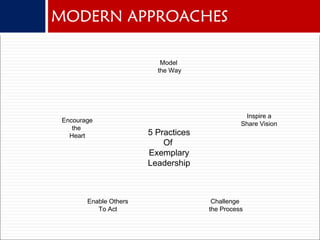
5 Practices
Of
Exemplary
Leadership
Model
the Way
Inspire a
Share Vision
Challenge
the Process
Enable Others
To Act
Encourage
the
Heart
MODEL THE WAY
It refers to the most fundamental way in which
leaders earn and sustain credibility
You must believe in the values you express, but
those values must not be merely your own principles,
they must represent what the company stands for
The best leaders are distinguished by relentless
effort, steadfastness, competence, and attention to
detail
5 PRACTICES OF EXEMPLARY LEADERSHIP
INSPIRE A VISION
An Exemplary leader is exceptionally good at
imagining a future that does not yet exist
The leader must convince people that he
understands their needs and have their interests at
heart
Leadership is a dialogue, not a monologue
5 PRACTICES OF EXEMPLARY LEADERSHIP
CHALLENGE THE PROCESS
Most leadership challenges involve a change in the
status quo and they must therefore challenge the
current process. They must search for opportunities
to innovate, grow and improve
The Exemplary Leaders minimize the risk of failure
for others while making people feel safe and
comfortable in taking risks
Failure is also a valuable learning experience
5 PRACTICES OF EXEMPLARY LEADERSHIP
ENABLE OTHERS TO ACT
Leaders must strengthen others by increasing self-
determination and developing competence
Leaders make an environment that makes it possible
for others to do good work
In short, a leader must turn his or her followers into
leaders themselves
5 PRACTICES OF EXEMPLARY LEADERSHIP
ENCOURAGE THE HEART
The leaders should show appreciation for people’s
contributions and create a culture to recognize
accomplishments
For example, establish a public recognition program
that rewards performance. First of all, this serves to
align behavior with the cherished values expressed
5 PRACTICES OF EXEMPLARY LEADERSHIP
Kouzes & Posner (2002) conducted research
for over 20 years on effective leadership
Found leaders are often ordinary people who help
guide others
Defined Five Practices of Exemplary Leadership to
help others become more successful leaders
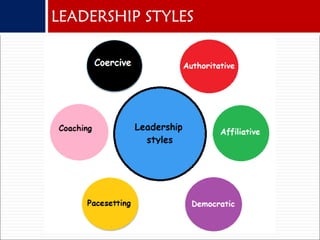
LEADERSHIP STYLES
LEADERSHIP STYLES
EMOTIONAL INTELLIGENCE
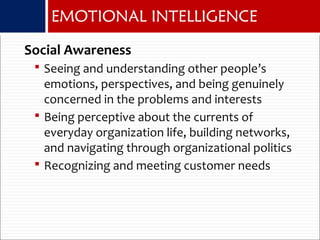
Social Awareness
 Seeing and understanding other people’s
emotions, perspectives, and being genuinely
concerned in the problems and interests
 Being perceptive about the currents of
everyday organization life, building networks,
and navigating through organizational politics
 Recognizing and meeting customer needs
EMOTIONAL INTELLIGENCE
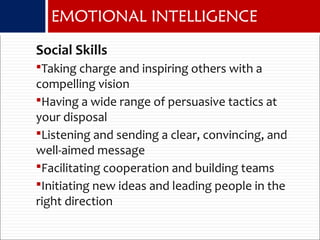
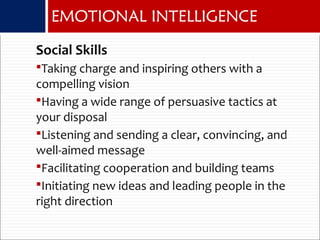
Social Skills
Taking charge and inspiring others with a
compelling vision
Having a wide range of persuasive tactics at
your disposal
Listening and sending a clear, convincing, and
well-aimed message
Facilitating cooperation and building teams
Initiating new ideas and leading people in the
right direction
EMOTIONAL INTELLIGENCE
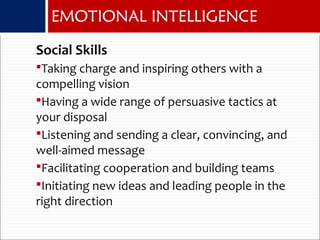
Social Skills
Taking charge and inspiring others with a
compelling vision
Having a wide range of persuasive tactics at
your disposal
Listening and sending a clear, convincing, and
well-aimed message
Facilitating cooperation and building teams
Initiating new ideas and leading people in the
right direction
EMOTIONAL INTELLIGENCE
Social Skills
Taking charge and inspiring others with a
compelling vision
Having a wide range of persuasive tactics at
your disposal
Listening and sending a clear, convincing, and
well-aimed message
Facilitating cooperation and building teams
Initiating new ideas and leading people in the
right direction
EMOTIONAL INTELLIGENCE
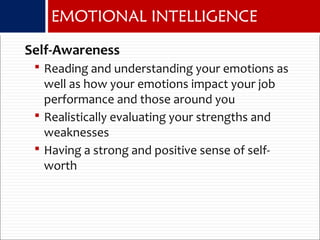
Self-Awareness
 Reading and understanding your emotions as
well as how your emotions impact your job
performance and those around you
 Realistically evaluating your strengths and
weaknesses
 Having a strong and positive sense of self-
worth
EMOTIONAL INTELLIGENCE
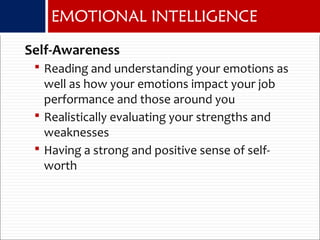
Self-Awareness
 Reading and understanding your emotions as
well as how your emotions impact your job
performance and those around you
 Realistically evaluating your strengths and
weaknesses
 Having a strong and positive sense of self-
worth

What is Project Management

  • 1.
    PROJECT LEADERSHIP AND ETHICS GROUPMEMBERS: NEELAM PRIYA UNNATI MATAI NAMITA KULKARNI RAKESH JAIN
  • 2.
     Introduction andDefinition  Managing v/s Leading a Project  Modern Approach to Leadership  5 practices of Exemplary Leadership  Leadership styles  Emotional Intelligence  Ethics in projects , business  Ethical Leadership  Common Ethical Dilemmas  Challenge to International Projects  Diversity Wheel OUTLINE
  • 3.
    So what isProject Management? The planning and organization of an organization's resources in order to move a specific task, event or duty toward completion It is the process of planning, organizing, coordinating, directing, and controlling the activities of others INTRODUCTION
  • 4.
    Then what isLeadership? It is of course different from management, although they tend to overlap Leadership can be considered as the process of influencing others to get the job done effectively over a sustained period of time. INTRODUCTION
  • 5.
    MANAGING v/s LEADINGA PROJECT Managing—coping with complexity Formulate plans and objectives Monitor results Take corrective action Expedite activities Solve technical problems Serve as peacemaker Make tradeoffs among time, costs, and project scope Leading—coping with change Recognize the need to change to keep the project on track Initiate change Provide direction and motivation Innovate and adapt as necessary Integrate assigned resources
  • 6.
    Kouzes & Posner(2002) conducted research for over 20 years on effective leadership Found leaders are often ordinary people who help guide others Defined Five Practices of Exemplary Leadership to help others become more successful leaders MODERN APPROACHES
  • 7.
    MODERN APPROACHES 5 Practices Of Exemplary Leadership Model theWay Inspire a Share Vision Challenge the Process Enable Others To Act Encourage the Heart
  • 8.
    MODEL THE WAY Itrefers to the most fundamental way in which leaders earn and sustain credibility You must believe in the values you express, but those values must not be merely your own principles, they must represent what the company stands for The best leaders are distinguished by relentless effort, steadfastness, competence, and attention to detail 5 PRACTICES OF EXEMPLARY LEADERSHIP
  • 9.
    INSPIRE A VISION AnExemplary leader is exceptionally good at imagining a future that does not yet exist The leader must convince people that he understands their needs and have their interests at heart Leadership is a dialogue, not a monologue 5 PRACTICES OF EXEMPLARY LEADERSHIP
  • 10.
    CHALLENGE THE PROCESS Mostleadership challenges involve a change in the status quo and they must therefore challenge the current process. They must search for opportunities to innovate, grow and improve The Exemplary Leaders minimize the risk of failure for others while making people feel safe and comfortable in taking risks Failure is also a valuable learning experience 5 PRACTICES OF EXEMPLARY LEADERSHIP
  • 11.
    ENABLE OTHERS TOACT Leaders must strengthen others by increasing self- determination and developing competence Leaders make an environment that makes it possible for others to do good work In short, a leader must turn his or her followers into leaders themselves 5 PRACTICES OF EXEMPLARY LEADERSHIP
  • 12.
    ENCOURAGE THE HEART Theleaders should show appreciation for people’s contributions and create a culture to recognize accomplishments For example, establish a public recognition program that rewards performance. First of all, this serves to align behavior with the cherished values expressed 5 PRACTICES OF EXEMPLARY LEADERSHIP
  • 13.
    Kouzes & Posner(2002) conducted research for over 20 years on effective leadership Found leaders are often ordinary people who help guide others Defined Five Practices of Exemplary Leadership to help others become more successful leaders LEADERSHIP STYLES
  • 14.
  • 15.
    EMOTIONAL INTELLIGENCE Social Awareness Seeing and understanding other people’s emotions, perspectives, and being genuinely concerned in the problems and interests  Being perceptive about the currents of everyday organization life, building networks, and navigating through organizational politics  Recognizing and meeting customer needs
  • 16.
    EMOTIONAL INTELLIGENCE Social Skills Takingcharge and inspiring others with a compelling vision Having a wide range of persuasive tactics at your disposal Listening and sending a clear, convincing, and well-aimed message Facilitating cooperation and building teams Initiating new ideas and leading people in the right direction
  • 17.
    EMOTIONAL INTELLIGENCE Social Skills Takingcharge and inspiring others with a compelling vision Having a wide range of persuasive tactics at your disposal Listening and sending a clear, convincing, and well-aimed message Facilitating cooperation and building teams Initiating new ideas and leading people in the right direction
  • 18.
    EMOTIONAL INTELLIGENCE Social Skills Takingcharge and inspiring others with a compelling vision Having a wide range of persuasive tactics at your disposal Listening and sending a clear, convincing, and well-aimed message Facilitating cooperation and building teams Initiating new ideas and leading people in the right direction
  • 19.
    EMOTIONAL INTELLIGENCE Self-Awareness  Readingand understanding your emotions as well as how your emotions impact your job performance and those around you  Realistically evaluating your strengths and weaknesses  Having a strong and positive sense of self- worth
  • 20.
    EMOTIONAL INTELLIGENCE Self-Awareness  Readingand understanding your emotions as well as how your emotions impact your job performance and those around you  Realistically evaluating your strengths and weaknesses  Having a strong and positive sense of self- worth