Organizing in the 21st century
Towards a new paradigm
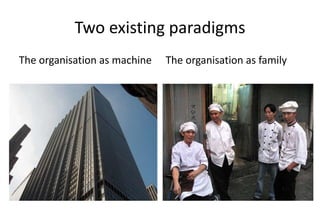
Two existing paradigms
The organization as machine The organization as family
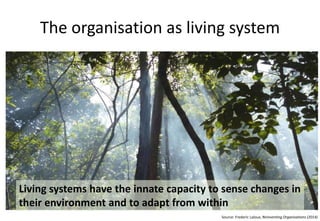
The organization as living system
Living systems have the innate capacity to sense changes in
their environment and to adapt from within
Source: Frederic Laloux, Reinventing Organisations (2014)
3 principles:
• Self-management
• Wholeness
• Evolutionairy purpose
Source: Frederic Laloux, Reinventing Organisations (2014)
Self-management
• No hierarchy/control, or
consensus but…
• Everyone has the level of
power necessary for their
job
• Clear structures
• Capacity building for conflict
resolving and decision-
making
• No functions but roles
• Transparancy
Source: Frederic Laloux, Reinventing Organisations (2014)
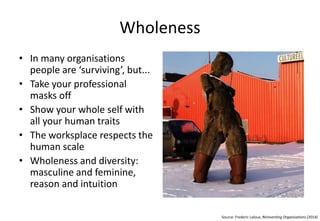
Wholeness
• In many organizations
people are ‘surviving’, but...
• Take your professional
masks off
• Show your whole self with
all your human traits
• The workplace respects the
human scale
• Wholeness and diversity:
masculine and feminine,
reason and intuition
Source: Frederic Laloux, Reinventing Organisations (2014)
Evolutionairy purpose
• The organization is not a
holding or a collection of
people, but...
• The organization has its
own evolutionary purpose
• Listen to what it wants to
become
• Follow the natural
development
Source: Frederic Laloux, Reinventing Organisations (2014)
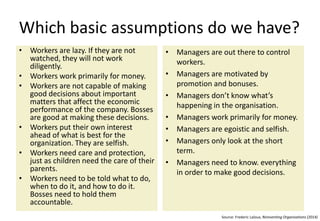
Which basic assumptions do we have?
• Workers are lazy. If they are not
watched, they will not work
diligently.
• Workers work primarily for money.
• Workers are not capable of making
good decisions about important
matters that affect the economic
performance of the company. Bosses
are good at making these decisions.
• Workers put their own interest
ahead of what is best for the
organization. They are selfish.
• Workers need care and protection,
just as children need the care of their
parents.
• Workers need to be told what to do,
when to do it, and how to do it.
Bosses need to hold them
accountable.
• Managers are out there to control
workers.
• Managers are motivated by
promotion and bonuses.
• Managers don’t know what’s
happening in the organisation.
• Managers work primarily for money.
• Managers are egoistic and selfish.
• Managers only look at the short
term.
• Managers need to have all
information in order to make good
decisions.
Source: Frederic Laloux, Reinventing Organisations (2014)
Which assumption do you have yourself?
• Fear, control, scarcity
Or
• Abundance, trust
“There are not problems waiting to be solved but
potential waiting to be unfolded” *
“It will be painful”
“Work with people
who are ready for it”
*Source: Frederic Laloux, Reinventing Organisations (2014)
Contact me for more information
or start a conversation
E-mail: m.sturm@salineadvies.nl
Phone: +31 6 22614208
A few people can build a bridge
that can be walked on by many

Teal organizations

  • 1.
    Organizing in the21st century Towards a new paradigm
  • 2.
    Two existing paradigms Theorganization as machine The organization as family
  • 3.
    The organization asliving system
  • 4.
    The organization asliving system Living systems have the innate capacity to sense changes in their environment and to adapt from within Source: Frederic Laloux, Reinventing Organisations (2014)
  • 5.
    3 principles: • Self-management •Wholeness • Evolutionairy purpose Source: Frederic Laloux, Reinventing Organisations (2014)
  • 6.
    Self-management • No hierarchy/control,or consensus but… • Everyone has the level of power necessary for their job • Clear structures • Capacity building for conflict resolving and decision- making • No functions but roles • Transparancy Source: Frederic Laloux, Reinventing Organisations (2014)
  • 7.
    Wholeness • In manyorganizations people are ‘surviving’, but... • Take your professional masks off • Show your whole self with all your human traits • The workplace respects the human scale • Wholeness and diversity: masculine and feminine, reason and intuition Source: Frederic Laloux, Reinventing Organisations (2014)
  • 8.
    Evolutionairy purpose • Theorganization is not a holding or a collection of people, but... • The organization has its own evolutionary purpose • Listen to what it wants to become • Follow the natural development Source: Frederic Laloux, Reinventing Organisations (2014)
  • 9.
    Which basic assumptionsdo we have? • Workers are lazy. If they are not watched, they will not work diligently. • Workers work primarily for money. • Workers are not capable of making good decisions about important matters that affect the economic performance of the company. Bosses are good at making these decisions. • Workers put their own interest ahead of what is best for the organization. They are selfish. • Workers need care and protection, just as children need the care of their parents. • Workers need to be told what to do, when to do it, and how to do it. Bosses need to hold them accountable. • Managers are out there to control workers. • Managers are motivated by promotion and bonuses. • Managers don’t know what’s happening in the organisation. • Managers work primarily for money. • Managers are egoistic and selfish. • Managers only look at the short term. • Managers need to have all information in order to make good decisions. Source: Frederic Laloux, Reinventing Organisations (2014)
  • 10.
    Which assumption doyou have yourself? • Fear, control, scarcity Or • Abundance, trust
  • 13.
    “There are notproblems waiting to be solved but potential waiting to be unfolded” * “It will be painful” “Work with people who are ready for it” *Source: Frederic Laloux, Reinventing Organisations (2014)
  • 14.
    Contact me formore information or start a conversation E-mail: m.sturm@salineadvies.nl Phone: +31 6 22614208
  • 15.
    A few peoplecan build a bridge that can be walked on by many