The Leadership Challenge
What Effective Leaders do?

 Leaders mobilize others to want to get extraordinary things
  done in organizations.
 Leaders transform values into actions, visions into realities,
  obstacles into innovations, separateness into solidarity, and
  risks into rewards.
 Leaders create the climate in which people turn challenging
  opportunities into remarkable successes.


                                         Kouzes & Posner, 2007, p.xi
Leadership

Definition of Leadership
 Leadership is a relationship; it is about behavior not
  personality. Leadership is everyone's business; it is an
  ongoing process that can happen anywhere and at any time.
 Leadership is the skill of influencing people to work
  enthusiastically for the common good.

Our Leadership Imperative
  Great Leadership = Engaged Employees = Positive Business Outcome
Importance of Employee Engagement

 The world's top-performing organizations understand that
  employee engagement is a force that drives business
  outcomes. In the best organizations, engagement is more
  than a human resources initiative -- it is a strategic
  foundation for the way they do business.
 World-class organizations unleash their potential for
  growth by optimizing their employee and customer
  relationships. Organizations that have optimized
  engagement have 2.6 times the earnings per share (EPS)
  growth rate compared to organizations with lower
  engagement in their same industry.


                                   Employee Engagement, 2009, p.1
Leadership Research

 Jim Kouzes and Barry Posner conducted extensive research
 on leadership. Kouzes and Posner collected thousands of
 "Personal Best" stories. People were asked to recalled peak
 leadership experiences. Despite differences in stories, a
 pattern emerged. The “best leadership experiences”
 revealed that when leaders are at their personal best, they
 display key behaviors. Kouzes and Posner grouped these
 behaviors into five key practices.


                           The Leadership Challenge : Approach, 2009
Five Practices of Exemplary Leadership

 When getting extraordinary things done in organizations,
 leaders engage in Five Practices of Exemplary Leadership.
    Model the Way
    Inspire a Shared Vision
    Challenge the Process
    Enable Others to Act
    Encourage the Heart


                                    Kouzes & Posner, 2007, p. 14
Ten Commitments of Leadership

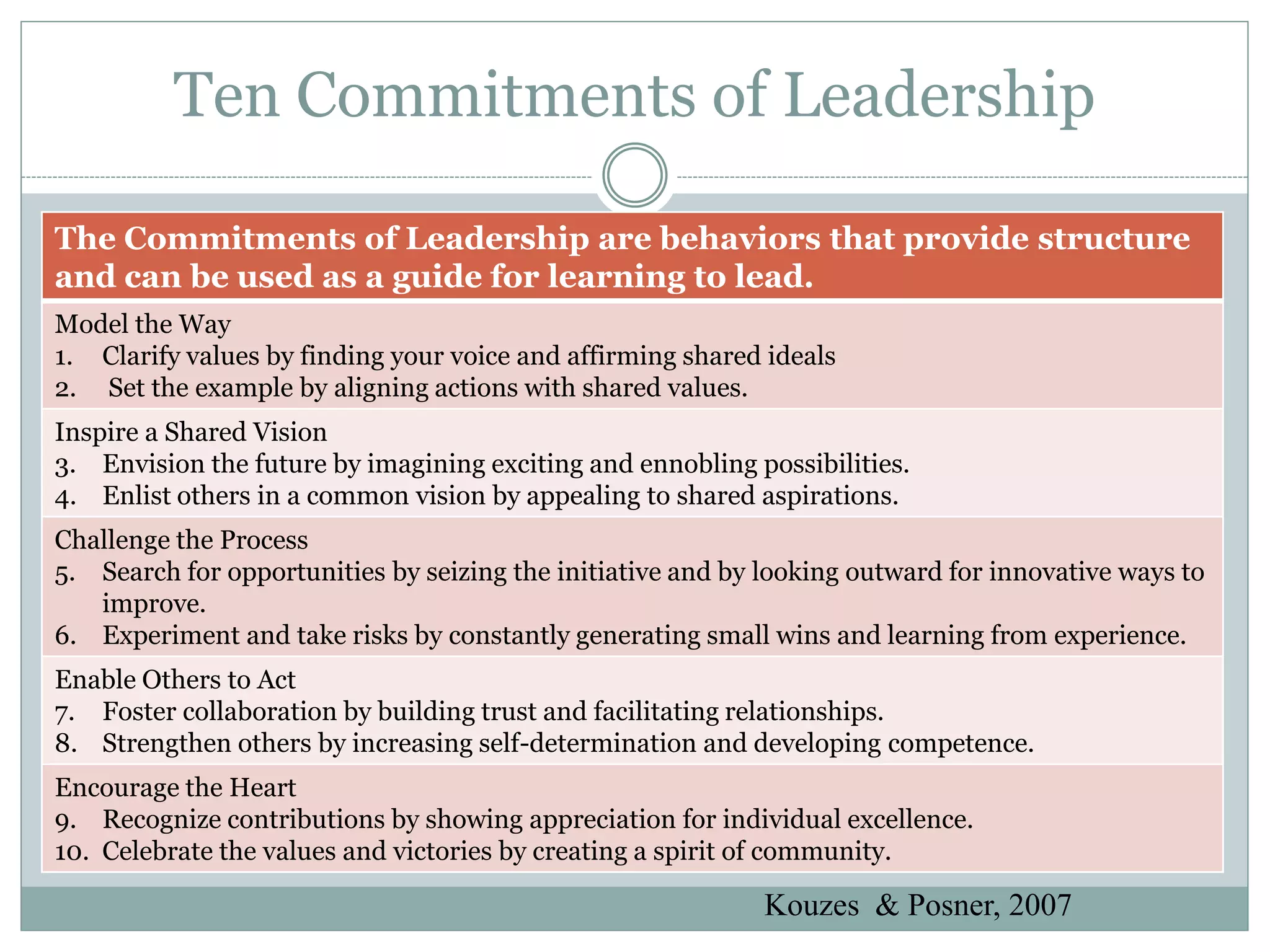
The Commitments of Leadership are behaviors that provide structure
and can be used as a guide for learning to lead.
Model the Way
1. Clarify values by finding your voice and affirming shared ideals
2. Set the example by aligning actions with shared values.
Inspire a Shared Vision
3. Envision the future by imagining exciting and ennobling possibilities.
4. Enlist others in a common vision by appealing to shared aspirations.
Challenge the Process
5. Search for opportunities by seizing the initiative and by looking outward for innovative ways to
   improve.
6. Experiment and take risks by constantly generating small wins and learning from experience.
Enable Others to Act
7. Foster collaboration by building trust and facilitating relationships.
8. Strengthen others by increasing self-determination and developing competence.
Encourage the Heart
9. Recognize contributions by showing appreciation for individual excellence.
10. Celebrate the values and victories by creating a spirit of community.

                                                             Kouzes & Posner, 2007
Foundation of Leadership

Credibility is the foundation of leadership
 Leadership is the relationship between the leader and the
  followers. In order for people to want to follow, there must
  be trust. Therefore, credibility is the foundation of
  leadership. Without credibility the leader's message will
  not be believed.
 Over 20 years of research by Kouzes and Posner continues
  to validate that followers expect leaders to be honest,
  forward-looking, competent and inspiring.


                                         Kouzes & Posner, 2007
Foundation of Leadership

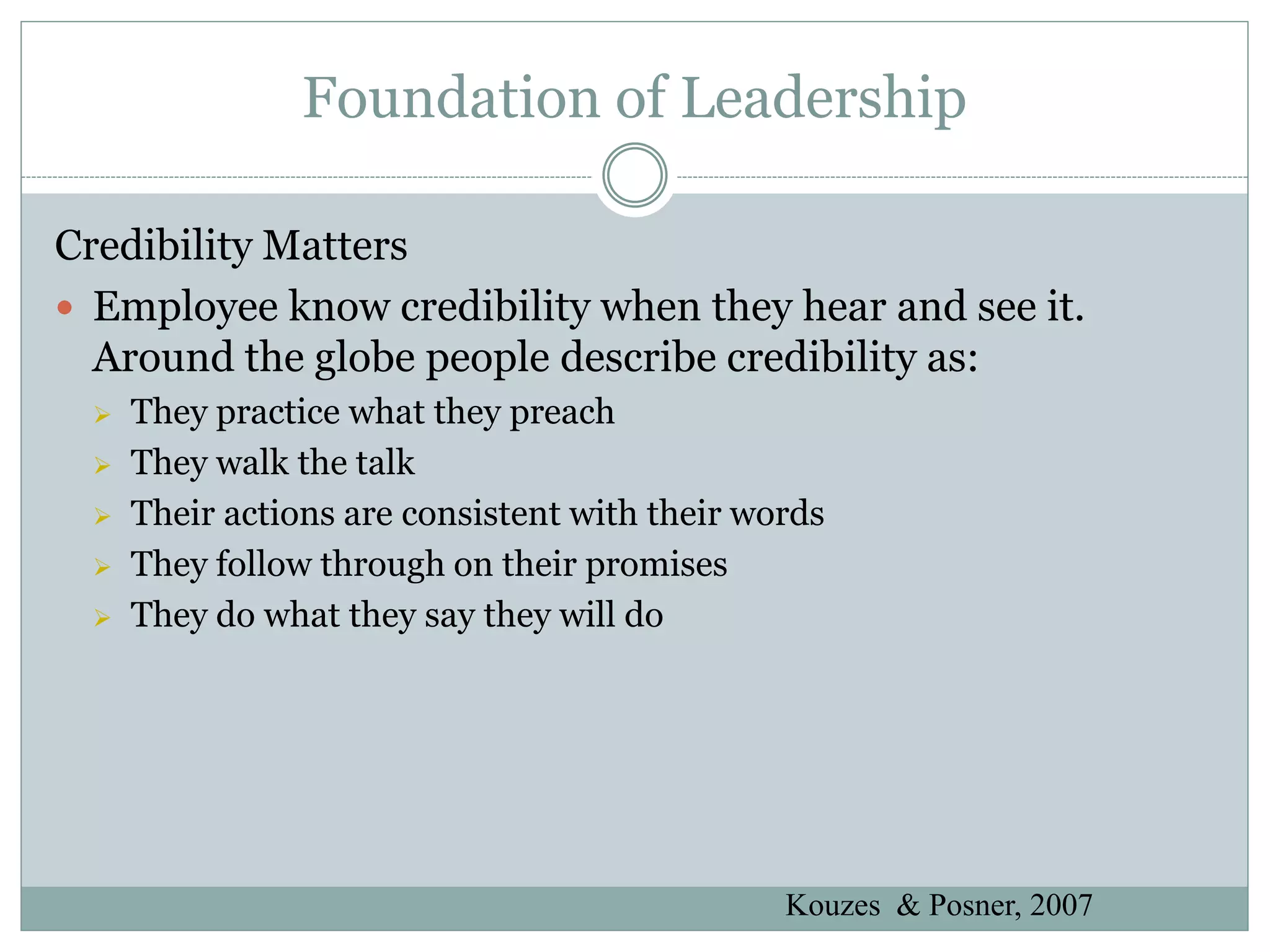
Credibility Matters
 If employees don’t trust and believe in their manager, they
  will not believe the message.
 When employees perceive their manager has high
  credibility, they are more likely to:
     Be promoters of the organization
     Have strong sense of team spirit
     Be attached and committed to the organization
     Have a sense of ownership
     See the alignment between their own personal values and the values
      of the organization


                                                  Kouzes & Posner, 2007
Foundation of Leadership

Credibility Matters
 When employees perceive their manager as having
  low credibility, they are more likely to:
    Produce only when they are being watched
    Be motivated primarily by money
    Promote the organization publicly but criticize the organization
     privately
    Feel unsupported and unappreciated


                                                   Kouzes & Posner, 2007
Foundation of Leadership

Credibility Matters
 Employee know credibility when they hear and see it.
  Around the globe people describe credibility as:
    They practice what they preach
    They walk the talk
    Their actions are consistent with their words
    They follow through on their promises
    They do what they say they will do


                                               Kouzes & Posner, 2007
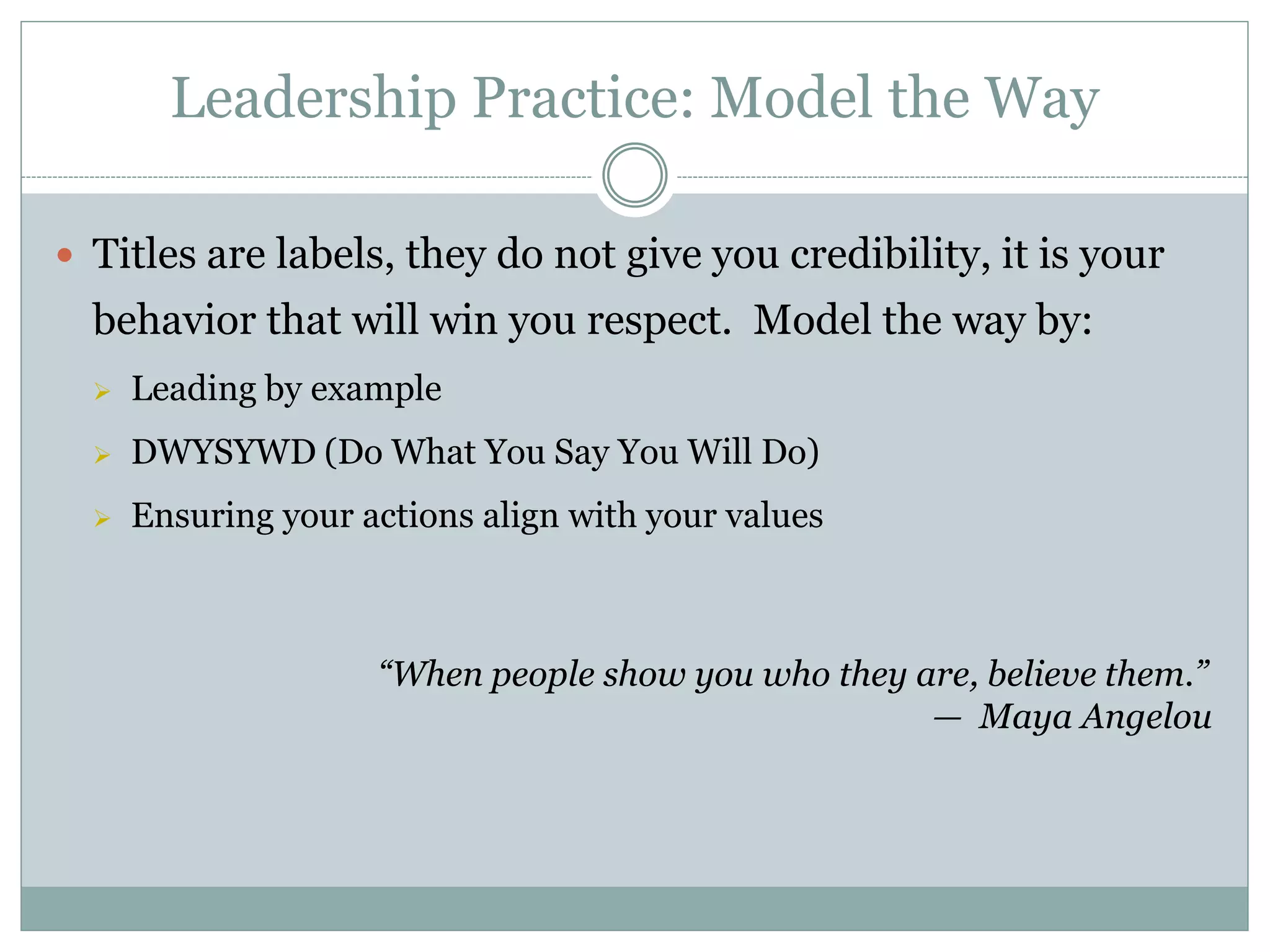
Leadership Practice: Model the Way

 Titles are labels, they do not give you credibility, it is your
  behavior that will win you respect. Model the way by:
     Leading by example
     DWYSYWD (Do What You Say You Will Do)
     Ensuring your actions align with your values


                     “When people show you who they are, believe them.”
                                                     — Maya Angelou
Leadership in Action: Model the Way

Commitment Number 1                 Commitment Number 2
 Essentials of:                     Essentials of:
  Clarifying Values                   Setting the Example
   Find your voice                    Personify the shared values

   Affirm shared values               Teach others to model the
                                        values
 Taking Action
                                     Taking Action
     Write a tribute to yourself
                                         Do a personal audit
     Write your credo
                                         Develop a routine for
     Engage in a credo dialogue          questioning
                                         Put storytelling on your meeting
                                          agenda
Leadership Practice: Inspire a Shared Vision

 Leaders awaken the passion in others by communicating a
 compelling vision of their followers. Inspire a shared vision
 by:
    Envisioning the future
    Finding a common purpose
    Listening to others
    Identifying what is important to others


            “A leader has the vision and conviction that a dream can be
            achieved. He inspires the power and energy to get it done.”
                                                         — Ralph Lauren
Leadership in Action: Inspire a Shared Vision

Commitment Number 3                    Commitment Number 4
 Essentials of:                        Essentials of:
  Envisioning the Future                 Enlisting Others
   Imagine the possibilities             Appeal to common ideals

   Find a common purpose                 Animate the vision


 Taking Action                         Taking Action
     Determine the something you           Record you shared vision
      want to do                            Breathe life into your vision
     Picture what you will do next         Expand your communication
     Survey your constituents about         and expressiveness skills
      their aspirations
Leadership Practice: Challenge the Process

 Leaders are always looking for ways to innovate, grow and
 improve. They are risk takers that recognize and support
 good ideas and learn from their mistakes. Challenge the
 Process by:
  Searching for opportunities
  Experimenting and taking risks
  Learning from your mistakes
  Encourage and promote good ideas

         "Don't be afraid to challenge the pros, even in their own
         backyard."
                                                         — Colin Powell
Leadership in Action: Challenge the Process

Commitment Number 5                     Commitment Number 6
 Essentials of:                         Essentials of:
  Searching for Opportunities             Experimenting and Taking Risks
   Seize the initiative                   Generate small wins

   Exercise outsight                      Learn from experience


 Taking Action                          Taking Action
     Treat every job as an adventure        Conduct postmortems
     Question the status quo                Conduct pre-mortems
     Send everyone shopping for             Strengthen resilience
      ideas
Leadership Practice: Enable Others to Act

 Leadership is a team effort. Great leaders can accomplish
  remarkable things by enabling others. They reinforce and
  support others, making each person feel talented and a vital
  part of the team. Enable Others to Act by:
     Sharing power with others
     Offering support
     Knowing when to be a coach and when to be a team member
     Building a culture of collaboration
            Good leaders make people feel that they’re at the very heart of
            things, not at the periphery. Everyone feels that he or she makes a
            difference to the success of the organization. When that happens
            people feel centered and that gives their work meaning.
                                                                — Warren Bennis
Leadership in Action: Enable Others to Act

Commitment Number 7                       Commitment Number 8
 Essentials of:                           Essentials of:
  Fostering Collaboration                   Strengthening Others
   Create a climate of trust                Enhance self-determination

   Facilitate relationships                 Develop competence and
                                               confidence
 Taking Action
     Show trust to build trust            Taking Action
     Say we, ask questions, listen and        Increase individual
      take advice                               accountability
     Get people interacting                   Offer visible support
                                               Conduct monthly coaching
                                                conversations
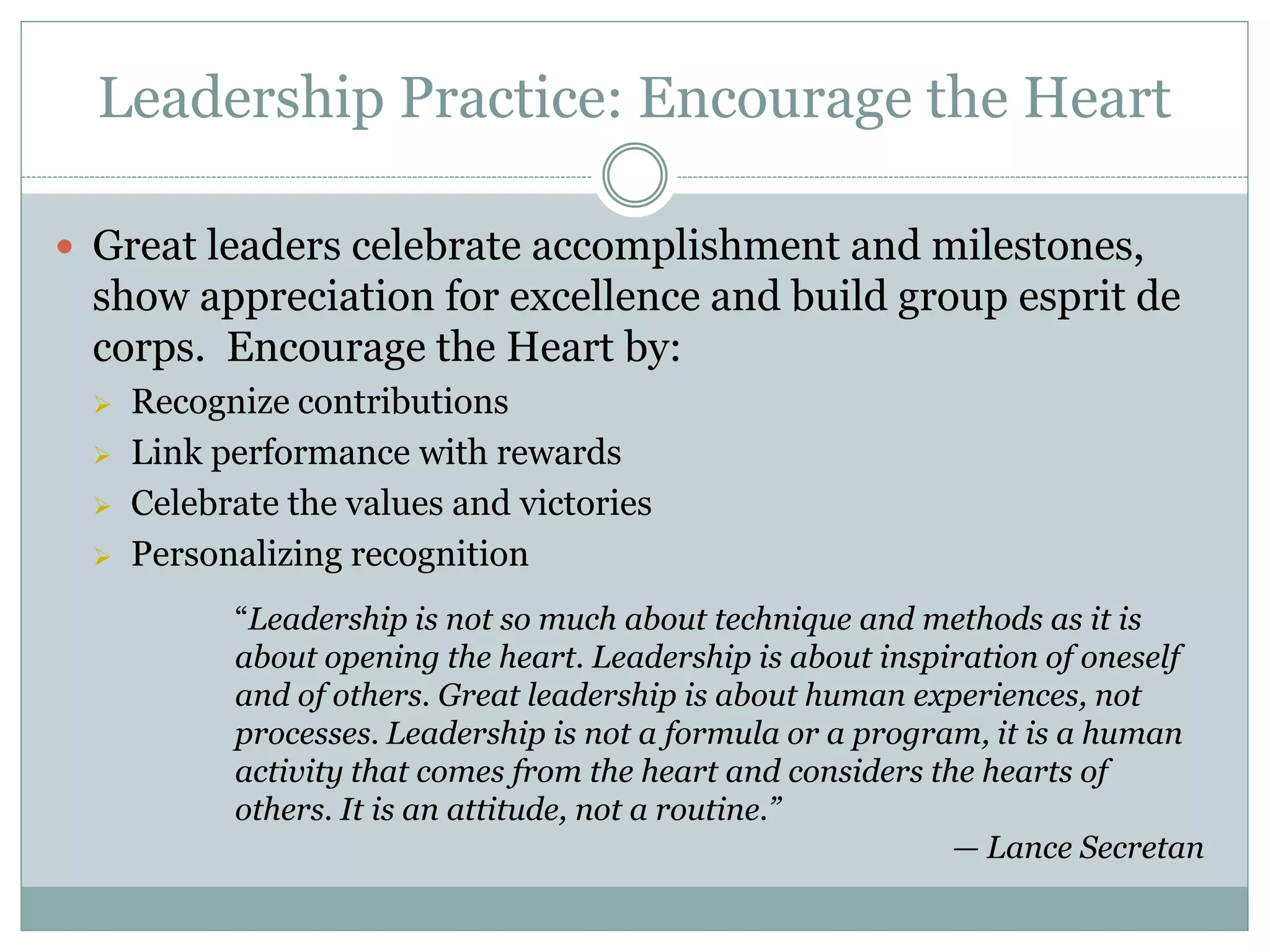
Leadership Practice: Encourage the Heart

 Great leaders celebrate accomplishment and milestones,
 show appreciation for excellence and build group esprit de
 corps. Encourage the Heart by:
    Recognize contributions
    Link performance with rewards
    Celebrate the values and victories
    Personalizing recognition
           “Leadership is not so much about technique and methods as it is
           about opening the heart. Leadership is about inspiration of oneself
           and of others. Great leadership is about human experiences, not
           processes. Leadership is not a formula or a program, it is a human
           activity that comes from the heart and considers the hearts of
           others. It is an attitude, not a routine.”
                                                              — Lance Secretan
Leadership in Action: Encourage the Heart

Commitment Number 9                  Commitment Number 10
 Essentials of:                      Essentials of:
  Recognizing Contributions            Celebrating the Values and
   Expect the best                    Victories
   Personalize recognition             Create a spirit of community

                                        Be personally involved

 Taking Action
     Find out what is encouraging    Taking Action
     Stop by for a visit                 Plan a celebration today
     Develop a winner’s attitude         Reinforce core values in your
                                           celebrations
                                          Enjoy yourself
Summary

 During these tough times, it is critical to continue to
 invest in building better leaders. An investment in
 the development of exemplary leaders will enable the
 organization to meet of the current and future
 business environment.
References

 George, B. (2008, November 19). Failed leadership caused the
  financial crisis. Retrieved September 21, 2009, from US News and
  World Report website:
  http://www.usnews.com/‌ obile/‌ rticles_mobile/‌ ailed-leadership-
                             m      a                f
  caused-the-financial-crisis/‌ndex.html
                               i
 Kouzes, J. M., & Posner, B. Z. (2007). The leadership challenge (4th
  ed.). San Francisco, CA: Jossey-Bass Wiley Imprint. (Original work
  published 1945)
 The leadership challenge: Approach. (n.d.). Retrieved September 21,
  2009, from John Wiley & Sons Inc. website:
  http://www.leadershipchallenge.com/‌ ileyCDA/‌ ection/‌d-
                                         W           S       i
  131055.html

Leadership challenge

  • 1.
  • 2.
    What Effective Leadersdo?  Leaders mobilize others to want to get extraordinary things done in organizations.  Leaders transform values into actions, visions into realities, obstacles into innovations, separateness into solidarity, and risks into rewards.  Leaders create the climate in which people turn challenging opportunities into remarkable successes. Kouzes & Posner, 2007, p.xi
  • 3.
    Leadership Definition of Leadership Leadership is a relationship; it is about behavior not personality. Leadership is everyone's business; it is an ongoing process that can happen anywhere and at any time.  Leadership is the skill of influencing people to work enthusiastically for the common good. Our Leadership Imperative Great Leadership = Engaged Employees = Positive Business Outcome
  • 4.
    Importance of EmployeeEngagement  The world's top-performing organizations understand that employee engagement is a force that drives business outcomes. In the best organizations, engagement is more than a human resources initiative -- it is a strategic foundation for the way they do business.  World-class organizations unleash their potential for growth by optimizing their employee and customer relationships. Organizations that have optimized engagement have 2.6 times the earnings per share (EPS) growth rate compared to organizations with lower engagement in their same industry. Employee Engagement, 2009, p.1
  • 5.
    Leadership Research  JimKouzes and Barry Posner conducted extensive research on leadership. Kouzes and Posner collected thousands of "Personal Best" stories. People were asked to recalled peak leadership experiences. Despite differences in stories, a pattern emerged. The “best leadership experiences” revealed that when leaders are at their personal best, they display key behaviors. Kouzes and Posner grouped these behaviors into five key practices. The Leadership Challenge : Approach, 2009
  • 6.
    Five Practices ofExemplary Leadership  When getting extraordinary things done in organizations, leaders engage in Five Practices of Exemplary Leadership.  Model the Way  Inspire a Shared Vision  Challenge the Process  Enable Others to Act  Encourage the Heart Kouzes & Posner, 2007, p. 14
  • 7.
    Ten Commitments ofLeadership The Commitments of Leadership are behaviors that provide structure and can be used as a guide for learning to lead. Model the Way 1. Clarify values by finding your voice and affirming shared ideals 2. Set the example by aligning actions with shared values. Inspire a Shared Vision 3. Envision the future by imagining exciting and ennobling possibilities. 4. Enlist others in a common vision by appealing to shared aspirations. Challenge the Process 5. Search for opportunities by seizing the initiative and by looking outward for innovative ways to improve. 6. Experiment and take risks by constantly generating small wins and learning from experience. Enable Others to Act 7. Foster collaboration by building trust and facilitating relationships. 8. Strengthen others by increasing self-determination and developing competence. Encourage the Heart 9. Recognize contributions by showing appreciation for individual excellence. 10. Celebrate the values and victories by creating a spirit of community. Kouzes & Posner, 2007
  • 8.
    Foundation of Leadership Credibilityis the foundation of leadership  Leadership is the relationship between the leader and the followers. In order for people to want to follow, there must be trust. Therefore, credibility is the foundation of leadership. Without credibility the leader's message will not be believed.  Over 20 years of research by Kouzes and Posner continues to validate that followers expect leaders to be honest, forward-looking, competent and inspiring. Kouzes & Posner, 2007
  • 9.
    Foundation of Leadership CredibilityMatters  If employees don’t trust and believe in their manager, they will not believe the message.  When employees perceive their manager has high credibility, they are more likely to:  Be promoters of the organization  Have strong sense of team spirit  Be attached and committed to the organization  Have a sense of ownership  See the alignment between their own personal values and the values of the organization Kouzes & Posner, 2007
  • 10.
    Foundation of Leadership CredibilityMatters  When employees perceive their manager as having low credibility, they are more likely to:  Produce only when they are being watched  Be motivated primarily by money  Promote the organization publicly but criticize the organization privately  Feel unsupported and unappreciated Kouzes & Posner, 2007
  • 11.
    Foundation of Leadership CredibilityMatters  Employee know credibility when they hear and see it. Around the globe people describe credibility as:  They practice what they preach  They walk the talk  Their actions are consistent with their words  They follow through on their promises  They do what they say they will do Kouzes & Posner, 2007
  • 12.
    Leadership Practice: Modelthe Way  Titles are labels, they do not give you credibility, it is your behavior that will win you respect. Model the way by:  Leading by example  DWYSYWD (Do What You Say You Will Do)  Ensuring your actions align with your values “When people show you who they are, believe them.” — Maya Angelou
  • 13.
    Leadership in Action:Model the Way Commitment Number 1 Commitment Number 2  Essentials of:  Essentials of: Clarifying Values Setting the Example  Find your voice  Personify the shared values  Affirm shared values  Teach others to model the values  Taking Action  Taking Action  Write a tribute to yourself  Do a personal audit  Write your credo  Develop a routine for  Engage in a credo dialogue questioning  Put storytelling on your meeting agenda
  • 14.
    Leadership Practice: Inspirea Shared Vision  Leaders awaken the passion in others by communicating a compelling vision of their followers. Inspire a shared vision by:  Envisioning the future  Finding a common purpose  Listening to others  Identifying what is important to others “A leader has the vision and conviction that a dream can be achieved. He inspires the power and energy to get it done.” — Ralph Lauren
  • 15.
    Leadership in Action:Inspire a Shared Vision Commitment Number 3 Commitment Number 4  Essentials of:  Essentials of: Envisioning the Future Enlisting Others  Imagine the possibilities  Appeal to common ideals  Find a common purpose  Animate the vision  Taking Action  Taking Action  Determine the something you  Record you shared vision want to do  Breathe life into your vision  Picture what you will do next  Expand your communication  Survey your constituents about and expressiveness skills their aspirations
  • 16.
    Leadership Practice: Challengethe Process  Leaders are always looking for ways to innovate, grow and improve. They are risk takers that recognize and support good ideas and learn from their mistakes. Challenge the Process by:  Searching for opportunities  Experimenting and taking risks  Learning from your mistakes  Encourage and promote good ideas "Don't be afraid to challenge the pros, even in their own backyard." — Colin Powell
  • 17.
    Leadership in Action:Challenge the Process Commitment Number 5 Commitment Number 6  Essentials of:  Essentials of: Searching for Opportunities Experimenting and Taking Risks  Seize the initiative  Generate small wins  Exercise outsight  Learn from experience  Taking Action  Taking Action  Treat every job as an adventure  Conduct postmortems  Question the status quo  Conduct pre-mortems  Send everyone shopping for  Strengthen resilience ideas
  • 18.
    Leadership Practice: EnableOthers to Act  Leadership is a team effort. Great leaders can accomplish remarkable things by enabling others. They reinforce and support others, making each person feel talented and a vital part of the team. Enable Others to Act by:  Sharing power with others  Offering support  Knowing when to be a coach and when to be a team member  Building a culture of collaboration Good leaders make people feel that they’re at the very heart of things, not at the periphery. Everyone feels that he or she makes a difference to the success of the organization. When that happens people feel centered and that gives their work meaning. — Warren Bennis
  • 19.
    Leadership in Action:Enable Others to Act Commitment Number 7 Commitment Number 8  Essentials of:  Essentials of: Fostering Collaboration Strengthening Others  Create a climate of trust  Enhance self-determination  Facilitate relationships  Develop competence and confidence  Taking Action  Show trust to build trust  Taking Action  Say we, ask questions, listen and  Increase individual take advice accountability  Get people interacting  Offer visible support  Conduct monthly coaching conversations
  • 20.
    Leadership Practice: Encouragethe Heart  Great leaders celebrate accomplishment and milestones, show appreciation for excellence and build group esprit de corps. Encourage the Heart by:  Recognize contributions  Link performance with rewards  Celebrate the values and victories  Personalizing recognition “Leadership is not so much about technique and methods as it is about opening the heart. Leadership is about inspiration of oneself and of others. Great leadership is about human experiences, not processes. Leadership is not a formula or a program, it is a human activity that comes from the heart and considers the hearts of others. It is an attitude, not a routine.” — Lance Secretan
  • 21.
    Leadership in Action:Encourage the Heart Commitment Number 9 Commitment Number 10  Essentials of:  Essentials of: Recognizing Contributions Celebrating the Values and  Expect the best Victories  Personalize recognition  Create a spirit of community  Be personally involved  Taking Action  Find out what is encouraging  Taking Action  Stop by for a visit  Plan a celebration today  Develop a winner’s attitude  Reinforce core values in your celebrations  Enjoy yourself
  • 22.
    Summary  During thesetough times, it is critical to continue to invest in building better leaders. An investment in the development of exemplary leaders will enable the organization to meet of the current and future business environment.
  • 23.
    References  George, B.(2008, November 19). Failed leadership caused the financial crisis. Retrieved September 21, 2009, from US News and World Report website: http://www.usnews.com/‌ obile/‌ rticles_mobile/‌ ailed-leadership- m a f caused-the-financial-crisis/‌ndex.html i  Kouzes, J. M., & Posner, B. Z. (2007). The leadership challenge (4th ed.). San Francisco, CA: Jossey-Bass Wiley Imprint. (Original work published 1945)  The leadership challenge: Approach. (n.d.). Retrieved September 21, 2009, from John Wiley & Sons Inc. website: http://www.leadershipchallenge.com/‌ ileyCDA/‌ ection/‌d- W S i 131055.html