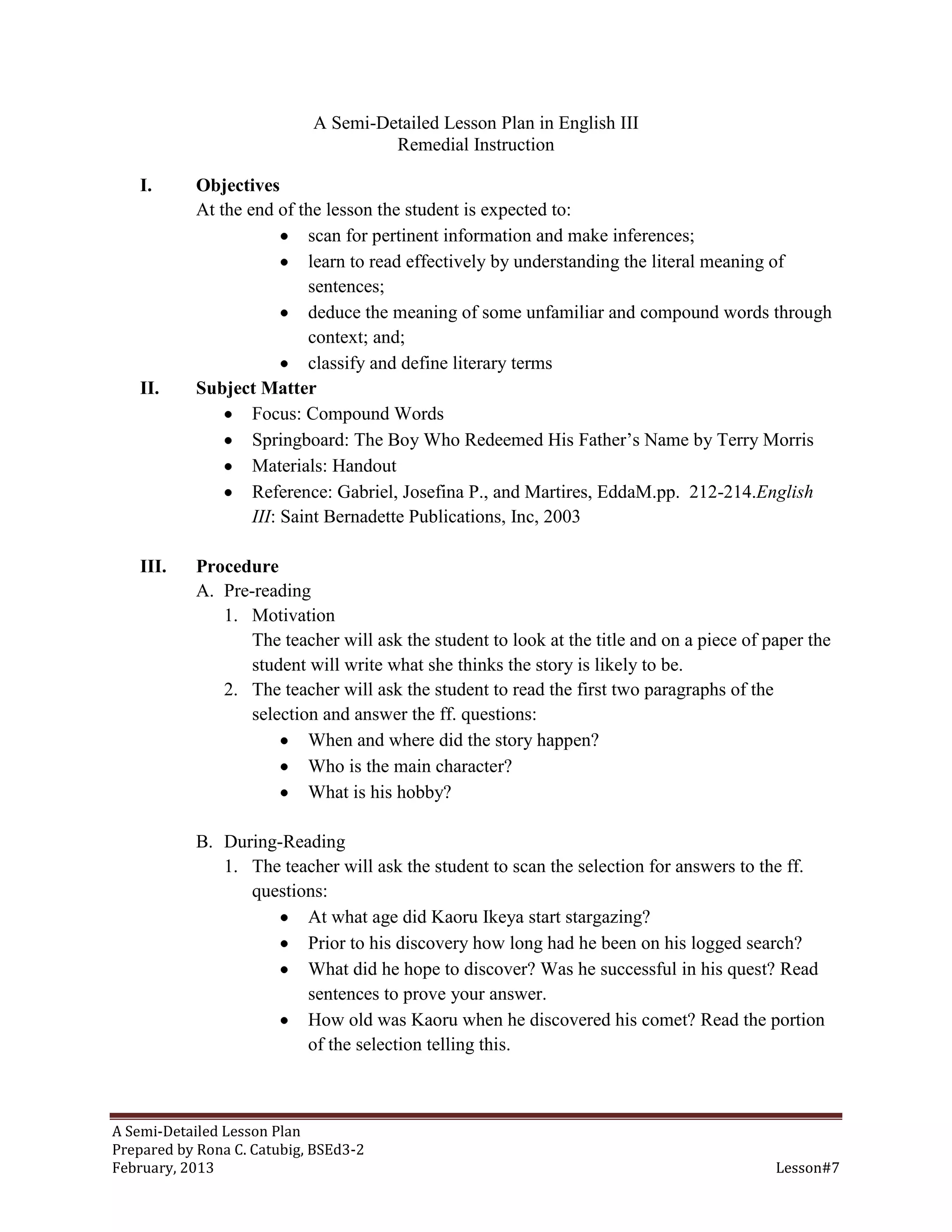
A Semi-Detailed Lesson Plan in English III
                                     Remedial Instruction

   I.      Objectives
           At the end of the lesson the student is expected to:
                           scan for pertinent information and make inferences;
                           learn to read effectively by understanding the literal meaning of
                           sentences;
                           deduce the meaning of some unfamiliar and compound words through
                           context; and;
                           classify and define literary terms
   II.     Subject Matter
                   Focus: Compound Words
                   Springboard: The Boy Who Redeemed His Father’s Name by Terry Morris
                   Materials: Handout
                   Reference: Gabriel, Josefina P., and Martires, EddaM.pp. 212-214.English
                   III: Saint Bernadette Publications, Inc, 2003

   III.    Procedure
           A. Pre-reading
              1. Motivation
                  The teacher will ask the student to look at the title and on a piece of paper the
                  student will write what she thinks the story is likely to be.
              2. The teacher will ask the student to read the first two paragraphs of the
                  selection and answer the ff. questions:
                          When and where did the story happen?
                          Who is the main character?
                          What is his hobby?

           B. During-Reading
              1. The teacher will ask the student to scan the selection for answers to the ff.
                 questions:
                        At what age did Kaoru Ikeya start stargazing?
                        Prior to his discovery how long had he been on his logged search?
                        What did he hope to discover? Was he successful in his quest? Read
                        sentences to prove your answer.
                        How old was Kaoru when he discovered his comet? Read the portion
                        of the selection telling this.


A Semi-Detailed Lesson Plan
Prepared by Rona C. Catubig, BSEd3-2
February, 2013                                                                             Lesson#7
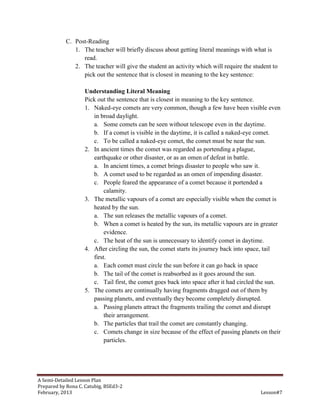
C. Post-Reading
              1. The teacher will briefly discuss about getting literal meanings with what is
                 read.
              2. The teacher will give the student an activity which will require the student to
                 pick out the sentence that is closest in meaning to the key sentence:

                   Understanding Literal Meaning
                   Pick out the sentence that is closest in meaning to the key sentence.
                   1. Naked-eye comets are very common, though a few have been visible even
                      in broad daylight.
                      a. Some comets can be seen without telescope even in the daytime.
                      b. If a comet is visible in the daytime, it is called a naked-eye comet.
                      c. To be called a naked-eye comet, the comet must be near the sun.
                   2. In ancient times the comet was regarded as portending a plague,
                      earthquake or other disaster, or as an omen of defeat in battle.
                      a. In ancient times, a comet brings disaster to people who saw it.
                      b. A comet used to be regarded as an omen of impending disaster.
                      c. People feared the appearance of a comet because it portended a
                           calamity.
                   3. The metallic vapours of a comet are especially visible when the comet is
                      heated by the sun.
                      a. The sun releases the metallic vapours of a comet.
                      b. When a comet is heated by the sun, its metallic vapours are in greater
                           evidence.
                      c. The heat of the sun is unnecessary to identify comet in daytime.
                   4. After circling the sun, the comet starts its journey back into space, tail
                      first.
                      a. Each comet must circle the sun before it can go back in space
                      b. The tail of the comet is reabsorbed as it goes around the sun.
                      c. Tail first, the comet goes back into space after it had circled the sun.
                   5. The comets are continually having fragments dragged out of them by
                      passing planets, and eventually they become completely disrupted.
                      a. Passing planets attract the fragments trailing the comet and disrupt
                           their arrangement.
                      b. The particles that trail the comet are constantly changing.
                      c. Comets change in size because of the effect of passing planets on their
                           particles.


A Semi-Detailed Lesson Plan
Prepared by Rona C. Catubig, BSEd3-2
February, 2013                                                                           Lesson#7
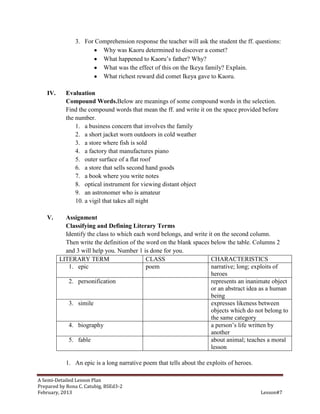
3. For Comprehension response the teacher will ask the student the ff. questions:
                        Why was Kaoru determined to discover a comet?
                        What happened to Kaoru’s father? Why?
                        What was the effect of this on the Ikeya family? Explain.
                        What richest reward did comet Ikeya gave to Kaoru.

   IV.     Evaluation
           Compound Words.Below are meanings of some compound words in the selection.
           Find the compound words that mean the ff. and write it on the space provided before
           the number.
               1. a business concern that involves the family
               2. a short jacket worn outdoors in cold weather
               3. a store where fish is sold
               4. a factory that manufactures piano
               5. outer surface of a flat roof
               6. a store that sells second hand goods
               7. a book where you write notes
               8. optical instrument for viewing distant object
               9. an astronomer who is amateur
               10. a vigil that takes all night

   V.      Assignment
           Classifying and Defining Literary Terms
           Identify the class to which each word belongs, and write it on the second column.
           Then write the definition of the word on the blank spaces below the table. Columns 2
           and 3 will help you. Number 1 is done for you.
         LITERARY TERM                      CLASS                    CHARACTERISTICS
            1. epic                         poem                     narrative; long; exploits of
                                                                     heroes
            2. personification                                       represents an inanimate object
                                                                     or an abstract idea as a human
                                                                     being
            3. simile                                                expresses likeness between
                                                                     objects which do not belong to
                                                                     the same category
            4. biography                                             a person’s life written by
                                                                     another
            5. fable                                                 about animal; teaches a moral
                                                                     lesson

           1. An epic is a long narrative poem that tells about the exploits of heroes.

A Semi-Detailed Lesson Plan
Prepared by Rona C. Catubig, BSEd3-2
February, 2013                                                                            Lesson#7

Semi-Detailed Lesson Plan on Compound Words and The Boy Who Redeemed His Father's Name

  • 1.
    A Semi-Detailed LessonPlan in English III Remedial Instruction I. Objectives At the end of the lesson the student is expected to: scan for pertinent information and make inferences; learn to read effectively by understanding the literal meaning of sentences; deduce the meaning of some unfamiliar and compound words through context; and; classify and define literary terms II. Subject Matter Focus: Compound Words Springboard: The Boy Who Redeemed His Father’s Name by Terry Morris Materials: Handout Reference: Gabriel, Josefina P., and Martires, EddaM.pp. 212-214.English III: Saint Bernadette Publications, Inc, 2003 III. Procedure A. Pre-reading 1. Motivation The teacher will ask the student to look at the title and on a piece of paper the student will write what she thinks the story is likely to be. 2. The teacher will ask the student to read the first two paragraphs of the selection and answer the ff. questions: When and where did the story happen? Who is the main character? What is his hobby? B. During-Reading 1. The teacher will ask the student to scan the selection for answers to the ff. questions: At what age did Kaoru Ikeya start stargazing? Prior to his discovery how long had he been on his logged search? What did he hope to discover? Was he successful in his quest? Read sentences to prove your answer. How old was Kaoru when he discovered his comet? Read the portion of the selection telling this. A Semi-Detailed Lesson Plan Prepared by Rona C. Catubig, BSEd3-2 February, 2013 Lesson#7
  • 2.
    C. Post-Reading 1. The teacher will briefly discuss about getting literal meanings with what is read. 2. The teacher will give the student an activity which will require the student to pick out the sentence that is closest in meaning to the key sentence: Understanding Literal Meaning Pick out the sentence that is closest in meaning to the key sentence. 1. Naked-eye comets are very common, though a few have been visible even in broad daylight. a. Some comets can be seen without telescope even in the daytime. b. If a comet is visible in the daytime, it is called a naked-eye comet. c. To be called a naked-eye comet, the comet must be near the sun. 2. In ancient times the comet was regarded as portending a plague, earthquake or other disaster, or as an omen of defeat in battle. a. In ancient times, a comet brings disaster to people who saw it. b. A comet used to be regarded as an omen of impending disaster. c. People feared the appearance of a comet because it portended a calamity. 3. The metallic vapours of a comet are especially visible when the comet is heated by the sun. a. The sun releases the metallic vapours of a comet. b. When a comet is heated by the sun, its metallic vapours are in greater evidence. c. The heat of the sun is unnecessary to identify comet in daytime. 4. After circling the sun, the comet starts its journey back into space, tail first. a. Each comet must circle the sun before it can go back in space b. The tail of the comet is reabsorbed as it goes around the sun. c. Tail first, the comet goes back into space after it had circled the sun. 5. The comets are continually having fragments dragged out of them by passing planets, and eventually they become completely disrupted. a. Passing planets attract the fragments trailing the comet and disrupt their arrangement. b. The particles that trail the comet are constantly changing. c. Comets change in size because of the effect of passing planets on their particles. A Semi-Detailed Lesson Plan Prepared by Rona C. Catubig, BSEd3-2 February, 2013 Lesson#7
  • 3.
    3. For Comprehensionresponse the teacher will ask the student the ff. questions: Why was Kaoru determined to discover a comet? What happened to Kaoru’s father? Why? What was the effect of this on the Ikeya family? Explain. What richest reward did comet Ikeya gave to Kaoru. IV. Evaluation Compound Words.Below are meanings of some compound words in the selection. Find the compound words that mean the ff. and write it on the space provided before the number. 1. a business concern that involves the family 2. a short jacket worn outdoors in cold weather 3. a store where fish is sold 4. a factory that manufactures piano 5. outer surface of a flat roof 6. a store that sells second hand goods 7. a book where you write notes 8. optical instrument for viewing distant object 9. an astronomer who is amateur 10. a vigil that takes all night V. Assignment Classifying and Defining Literary Terms Identify the class to which each word belongs, and write it on the second column. Then write the definition of the word on the blank spaces below the table. Columns 2 and 3 will help you. Number 1 is done for you. LITERARY TERM CLASS CHARACTERISTICS 1. epic poem narrative; long; exploits of heroes 2. personification represents an inanimate object or an abstract idea as a human being 3. simile expresses likeness between objects which do not belong to the same category 4. biography a person’s life written by another 5. fable about animal; teaches a moral lesson 1. An epic is a long narrative poem that tells about the exploits of heroes. A Semi-Detailed Lesson Plan Prepared by Rona C. Catubig, BSEd3-2 February, 2013 Lesson#7