What is Poetry?
literary work in
which special
intensity is given to
the expression of
feelings and ideas
by the use of
distinctive style
and rhythm; poems
collectively or as a
genre of literature
All the World’s a Stage
Elements
1. Rhythm: This is the music made by the statements of
the poem, which includes the syllables in the lines. The
best method of understanding this is to read the poem
aloud, and understand the stressed and unstressed
syllables. Listen for the sounds and the music made
when we hear the lines spoken aloud. How do the words
resonate with each other? How do the words flow when
they are linked with one another? Does sound right? Do
the words fit with each other? These are the things you
consider while studying the rhythm of the poem.
2. Meter: This is the basic structural make-up of the
poem. Do the syllables match with each other?
Every line in the poem must adhere to this
structure. A poem is made up of blocks of lines,
which convey a single strand of thought. Within
those blocks, a structure of syllables which follow
the rhythm has to be included. This is the meter or
the metrical form of poetry.
3. Stanza: Stanza in poetry is defined as a smaller
unit or group of lines or a paragraph in a poem. A
particular stanza has a specific meter, rhyme
scheme, etc. Based on the number of lines,
stanzas are named as couplet (2 lines), Tercet (3
lines), Quatrain (4 lines), Cinquain (5 lines), Sestet
(6 lines), Septet (7 lines), Octave (8 lines).
4. Rhyme: A poem may or may not have a rhyme.
When you write poetry that has rhyme, it means
that the last words or sounds of the lines match
with each other in some form. Rhyme is basically
similar sounding words like 'cat' and 'hat', 'close'
and 'shows', 'house' and 'mouse', etc. Free verse
poetry, though, does not follow this system.
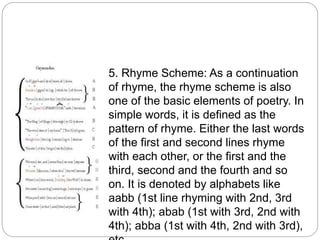
5. Rhyme Scheme: As a continuation
of rhyme, the rhyme scheme is also
one of the basic elements of poetry. In
simple words, it is defined as the
pattern of rhyme. Either the last words
of the first and second lines rhyme
with each other, or the first and the
third, second and the fourth and so
on. It is denoted by alphabets like
aabb (1st line rhyming with 2nd, 3rd
with 4th); abab (1st with 3rd, 2nd with
4th); abba (1st with 4th, 2nd with 3rd),
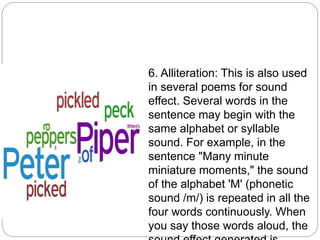
6. Alliteration: This is also used
in several poems for sound
effect. Several words in the
sentence may begin with the
same alphabet or syllable
sound. For example, in the
sentence "Many minute
miniature moments," the sound
of the alphabet 'M' (phonetic
sound /m/) is repeated in all the
four words continuously. When
you say those words aloud, the
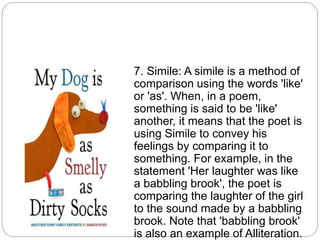
7. Simile: A simile is a method of
comparison using the words 'like'
or 'as'. When, in a poem,
something is said to be 'like'
another, it means that the poet is
using Simile to convey his
feelings by comparing it to
something. For example, in the
statement 'Her laughter was like
a babbling brook', the poet is
comparing the laughter of the girl
to the sound made by a babbling
brook. Note that 'babbling brook'
is also an example of Alliteration.
7. Metaphor: A metaphor is a method of
comparison where the words 'like' and 'as' are
not used. To modify the earlier example, if the
statement had been 'Her English teacher, a
tigress ', then it would be the use of Metaphor.
8. Theme: This is what the poem is all about.
The theme of the poem is the central idea that
the poet wants to convey. It can be a story, or a
thought, or a description of something or
someone; anything that the poem is about.
9. Symbolism: Often poems will
convey ideas and thoughts using
symbols. A symbol can stand for
many things at one time and leads
the reader out of a systematic and
structured method of looking at
things. Often a symbol used in the
poem will be used to create such an
effect.
10. Imagery: Imagery is also one of
the important elements of a poem.
This device is used by the poet for
readers to create an image in their
imagination. Imagery appeals to all
the five senses. For e.g., when the
poet describes, 'the flower is bright
red', an image of a red flower is
immediately created in the reader's
The elements of poetry are an essential
part of the structure of a good poem. Of
course, it does not mean, that all poems
must have all these elements. It depends
entirely upon the poet, who has all these
tools at his disposal to use in order to
convey his ideas effectively.

Grade 9 Poetry and its Basic Elements

  • 2.
    What is Poetry? literarywork in which special intensity is given to the expression of feelings and ideas by the use of distinctive style and rhythm; poems collectively or as a genre of literature
  • 3.
  • 4.
    Elements 1. Rhythm: Thisis the music made by the statements of the poem, which includes the syllables in the lines. The best method of understanding this is to read the poem aloud, and understand the stressed and unstressed syllables. Listen for the sounds and the music made when we hear the lines spoken aloud. How do the words resonate with each other? How do the words flow when they are linked with one another? Does sound right? Do the words fit with each other? These are the things you consider while studying the rhythm of the poem.
  • 5.
    2. Meter: Thisis the basic structural make-up of the poem. Do the syllables match with each other? Every line in the poem must adhere to this structure. A poem is made up of blocks of lines, which convey a single strand of thought. Within those blocks, a structure of syllables which follow the rhythm has to be included. This is the meter or the metrical form of poetry.
  • 6.
    3. Stanza: Stanzain poetry is defined as a smaller unit or group of lines or a paragraph in a poem. A particular stanza has a specific meter, rhyme scheme, etc. Based on the number of lines, stanzas are named as couplet (2 lines), Tercet (3 lines), Quatrain (4 lines), Cinquain (5 lines), Sestet (6 lines), Septet (7 lines), Octave (8 lines).
  • 7.
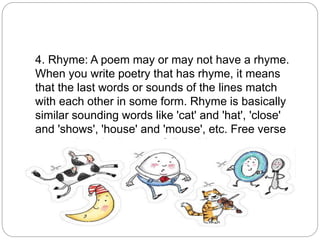
    4. Rhyme: Apoem may or may not have a rhyme. When you write poetry that has rhyme, it means that the last words or sounds of the lines match with each other in some form. Rhyme is basically similar sounding words like 'cat' and 'hat', 'close' and 'shows', 'house' and 'mouse', etc. Free verse poetry, though, does not follow this system.
  • 8.
    5. Rhyme Scheme:As a continuation of rhyme, the rhyme scheme is also one of the basic elements of poetry. In simple words, it is defined as the pattern of rhyme. Either the last words of the first and second lines rhyme with each other, or the first and the third, second and the fourth and so on. It is denoted by alphabets like aabb (1st line rhyming with 2nd, 3rd with 4th); abab (1st with 3rd, 2nd with 4th); abba (1st with 4th, 2nd with 3rd),
  • 9.
    6. Alliteration: Thisis also used in several poems for sound effect. Several words in the sentence may begin with the same alphabet or syllable sound. For example, in the sentence "Many minute miniature moments," the sound of the alphabet 'M' (phonetic sound /m/) is repeated in all the four words continuously. When you say those words aloud, the
  • 10.
    7. Simile: Asimile is a method of comparison using the words 'like' or 'as'. When, in a poem, something is said to be 'like' another, it means that the poet is using Simile to convey his feelings by comparing it to something. For example, in the statement 'Her laughter was like a babbling brook', the poet is comparing the laughter of the girl to the sound made by a babbling brook. Note that 'babbling brook' is also an example of Alliteration.
  • 11.
    7. Metaphor: Ametaphor is a method of comparison where the words 'like' and 'as' are not used. To modify the earlier example, if the statement had been 'Her English teacher, a tigress ', then it would be the use of Metaphor.
  • 12.
    8. Theme: Thisis what the poem is all about. The theme of the poem is the central idea that the poet wants to convey. It can be a story, or a thought, or a description of something or someone; anything that the poem is about.
  • 13.
    9. Symbolism: Oftenpoems will convey ideas and thoughts using symbols. A symbol can stand for many things at one time and leads the reader out of a systematic and structured method of looking at things. Often a symbol used in the poem will be used to create such an effect.
  • 14.
    10. Imagery: Imageryis also one of the important elements of a poem. This device is used by the poet for readers to create an image in their imagination. Imagery appeals to all the five senses. For e.g., when the poet describes, 'the flower is bright red', an image of a red flower is immediately created in the reader's
  • 15.
    The elements ofpoetry are an essential part of the structure of a good poem. Of course, it does not mean, that all poems must have all these elements. It depends entirely upon the poet, who has all these tools at his disposal to use in order to convey his ideas effectively.