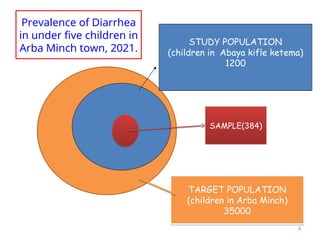
TARGET POPULATION
(children inArba Minch)
35000
STUDY POPULATION
(children in Abaya kifle ketema)
1200
SAMPLE(384)
Prevalence of Diarrhea
in under five children in
Arba Minch town, 2021.
4
5.
Definitions of terms
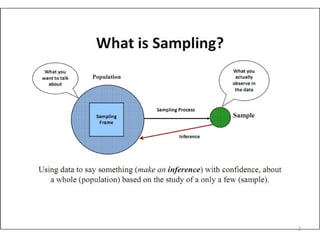
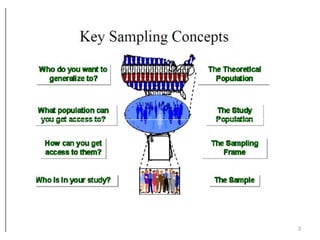
Targetpopulation (reference population): Is that population
about which an investigator wishes to draw a conclusion.
Study population (population sampled): Population from
which the researcher can access to select his samples.
• For Practical reasons the study population is often more limited
than the target population.
• In some instances, the target population and the study
population are identical.
5
6.
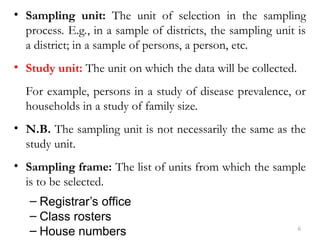
• Sampling unit:The unit of selection in the sampling
process. E.g., in a sample of districts, the sampling unit is
a district; in a sample of persons, a person, etc.
• Study unit: The unit on which the data will be collected.
For example, persons in a study of disease prevalence, or
households in a study of family size.
• N.B. The sampling unit is not necessarily the same as the
study unit.
• Sampling frame: The list of units from which the sample
is to be selected.
– Registrar’s office
– Class rosters
– House numbers 6
7.
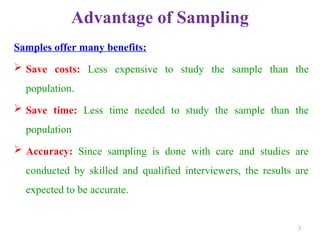
Advantage of Sampling
Samplesoffer many benefits:
Save costs: Less expensive to study the sample than the
population.
Save time: Less time needed to study the sample than the
population
Accuracy: Since sampling is done with care and studies are
conducted by skilled and qualified interviewers, the results are
expected to be accurate.
7
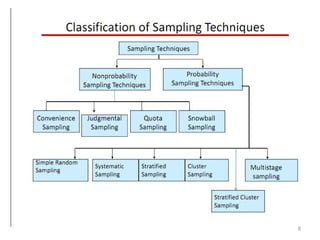
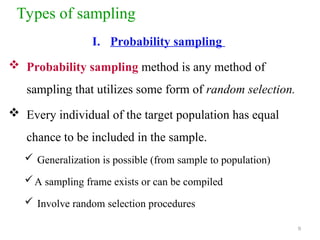
Types of sampling
I.Probability sampling
Probability sampling method is any method of
sampling that utilizes some form of random selection.
Every individual of the target population has equal
chance to be included in the sample.
Generalization is possible (from sample to population)
A sampling frame exists or can be compiled
Involve random selection procedures
9
10.
A. Simple RandomSampling(SRS)
• A sample size ‘n’ is drawn from a population ‘N’ in
such a way that every possible element in the
population has the same chance of being selected.
• This is the most basic scheme of random sampling.
Assumption of the population
Homogeneity with respect to the variable of
interest
If all members of a population are identical, the
population is considered to be homogenous.
Availability of frame
10
11.
A) Simple RandomSampling cont.
Representativeness of the sample is ensured.
Disadvantage
It is costly to conduct SRS.
Moreover, minority subgroups of interest in the
population may not be present in the sample in sufficient
numbers for study.
11
12.
To select asimple random sample you need to:
Make a numbered list of all the units in the population from which
you want to draw a sample.
Each unit on the list should be numbered in sequence from 1 to N
(where N is the size of the population)
Decide on the size of the sample
Select the required number of study units, using a
Lottery method
A table of random numbers or
computer generated random numbers
12
13.
"Lottery” method: fora small population it may be
possible to use the “lottery” method:
• Each unit in the population is represented by a slip of
paper, these are put in a box and mixed and a sample will
be taken.
• Used if n is less than 50
Table of random numbers: if there are many units,
however, the above technique soon becomes laborious.
13
14.
Simple random sampling…
Example: evaluate the prevalence of tooth decay
among 1200 children attending a school
List of children attending the school
Children numerated from 1 to 1200
Sample size = 100 children
Random sampling of 100 numbers between 1 and
1200
•How to randomly select?
14
15.
Let= If youwant to study the prevalence of bed net utilization in
Nech sar kifle ketema,
1. What is the target population?
2. What is the study population?
3. What is the study unit?
4. What type of SRS method will you use if n=10 from N=20?
5. What type of SRS method will you use if n=384 from N=100,000
15
16.
B) Systematic Sampling
•Starting from a random point on a sampling frame, every nth
element in the frame is selected at equal intervals (sampling
interval).
• Sampling Interval tells the researcher how to select elements
from the frame (1 in ‘k’ elements is selected).
Depends on sample size needed
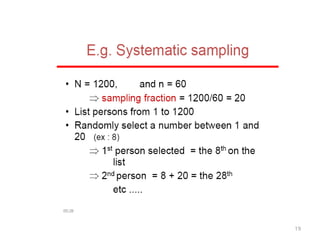
• For example, a systematic sample is to be selected from 1200
students of a school. The sample size is decided to be 100.
• The sampling fraction is: 1200/100 = 12.
• Hence, the sample interval is 12. 16
17.
• The numberof the first student to be included in the sample is
chosen randomly, for example by blindly picking one out of
twelve pieces of paper, numbered 1 to 12.
• If number 6 is picked, every twelfth student will be included in
the sample, starting with student number 6, until 100 students
are selected.
• The numbers selected would be 6,18,30,42,etc
17
18.
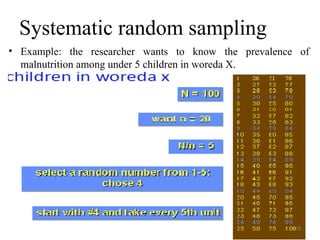
Systematic random sampling
•Example: the researcher wants to know the prevalence of
malnutrition among under 5 children in woreda X.
18
Advantages
Systematic samplingis usually less time consuming and easier to
perform than simple random sampling.
It provides a good approximation to SRS.
Unlike SRS, systematic sampling can be conducted without a
sampling frame (useful in some situations where a sampling
frame is not readily available).
E.g. In patients attending a health center, where it is not possible
to predict in advance who will be attending
21
22.
Disadvantages:
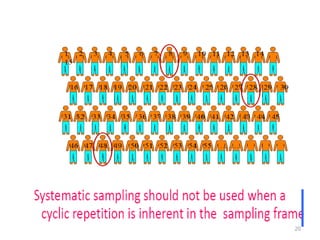
• If thereis any sort of cyclic pattern in the ordering of the
subjects which coincides with the sampling interval, the sample
will not be representative of the population.
Examples
- List of married couples arranged with men's names alternatively
with the women's names (every 2nd, 4th, etc.) will result in a
sample of all men or women).
22
23.
• Let= Ifyou want to study the prevalence of bed
net utilization in Nech Sar kifle ketema,You want
to use systematic sampling method n=10 from
N=40?
1.What are the numbers to be included in your
study?
23
24.
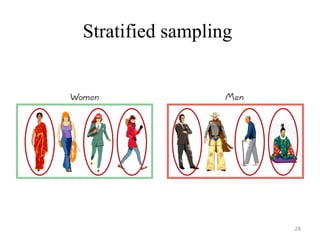
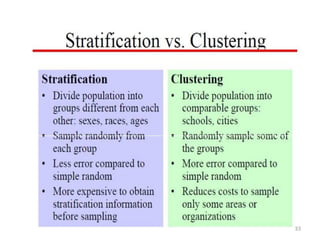
C) Stratified Sampling
•It is appropriate when the distribution of the characteristic to be
studied is strongly affected by certain variable (heterogeneous
population).
• The population is first divided into groups (strata) according to a
characteristic of interest (eg., sex, geographic area, prevalence of
disease, etc.).
• A separate sample is then taken independently from each
stratum, by simple random or systematic sampling.
24
25.
Procedure
• Divide thepopulation by certain characteristics into
homogeneous subgroups (strata).
• Elements within each strata are homogeneous, but are
heterogeneous across strata.
• A simple random or a systematic sample is taken from
each strata relative to the proportion of that stratum to
each of the others.
25
26.
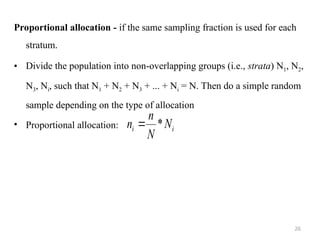
Proportional allocation -if the same sampling fraction is used for each
stratum.
• Divide the population into non-overlapping groups (i.e., strata) N1, N2,
N3, Ni, such that N1 + N2 + N3 + ... + Ni = N. Then do a simple random
sample depending on the type of allocation
• Proportional allocation: i
i N
N
n
n *
26
27.
Merit
• The representativenessof the sample is improved.
• That is, adequate representation of minority subgroups of
interest can be ensured by stratification and by varying the
sampling fraction between strata as required.
Demerit
• Sampling frame for the entire population has to be prepared
separately for each stratum.
27
D) Cluster sampling
•A cluster sample is a simple random sample of groups or clusters of
elements (vs. a simple random sample of individual objects).
• This method is useful when it is difficult or costly to develop a
complete list of the population members or when the population
elements are widely dispersed geographically.
• Cluster sampling may increase sampling error due to similarities
among cluster members.
29
30.
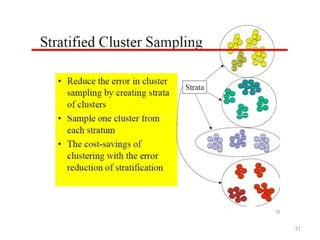
Procedure
• The referencepopulation (homogeneous) is divided
into clusters.
• These clusters are often geographic units (e.g
districts, villages, etc.)
• A sample of such clusters is selected
• All the units in the selected clusters are studied
30
Merit
• A listof all the individual study units in the reference
population is not required.
• It is sufficient to have a list of clusters.
Demerit
• It is based on the assumption that the characteristic to be
studied is uniformly distributed throughout the reference
population, which may not always be the case.
• Hence, sampling error is usually higher than for a simple
random sample of the same size.
32
E) Multi-stage sampling
•This method is appropriate when the reference
population is large and widely scattered.
• Selection is done in stages until the final sampling
unit (e.g. households or persons) are arrived at.
• The primary sampling unit (PSU) is the sampling
unit (usually large size) in the first sampling stage.
• The secondary sampling unit (SSU) is the sampling
unit in the second sampling stage, etc.
• Example - The PSUs could be District and the SSUs
could be Kebeles.
34
II. Non-probability sampling
No random selection (unrepresentative of the given population)
Used when a sampling frame does not exist
Inappropriate if the aim is to measure variables and generalize
findings obtained from a sample to the population.
They are cheaper and easier.
Good for pretests, pilot studies, In-depth interviews
36
37.
Quota sampling
• Selectionis based on fixed number
• Interviews as many people as he can find until his quota.
• For example, an interviewer may be told to sample 200
females and 300 males between the age of 45 and 60.
• It is this second step which makes the technique one of non-
probability sampling.
• In quota sampling the selection of the sample is non-
random.
• For example interviewers might be tempted to interview
those who look most helpful. The problem is that these
samples may be biased because not everyone gets a chance
of selection.
37
38.
CONVENIENCE SAMPLING
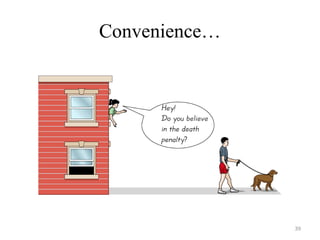
• Atype of non probability sampling which involves the
sample being drawn from that part of the population which
is close to hand.
• That is, readily available and convenient.
• For example, if the interviewer was to conduct a survey at a
shopping center early in the morning on a given day, the
people that he/she could interview would be limited to those
given there at that given time, which would not represent
the views of other members of society in such an area, if the
survey was to be conducted at different times of day and
several times per week.
• This type of sampling is most useful for pilot testing.
38
Judgmental or Purposivesampling
• The researcher chooses the sample based on
who they think would be appropriate for the
study.
• This is used primarily when there is a limited
number of people that have expertise in the
area being researched
40
41.
snowball sampling
• isa technique, where existing study subjects are
used to recruit more subjects into the sample.
• Used in social sensitive ideas
• The process continues until the required size is
achieved
41
42.
Snowball: A keyinformant is identified first and the key informant in turn
identifies members of the target group.
The process continues until the required size is achieved
Purposive: Selection of subjects on the basis of your knowledge of the
population, its elements and the nature of the research objective
Convenience: Selection of a sample based on easy accessibility.
The study units that happen to be available at the time of data collection are
selected
– friends, workmates
Quota: selection of samples based on a fixed quota.
Investigator interviews as many people as he can find until he has filled his
quota.
42
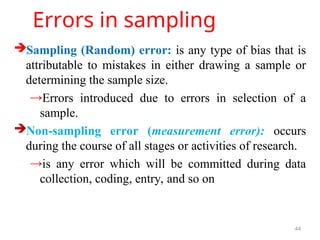
Errors in sampling
Sampling(Random) error: is any type of bias that is
attributable to mistakes in either drawing a sample or
determining the sample size.
→Errors introduced due to errors in selection of a
sample.
Non-sampling error (measurement error): occurs
during the course of all stages or activities of research.
→is any error which will be committed during data
collection, coding, entry, and so on
44
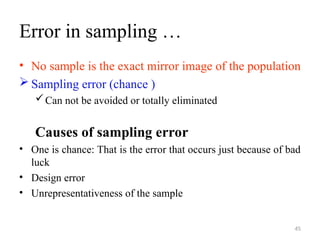
45.
Error in sampling…
• No sample is the exact mirror image of the population
Sampling error (chance )
Can not be avoided or totally eliminated
Causes of sampling error
• One is chance: That is the error that occurs just because of bad
luck
• Design error
• Unrepresentativeness of the sample
45
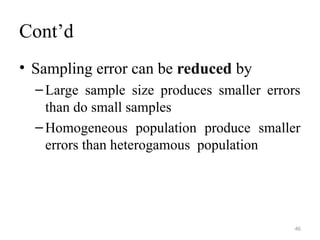
46.
Cont’d
• Sampling errorcan be reduced by
–Large sample size produces smaller errors
than do small samples
–Homogeneous population produce smaller
errors than heterogamous population
46
47.
Error in Sampling…
Non-sampling error
Observational error
Respondent error
Lack of preciseness of definition
Error in editing and tabulation of the data
47
48.
Exercise
• If youtake male students only from a
student dormitory in Ethiopia in order to
determine the proportion of smokers,
then what type of error will you commit?
Sampling vs non sampling error
48
49.
Group 1
For thetopic entitled “Prevalence of substance
induced psychiatric disorders and associated
factors among psychotic patients treated at
Amanuel mental specialized hospital”:
– Define the target population
– Define the study population
– What is the appropriate sampling method
49
50.
Exercises
Group 2
For thetopic entitled “Assessment of contraceptive
preference and associated factor among
women of reproductive age group in Gamo
Gofa Zone, SNNPR”:
– Define the target population
– Define the study population
– What is the appropriate sampling method
50
51.
Exercises
Group 3
For thetopic entitled “Knowledge, Attitude and
Practice on Personal Hygiene and associated
factors among Primary School students in Birbir
town Mirab Abaya woreda”:
– Define the target population
– Define the study population
– What is the appropriate sampling method
51