Permanent
canines
contents
● Introduction
● Maxillary canine (all aspects)
● Dimensions of maxillary canine
● Mandibular canine
● Dimensions of mandibular canine
1. Introduction
● The four canines are
placed at the corners of
the mouth .
● 3rd tooth from median
line
● Longest tooth
● Canine guidance
● Most stable teeth
● Self cleansing
● Canine eminence
● 4 lobes
Chronology of maxillary canine :
1) First evidence of calcification : 4-5 months
2) Enamel completed : 6-7 yr
3) Eruption : 11-12 yr
4) Root completed : 13-15yr
Maxillary canine
1) The outline of the labial or lingual aspect of maxillary
canine is a series of curves except for the angle made by
tip of cusp .
2) The labiolingual measurement of crown is about 1mm
greater than that of maxillary central incisor .
3) Cingulum shows greater development than that of
central incisor .
4) Root is thick labiolingually with developmental
depressions mesially and distally .
Labial aspect :
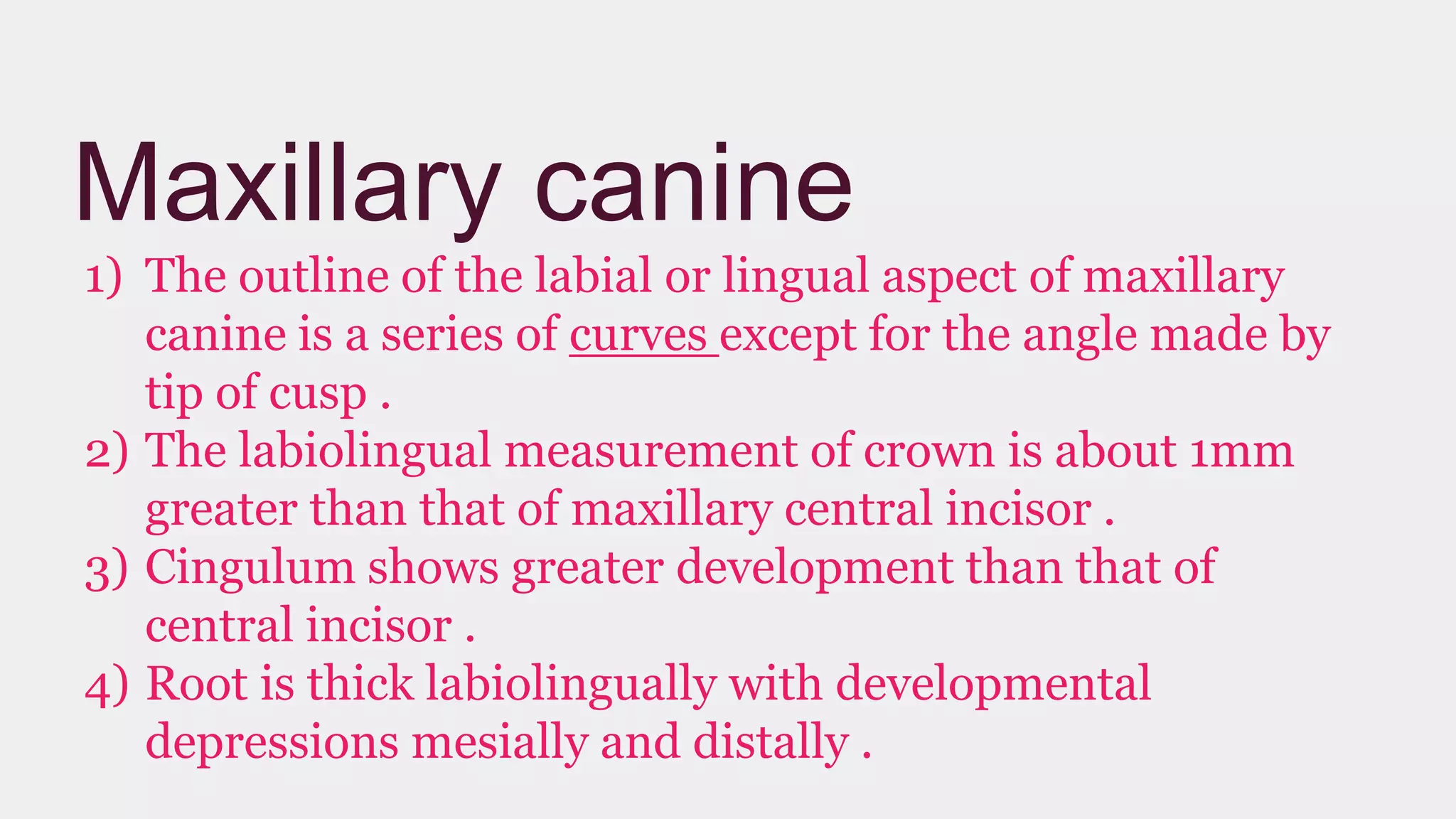
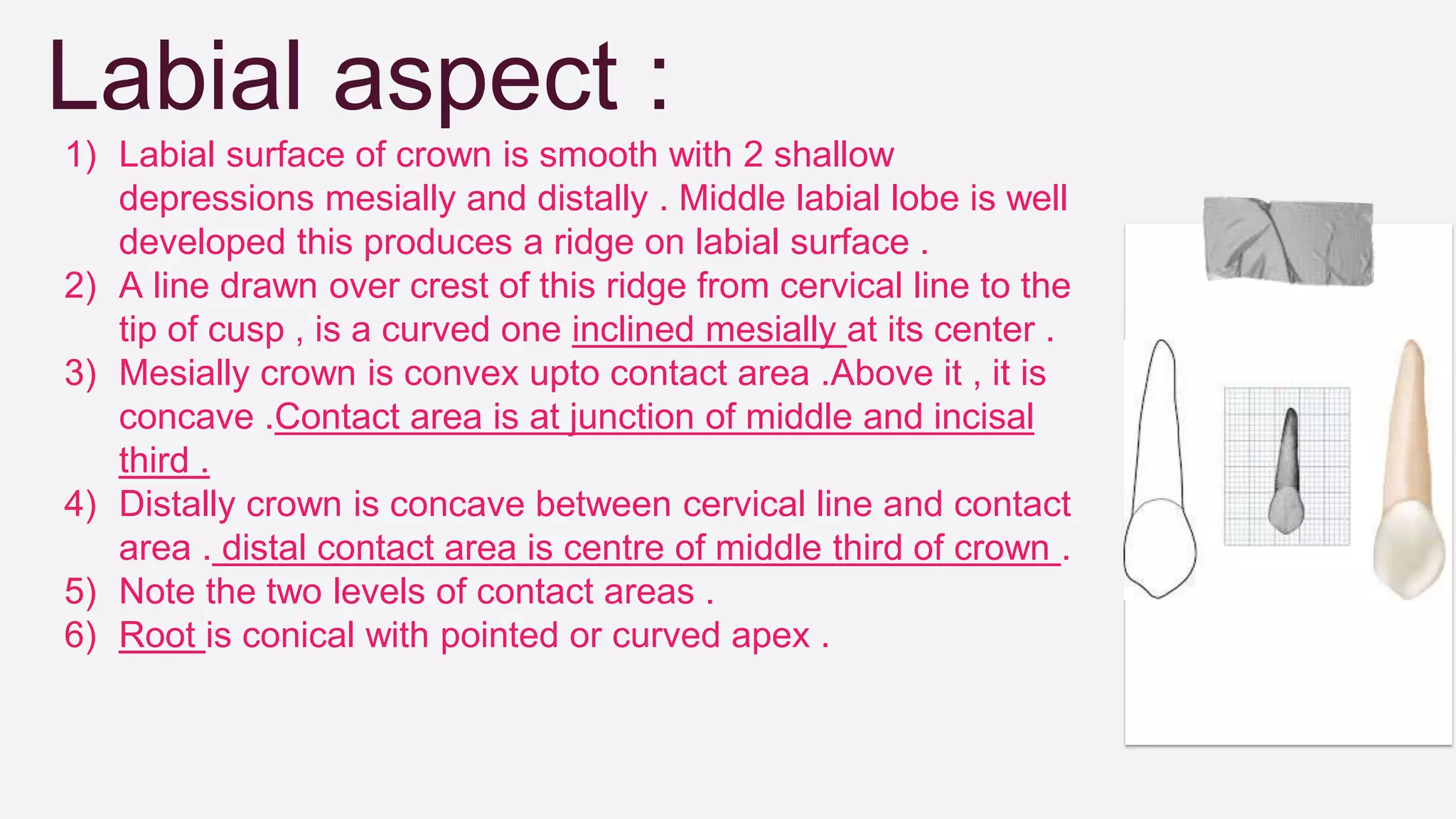
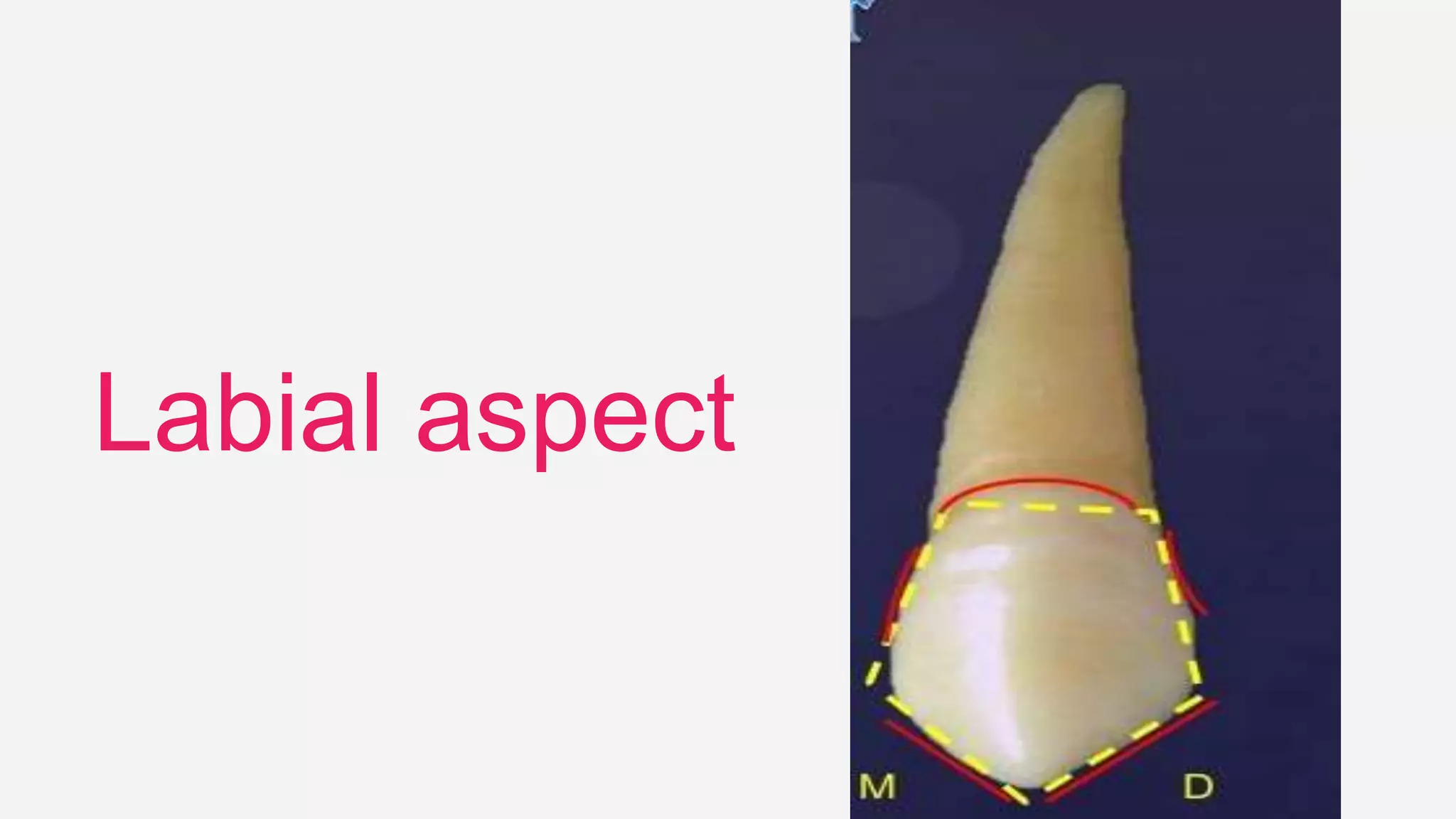
1) Labial surface of crown is smooth with 2 shallow
depressions mesially and distally . Middle labial lobe is well
developed this produces a ridge on labial surface .
2) A line drawn over crest of this ridge from cervical line to the
tip of cusp , is a curved one inclined mesially at its center .
3) Mesially crown is convex upto contact area .Above it , it is
concave .Contact area is at junction of middle and incisal
third .
4) Distally crown is concave between cervical line and contact
area . distal contact area is centre of middle third of crown .
5) Note the two levels of contact areas .
6) Root is conical with pointed or curved apex .
Labial aspect
Lingual aspect :
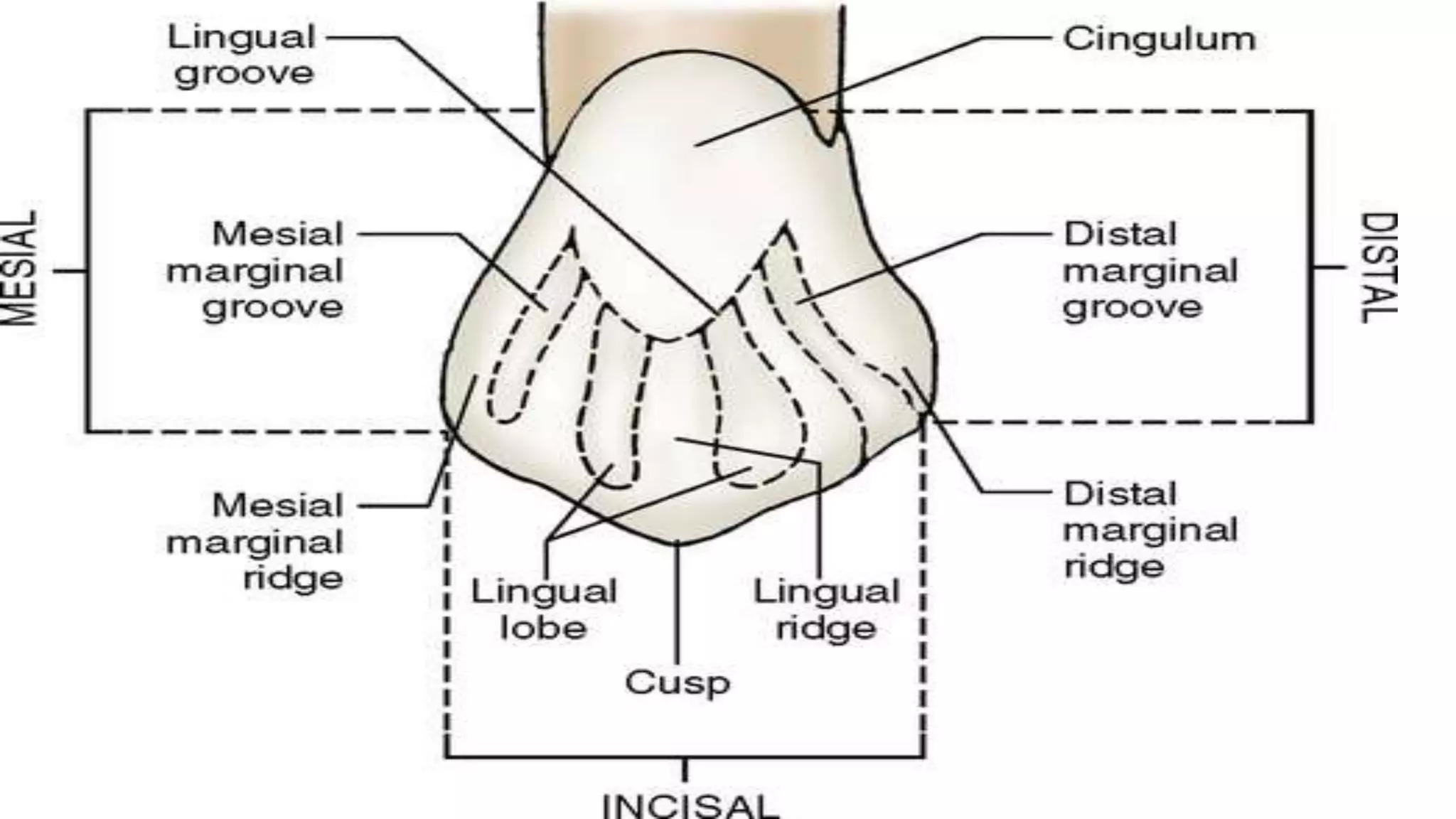
1) Crown and root are narrower lingually than
labially . Cervical line shows more even
curvature.
2) Cingulum is large and pointed like a cusp .
3) Below the cingulum are definite ridges
between marginal ridges .
4) Depressions are found between these
ridges .
5) Shallow concavities between ridges are
mesial and distal lingual fossae .
6) Mesial and distal surfaces of crown is
visible from lingual aspect .
MESIAL ASPECT :
1)shows greater bulk and greater
labiolingual measurement than any other
anterior teeth.
2)crown - wedge shape, cervical third
there is greater measurement .
3)labial outline and lingual outline
4)cervical line
5)root -conical
Mesial aspect
Distal aspect:-
1)somewhat same form as mesial
aspect.
2)cervical line exhibits less curvature .
3)distal marginal ridge is heavier and
more irregular in outline .
4)surface displays more concavity
above contact area.
4)developmental depression on root is
more pronounced .
Distal aspect
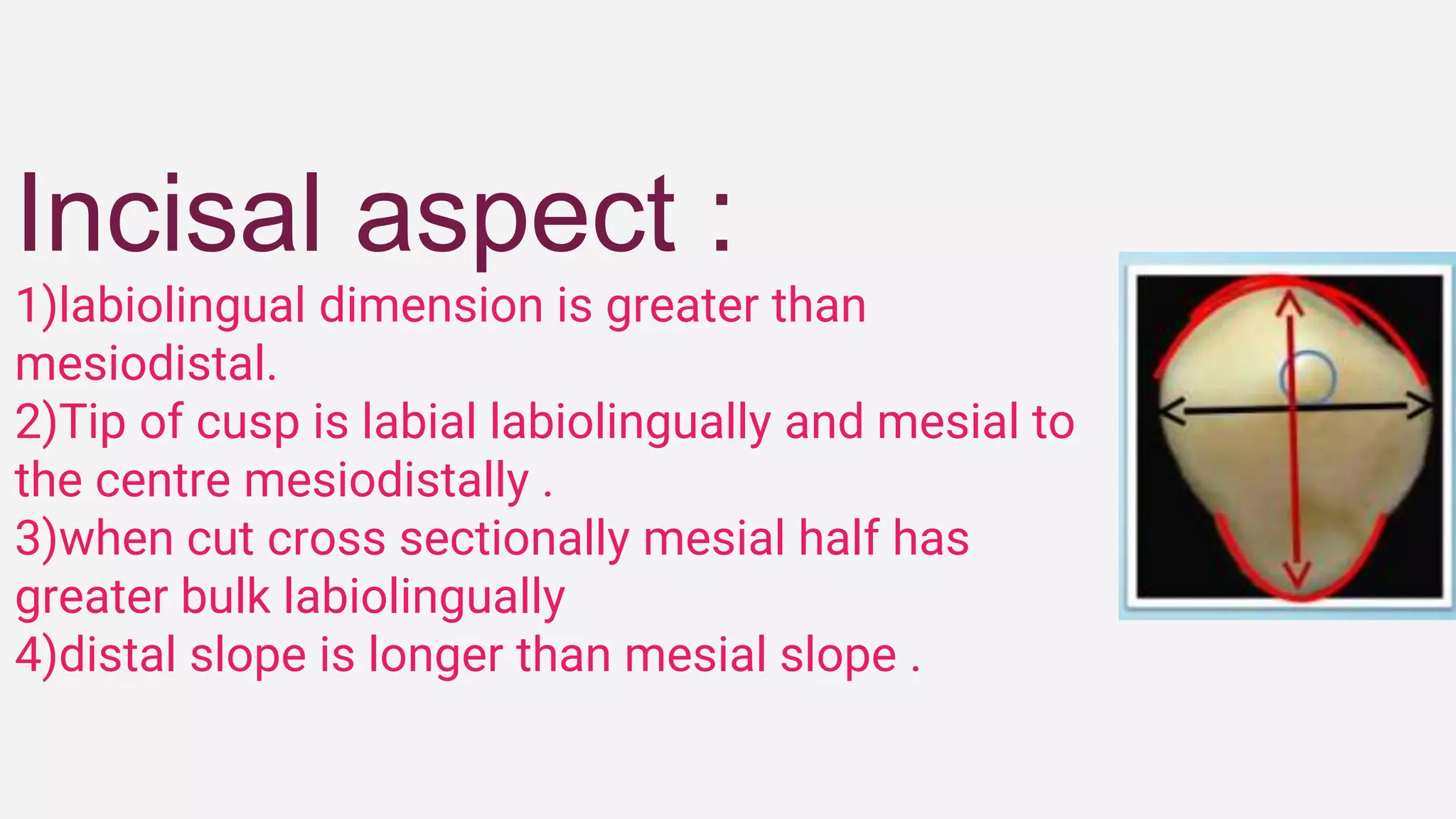
Incisal aspect :
1)labiolingual dimension is greater than
mesiodistal.
2)Tip of cusp is labial labiolingually and mesial to
the centre mesiodistally .
3)when cut cross sectionally mesial half has
greater bulk labiolingually
4)distal slope is longer than mesial slope .
Dimensions of
maxillary canine :
1) Length of crown : 10.0 mm
1) Length of root : 17.0 mm
1) MD diameter of crown : 7.5 mm
2) MD diameter of crown at cervix : 5.5 mm
1) LL diameter of crown : 8.0 mm
2) LL diameter at cervix : 7.0 mm
1) Curvature of cervical line (mesial) : 2.5 mm
2) Curvature of cervical line (distal ) : 1.5 mm
17mm
10mm
7.5mm
5.5mm
7 mm
8 mm
Chronology of mandibular canine:
1) First evidence of calcification :4 - 5 yr
1) Enamel completed :6 - 7 yr
1) Eruption : 9 - 10 yr
1) Root completed : 12 - 14 yr
Mandibular canine :
1) Bears a close resemblance to maxillary canine .
2) It is narrower mesiodistally than maxillary canine .
3) Labiolingual diameter is less.crowns longer than
maxillary. Higher contact areas .
4) The root may be as long as maxillary canine but
usually it is somewhat shorter .
5) Less cingulum development .
6) Less bulk marginal ridges .
7) Lingual portion resembles mandibular LI in crown .
8) Cusp not as developed as maxillary.
- Bifurcated roots a variation .
Dimensions of
mandibular canine :
1) Length of crown :11.0 mm
2) Length of root : 16.0 mm
3) MD diameter of crown : 7.0 mm
4) MD diameter of crown at cervix : 5.5 mm
5)LL diameter of crown : 7.5 mm
6) LL diameter at cervix : 7.0 mm
7) curvature of cervical line (mesial) : 2.5 mm
8) curvature of cervical line ( distal ): 1.0 mm
Thank you !!!

Canines

  • 1.
  • 2.
    contents ● Introduction ● Maxillarycanine (all aspects) ● Dimensions of maxillary canine ● Mandibular canine ● Dimensions of mandibular canine
  • 3.
    1. Introduction ● Thefour canines are placed at the corners of the mouth . ● 3rd tooth from median line ● Longest tooth ● Canine guidance ● Most stable teeth ● Self cleansing ● Canine eminence ● 4 lobes
  • 5.
    Chronology of maxillarycanine : 1) First evidence of calcification : 4-5 months 2) Enamel completed : 6-7 yr 3) Eruption : 11-12 yr 4) Root completed : 13-15yr
  • 6.
    Maxillary canine 1) Theoutline of the labial or lingual aspect of maxillary canine is a series of curves except for the angle made by tip of cusp . 2) The labiolingual measurement of crown is about 1mm greater than that of maxillary central incisor . 3) Cingulum shows greater development than that of central incisor . 4) Root is thick labiolingually with developmental depressions mesially and distally .
  • 8.
    Labial aspect : 1)Labial surface of crown is smooth with 2 shallow depressions mesially and distally . Middle labial lobe is well developed this produces a ridge on labial surface . 2) A line drawn over crest of this ridge from cervical line to the tip of cusp , is a curved one inclined mesially at its center . 3) Mesially crown is convex upto contact area .Above it , it is concave .Contact area is at junction of middle and incisal third . 4) Distally crown is concave between cervical line and contact area . distal contact area is centre of middle third of crown . 5) Note the two levels of contact areas . 6) Root is conical with pointed or curved apex .
  • 9.
  • 11.
    Lingual aspect : 1)Crown and root are narrower lingually than labially . Cervical line shows more even curvature. 2) Cingulum is large and pointed like a cusp . 3) Below the cingulum are definite ridges between marginal ridges . 4) Depressions are found between these ridges . 5) Shallow concavities between ridges are mesial and distal lingual fossae . 6) Mesial and distal surfaces of crown is visible from lingual aspect .
  • 13.
    MESIAL ASPECT : 1)showsgreater bulk and greater labiolingual measurement than any other anterior teeth. 2)crown - wedge shape, cervical third there is greater measurement . 3)labial outline and lingual outline 4)cervical line 5)root -conical
  • 14.
  • 15.
    Distal aspect:- 1)somewhat sameform as mesial aspect. 2)cervical line exhibits less curvature . 3)distal marginal ridge is heavier and more irregular in outline . 4)surface displays more concavity above contact area. 4)developmental depression on root is more pronounced .
  • 16.
  • 17.
    Incisal aspect : 1)labiolingualdimension is greater than mesiodistal. 2)Tip of cusp is labial labiolingually and mesial to the centre mesiodistally . 3)when cut cross sectionally mesial half has greater bulk labiolingually 4)distal slope is longer than mesial slope .
  • 18.
  • 19.
    1) Length ofcrown : 10.0 mm 1) Length of root : 17.0 mm 1) MD diameter of crown : 7.5 mm 2) MD diameter of crown at cervix : 5.5 mm 1) LL diameter of crown : 8.0 mm 2) LL diameter at cervix : 7.0 mm 1) Curvature of cervical line (mesial) : 2.5 mm 2) Curvature of cervical line (distal ) : 1.5 mm
  • 20.
  • 21.
    Chronology of mandibularcanine: 1) First evidence of calcification :4 - 5 yr 1) Enamel completed :6 - 7 yr 1) Eruption : 9 - 10 yr 1) Root completed : 12 - 14 yr
  • 22.
    Mandibular canine : 1)Bears a close resemblance to maxillary canine . 2) It is narrower mesiodistally than maxillary canine . 3) Labiolingual diameter is less.crowns longer than maxillary. Higher contact areas . 4) The root may be as long as maxillary canine but usually it is somewhat shorter . 5) Less cingulum development . 6) Less bulk marginal ridges . 7) Lingual portion resembles mandibular LI in crown . 8) Cusp not as developed as maxillary. - Bifurcated roots a variation .
  • 23.
  • 24.
    1) Length ofcrown :11.0 mm 2) Length of root : 16.0 mm 3) MD diameter of crown : 7.0 mm 4) MD diameter of crown at cervix : 5.5 mm 5)LL diameter of crown : 7.5 mm 6) LL diameter at cervix : 7.0 mm 7) curvature of cervical line (mesial) : 2.5 mm 8) curvature of cervical line ( distal ): 1.0 mm
  • 25.

Editor's Notes

  • #4 Roots they reach almost floor of maxillary sinus . The shape and position of the canines contribute to the guidance of teeth into intercuspal position by canine guidance . When teeth are lost canines are usually last ones to go . Crown protions are shaped in a manner that promote self cleansing . The bony ridge over the labial surface of root is called canine eminence it ensures facial expression . Lobes 3 well developed and middle is cingulum
  • #7 Developmental depressions help in securing teeth in arch. Arch means a ridge with teeth