University of Technology-Iraq
Civil Engineering Department
Investigating and searching for Implementation methods
necessary that use for obtain low-cost housing
BY
Tarik Salah
Aisha Mohmmed
Mohammed Falah
SUPERVISOR
Maen Nihad Ibrahim
Graduation Project
abstract :
Population inflationand the steady increase in the number of births are among the most difficult challenges
that may face any country in the world, especially in developing countries, which often suffer from political,
security, and economic structural problems accompanied by an institutional inability to formulate public
policies, development and economic strategies that would Accommodating the demands and pressures of
the growing human mass.
4.
Research objective:
1- Designinggood quality homes that provide safety and comfort factors and at the appropriate cost using a
building system that is appropriate to the economic situation and meets the requirements of humanity.
2- Finding alternatives to traditional building materials for the purpose of providing low-cost housing.
3- Study the actual cost of each housing and the possibility of implementing it.
4-Knowing the possibility of following a low-cost building system in normal conditions for the purpose of providing
good housing for people with limited income.
5.
Research methodology:
The researchconsists of two aspects:
1- The theoretical aspect means studying the literature on the types of buildings, the materials used in low-cost
construction, methods of implementation, their advantages, and the reasons for their use.
2- The practical part , which includes a survey of the Iraqi markets regarding available alternatives and knowing the
prices of materials while comparing the prices of alternatives for the purpose of choosing the appropriate alternative.
6.
The concept oflow-cost housing
The term low-cost varies from region to region depending on the region you use. Low-cost housing in developed and rich
countries is highly expensive in poor countries in Asia and Africa, due to economic, social and environmental disparities
between countries.
However, the housing literature almost agreed to call the term low-cost on residential complexes in which the ratio of
cost to total benefits is low compared to the financial ability of low-income people, while the ratio of costs to total
benefits rises for middle- and high-income people , meaning that low-cost housing costs within the limits of the financial
capacity of its beneficiaries. The basic human need and meets the necessary requirements for human life of security,
comfort, tranquility and freedom .
7.
Economical housing requirements:
Economic housing must meet the contemporary requirements of man and harmonize with
the social framework of society and at the same time reduce the cost of construction by
reducing dependence on import materials. In order to provide economic housing, the
following requirements are supposed to be met:
1-Cost reduction.
2- Reducing the completion period.
3- Providing good quality.
4- Achieving the performance efficiency of the building.
8.
Low-cost building materialsused in a number of countries :
1-Construction using sandbags
Houses made of sandbags are an effective and easy way for simple people or lovers of simplicity and
environmentally friendly technologies, as well as the afflicted and displaced due to war or disaster
conditions, who can build houses. it is also a masterpiece and a unique architectural style also :
1-It is very flexible and allows making turns and turns easily.
2- Each housing unit is 14 square meters.
3- These houses are built from available materials.
4- It is resistant to rain, hurricanes, and earthquakes, and insects do not live in it .
5-Strong buildings that are equivalent to concrete buildings in strength and cohesion.
6- It is very easy to build and anyone can use it.
9.
2-Lightweight concrete
Widely usedlightweight concrete is defined in the world as concrete containing lightweight aggregates with a density
between 90 and 115 pounds / ft 3 according to the American standard (ASTM C567) for the year 2008. Lightweight concrete
is produced by different means, methods, materials and equipment according to the companies producing the equipment
and chemicals generating it. Light concrete is called by different names, depending on the methods of its production, and
lightweight concrete is characterized by its name, low weight, density, good thermal insulation property and resistance to
fire and frost. Light weight concrete can be widely used in Iraq to relieve pressure on traditional materials such as bricks and
concrete blocks because it is a building unit that is easy to manufacture and use.
10.
3-Ferrocement
The low costand labor requirements make the ferro cement a good construction material for
the construction of residential complexes and service facilities also :
1 – Free of asbestos or any other harmful materials (environmentally friendly).
2 – The properties are stable over time and do not change.
3- Easy to cut, saw, paint, and apply a veneer layer on it.
4 – Resistant to water effects
5- Strong and can withstand shocks
6 – Not susceptible to the growth of bacteria and fungi
11.
4-Construction using shippingcontainers:
Building houses and buildings using shipping containers that were neglected after the high costs of shipping
them from one port to another is one of the most important new alternatives to traditional building materials.
There are countless numbers of empty, unused shipping containers around the world that take up a lot of space
while they are on shipping docks. The reason for this is the high cost of shipping these empty containers back to
their source, as in most cases purchasing new ones is less expensive as a result. These containers are waiting to
be used to make a home, office, apartment, school, dormitory, studio, emergency shelter, or anything else.
12.
5-Precast construction:
Precast constructionis a smart way to build any type of building in a safe and affordable way. This method originated
and developed in the northern countries, and it is one of the most common and efficient ways in the world in
construction, as it provides fast construction, good quality, in addition to the aesthetic and modernity that it adds to
the construction Ready construction means transferring work from sites to factories and this leads to increasing
productivity and quality and reducing the implementation time of the project in addition to reducing the cost of
construction in a significant way.
13.
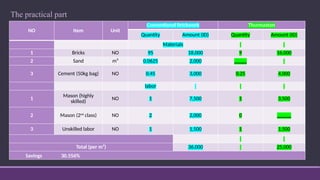
The practical part
NOItem Unit
Conventional Brickwork Thurmaston
Quantity Amount (ID) Quantity Amount (ID)
Materials
1 Bricks NO 95 18,000 9 16,000
2 Sand m³ 0.0625 2,000 ــــــــ
3 Cement (50kg bag) NO 0.45 3,000 0.25 4,000
labor
1
Mason (highly
skilled)
NO 1 7,500 1 3,500
2 Mason (2nd
class) NO 2 2,000 0 ـــــــــ
3 Unskilled labor NO 1 1,500 1 1,500
Total (per m²) 36,000 25,000
Savings 30.556%
14.
Comparison and conclusion:
Fromthe table that was discussed in the previous chapter comparing Thermostone and traditional
building materials, we note the price difference between the bricks at 18,000IQD and the price of
Thermostone at 16,000 IQD , as the Thermostone is cheaper than the bricks by a difference of 2,000IQD .
We also note the additional cost of sand of 2,000 IQD , and despite the price of cement for Thermostone
being more than traditional construction, the total building materials The traditional one is 23,000 IQD
while the Thermiston is 2,000 IQD
We also note the price difference for workers, as traditional construction requires a highly skilled worker,
as well as two second-class workers and an unskilled worker. The total traditional construction staff is
11,000 IQD , and when combined with the materials, the total number of workers and materials will be
36,000 IQD.
While in Thermostone, it requires one skilled worker and one unskilled worker, so the total work staff will
be 5,000 IQD , and when combined with the materials, it will be 25,000IQD .
This means that building with thermostone will save 30.556%.