Module3
Traditional constructions using stone, brick,
timber, bamboo, mud, lime, etc.
Low cost housing-materials & methods
(conceptual introduction only),
Maintenance, Repairs, Rehabilitation
Prepared by-
Prof. Basweshwar S. J.
Introduction
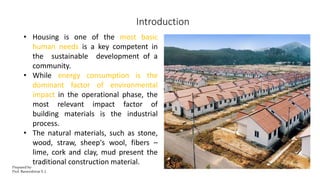
• Housing is one of the most basic
human needs is a key competent in
the sustainable development of a
community.
• While energy consumption is the
dominant factor of environmental
impact in the operational phase, the
most relevant impact factor of
building materials is the industrial
process.
• The natural materials, such as stone,
wood, straw, sheep's wool, fibers –
lime, cork and clay, mud present the
traditional construction material.
Prepared by-
Prof. Basweshwar S. J.
Prepared by-
Prof. Basweshwar S. J.
The total cost of building materials
• Economic costs
• Initial economic cost of building materials is the purchase price.
• This is often what governs decision making about what materials to use.
• Ecological costs
• The macro, environmental pollution of extraction industries building materials rely on
such as mining, petroleum, and logging produce environmental damage at their source
and in transportation of the raw materials, manufacturing, transportation of the
products, retailing, and installation.
• Energy costs
• The Initial energy costs include the amount of energy consumed to produce, deliver and
install the material.
• The long term energy cost is the economic, ecological, and social costs of continuing to
produce and deliver energy to the building for its use, maintenance, and eventual
removal.
• Social costs
• Social costs are injury and health of the people producing and transporting the materials
and potential health problems of the building occupants if there are problems with the
building biology.
Prepared by-
Prof. Basweshwar S. J.
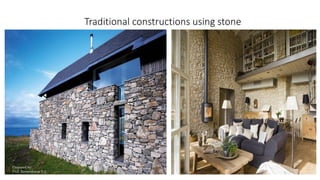
Traditional constructions using stone
Prepared by-
Prof. Basweshwar S. J.
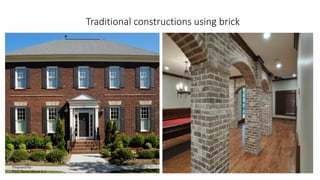
Traditional constructions using brick
Prepared by-
Prof. Basweshwar S. J.
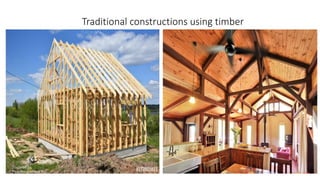
Traditional constructions using timber
Prepared by-
Prof. Basweshwar S. J.
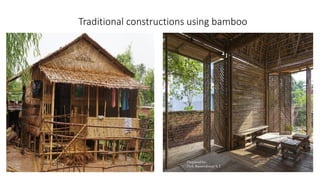
Traditional constructions using bamboo
Prepared by-
Prof. Basweshwar S. J.
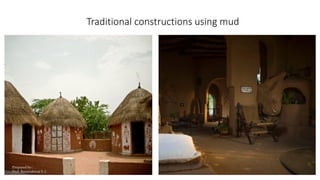
Traditional constructions using mud
Prepared by-
Prof. Basweshwar S. J.
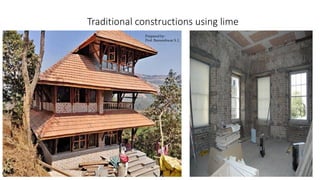
Traditional constructions using lime
Prepared by-
Prof. Basweshwar S. J.
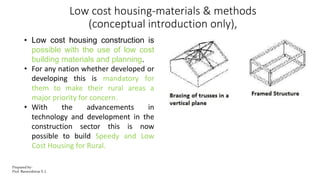
Low cost housing-materials & methods
(conceptual introduction only),
• Low cost housing construction is
possible with the use of low cost
building materials and planning.
• For any nation whether developed or
developing this is mandatory for
them to make their rural areas a
major priority for concern.
• With the advancements in
technology and development in the
construction sector this is now
possible to build Speedy and Low
Cost Housing for Rural.
Prepared by-
Prof. Basweshwar S. J.
Low cost housing-materials & methods
(conceptual introduction only),
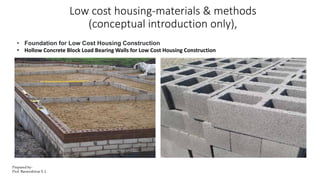
• Foundation for Low Cost Housing Construction
• Hollow Concrete Block Load Bearing Walls for Low Cost Housing Construction
Prepared by-
Prof. Basweshwar S. J.
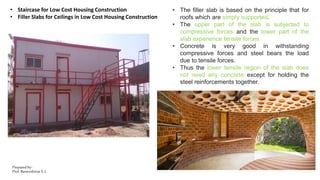
• Staircase for Low Cost Housing Construction
• Filler Slabs for Ceilings in Low Cost Housing Construction
• The filler slab is based on the principle that for
roofs which are simply supported.
• The upper part of the slab is subjected to
compressive forces and the lower part of the
slab experience tensile forces.
• Concrete is very good in withstanding
compressive forces and steel bears the load
due to tensile forces.
• Thus the lower tensile region of the slab does
not need any concrete except for holding the
steel reinforcements together.
Prepared by-
Prof. Basweshwar S. J.
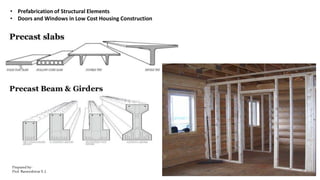
• Prefabrication of Structural Elements
• Doors and Windows in Low Cost Housing Construction
Prepared by-
Prof. Basweshwar S. J.
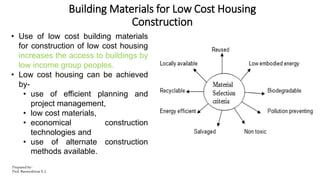
Building Materials for Low Cost Housing
Construction
• Use of low cost building materials
for construction of low cost housing
increases the access to buildings by
low income group peoples.
• Low cost housing can be achieved
by-
• use of efficient planning and
project management,
• low cost materials,
• economical construction
technologies and
• use of alternate construction
methods available.
Prepared by-
Prof. Basweshwar S. J.
Selection of Low Cost Building Materials for Low
Cost Housing
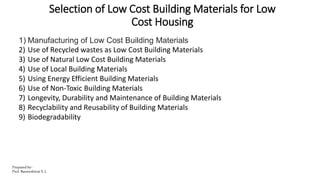
1) Manufacturing of Low Cost Building Materials
2) Use of Recycled wastes as Low Cost Building Materials
3) Use of Natural Low Cost Building Materials
4) Use of Local Building Materials
5) Using Energy Efficient Building Materials
6) Use of Non-Toxic Building Materials
7) Longevity, Durability and Maintenance of Building Materials
8) Recyclability and Reusability of Building Materials
9) Biodegradability
Prepared by-
Prof. Basweshwar S. J.
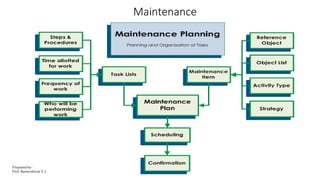
Maintenance
Prepared by-
Prof. Basweshwar S. J.
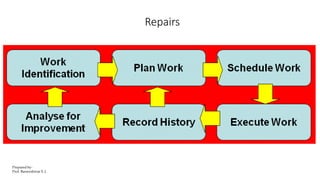
Repairs
Prepared by-
Prof. Basweshwar S. J.
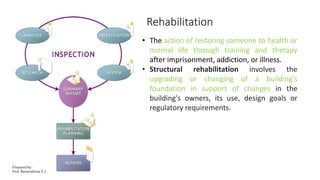
Rehabilitation
• The action of restoring someone to health or
normal life through training and therapy
after imprisonment, addiction, or illness.
• Structural rehabilitation involves the
upgrading or changing of a building's
foundation in support of changes in the
building's owners, its use, design goals or
regulatory requirements.
Prepared by-
Prof. Basweshwar S. J.

MODULE-III BUILDING PLANNING AND DESIGN BTCVC606

  • 1.
    Module3 Traditional constructions usingstone, brick, timber, bamboo, mud, lime, etc. Low cost housing-materials & methods (conceptual introduction only), Maintenance, Repairs, Rehabilitation Prepared by- Prof. Basweshwar S. J.
  • 2.
    Introduction • Housing isone of the most basic human needs is a key competent in the sustainable development of a community. • While energy consumption is the dominant factor of environmental impact in the operational phase, the most relevant impact factor of building materials is the industrial process. • The natural materials, such as stone, wood, straw, sheep's wool, fibers – lime, cork and clay, mud present the traditional construction material. Prepared by- Prof. Basweshwar S. J.
  • 3.
  • 4.
    The total costof building materials • Economic costs • Initial economic cost of building materials is the purchase price. • This is often what governs decision making about what materials to use. • Ecological costs • The macro, environmental pollution of extraction industries building materials rely on such as mining, petroleum, and logging produce environmental damage at their source and in transportation of the raw materials, manufacturing, transportation of the products, retailing, and installation. • Energy costs • The Initial energy costs include the amount of energy consumed to produce, deliver and install the material. • The long term energy cost is the economic, ecological, and social costs of continuing to produce and deliver energy to the building for its use, maintenance, and eventual removal. • Social costs • Social costs are injury and health of the people producing and transporting the materials and potential health problems of the building occupants if there are problems with the building biology. Prepared by- Prof. Basweshwar S. J.
  • 5.
    Traditional constructions usingstone Prepared by- Prof. Basweshwar S. J.
  • 6.
    Traditional constructions usingbrick Prepared by- Prof. Basweshwar S. J.
  • 7.
    Traditional constructions usingtimber Prepared by- Prof. Basweshwar S. J.
  • 8.
    Traditional constructions usingbamboo Prepared by- Prof. Basweshwar S. J.
  • 9.
    Traditional constructions usingmud Prepared by- Prof. Basweshwar S. J.
  • 10.
    Traditional constructions usinglime Prepared by- Prof. Basweshwar S. J.
  • 11.
    Low cost housing-materials& methods (conceptual introduction only), • Low cost housing construction is possible with the use of low cost building materials and planning. • For any nation whether developed or developing this is mandatory for them to make their rural areas a major priority for concern. • With the advancements in technology and development in the construction sector this is now possible to build Speedy and Low Cost Housing for Rural. Prepared by- Prof. Basweshwar S. J.
  • 12.
    Low cost housing-materials& methods (conceptual introduction only), • Foundation for Low Cost Housing Construction • Hollow Concrete Block Load Bearing Walls for Low Cost Housing Construction Prepared by- Prof. Basweshwar S. J.
  • 13.
    • Staircase forLow Cost Housing Construction • Filler Slabs for Ceilings in Low Cost Housing Construction • The filler slab is based on the principle that for roofs which are simply supported. • The upper part of the slab is subjected to compressive forces and the lower part of the slab experience tensile forces. • Concrete is very good in withstanding compressive forces and steel bears the load due to tensile forces. • Thus the lower tensile region of the slab does not need any concrete except for holding the steel reinforcements together. Prepared by- Prof. Basweshwar S. J.
  • 14.
    • Prefabrication ofStructural Elements • Doors and Windows in Low Cost Housing Construction Prepared by- Prof. Basweshwar S. J.
  • 15.
    Building Materials forLow Cost Housing Construction • Use of low cost building materials for construction of low cost housing increases the access to buildings by low income group peoples. • Low cost housing can be achieved by- • use of efficient planning and project management, • low cost materials, • economical construction technologies and • use of alternate construction methods available. Prepared by- Prof. Basweshwar S. J.
  • 16.
    Selection of LowCost Building Materials for Low Cost Housing 1) Manufacturing of Low Cost Building Materials 2) Use of Recycled wastes as Low Cost Building Materials 3) Use of Natural Low Cost Building Materials 4) Use of Local Building Materials 5) Using Energy Efficient Building Materials 6) Use of Non-Toxic Building Materials 7) Longevity, Durability and Maintenance of Building Materials 8) Recyclability and Reusability of Building Materials 9) Biodegradability Prepared by- Prof. Basweshwar S. J.
  • 17.
  • 18.
  • 19.
    Rehabilitation • The actionof restoring someone to health or normal life through training and therapy after imprisonment, addiction, or illness. • Structural rehabilitation involves the upgrading or changing of a building's foundation in support of changes in the building's owners, its use, design goals or regulatory requirements. Prepared by- Prof. Basweshwar S. J.