Pick any technological problem statement, The Problem statement must solve
using the technology the Internet of Things, Design the Solution for the problem
and explain here the Protocols, Circuit Diagram and Algorithm for the same.
Ans.
 Technological problem statement:
Detection of harmful gases in air with cheap long range feasible solution and
efficient controlling measures
 Already available solution:
The commercial meters available in the market are Fluke CO-220 carbon
monoxide meter for CO, Amprobe CO2 meter for CO2, Forbix Semicon LPG gas
leakage sensor alarm for LPG leakage detection. The researchers in this field
have proposed various air quality monitoring systems based on WSN (Web-
based management), GSM and GIS. Now each technology has limited uses
according to the intended function, as Zigbee is meant for users with Zigbee
trans-receiver, Bluetooth.
 Solution Introduced:
A IoT based monitoring system for detecting the harmful gases present in air
through LoRa technology which is the cheapest power efficient long range
solution for sending small sized sensor data.
In recent years, car emissions, chemicals from factories, smoke and dust are
everywhere. The air pollution may contain a lot of dangerous substances, such
as LPG gas, smoke, carbon monoxide, methane etc. Substances in the polluted
air are very dangerous. For example, if the carbon monoxide is above 100ppm, it
makes human feel dizzy, nauseous, and within minutes they could die.
 What is LoRa?
LoRa is an emerging duplex radio frequency based wireless technology for long
range communication for large area that requires dense deployment of LoRa
gateways to ensure that indoor Lora devices can transfer data back to remote
servers.
LoRa end node consists of the two parts:
1. Radio module with antenna
2. Micro- processor to process for example the sensor data.
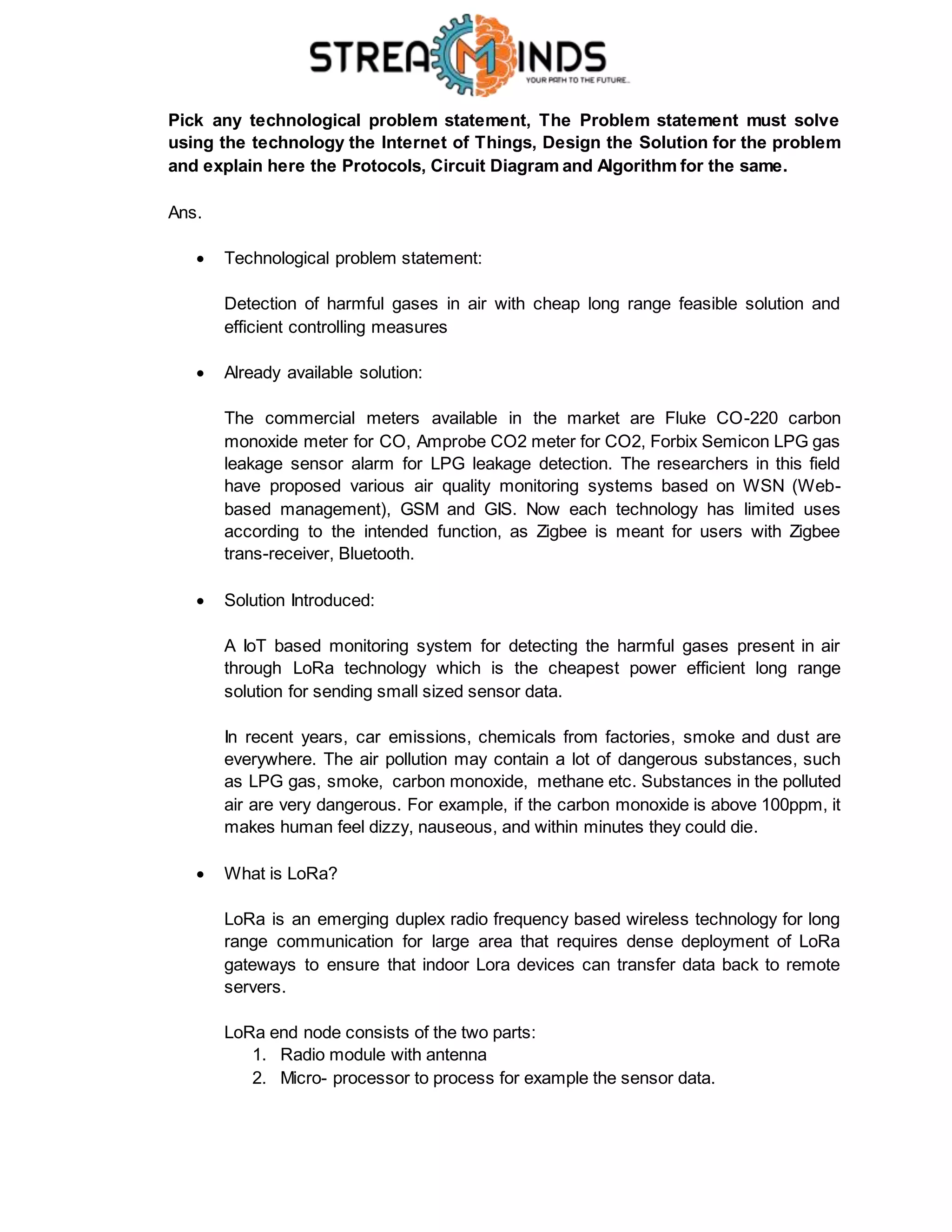
 Working/ Circuit Architecture:
First the sensors sense the gas level, if the harmful gas level is more than that of
the specified figures (that is mentioned in the code) then the message and the
measured data is broadcasted to the LoRa gateways that can be installed
anywhere remotely. Data reaches from various gateways to network server
which then sends it to the application servers.
Now, the application users decides to send the type of alert that triggers some
device when pollution/ harmful gases goes beyond some level (as set in the
coding of the micro- controller), like we can switch on the exhaust fan or can
send alert SMS or mail to the user. This is done by LoRa mesh- networking
module for IoT applications.
LoRa Network Architecture
{Source: https://lora-alliance.org/sites/default/files/2018-04/what-is-lorawan.pdf}
 Protocol used:
For collecting and using various sensors data mesh algorithms would be very
efficient. Since, a mesh network attempts to talk to all the other nodes in the
mesh. Mesh networking is a solution for increasing the communication range and
packet delivery ratio without the need to install additional LoRa gateways.
Sending data and receiving acknowledgements lets a node determine which
node can successfully communicate with the other directly.
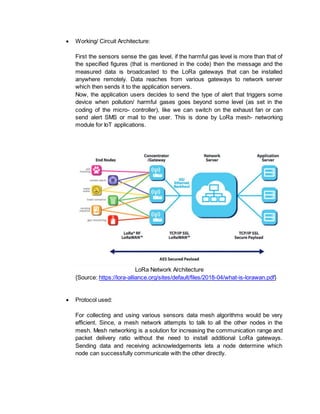
LoRa Protocol Stack
{Source: https://lora-alliance.org/sites/default/files/2018-04/what-is-lorawan.pdf}
 Why LoRa commmunicaton is best for this problem statement?
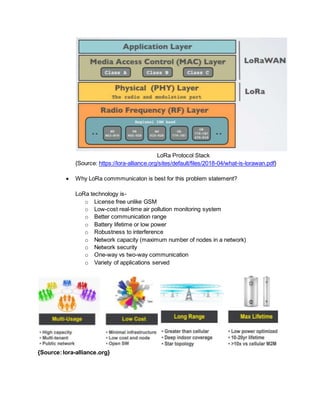
LoRa technology is-
o License free unlike GSM
o Low-cost real-time air pollution monitoring system
o Better communication range
o Battery lifetime or low power
o Robustness to interference
o Network capacity (maximum number of nodes in a network)
o Network security
o One-way vs two-way communication
o Variety of applications served
{Source:lora-alliance.org}
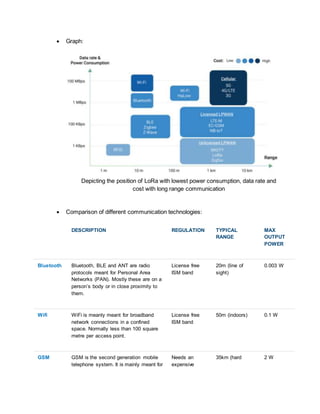
 Graph:
Depicting the position of LoRa with lowest power consumption, data rate and
cost with long range communication
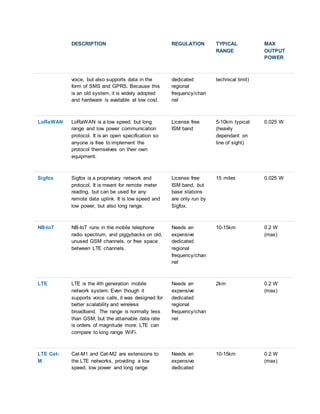
 Comparison of different communication technologies:
DESCRIPTION REGULATION TYPICAL
RANGE
MAX
OUTPUT
POWER
Bluetooth Bluetooth, BLE and ANT are radio
protocols meant for Personal Area
Networks (PAN). Mostly these are on a
person’s body or in close proximity to
them.
License free
ISM band
20m (line of
sight)
0.003 W
Wifi WiFi is meanly meant for broadband
network connections in a confined
space. Normally less than 100 square
metre per access point.
License free
ISM band
50m (indoors) 0.1 W
GSM GSM is the second generation mobile
telephone system. It is mainly meant for
Needs an
expensive
35km (hard 2 W
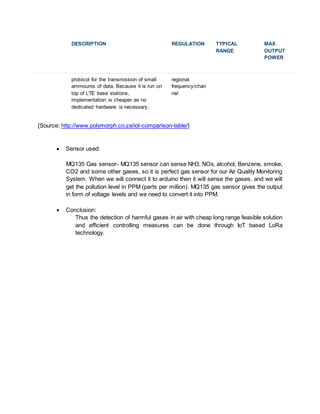
DESCRIPTION REGULATION TYPICAL
RANGE
MAX
OUTPUT
POWER
voice, but also supports data in the
form of SMS and GPRS. Because this
is an old system, it is widely adopted
and hardware is available at low cost.
dedicated
regional
frequency/chan
nel
technical limit)
LoRaWAN LoRaWAN is a low speed, but long
range and low power communication
protocol. It is an open specification so
anyone is free to implement the
protocol themselves on their own
equipment.
License free
ISM band
5-10km typical
(heavily
dependant on
line of sight)
0.025 W
Sigfox Sigfox is a proprietary network and
protocol. It is meant for remote meter
reading, but can be used for any
remote data uplink. It is low speed and
low power, but also long range.
License free
ISM band, but
base stations
are only run by
Sigfox.
15 miles 0.025 W
NB-IoT NB-IoT runs in the mobile telephone
radio spectrum, and piggybacks on old,
unused GSM channels, or free space
between LTE channels.
Needs an
expensive
dedicated
regional
frequency/chan
nel
10-15km 0.2 W
(max)
LTE LTE is the 4th generation mobile
network system. Even though it
supports voice calls, it was designed for
better scalability and wireless
broadband. The range is normally less
than GSM, but the attainable data rate
is orders of magnitude more. LTE can
compare to long range WiFi.
Needs an
expensive
dedicated
regional
frequency/chan
nel
2km 0.2 W
(max)
LTE Cat-
M
Cat-M1 and Cat-M2 are extensions to
the LTE networks, providing a low
speed, low power and long range
Needs an
expensive
dedicated
10-15km 0.2 W
(max)
DESCRIPTION REGULATION TYPICAL
RANGE
MAX
OUTPUT
POWER
protocol for the transmission of small
ammounts of data. Because it is run on
top of LTE base stations,
implementation is cheaper as no
dedicated hardware is necessary.
regional
frequency/chan
nel
{Source: http://www.polymorph.co.za/iot-comparison-table/}
 Sensor used:
MQ135 Gas sensor- MQ135 sensor can sense NH3, NOx, alcohol, Benzene, smoke,
CO2 and some other gases, so it is perfect gas sensor for our Air Quality Monitoring
System. When we will connect it to arduino then it will sense the gases, and we will
get the pollution level in PPM (parts per million). MQ135 gas sensor gives the output
in form of voltage levels and we need to convert it into PPM.
 Conclusion:
Thus the detection of harmful gases in air with cheap long range feasible solution
and efficient controlling measures can be done through IoT based LoRa
technology.

LoRa application for detecting the harmful gases

  • 1.
    Pick any technologicalproblem statement, The Problem statement must solve using the technology the Internet of Things, Design the Solution for the problem and explain here the Protocols, Circuit Diagram and Algorithm for the same. Ans.  Technological problem statement: Detection of harmful gases in air with cheap long range feasible solution and efficient controlling measures  Already available solution: The commercial meters available in the market are Fluke CO-220 carbon monoxide meter for CO, Amprobe CO2 meter for CO2, Forbix Semicon LPG gas leakage sensor alarm for LPG leakage detection. The researchers in this field have proposed various air quality monitoring systems based on WSN (Web- based management), GSM and GIS. Now each technology has limited uses according to the intended function, as Zigbee is meant for users with Zigbee trans-receiver, Bluetooth.  Solution Introduced: A IoT based monitoring system for detecting the harmful gases present in air through LoRa technology which is the cheapest power efficient long range solution for sending small sized sensor data. In recent years, car emissions, chemicals from factories, smoke and dust are everywhere. The air pollution may contain a lot of dangerous substances, such as LPG gas, smoke, carbon monoxide, methane etc. Substances in the polluted air are very dangerous. For example, if the carbon monoxide is above 100ppm, it makes human feel dizzy, nauseous, and within minutes they could die.  What is LoRa? LoRa is an emerging duplex radio frequency based wireless technology for long range communication for large area that requires dense deployment of LoRa gateways to ensure that indoor Lora devices can transfer data back to remote servers. LoRa end node consists of the two parts: 1. Radio module with antenna 2. Micro- processor to process for example the sensor data.
  • 2.
     Working/ CircuitArchitecture: First the sensors sense the gas level, if the harmful gas level is more than that of the specified figures (that is mentioned in the code) then the message and the measured data is broadcasted to the LoRa gateways that can be installed anywhere remotely. Data reaches from various gateways to network server which then sends it to the application servers. Now, the application users decides to send the type of alert that triggers some device when pollution/ harmful gases goes beyond some level (as set in the coding of the micro- controller), like we can switch on the exhaust fan or can send alert SMS or mail to the user. This is done by LoRa mesh- networking module for IoT applications. LoRa Network Architecture {Source: https://lora-alliance.org/sites/default/files/2018-04/what-is-lorawan.pdf}  Protocol used: For collecting and using various sensors data mesh algorithms would be very efficient. Since, a mesh network attempts to talk to all the other nodes in the mesh. Mesh networking is a solution for increasing the communication range and packet delivery ratio without the need to install additional LoRa gateways. Sending data and receiving acknowledgements lets a node determine which node can successfully communicate with the other directly.
  • 3.
    LoRa Protocol Stack {Source:https://lora-alliance.org/sites/default/files/2018-04/what-is-lorawan.pdf}  Why LoRa commmunicaton is best for this problem statement? LoRa technology is- o License free unlike GSM o Low-cost real-time air pollution monitoring system o Better communication range o Battery lifetime or low power o Robustness to interference o Network capacity (maximum number of nodes in a network) o Network security o One-way vs two-way communication o Variety of applications served {Source:lora-alliance.org}
  • 4.
     Graph: Depicting theposition of LoRa with lowest power consumption, data rate and cost with long range communication  Comparison of different communication technologies: DESCRIPTION REGULATION TYPICAL RANGE MAX OUTPUT POWER Bluetooth Bluetooth, BLE and ANT are radio protocols meant for Personal Area Networks (PAN). Mostly these are on a person’s body or in close proximity to them. License free ISM band 20m (line of sight) 0.003 W Wifi WiFi is meanly meant for broadband network connections in a confined space. Normally less than 100 square metre per access point. License free ISM band 50m (indoors) 0.1 W GSM GSM is the second generation mobile telephone system. It is mainly meant for Needs an expensive 35km (hard 2 W
  • 5.
    DESCRIPTION REGULATION TYPICAL RANGE MAX OUTPUT POWER voice,but also supports data in the form of SMS and GPRS. Because this is an old system, it is widely adopted and hardware is available at low cost. dedicated regional frequency/chan nel technical limit) LoRaWAN LoRaWAN is a low speed, but long range and low power communication protocol. It is an open specification so anyone is free to implement the protocol themselves on their own equipment. License free ISM band 5-10km typical (heavily dependant on line of sight) 0.025 W Sigfox Sigfox is a proprietary network and protocol. It is meant for remote meter reading, but can be used for any remote data uplink. It is low speed and low power, but also long range. License free ISM band, but base stations are only run by Sigfox. 15 miles 0.025 W NB-IoT NB-IoT runs in the mobile telephone radio spectrum, and piggybacks on old, unused GSM channels, or free space between LTE channels. Needs an expensive dedicated regional frequency/chan nel 10-15km 0.2 W (max) LTE LTE is the 4th generation mobile network system. Even though it supports voice calls, it was designed for better scalability and wireless broadband. The range is normally less than GSM, but the attainable data rate is orders of magnitude more. LTE can compare to long range WiFi. Needs an expensive dedicated regional frequency/chan nel 2km 0.2 W (max) LTE Cat- M Cat-M1 and Cat-M2 are extensions to the LTE networks, providing a low speed, low power and long range Needs an expensive dedicated 10-15km 0.2 W (max)
  • 6.
    DESCRIPTION REGULATION TYPICAL RANGE MAX OUTPUT POWER protocolfor the transmission of small ammounts of data. Because it is run on top of LTE base stations, implementation is cheaper as no dedicated hardware is necessary. regional frequency/chan nel {Source: http://www.polymorph.co.za/iot-comparison-table/}  Sensor used: MQ135 Gas sensor- MQ135 sensor can sense NH3, NOx, alcohol, Benzene, smoke, CO2 and some other gases, so it is perfect gas sensor for our Air Quality Monitoring System. When we will connect it to arduino then it will sense the gases, and we will get the pollution level in PPM (parts per million). MQ135 gas sensor gives the output in form of voltage levels and we need to convert it into PPM.  Conclusion: Thus the detection of harmful gases in air with cheap long range feasible solution and efficient controlling measures can be done through IoT based LoRa technology.