Water Level Monitoring System Using IOT
School Of CSA, REVA University 2019-20 Page 1
1. INTRODUCTION TO PROJECT
1.1 PROBLEM STATEMENT
Water wastage is an increasing problem in a country like India. Now a days embedded
systems are playing a vital role in Engineering design process for efficient analysis and
effective operation. Due to time complexity in electronic aspects embedded systems have
become a major part of our daily life. So therefore, with the help of embedded systems we
have designed a project which can measure the water level of a storage tank and display it
on the LCD. This not only provides us with the required information about the status of the
water tank but also helps and reduces the manpower required in this whole process. Our
project is a contribution towards the solution for water scarcity problems. Also, the
application of embedded systems reduces the probability of error caused by human
intervention.
1.2 BENIFITE OF PROJECT
Water level monitoring system are basically electronic gadgets which are used to
control the functions of your pump Most of the people prefer to use fully automatic control
devices to check the supply of water, The automatic water level monitoring devices are
capable of controlling the functions of the motor and help to reduce the consumption of
electricity, One of the main advantages of water level monitoring devices includes the
ability to control power fluctuations when the motor is switched on. Most of these devices
ensures uninterrupted water supply by filling the overhead tank once it is below level. The
motor power is switched on when the overhead tank becomes empty and switches off
automatically when the underground tank is empty or the overhead tank becomes full. In
this way it becomes easy to ensure 24 hours water supply without any kind of interruption.
Water Level Monitoring System Using IOT
School Of CSA, REVA University 2019-20 Page 2
There are several benefits of using these devices
 The device does not require manual controls. It can be operated automatically with the
help of timer switches
 With the use of these devices, the possibility of tanks getting over filled can be negated
completely. The motor switch is automatically switched off even when the underground
tank is empty.
 The use of water level monitoring devices also avoids running the pumps during odd
hours, particularly at night. It also ensures maximum water supply during peak hours
especially during morning hours. The special sensors and time controllers are apt in
pumping the water level to its maximum before the peak hours. It also maintains the water
level throughout the day.
Water Level Monitoring System Using IOT
School Of CSA, REVA University 2019-20 Page 3
2. SYSTEM ANALYSIS
2.1 EXISTING SYSTEM
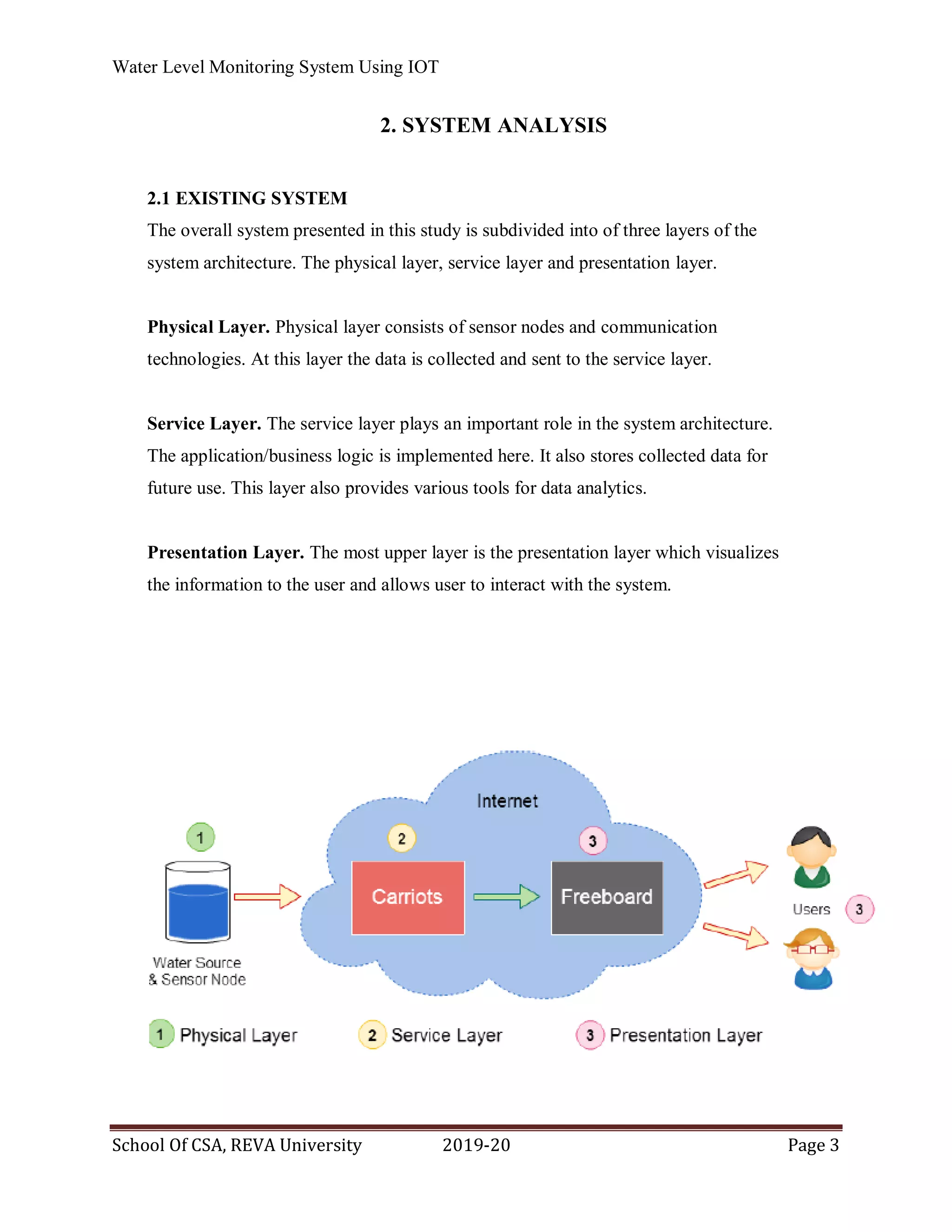
The overall system presented in this study is subdivided into of three layers of the
system architecture. The physical layer, service layer and presentation layer.
Physical Layer. Physical layer consists of sensor nodes and communication
technologies. At this layer the data is collected and sent to the service layer.
Service Layer. The service layer plays an important role in the system architecture.
The application/business logic is implemented here. It also stores collected data for
future use. This layer also provides various tools for data analytics.
Presentation Layer. The most upper layer is the presentation layer which visualizes
the information to the user and allows user to interact with the system.
Water Level Monitoring System Using IOT
School Of CSA, REVA University 2019-20 Page 4
2.2 DRAWBACKS OF EXISTING SYSTEM
1. Notification to the concerned authority: When the smart dispenser is empty definitely
there should be a notification that has to be sent to the concerned authority. All the water
management systems till now do this action by the way of sending SMS through GSM
model. But there are chances that those SMS may not be definitely transferred to the
concerned authority or might be prone to spam messages by the hackers. This may lead to
the wrong interpretation of the status of the cans by the concerned authority. If the SMS
from the cans is sent all at a time it may also lead to traffic congestion and the entire system
may be down for some time.
2. Use of Cameras for water line detection: The various smart dispensers developed till
date use cameras in it. Testing with the installed cameras with a real-world image shows not
so accurate detection of the water level with any different staff-gauge location. There also
exists complex challenges of viewpoints variations, low quality images as well as changing
illumination conditions.
3. Damage to sensors: Though smart dispensers can be built and established, it takes a lot
of time to educate people about its use especially in the countries like India. Due to the lack
of knowledge the people may not take care of the sensors in a proper way. There might be
chances that the sensor be thrown away or might be damaged. In such cases there should be
some proper mechanism through which the concerned authority should get to know about
the improper functioning sensors and take necessary measures to replace or repair them.
2.3 PROPOSED SYSTEM
In this proposed application architecture of the system, the physical layer consists of the
physical environment such as water source and WSN node to sense the water level in a
water source with required network connectivity. The sensor data is uploaded to carriots at
service layer of the architecture which is the second layer. The carriots is a cloud application
platform for IoT. Carriots has many advantages. It receive data stream from WSN in real-
Water Level Monitoring System Using IOT
School Of CSA, REVA University 2019-20 Page 5
time and is used to store and analyze data stream. Many other operations can be performed
on data streams such as generating event triggers, alerting users through SMS or social
network. At the presentation layer of the system, user of the application is the main focus .
This layer allows user to interact with the system. At the presentation layer of the
application architecture freeboard [10] is used to visualize the data. Freeboard is a
dashboard that works as a visualization tool. It provides several widgets for this purpose.
Freeboard receives data stream from carriots in JSON format and then visualize it according
to selected widgets. The widgets at freeboard are updated in real-time as soon as carriots is
updated with data stream. The communication between carriots and freeboard is done using
REST API.
water dispenser management system proposed here involves building of the smart water
dispensers. These dispensers are built with the help of ultrasonic sensors. When the level of
the water left inside the dispenser reaches some calculated threshold value, then a
notification is sent to the concerned authority through a mobile application. The mobile
application then gets a push notification from the dispensers which are at a low level of
water. Also, when the sensor is tampered or when it stops functioning, a notification is sent.
For the better implementation of locating dispensers, one single smart dispenser is built and
for the remaining dispensers simulation technique will be used so that the entire system will
be equivalent to building of two to three smart dispensers. Some networking concepts will
also be used for the communication between simulators and application. Laptops will be
utilized for the simulation purpose.
Block Diagram:
Fig 1 Block Diagram of water level monitoring system.
sensor
network
signal
conditioner
displaymicro
controller
motor
driver
motor
Water Level Monitoring System Using IOT
School Of CSA, REVA University 2019-20 Page 6
The proposed system uses five sensors to sense various levels of the storage. Whenever the
water level rises or decreases and comes in contact of any sensor then the circuit is complete
and current flows due to which the corresponding transistor conducts and circuit is closed.
The output of the sensor circuit triggers the microcontroller. Whenever the water level rises
above the highest level or decreases below the lowest threshold level then the sensor circuit
triggers the microcontroller. According to the code written and burnt in the microcontroller,
it will drive the DC motor. The motor driver is provided to drive and control the motor. An
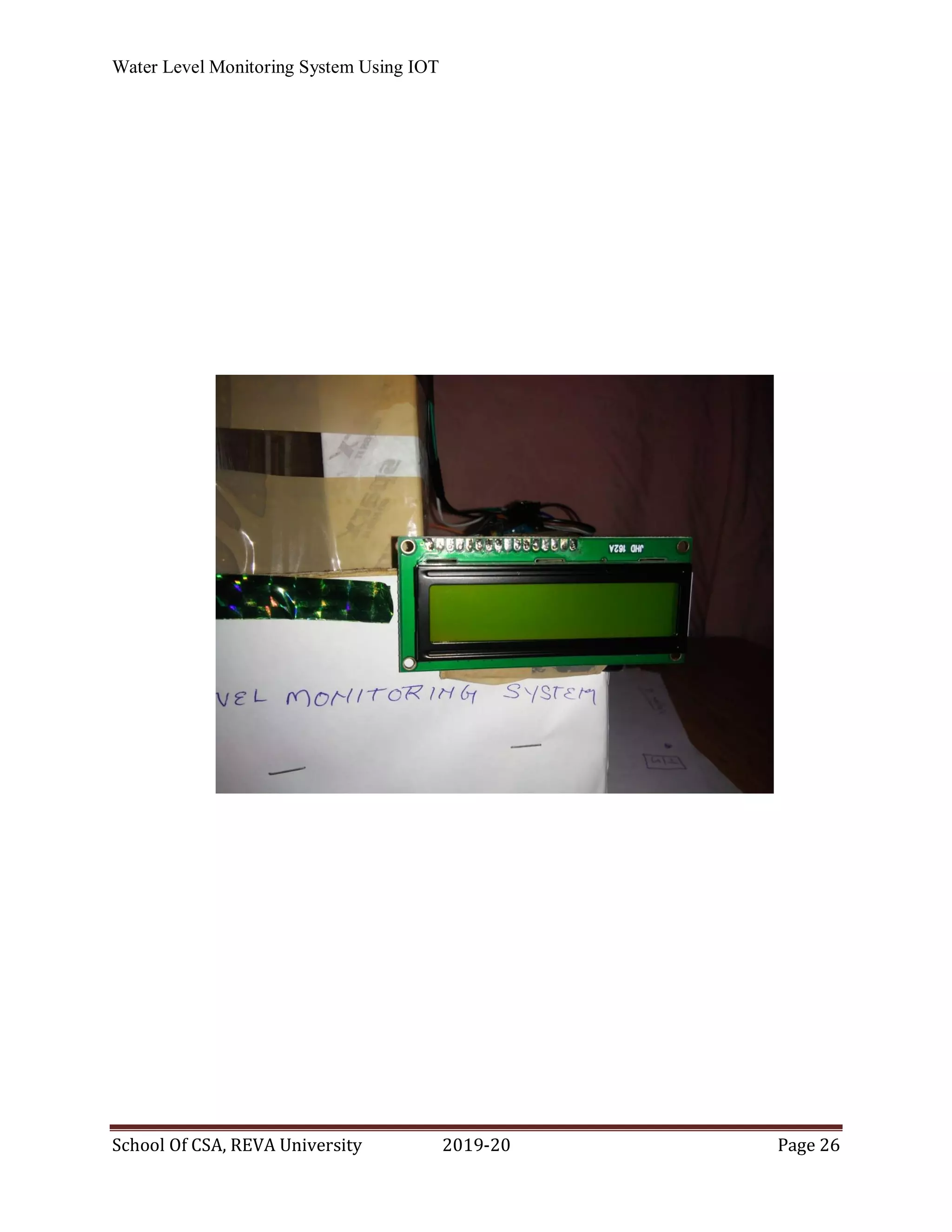
LCD is provided to inform the user about the status of the water level in the tank .
LCD modules are very commonly used in most embedded projects, the reason being its
cheap price, availability and programmer friendly. There are a lot of combinations available
like, 8×1, 8×2, 10×2, 16×1, etc. but the most used one is the 16×2 LCD. 16×2 LCD is
named so because; it has 16 Columns and 2 Rows. It will have (16×2=32) 32 characters in
total and each character will be made of 5×8 Pixel Dots. Each character has (5×8=40) 40
Pixels and for 32 characters we will have (32×40) 1280 Pixels. Further, the LCD should also
be instructed about the Position of the Pixels. Hence it will be a hectic task to handle
everything with the help of MCU, hence an Interface IC like HD44780 is used, which is
mounted on the backside of the LCD Module itself. The function of this IC is to get the
Commands and Data from the MCU and process them to display meaningful information
onto our LCD Screen.
Arduino Uno
Arduino is an open source computer hardware and software company, project, and user
community that designs and manufactures single-board microcontrollers and
microcontroller kits for building digital devices and interactive objects that can sense and
control objects in the physical and digital world. The UNO is the best board to get started
with electronics and coding. The UNO is the most used and documented board of the whole
Arduino family. Arduino Uno is a microcontroller board based on the ATmega328 [4]. It
has 14 digital input/output pins (of which 6 can be used as PWM outputs), 6 analog inputs, a
16 MHz quartz crystal, a USB connection, a power jack, an ICSP header and a reset button.
It contains everything needed to support the microcontroller; simply connect it to a
Water Level Monitoring System Using IOT
School Of CSA, REVA University 2019-20 Page 7
computer with a USB cable or power it with an AC-to-DC adapter or battery to get started.
The Arduino Uno is cheap and can therefore be used with a mindset of not worrying about
the board.
Water level sensor
In this project we have used five electrodes to sense the water in a tank. These five sensors
are placed in the tank at 20%, 40%, 60%, 80% and at the top or 100% of the tank level. As
given in the circuit, we put one wire of 5V supply in the bottom of the tank and remaining
wires at different equally spaced levels in the tank. When water is around 25% then 5V
supply wire and electrode at 20% will be short and the circuit will be completed.
Water Level Monitoring System Using IOT
School Of CSA, REVA University 2019-20 Page 8
3. ADVANTAGES AND DISADVANTAGES
3.1 Advantages: 1.In this system mobile application will be developed which is user
friendly. 2.Only authorized people can have access to the application.
3.Sensors can be protected by notifying the authorized person in case of damage.
4.The proposed system employs smart water dispensers which use ultrasonic sensors to
measure the level of water and Arduino.
5.Arduino on low water level detection sends a notification to an application using Firebase
cloud messaging.
6.A mobile application will receive the message and notify the person in charge to take the
necessary action.
7.Only a single person can manage multiple dispensers.
3.2 Disadvantages:
1.The proposed system is expensive and one system is used by one water dispenser.
2.The proposed system currently demonstrates only the admin module that can be logged in
and be used to monitor the water dispenser. The users can also register, login and get some
credentials as implementation of other modules.
Water Level Monitoring System Using IOT
School Of CSA, REVA University 2019-20 Page 9
4. FEASIBILITY STUDY
When a project is started an initial investigation is carried out. During
this phase of study users need has recognized and other requirements are determined.
Once the problem has been defined a study is carried out to select the best system
i.e. a feasible system that meets performance requirements. So Feasibility is the
determination of whether or not a project is worth doing and the process followed in
making this determination is called a Feasibility Study. In order to conduct the
feasibility study we have seven distinct, but inter-related types of feasibility, these are
Technical feasibility, Operational feasibility, Economical feasibility, Social feasibility,
Management feasibility, Legal feasibility and Time feasibility.
The objective of the feasibility study is not only to solve the problem but also to acquire the
sense of its scope. During the study, the problem definition is crystallized and aspects of the
problem be included in the system are estimated. Cost and benefits are estimate with greater
accuracy at this stage. There keys constraints are involved in feasibility study.
 Financial and Economic feasibility.
 Technical feasibility.
 Operational feasibility.
4.1 Financial And Economic Feasibility-
Economic feasibility or cost benefit is an assessment of the economic justification for a
computer system project. Since the system is a web based, any number of employer can use
this tool from anywhere and anytime.
Not only the cost of hardware, software…etc…is considered but also benefits in the form of
reduced cost are considered. The immigrant can be apply for the VISA online without going
to foreign exchange.
Water Level Monitoring System Using IOT
School Of CSA, REVA University 2019-20 Page 10
4.2 Technical Feasibility-
According to roger S. pressman “technical feasibility” is the assessment of the technical of
the system. The develop for platform independent environment VB and SQL server are used
to developed the system. The technical feasibility has been carried out. The system is
technical feasible for developed. The system can be developed with exiting facility. The
technical consideration evaluates the hardware requirement, software technology etc…as
per the requirement VB as front end SQL server as back end.
4.3 Operating Feasibility-
Operational feasibility deals with study prospectus of the system. This system operationally
eliminates all the tensions of the admin and effectively tracking the project process. This
kind of automation will surely reduce time and energy, which previously consumed in
manual work. Based on the study, the system is provided to be operationally feasible.
Processed feasibility is beneficial only it meet the user requirement. This system will
certainly be supported since it produces good results lots of work.
Water Level Monitoring System Using IOT
School Of CSA, REVA University 2019-20 Page 11
5. TOOLS AND TECHNOLOGIES
5.1 SYSTEM RQUIREMENT
The system requirement definition is concerned with the analysis of the existing system with
the aim of determining and structuring the requirement of the proposed system. It is
achieved with the aid of user requirement. The analysis stage was specifically carried out in
focus of the functionality dataflow at WATER LEVEL MONITORING SYSTEM.
PLATFORM
Windows is very powerful scalable Operating System that provides basic file and prints
services as well as robust platform for server application. Main features are as follow-
 An easier way to use Interface and tools
 More extensive Network Performance.
 Enhanced communication features.
5.2 HARDWARE REQUIREMENT
 Arduino Uno R3
 LCD((Liquid Crystal Display)
 Liquid Level sensor
 Ultra sonic sensor
 Male-Female jumper wires
 Water source
Water Level Monitoring System Using IOT
School Of CSA, REVA University 2019-20 Page 12
5.3 SOFTWARE REQUIREMENT
Software requirements definition is an abstract description of the services, that the system
should provide, and constraints under which the system must operate. Only the superficial
behavior of the system should be specified and is not concerned with system design
characteristics
 Arduino Software
 An account on Carriots.com
 Operating System: Windows ,2007,windows 8,windows10.
5.4 Language used
 Embedded C
5.5 SYSTEM REQUIREMENT AND SPECIFICATION
The automation system that is developed works as follows. When water is detected the
LED’s are switched on and vice versa. For this, the movement is detected by the IR sensor.
The various levels will be shown. The automation system that is developed works as
follows. When water is detected the LED’s are switched on and vice versa. For this, the
movement is detected by the IR sensor. The various levels will be shown.
5.6 FUNCTIONAL REQUIREMENT
Functional Requirement define the specific function that the system perform, along
with the data operated on by the functions. The functional requirements are presented
in scenarios that depict an operational system from the perspective of its user.
Included are one or more example of all system feature and an enumeration of all the
specific requirement associated with these feature.
Water Level Monitoring System Using IOT
School Of CSA, REVA University 2019-20 Page 13
5.7 NON FUNCTIONAL REQUIREMENT
Non-functional requirements address aspects of the system other than the specific
functions it performs. These aspects include system performance, costs, and such
general system characteristics as reliability, security, and portability. The non-
functional requirements also address aspects of the system development process and
operational personnel. It includes the following:
 The system shall be used friendly and consistent
 The system shall provide attractive graphical interface for the user
The system shall allow developer access to installed environment
Water Level Monitoring System Using IOT
School Of CSA, REVA University 2019-20 Page 14
6. SYSTEM DESIGN
Systems design is the process of defining the architecture, components, modules, interfaces,
and data for a system to satisfy specified requirements. Systems design could be seen as the
application of systems theory to product development. There is some overlap with the
disciplines of systems analysis, systems architecture and systems engineering.
System can be classified in two categories :
1) Field System consisting of a water level sensor and a Control System Unit, Dan
2)External system(android mobile application Dan firebase database real-time).
Sensors take measurements periodically in an interval of 200ms(measuring water level
and water flow). Measuring water level is used as a reference for controlling pump switches
(On/Off). The water flow sensor can be used as an indicator of the pump state(On or Off
condition).Measurement data is sent to the System Control Unit via RS485 BUS
communication every one second. The Control System unit receives sensor measuring data
and stores it in internal memory (data is deleted periodically).Control System Unit for
processing data and calculating the capacity of water in a tank. If the water level is at the
minimum threshold value, Control System unit send a signal to turn on the pump. And when
the water level is at the maximum threshold value, Control System unit send a signal to turn
off the pump.
User can monitor the volume of water in the reservoir through an android-based
mobile
application. Users can also control the pump remotely (over internet connation).The
application provides real-time data through a real time firebase database which functioned
as a gateway(not as a data storage media).
Water Level Monitoring System Using IOT
School Of CSA, REVA University 2019-20 Page 15
6.1 ARCHITECTURE DIAGRAM
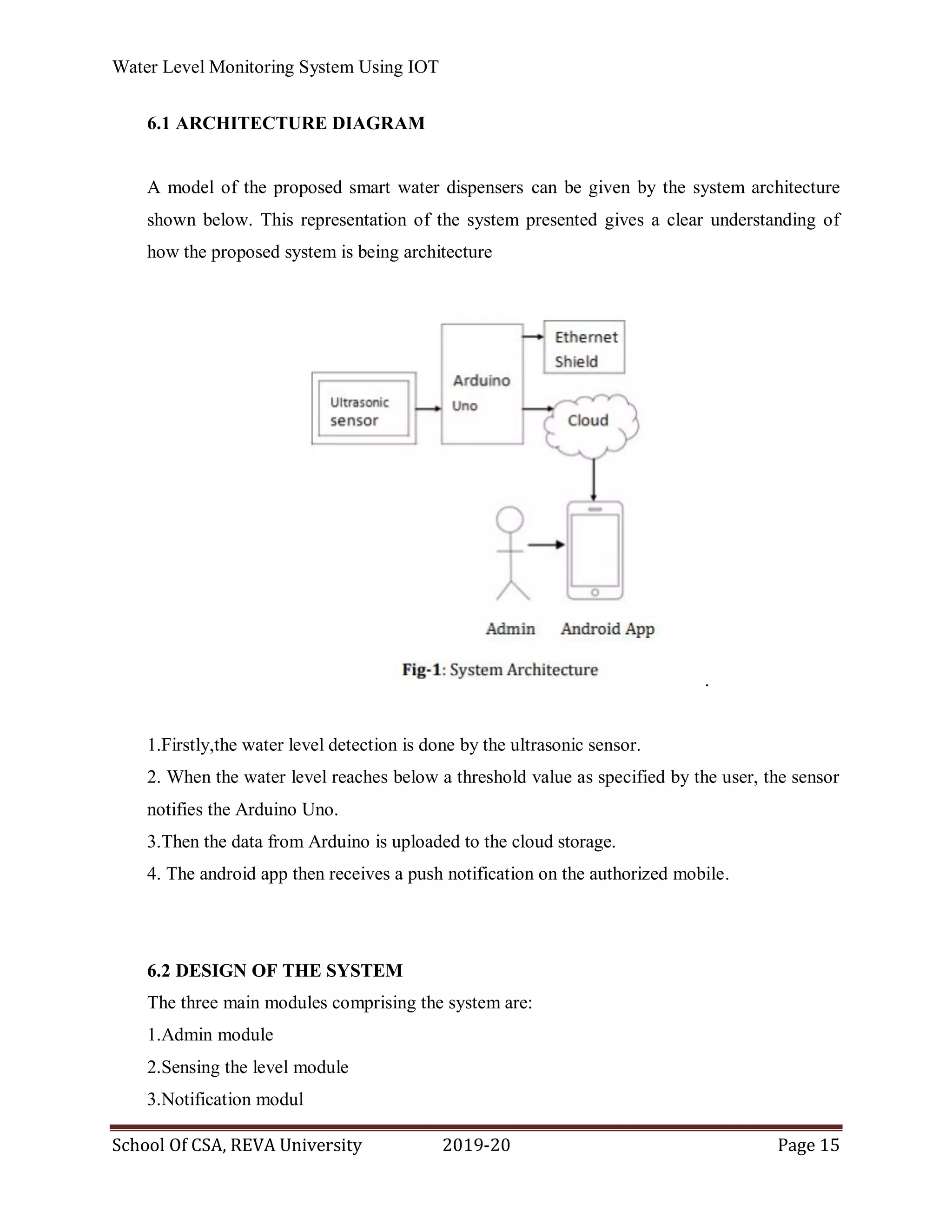
A model of the proposed smart water dispensers can be given by the system architecture
shown below. This representation of the system presented gives a clear understanding of
how the proposed system is being architecture
.
1.Firstly,the water level detection is done by the ultrasonic sensor.
2. When the water level reaches below a threshold value as specified by the user, the sensor
notifies the Arduino Uno.
3.Then the data from Arduino is uploaded to the cloud storage.
4. The android app then receives a push notification on the authorized mobile.
6.2 DESIGN OF THE SYSTEM
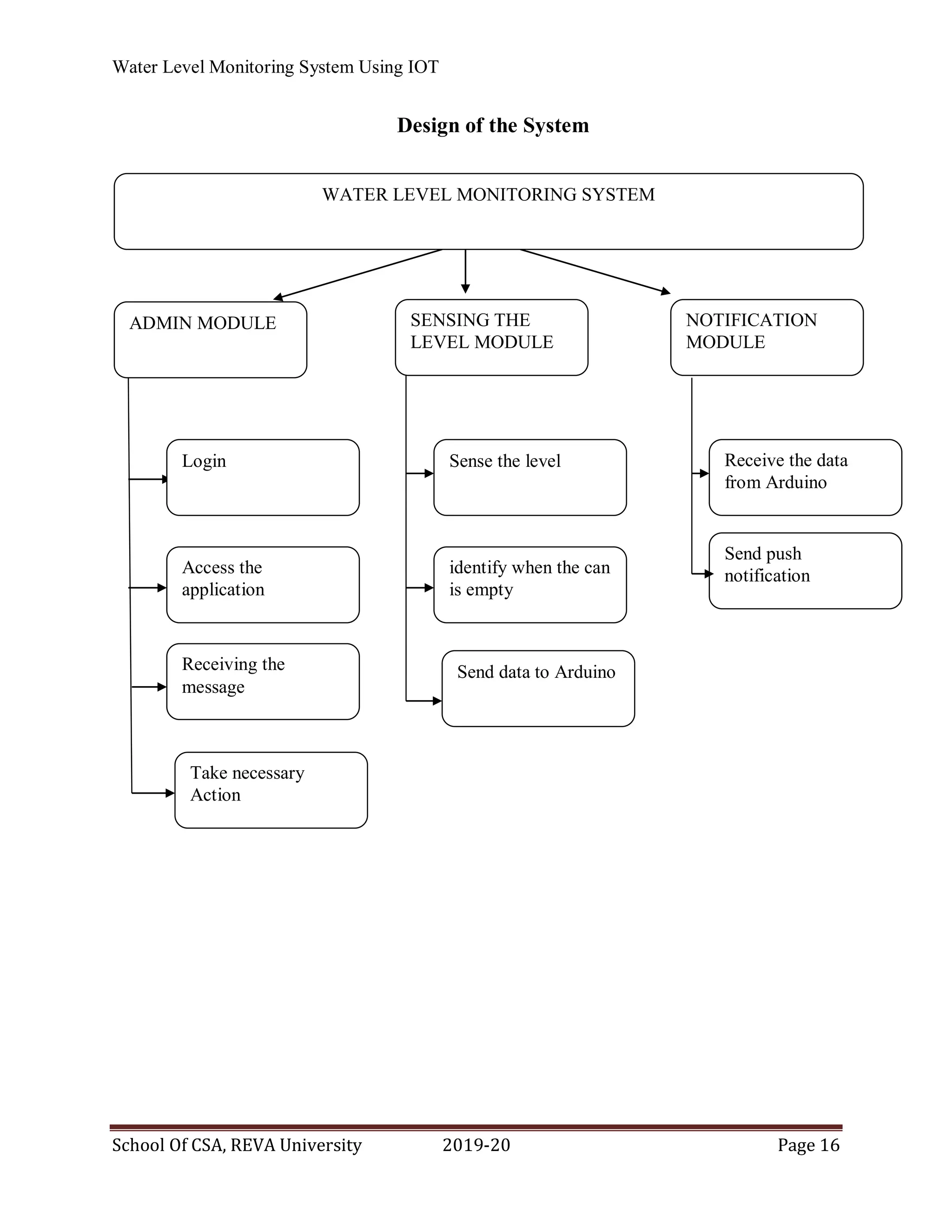
The three main modules comprising the system are:
1.Admin module
2.Sensing the level module
3.Notification modul
Water Level Monitoring System Using IOT
School Of CSA, REVA University 2019-20 Page 16
Design of the System
EATER
Send push
notification
WATER LEVEL MONITORING SYSTEM
Take necessary
Action
ADMIN MODULE SENSING THE
LEVEL MODULE
NOTIFICATION
MODULE
Sense the level Receive the data
from Arduino
Receiving the
message
identify when the can
is empty
Access the
application
Login
Send data to Arduino
Water Level Monitoring System Using IOT
School Of CSA, REVA University 2019-20 Page 17
6.3 SYSTEM DEVELOPMENT STRATEGY
The working of the entire system can be represented by a flowchart. The system begins with
the sensor connected to a water dispenser. The sensor checks the water level and sends
signal to the Arduino Uno micro controller. Arduino Uno then forwards the data to the
cloud. Using Firebase Cloud Messaging the information is sent as a push notification to the
respective application.
Algorithm:
The system implements the following algorithm:
Step 1: The hardware is powered on.
Step 2: The sensor measures the level of water. If the can is not empty repeat this step.
Step 3: The Arduino Uno micro controller sends notification to android application via
firebase cloud messaging.
Step 4: The user after receiving the notification uses the application to order a new can.
Step 5: After the new can has been put into the dispenser the water level increases. Again
start from step 2.
6.4 IMPLEMENTATION STEPS
1. A database is created that stores the water dispensers locations.
2. An android application receives notification for various causes.
3. An android device is registered with the mobile application to login to the application.
4. The data from the sensor is transferred to Arduino Uno when it detects low level of
water.
5. The data from Arduino Uno is sent to the Firebase cloud.
6. The firebase cloud then notifies the android application running on the registered android
device.
7. The user then uses the android application to place order for new can.
8. If no notification is received for many days the sensor might have been damaged.
Water Level Monitoring System Using IOT
School Of CSA, REVA University 2019-20 Page 18
7.TESTING
This is the testing process which we can do manually because in this testing program is a
tested individually using dummy record to see whether that program produce satisfied
output as the company and validation also.
 System Testing:-
System testing is actually a series different test whose primary purpose is to full exercise the
computer base system. Where the software and other system elements are tested as whole
.To test computer software ,we spiral out along streamlines that broadens the scope of
testing with each turn. The last higher-order testing step falls outside the boundary of
software Engineering and in to the broader context of computer system engineering.
Software, once validated, must be combining with order system Elements (e.g. hardware,
people, databases).System testing verifies that all the elements Mesh properly and that
overall system function/performance is achieved.
Recovery Testing
Security Testing
Stress Testing
 Module Testing
Module testing is defined as a software testing type, which checks individual subprograms,
subroutines, classes, or procedures in a program. Instead of testing whole software program
at once, module testing recommends testing the smaller building blocks of the program.
Module testing is largely a white box oriented. The objective of doing Module, testing is not
to demonstrate proper functioning of the module but to demonstrate the presence of an error
in the module.
 Unit Testing
UNIT TESTING is a level of software testing where individual units/ components of a
software are tested. The purpose is to validate that each unit of the software performs as
designed. A unit is the smallest testable part of any software. It usually has one or a few
Water Level Monitoring System Using IOT
School Of CSA, REVA University 2019-20 Page 19
inputs and usually a single output. In procedural programming, a unit may be an individual
program, function, procedure, etc. In object-oriented programming, the smallest unit is a
method, which may belong to a base/ super class, abstract class or derived/ child class.
(Some treat a module of an application as a unit. This is to be discouraged as there will
probably be many individual units within that module.) Unit testing frameworks, drivers,
stubs, and mock/ fake objects are used to assist in unit testing.
Water Level Monitoring System Using IOT
School Of CSA, REVA University 2019-20 Page 20
8.FLOW CHART
Flow Chart of Water Level Monitoring System
Yes
NO
start
Read water level
calculate height
if height >=
than threshold
SMS Send to User
Delay
Water Level Monitoring System Using IOT
School Of CSA, REVA University 2019-20 Page 21
Working Diagram Of Model
ARDUINO
UNO
Float Sensors
IOT Module
Signal
conditioner
Buzzer
LCD Display
Water Level Monitoring System Using IOT
School Of CSA, REVA University 2019-20 Page 22
9.CIRCUIT DIAGRAM OF WATER LEVEL MONITORING SYSTE
Water Level Monitoring System Using IOT
School Of CSA, REVA University 2019-20 Page 23
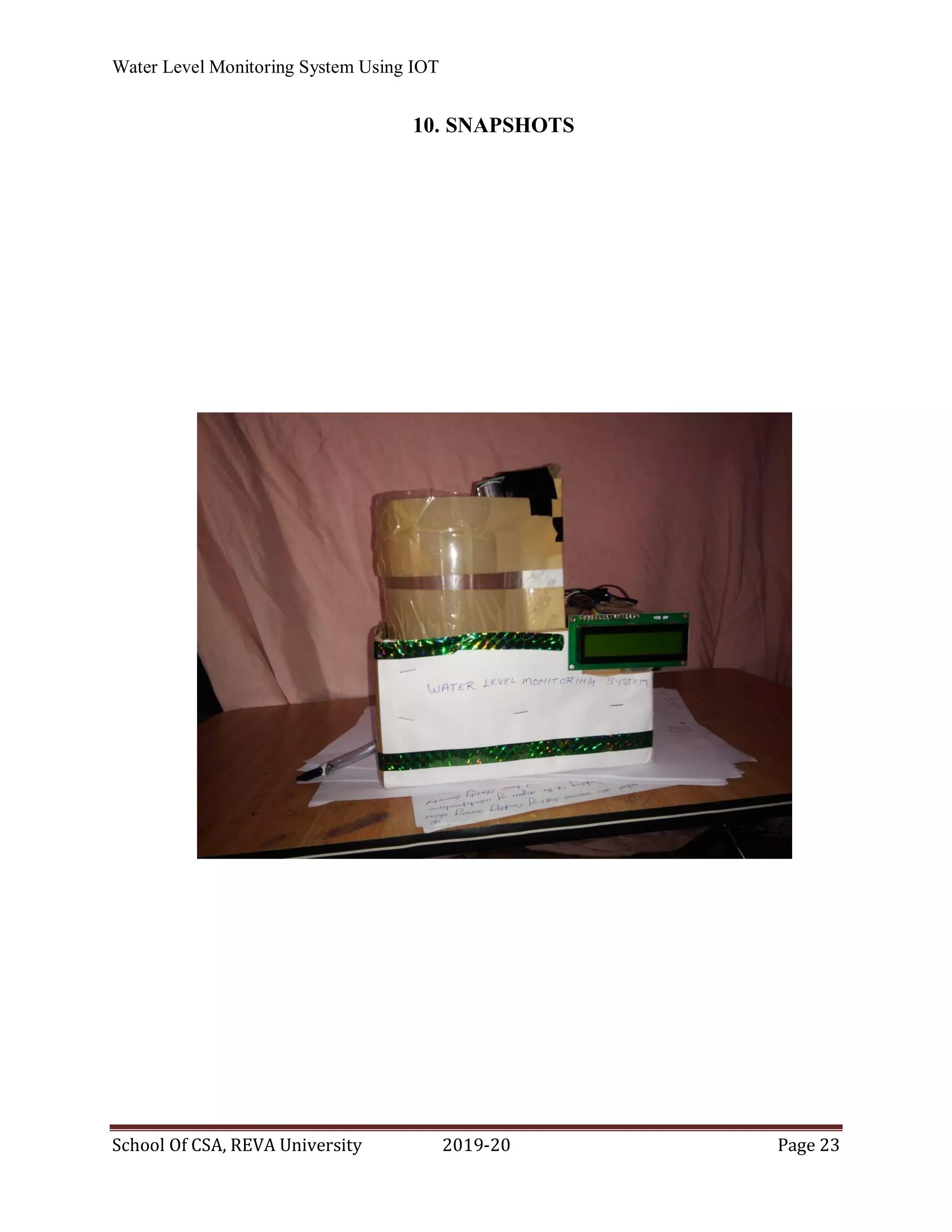
10. SNAPSHOTS
Water Level Monitoring System Using IOT
School Of CSA, REVA University 2019-20 Page 24
Water Level Monitoring System Using IOT
School Of CSA, REVA University 2019-20 Page 25
Water Level Monitoring System Using IOT
School Of CSA, REVA University 2019-20 Page 26
Water Level Monitoring System Using IOT
School Of CSA, REVA University 2019-20 Page 27
Water Level Monitoring System Using IOT
School Of CSA, REVA University 2019-20 Page 28
11. CONCLUSION
Most of the people in residential areas face the problem of running out of water and
overflow of water in water tanks due to excess supply of water. Even when the pump is
turned on users will not realize when the water tank gets filled which may result in
overflow. It becomes difficult for users to judge the level of water in water tanks, due to
which at times of need users may run out of water, Water tank monitoring system is used to
sort out the issues associated with water tank. It is also possible to check the level of the
water using sensor so that whenever the water goes below certain threshold limit, a
notification is sent to user through the android application using Arduino Board and user
needs to turn on the motor. Also if the water level goes above certain limit the motor gets
turned off automatically. This system prevents wastage of water.
The main aim of this system is to monitor the water level at rural areas such as big water
tanks so that they help in detecting the wastage of water and measures can be taken to avoid
unnecessary overflowing of water in the areas where monitoring is a difficult task.
This study presented the design phase of Water Level Monitoring System using Arduino
and ultrasonic sensors. The requirement analysis and the system design details have been
conducted in depth for the better understanding of the project and also to know risk factors
that will be faced during the construction phase. From the above analysis we can conclude
that the entire system can be built with low cost, reliable instruments there by providing an
efficient Water Level Monitoring System.
Future Work can involve the analysis of water level in a particular area so that the
underutilized water can be diverted to some other places. We can also include the GSM-
based system for proper utilization of water.

Water level monitoring system

  • 1.
    Water Level MonitoringSystem Using IOT School Of CSA, REVA University 2019-20 Page 1 1. INTRODUCTION TO PROJECT 1.1 PROBLEM STATEMENT Water wastage is an increasing problem in a country like India. Now a days embedded systems are playing a vital role in Engineering design process for efficient analysis and effective operation. Due to time complexity in electronic aspects embedded systems have become a major part of our daily life. So therefore, with the help of embedded systems we have designed a project which can measure the water level of a storage tank and display it on the LCD. This not only provides us with the required information about the status of the water tank but also helps and reduces the manpower required in this whole process. Our project is a contribution towards the solution for water scarcity problems. Also, the application of embedded systems reduces the probability of error caused by human intervention. 1.2 BENIFITE OF PROJECT Water level monitoring system are basically electronic gadgets which are used to control the functions of your pump Most of the people prefer to use fully automatic control devices to check the supply of water, The automatic water level monitoring devices are capable of controlling the functions of the motor and help to reduce the consumption of electricity, One of the main advantages of water level monitoring devices includes the ability to control power fluctuations when the motor is switched on. Most of these devices ensures uninterrupted water supply by filling the overhead tank once it is below level. The motor power is switched on when the overhead tank becomes empty and switches off automatically when the underground tank is empty or the overhead tank becomes full. In this way it becomes easy to ensure 24 hours water supply without any kind of interruption.
  • 2.
    Water Level MonitoringSystem Using IOT School Of CSA, REVA University 2019-20 Page 2 There are several benefits of using these devices  The device does not require manual controls. It can be operated automatically with the help of timer switches  With the use of these devices, the possibility of tanks getting over filled can be negated completely. The motor switch is automatically switched off even when the underground tank is empty.  The use of water level monitoring devices also avoids running the pumps during odd hours, particularly at night. It also ensures maximum water supply during peak hours especially during morning hours. The special sensors and time controllers are apt in pumping the water level to its maximum before the peak hours. It also maintains the water level throughout the day.
  • 3.
    Water Level MonitoringSystem Using IOT School Of CSA, REVA University 2019-20 Page 3 2. SYSTEM ANALYSIS 2.1 EXISTING SYSTEM The overall system presented in this study is subdivided into of three layers of the system architecture. The physical layer, service layer and presentation layer. Physical Layer. Physical layer consists of sensor nodes and communication technologies. At this layer the data is collected and sent to the service layer. Service Layer. The service layer plays an important role in the system architecture. The application/business logic is implemented here. It also stores collected data for future use. This layer also provides various tools for data analytics. Presentation Layer. The most upper layer is the presentation layer which visualizes the information to the user and allows user to interact with the system.
  • 4.
    Water Level MonitoringSystem Using IOT School Of CSA, REVA University 2019-20 Page 4 2.2 DRAWBACKS OF EXISTING SYSTEM 1. Notification to the concerned authority: When the smart dispenser is empty definitely there should be a notification that has to be sent to the concerned authority. All the water management systems till now do this action by the way of sending SMS through GSM model. But there are chances that those SMS may not be definitely transferred to the concerned authority or might be prone to spam messages by the hackers. This may lead to the wrong interpretation of the status of the cans by the concerned authority. If the SMS from the cans is sent all at a time it may also lead to traffic congestion and the entire system may be down for some time. 2. Use of Cameras for water line detection: The various smart dispensers developed till date use cameras in it. Testing with the installed cameras with a real-world image shows not so accurate detection of the water level with any different staff-gauge location. There also exists complex challenges of viewpoints variations, low quality images as well as changing illumination conditions. 3. Damage to sensors: Though smart dispensers can be built and established, it takes a lot of time to educate people about its use especially in the countries like India. Due to the lack of knowledge the people may not take care of the sensors in a proper way. There might be chances that the sensor be thrown away or might be damaged. In such cases there should be some proper mechanism through which the concerned authority should get to know about the improper functioning sensors and take necessary measures to replace or repair them. 2.3 PROPOSED SYSTEM In this proposed application architecture of the system, the physical layer consists of the physical environment such as water source and WSN node to sense the water level in a water source with required network connectivity. The sensor data is uploaded to carriots at service layer of the architecture which is the second layer. The carriots is a cloud application platform for IoT. Carriots has many advantages. It receive data stream from WSN in real-
  • 5.
    Water Level MonitoringSystem Using IOT School Of CSA, REVA University 2019-20 Page 5 time and is used to store and analyze data stream. Many other operations can be performed on data streams such as generating event triggers, alerting users through SMS or social network. At the presentation layer of the system, user of the application is the main focus . This layer allows user to interact with the system. At the presentation layer of the application architecture freeboard [10] is used to visualize the data. Freeboard is a dashboard that works as a visualization tool. It provides several widgets for this purpose. Freeboard receives data stream from carriots in JSON format and then visualize it according to selected widgets. The widgets at freeboard are updated in real-time as soon as carriots is updated with data stream. The communication between carriots and freeboard is done using REST API. water dispenser management system proposed here involves building of the smart water dispensers. These dispensers are built with the help of ultrasonic sensors. When the level of the water left inside the dispenser reaches some calculated threshold value, then a notification is sent to the concerned authority through a mobile application. The mobile application then gets a push notification from the dispensers which are at a low level of water. Also, when the sensor is tampered or when it stops functioning, a notification is sent. For the better implementation of locating dispensers, one single smart dispenser is built and for the remaining dispensers simulation technique will be used so that the entire system will be equivalent to building of two to three smart dispensers. Some networking concepts will also be used for the communication between simulators and application. Laptops will be utilized for the simulation purpose. Block Diagram: Fig 1 Block Diagram of water level monitoring system. sensor network signal conditioner displaymicro controller motor driver motor
  • 6.
    Water Level MonitoringSystem Using IOT School Of CSA, REVA University 2019-20 Page 6 The proposed system uses five sensors to sense various levels of the storage. Whenever the water level rises or decreases and comes in contact of any sensor then the circuit is complete and current flows due to which the corresponding transistor conducts and circuit is closed. The output of the sensor circuit triggers the microcontroller. Whenever the water level rises above the highest level or decreases below the lowest threshold level then the sensor circuit triggers the microcontroller. According to the code written and burnt in the microcontroller, it will drive the DC motor. The motor driver is provided to drive and control the motor. An LCD is provided to inform the user about the status of the water level in the tank . LCD modules are very commonly used in most embedded projects, the reason being its cheap price, availability and programmer friendly. There are a lot of combinations available like, 8×1, 8×2, 10×2, 16×1, etc. but the most used one is the 16×2 LCD. 16×2 LCD is named so because; it has 16 Columns and 2 Rows. It will have (16×2=32) 32 characters in total and each character will be made of 5×8 Pixel Dots. Each character has (5×8=40) 40 Pixels and for 32 characters we will have (32×40) 1280 Pixels. Further, the LCD should also be instructed about the Position of the Pixels. Hence it will be a hectic task to handle everything with the help of MCU, hence an Interface IC like HD44780 is used, which is mounted on the backside of the LCD Module itself. The function of this IC is to get the Commands and Data from the MCU and process them to display meaningful information onto our LCD Screen. Arduino Uno Arduino is an open source computer hardware and software company, project, and user community that designs and manufactures single-board microcontrollers and microcontroller kits for building digital devices and interactive objects that can sense and control objects in the physical and digital world. The UNO is the best board to get started with electronics and coding. The UNO is the most used and documented board of the whole Arduino family. Arduino Uno is a microcontroller board based on the ATmega328 [4]. It has 14 digital input/output pins (of which 6 can be used as PWM outputs), 6 analog inputs, a 16 MHz quartz crystal, a USB connection, a power jack, an ICSP header and a reset button. It contains everything needed to support the microcontroller; simply connect it to a
  • 7.
    Water Level MonitoringSystem Using IOT School Of CSA, REVA University 2019-20 Page 7 computer with a USB cable or power it with an AC-to-DC adapter or battery to get started. The Arduino Uno is cheap and can therefore be used with a mindset of not worrying about the board. Water level sensor In this project we have used five electrodes to sense the water in a tank. These five sensors are placed in the tank at 20%, 40%, 60%, 80% and at the top or 100% of the tank level. As given in the circuit, we put one wire of 5V supply in the bottom of the tank and remaining wires at different equally spaced levels in the tank. When water is around 25% then 5V supply wire and electrode at 20% will be short and the circuit will be completed.
  • 8.
    Water Level MonitoringSystem Using IOT School Of CSA, REVA University 2019-20 Page 8 3. ADVANTAGES AND DISADVANTAGES 3.1 Advantages: 1.In this system mobile application will be developed which is user friendly. 2.Only authorized people can have access to the application. 3.Sensors can be protected by notifying the authorized person in case of damage. 4.The proposed system employs smart water dispensers which use ultrasonic sensors to measure the level of water and Arduino. 5.Arduino on low water level detection sends a notification to an application using Firebase cloud messaging. 6.A mobile application will receive the message and notify the person in charge to take the necessary action. 7.Only a single person can manage multiple dispensers. 3.2 Disadvantages: 1.The proposed system is expensive and one system is used by one water dispenser. 2.The proposed system currently demonstrates only the admin module that can be logged in and be used to monitor the water dispenser. The users can also register, login and get some credentials as implementation of other modules.
  • 9.
    Water Level MonitoringSystem Using IOT School Of CSA, REVA University 2019-20 Page 9 4. FEASIBILITY STUDY When a project is started an initial investigation is carried out. During this phase of study users need has recognized and other requirements are determined. Once the problem has been defined a study is carried out to select the best system i.e. a feasible system that meets performance requirements. So Feasibility is the determination of whether or not a project is worth doing and the process followed in making this determination is called a Feasibility Study. In order to conduct the feasibility study we have seven distinct, but inter-related types of feasibility, these are Technical feasibility, Operational feasibility, Economical feasibility, Social feasibility, Management feasibility, Legal feasibility and Time feasibility. The objective of the feasibility study is not only to solve the problem but also to acquire the sense of its scope. During the study, the problem definition is crystallized and aspects of the problem be included in the system are estimated. Cost and benefits are estimate with greater accuracy at this stage. There keys constraints are involved in feasibility study.  Financial and Economic feasibility.  Technical feasibility.  Operational feasibility. 4.1 Financial And Economic Feasibility- Economic feasibility or cost benefit is an assessment of the economic justification for a computer system project. Since the system is a web based, any number of employer can use this tool from anywhere and anytime. Not only the cost of hardware, software…etc…is considered but also benefits in the form of reduced cost are considered. The immigrant can be apply for the VISA online without going to foreign exchange.
  • 10.
    Water Level MonitoringSystem Using IOT School Of CSA, REVA University 2019-20 Page 10 4.2 Technical Feasibility- According to roger S. pressman “technical feasibility” is the assessment of the technical of the system. The develop for platform independent environment VB and SQL server are used to developed the system. The technical feasibility has been carried out. The system is technical feasible for developed. The system can be developed with exiting facility. The technical consideration evaluates the hardware requirement, software technology etc…as per the requirement VB as front end SQL server as back end. 4.3 Operating Feasibility- Operational feasibility deals with study prospectus of the system. This system operationally eliminates all the tensions of the admin and effectively tracking the project process. This kind of automation will surely reduce time and energy, which previously consumed in manual work. Based on the study, the system is provided to be operationally feasible. Processed feasibility is beneficial only it meet the user requirement. This system will certainly be supported since it produces good results lots of work.
  • 11.
    Water Level MonitoringSystem Using IOT School Of CSA, REVA University 2019-20 Page 11 5. TOOLS AND TECHNOLOGIES 5.1 SYSTEM RQUIREMENT The system requirement definition is concerned with the analysis of the existing system with the aim of determining and structuring the requirement of the proposed system. It is achieved with the aid of user requirement. The analysis stage was specifically carried out in focus of the functionality dataflow at WATER LEVEL MONITORING SYSTEM. PLATFORM Windows is very powerful scalable Operating System that provides basic file and prints services as well as robust platform for server application. Main features are as follow-  An easier way to use Interface and tools  More extensive Network Performance.  Enhanced communication features. 5.2 HARDWARE REQUIREMENT  Arduino Uno R3  LCD((Liquid Crystal Display)  Liquid Level sensor  Ultra sonic sensor  Male-Female jumper wires  Water source
  • 12.
    Water Level MonitoringSystem Using IOT School Of CSA, REVA University 2019-20 Page 12 5.3 SOFTWARE REQUIREMENT Software requirements definition is an abstract description of the services, that the system should provide, and constraints under which the system must operate. Only the superficial behavior of the system should be specified and is not concerned with system design characteristics  Arduino Software  An account on Carriots.com  Operating System: Windows ,2007,windows 8,windows10. 5.4 Language used  Embedded C 5.5 SYSTEM REQUIREMENT AND SPECIFICATION The automation system that is developed works as follows. When water is detected the LED’s are switched on and vice versa. For this, the movement is detected by the IR sensor. The various levels will be shown. The automation system that is developed works as follows. When water is detected the LED’s are switched on and vice versa. For this, the movement is detected by the IR sensor. The various levels will be shown. 5.6 FUNCTIONAL REQUIREMENT Functional Requirement define the specific function that the system perform, along with the data operated on by the functions. The functional requirements are presented in scenarios that depict an operational system from the perspective of its user. Included are one or more example of all system feature and an enumeration of all the specific requirement associated with these feature.
  • 13.
    Water Level MonitoringSystem Using IOT School Of CSA, REVA University 2019-20 Page 13 5.7 NON FUNCTIONAL REQUIREMENT Non-functional requirements address aspects of the system other than the specific functions it performs. These aspects include system performance, costs, and such general system characteristics as reliability, security, and portability. The non- functional requirements also address aspects of the system development process and operational personnel. It includes the following:  The system shall be used friendly and consistent  The system shall provide attractive graphical interface for the user The system shall allow developer access to installed environment
  • 14.
    Water Level MonitoringSystem Using IOT School Of CSA, REVA University 2019-20 Page 14 6. SYSTEM DESIGN Systems design is the process of defining the architecture, components, modules, interfaces, and data for a system to satisfy specified requirements. Systems design could be seen as the application of systems theory to product development. There is some overlap with the disciplines of systems analysis, systems architecture and systems engineering. System can be classified in two categories : 1) Field System consisting of a water level sensor and a Control System Unit, Dan 2)External system(android mobile application Dan firebase database real-time). Sensors take measurements periodically in an interval of 200ms(measuring water level and water flow). Measuring water level is used as a reference for controlling pump switches (On/Off). The water flow sensor can be used as an indicator of the pump state(On or Off condition).Measurement data is sent to the System Control Unit via RS485 BUS communication every one second. The Control System unit receives sensor measuring data and stores it in internal memory (data is deleted periodically).Control System Unit for processing data and calculating the capacity of water in a tank. If the water level is at the minimum threshold value, Control System unit send a signal to turn on the pump. And when the water level is at the maximum threshold value, Control System unit send a signal to turn off the pump. User can monitor the volume of water in the reservoir through an android-based mobile application. Users can also control the pump remotely (over internet connation).The application provides real-time data through a real time firebase database which functioned as a gateway(not as a data storage media).
  • 15.
    Water Level MonitoringSystem Using IOT School Of CSA, REVA University 2019-20 Page 15 6.1 ARCHITECTURE DIAGRAM A model of the proposed smart water dispensers can be given by the system architecture shown below. This representation of the system presented gives a clear understanding of how the proposed system is being architecture . 1.Firstly,the water level detection is done by the ultrasonic sensor. 2. When the water level reaches below a threshold value as specified by the user, the sensor notifies the Arduino Uno. 3.Then the data from Arduino is uploaded to the cloud storage. 4. The android app then receives a push notification on the authorized mobile. 6.2 DESIGN OF THE SYSTEM The three main modules comprising the system are: 1.Admin module 2.Sensing the level module 3.Notification modul
  • 16.
    Water Level MonitoringSystem Using IOT School Of CSA, REVA University 2019-20 Page 16 Design of the System EATER Send push notification WATER LEVEL MONITORING SYSTEM Take necessary Action ADMIN MODULE SENSING THE LEVEL MODULE NOTIFICATION MODULE Sense the level Receive the data from Arduino Receiving the message identify when the can is empty Access the application Login Send data to Arduino
  • 17.
    Water Level MonitoringSystem Using IOT School Of CSA, REVA University 2019-20 Page 17 6.3 SYSTEM DEVELOPMENT STRATEGY The working of the entire system can be represented by a flowchart. The system begins with the sensor connected to a water dispenser. The sensor checks the water level and sends signal to the Arduino Uno micro controller. Arduino Uno then forwards the data to the cloud. Using Firebase Cloud Messaging the information is sent as a push notification to the respective application. Algorithm: The system implements the following algorithm: Step 1: The hardware is powered on. Step 2: The sensor measures the level of water. If the can is not empty repeat this step. Step 3: The Arduino Uno micro controller sends notification to android application via firebase cloud messaging. Step 4: The user after receiving the notification uses the application to order a new can. Step 5: After the new can has been put into the dispenser the water level increases. Again start from step 2. 6.4 IMPLEMENTATION STEPS 1. A database is created that stores the water dispensers locations. 2. An android application receives notification for various causes. 3. An android device is registered with the mobile application to login to the application. 4. The data from the sensor is transferred to Arduino Uno when it detects low level of water. 5. The data from Arduino Uno is sent to the Firebase cloud. 6. The firebase cloud then notifies the android application running on the registered android device. 7. The user then uses the android application to place order for new can. 8. If no notification is received for many days the sensor might have been damaged.
  • 18.
    Water Level MonitoringSystem Using IOT School Of CSA, REVA University 2019-20 Page 18 7.TESTING This is the testing process which we can do manually because in this testing program is a tested individually using dummy record to see whether that program produce satisfied output as the company and validation also.  System Testing:- System testing is actually a series different test whose primary purpose is to full exercise the computer base system. Where the software and other system elements are tested as whole .To test computer software ,we spiral out along streamlines that broadens the scope of testing with each turn. The last higher-order testing step falls outside the boundary of software Engineering and in to the broader context of computer system engineering. Software, once validated, must be combining with order system Elements (e.g. hardware, people, databases).System testing verifies that all the elements Mesh properly and that overall system function/performance is achieved. Recovery Testing Security Testing Stress Testing  Module Testing Module testing is defined as a software testing type, which checks individual subprograms, subroutines, classes, or procedures in a program. Instead of testing whole software program at once, module testing recommends testing the smaller building blocks of the program. Module testing is largely a white box oriented. The objective of doing Module, testing is not to demonstrate proper functioning of the module but to demonstrate the presence of an error in the module.  Unit Testing UNIT TESTING is a level of software testing where individual units/ components of a software are tested. The purpose is to validate that each unit of the software performs as designed. A unit is the smallest testable part of any software. It usually has one or a few
  • 19.
    Water Level MonitoringSystem Using IOT School Of CSA, REVA University 2019-20 Page 19 inputs and usually a single output. In procedural programming, a unit may be an individual program, function, procedure, etc. In object-oriented programming, the smallest unit is a method, which may belong to a base/ super class, abstract class or derived/ child class. (Some treat a module of an application as a unit. This is to be discouraged as there will probably be many individual units within that module.) Unit testing frameworks, drivers, stubs, and mock/ fake objects are used to assist in unit testing.
  • 20.
    Water Level MonitoringSystem Using IOT School Of CSA, REVA University 2019-20 Page 20 8.FLOW CHART Flow Chart of Water Level Monitoring System Yes NO start Read water level calculate height if height >= than threshold SMS Send to User Delay
  • 21.
    Water Level MonitoringSystem Using IOT School Of CSA, REVA University 2019-20 Page 21 Working Diagram Of Model ARDUINO UNO Float Sensors IOT Module Signal conditioner Buzzer LCD Display
  • 22.
    Water Level MonitoringSystem Using IOT School Of CSA, REVA University 2019-20 Page 22 9.CIRCUIT DIAGRAM OF WATER LEVEL MONITORING SYSTE
  • 23.
    Water Level MonitoringSystem Using IOT School Of CSA, REVA University 2019-20 Page 23 10. SNAPSHOTS
  • 24.
    Water Level MonitoringSystem Using IOT School Of CSA, REVA University 2019-20 Page 24
  • 25.
    Water Level MonitoringSystem Using IOT School Of CSA, REVA University 2019-20 Page 25
  • 26.
    Water Level MonitoringSystem Using IOT School Of CSA, REVA University 2019-20 Page 26
  • 27.
    Water Level MonitoringSystem Using IOT School Of CSA, REVA University 2019-20 Page 27
  • 28.
    Water Level MonitoringSystem Using IOT School Of CSA, REVA University 2019-20 Page 28 11. CONCLUSION Most of the people in residential areas face the problem of running out of water and overflow of water in water tanks due to excess supply of water. Even when the pump is turned on users will not realize when the water tank gets filled which may result in overflow. It becomes difficult for users to judge the level of water in water tanks, due to which at times of need users may run out of water, Water tank monitoring system is used to sort out the issues associated with water tank. It is also possible to check the level of the water using sensor so that whenever the water goes below certain threshold limit, a notification is sent to user through the android application using Arduino Board and user needs to turn on the motor. Also if the water level goes above certain limit the motor gets turned off automatically. This system prevents wastage of water. The main aim of this system is to monitor the water level at rural areas such as big water tanks so that they help in detecting the wastage of water and measures can be taken to avoid unnecessary overflowing of water in the areas where monitoring is a difficult task. This study presented the design phase of Water Level Monitoring System using Arduino and ultrasonic sensors. The requirement analysis and the system design details have been conducted in depth for the better understanding of the project and also to know risk factors that will be faced during the construction phase. From the above analysis we can conclude that the entire system can be built with low cost, reliable instruments there by providing an efficient Water Level Monitoring System. Future Work can involve the analysis of water level in a particular area so that the underutilized water can be diverted to some other places. We can also include the GSM- based system for proper utilization of water.