Window on America Center©
                            Dnipropetrovs’k
                                    Ukraine
                                       2012


T.Gavryluk,
design S.Usenko
 was   born on 27
  February 1807, in the
  city of Portland, Maine
 To the lawyer Stephen
  Longfellow and his
  wife Zilpah née
  Wadsworth.
 Earlyon young Henry
 knew he wanted to be
 a poet;
 he was a fast learner
 and loved to write
 stories and poems.
 The Portland Gazette
 printed his first poem
 at the age of thirteen.
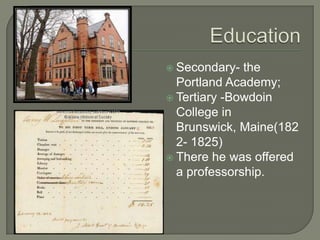
 Secondary-  the
  Portland Academy;
 Tertiary -Bowdoin
  College in
  Brunswick, Maine(182
  2- 1825)
 There he was offered
  a professorship.
 The  college had
 advised him to further
 study languages
 Longfellow immersed
 himself in the
 literature of
 Europe, and in
 mastering half a
 dozen languages.
 Upon  arrival back in
 America he settled at
 Bowdoin to teach
 modern languages
 including French and
 Italian from 1829-
 1835.
 He also wrote many
 textbooks for the
 college.
 In1831 Longfellow
 married Mary Storer
 Potter (1813-1835).
 On his next trip to
 Europe, this time with
 his wife, Mary
 suddenly died in
 Rotterdam,
 after having a
 miscarriage
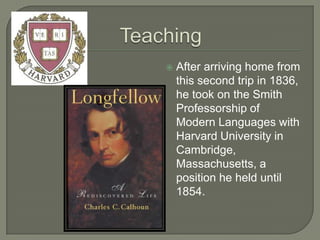
   After arriving home from
    this second trip in 1836,
    he took on the Smith
    Professorship of
    Modern Languages with
    Harvard University in
    Cambridge,
    Massachusetts, a
    position he held until
    1854.
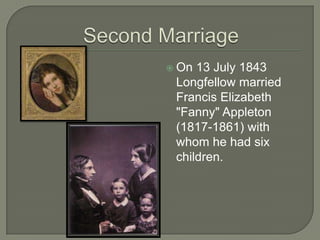
 On 13 July 1843
 Longfellow married
 Francis Elizabeth
 "Fanny" Appleton
 (1817-1861) with
 whom he had six
 children.
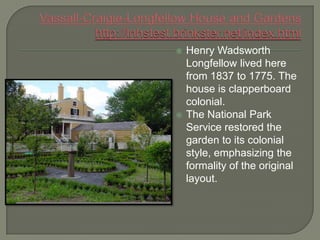
   Henry Wadsworth
    Longfellow lived here
    from 1837 to 1775. The
    house is clapperboard
    colonial.
   The National Park
    Service restored the
    garden to its colonial
    style, emphasizing the
    formality of the original
    layout.
 While teaching full
  time, Longfellow
  continued his
  prodigious output of
  poetry that was warmly
  received in North
  America and Europe.
 After resigning from
  teaching in
  1854, Longfellow was
  able to put all his
  energies into writing.
 1861 Fanny’s dress
  suddenly caught fire
  from a candle and she
  was engulfed in flames.
 Henry tried desperately
  to smother the flames,
  suffering burns to his
  hands and face, to no
  avail.
 Fanny soon succumbed
  to her wounds.
    Longfellow's grief
    changed him forever;
    his flowing white
    beard covered his
    burn marks.
 In1868  Longfellow
  made his last trip
  to Europe.
 The Longfellow
  Family, Venice, 29
  May 1869.
   A.
  Sorgato, photograp
  her.
 Queen Victoria invited
 him to tea (1868)

 Hereceived honorary
 doctoral degrees from
 Cambridge and Oxford
 Universities
   In 1884 he was the first
    citizen of the United
    States to be honored in
    Poets' Corner of
    Westminster Abbey in
    London, England.

   His marble bust now
    stands among the
    monuments to other
    world-renowned authors
    and poets
    Dickens, Kipling, Brow
    ning
 1855
 Song of Hiawatha
 as a tribute
  to North American
  Indians.
 1861
 translation   of Dante
 Alighieri’s
“Divine Comedy”.
Longfellow was the first
 American to translate
 Dante.
   The Spanish Student. A          The Seaside and the
    Play in Three Acts (1843),       Fireside (poetry, 1850),
   Poets and Poetry of             The Golden Legend
    Europe (translations,            (dramatic poem, 1851),
    1844),                          "The Children's Hour"
   The Belfry of Bruges and         (1859),
    Other Poems (1845),
   Evangeline: A Tale of           Christus: A Mystery
    Acadie (epic poem, 1847),        (1872),
                                    "Aftermath" (1873),
   Kavanagh: A Tale (1849),        The Masque of Pandora
                                     and Other Poems (1875).
 Hecontinued to write
 up until the year of his
 death -1882.
 Thisis the first stamp
 to honor Longfellow.


A one-cent stamp
 featuring a portrait of
 the poet, was issued
 February 16, 1940.
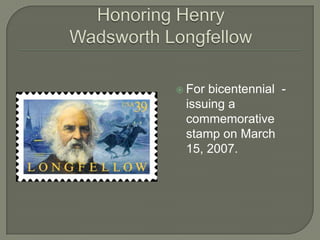
 Forbicentennial -
 issuing a
 commemorative
 stamp on March
 15, 2007.
Longfellow

Longfellow

  • 1.
    Window on AmericaCenter© Dnipropetrovs’k Ukraine 2012 T.Gavryluk, design S.Usenko
  • 2.
     was born on 27 February 1807, in the city of Portland, Maine  To the lawyer Stephen Longfellow and his wife Zilpah née Wadsworth.
  • 3.
     Earlyon youngHenry knew he wanted to be a poet;  he was a fast learner and loved to write stories and poems.  The Portland Gazette printed his first poem at the age of thirteen.
  • 4.
     Secondary- the Portland Academy;  Tertiary -Bowdoin College in Brunswick, Maine(182 2- 1825)  There he was offered a professorship.
  • 5.
     The college had advised him to further study languages  Longfellow immersed himself in the literature of Europe, and in mastering half a dozen languages.
  • 6.
     Upon arrival back in America he settled at Bowdoin to teach modern languages including French and Italian from 1829- 1835.  He also wrote many textbooks for the college.
  • 7.
     In1831 Longfellow married Mary Storer Potter (1813-1835).  On his next trip to Europe, this time with his wife, Mary suddenly died in Rotterdam, after having a miscarriage
  • 8.
    After arriving home from this second trip in 1836, he took on the Smith Professorship of Modern Languages with Harvard University in Cambridge, Massachusetts, a position he held until 1854.
  • 9.
     On 13July 1843 Longfellow married Francis Elizabeth "Fanny" Appleton (1817-1861) with whom he had six children.
  • 10.
    Henry Wadsworth Longfellow lived here from 1837 to 1775. The house is clapperboard colonial.  The National Park Service restored the garden to its colonial style, emphasizing the formality of the original layout.
  • 11.
     While teachingfull time, Longfellow continued his prodigious output of poetry that was warmly received in North America and Europe.  After resigning from teaching in 1854, Longfellow was able to put all his energies into writing.
  • 12.
     1861 Fanny’sdress suddenly caught fire from a candle and she was engulfed in flames.  Henry tried desperately to smother the flames, suffering burns to his hands and face, to no avail.  Fanny soon succumbed to her wounds.
  • 13.
    Longfellow's grief changed him forever; his flowing white beard covered his burn marks.
  • 14.
     In1868 Longfellow made his last trip to Europe.  The Longfellow Family, Venice, 29 May 1869. A. Sorgato, photograp her.
  • 15.
     Queen Victoriainvited him to tea (1868)  Hereceived honorary doctoral degrees from Cambridge and Oxford Universities
  • 16.
    In 1884 he was the first citizen of the United States to be honored in Poets' Corner of Westminster Abbey in London, England.  His marble bust now stands among the monuments to other world-renowned authors and poets Dickens, Kipling, Brow ning
  • 17.
     1855 Songof Hiawatha as a tribute to North American Indians.
  • 18.
     1861  translation of Dante Alighieri’s “Divine Comedy”. Longfellow was the first American to translate Dante.
  • 19.
    The Spanish Student. A  The Seaside and the Play in Three Acts (1843), Fireside (poetry, 1850),  Poets and Poetry of  The Golden Legend Europe (translations, (dramatic poem, 1851), 1844),  "The Children's Hour"  The Belfry of Bruges and (1859), Other Poems (1845),  Evangeline: A Tale of  Christus: A Mystery Acadie (epic poem, 1847), (1872),  "Aftermath" (1873),  Kavanagh: A Tale (1849),  The Masque of Pandora and Other Poems (1875).
  • 20.
     Hecontinued towrite up until the year of his death -1882.
  • 21.
     Thisis thefirst stamp to honor Longfellow. A one-cent stamp featuring a portrait of the poet, was issued February 16, 1940.
  • 22.
     Forbicentennial - issuing a commemorative stamp on March 15, 2007.