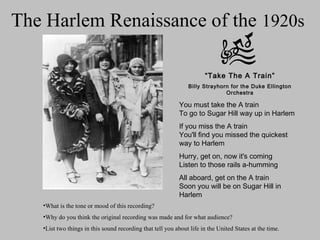
The Harlem Renaissance of the 1920s
“Take The A Train”
Billy Strayhorn for the Duke Ellington
Orchestra

You must take the A train
To go to Sugar Hill way up in Harlem
If you miss the A train
You'll find you missed the quickest
way to Harlem
Hurry, get on, now it's coming
Listen to those rails a-humming
All aboard, get on the A train
Soon you will be on Sugar Hill in
Harlem
•What is the tone or mood of this recording?
•Why do you think the original recording was made and for what audience?
•List two things in this sound recording that tell you about life in the United States at the time.
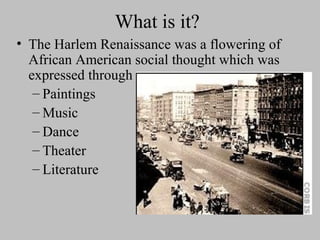
What is it?
• The Harlem Renaissance was a flowering of
African American social thought which was
expressed through
– Paintings
– Music
– Dance
– Theater
– Literature
Where is Harlem?
The island of Manhattan

New York City is on Manhattan island

Neighborhoods
Where was the Harlem
Renaissance centered?
• Centered in the
Harlem district of
New York City, the
New Negro
Movement (as it
was called at the
time) had a major
influence across the
Unites States and
even the world.
How does the Harlem
Renaissance connect to
the Great Migration?
• The economic opportunities of the era triggered a
widespread migration of black Americans from the
rural south to the industrial centers of the north - and
especially to New York City.
• In New York and other cities, black Americans
explored new opportunities for intellectual and social
freedom.
• Black American artists, writers, and musicians began
to use their talents to work for civil rights and obtain
equality.
How did it impact history?
• The Harlem Renaissance helped to redefine how
Americans and the world understood African
American culture. It integrated black and white
cultures, and marked the beginning of a black urban
society.
• The Harlem Renaissance set the stage for the Civil
Rights Movement of the 1950s and 60s.
Now that you’ve learned
more about the Harlem
Renaissance, listen again
to this song. Does it
change your answers to
the analysis questions
below?

“Take The A Train”
Billy Strayhorn for the Duke Ellington
Orchestra

You must take the A train
To go to Sugar Hill way up in Harlem
If you miss the A train
You'll find you missed the quickest
way to Harlem
Hurry, get on, now it's coming
Listen to those rails a-humming
All aboard, get on the A train
Soon you will be on Sugar Hill in
Harlem

•What is the tone or mood of this recording?
•Why do you think the original recording was made and for what audience?
•List two things in this sound recording that tell you about life in the United States at the time.
Who do we associate with the
Harlem Renaissance?
• Artists such as Jacob Lawrence
• Authors such as Langston Hughes
• Musicians such as Duke Ellington, Louis
Armstrong, and Bessie Smith
Jacob Lawrence
•

•

•

Jacob Lawrence grew up in a
settlement house in Harlem during
the Harlem Renaissance
Lawrence's parents were among
those who migrated between 19161919, considered the first wave of
the migration.
His own life in Harlem ,
and the struggle of other Black
Americans
inspired his earliest work
Lawrence’s Work

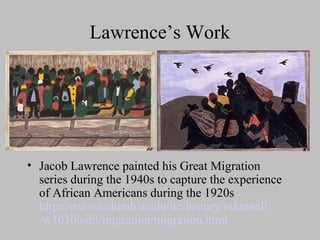
• Jacob Lawrence painted his Great Migration
series during the 1940s to capture the experience
of African Americans during the 1920s
http://www.columbia.edu/itc/history/odonnell
/w1010/edit/migration/migration.html
Jacob Lawrence

Painter

Painted scenes of:
•his own background in Harlem
•the hard life of black Americans
in the 1920s
The Great Migration series is his
most recognized work
Langston Hughes
• Hughes is known for his insightful,
colorful, realistic portrayals of black
life in America.
• He wrote poetry, short stories,
novels, and plays, and is known for
his involvement with the world of
jazz and the influence it had on his
writing.
• His life and work were enormously
important in shaping the artistic
contributions of the Harlem
Renaissance in the 1920s.
• He wanted to tell the stories of his
people in ways that reflected their
actual culture, including both their
suffering and their love of music,
laughter, and language itself.
The Negro Speaks of Rivers
(1919)

To listen to Langston Hughes read
his poem, click here.
One of Hughes's poetic innovations was to draw on
the rhythms of black musical traditions such as jazz
and blues, but in 'The Negro Speaks of Rivers' it's
the heritage of Negro spirituals which is recalled by
the poem's majestic imagery and sonorous
repetitions. Written when Hughes was only
seventeen as he traveled by train across the
Mississippi, 'The Negro Speaks of Rivers' is a
beautiful statement of strength in the history of
black people, which Hughes imagines stretching as
far back as ancient Egypt and further into Africa and
the cradle of civilization. The poem returns at the
end to America in a moment of optimistic alchemy
when he sees the "muddy bosom" of the Mississippi
"turn all golden in the sunset".

I've known rivers:
I've known rivers ancient as the
world and older than the
flow of human blood in human
veins.
My soul has grown deep like
the rivers.
I bathed in the Euphrates when
dawns were young.
I built my hut near the Congo
and it lulled me to sleep.
I looked upon the Nile and
raised the pyramids above it.
I heard the singing of the
Mississippi when Abe Lincoln
went down to New Orleans,
and I've seen its muddy
bosom turn all golden in the
sunset.
I've known rivers:
Ancient, dusky rivers.

From PoetryArchive.org

•What is the tone or mood of this poem?
•Why do you think the poem was written and for what audience?

My soul has
grown deep like
the rivers.

•List two things in this poem that tell you about life in the United States at the time.
I, too, sing America
(1920s)

To listen to Langston Hughes read
his poem, click here.
'I, Too' written just before Hughes’ return to the
States from Europe and after he'd been denied
passage on a ship because of his color, has a
contemporary feel in contrast to the mythical
dimension of 'The Negro Speaks of Rivers'. It is
no less powerful however, in its expression of
social injustice. The calm clear statements of the
'I' have an unstoppable force like the progress the
poem envisages. Hughes's dignified introductions
to these poems and his beautiful speaking voice
render them all the more moving.
From PoetryArchive.org

I, too, sing America.
I am the darker brother.
They send me to eat in the kitchen
When company comes,
But I laugh,
And eat well,
And grow strong.
Tomorrow,
I'll be at the table
When company comes.
Nobody'll dare
Say to me,
"Eat in the kitchen,“
Then.
Besides,
They'll see how beautiful I am
And be ashamed--

•What is the tone or mood of this poem?
•Why do you think the poem was written and for what audience?
•List two things in this poem that tell you about life in the United States at the time.

I, too, am America.
Wrote poetry, short stories,
novels, and plays.
Langston Hughes Poet and Author

Known for his colorful,
realistic portrayals of black
life in America.
Duke Ellington
• Ellington was a jazz composer,
conductor, and performer during the
Harlem Renaissance.
• During the formative Cotton Club
years, he experimented with and
developed the style that would
quickly bring him worldwide
success. Ellington would be among
the first to focus on musical form
and composition in jazz.
• Ellington wrote over 2000 pieces in
his lifetime.
The Cotton Club
• The Duke Ellington Orchestra
was the "house" orchestra for a
number of years at the Cotton
Club. The revues featured
glamorous dancing girls,
acclaimed tap dancers, vaudeville
performers, and comics. All the
white world came to Harlem to
see the show.
• The first Cotton Club revue was
in 1923. There were two new fast
paced revues produced a year for
at least 16 years.
Duke Ellington Composer/Conductor

Jazz composer, conductor,
and performer during the
Harlem Renaissance

To hear Duke Ellington, click the link.
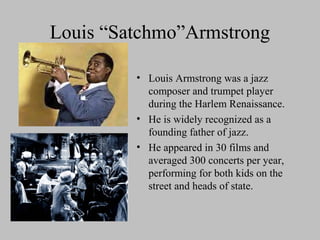
Louis “Satchmo”Armstrong
• Louis Armstrong was a jazz
composer and trumpet player
during the Harlem Renaissance.
• He is widely recognized as a
founding father of jazz.
• He appeared in 30 films and
averaged 300 concerts per year,
performing for both kids on the
street and heads of state.
Composer and trumpet
player during the Harlem
Louis Armstrong Composer/Trumpeter Renaissance
Widely recognized as a
founding father of jazz

To hear Louis Armstrong, click the link.
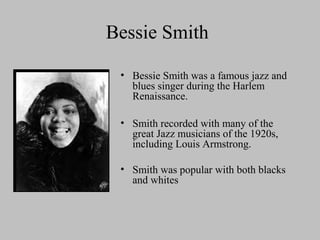
Bessie Smith
• Bessie Smith was a famous jazz and
blues singer during the Harlem
Renaissance.
• Smith recorded with many of the
great Jazz musicians of the 1920s,
including Louis Armstrong.
• Smith was popular with both blacks
and whites
Bessie Smith

Famous jazz and blues singer
during the Harlem
Renaissance
Jazz & Blues
Singer

Popular with both blacks and
whites

To hear Bessie Smith, click the link.
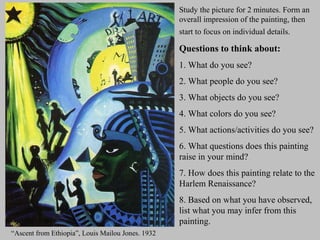
Study the picture for 2 minutes. Form an
overall impression of the painting, then
start to focus on individual details.

Questions to think about:
1. What do you see?
2. What people do you see?
3. What objects do you see?
4. What colors do you see?
5. What actions/activities do you see?
6. What questions does this painting
raise in your mind?
7. How does this painting relate to the
Harlem Renaissance?
8. Based on what you have observed,
list what you may infer from this
painting.
“Ascent from Ethiopia”, Louis Mailou Jones. 1932
As you work through your centers, you will have a set
amount of time to complete your work.

Keep focused and keep an eye on the time!

http://www.online-stopwatch.com/large-stopwatch/

Harlem renaissance-presentation

  • 1.
    The Harlem Renaissanceof the 1920s “Take The A Train” Billy Strayhorn for the Duke Ellington Orchestra You must take the A train To go to Sugar Hill way up in Harlem If you miss the A train You'll find you missed the quickest way to Harlem Hurry, get on, now it's coming Listen to those rails a-humming All aboard, get on the A train Soon you will be on Sugar Hill in Harlem •What is the tone or mood of this recording? •Why do you think the original recording was made and for what audience? •List two things in this sound recording that tell you about life in the United States at the time.
  • 2.
    What is it? •The Harlem Renaissance was a flowering of African American social thought which was expressed through – Paintings – Music – Dance – Theater – Literature
  • 3.
    Where is Harlem? Theisland of Manhattan New York City is on Manhattan island Neighborhoods
  • 4.
    Where was theHarlem Renaissance centered? • Centered in the Harlem district of New York City, the New Negro Movement (as it was called at the time) had a major influence across the Unites States and even the world.
  • 5.
    How does theHarlem Renaissance connect to the Great Migration? • The economic opportunities of the era triggered a widespread migration of black Americans from the rural south to the industrial centers of the north - and especially to New York City. • In New York and other cities, black Americans explored new opportunities for intellectual and social freedom. • Black American artists, writers, and musicians began to use their talents to work for civil rights and obtain equality.
  • 6.
    How did itimpact history? • The Harlem Renaissance helped to redefine how Americans and the world understood African American culture. It integrated black and white cultures, and marked the beginning of a black urban society. • The Harlem Renaissance set the stage for the Civil Rights Movement of the 1950s and 60s.
  • 7.
    Now that you’velearned more about the Harlem Renaissance, listen again to this song. Does it change your answers to the analysis questions below? “Take The A Train” Billy Strayhorn for the Duke Ellington Orchestra You must take the A train To go to Sugar Hill way up in Harlem If you miss the A train You'll find you missed the quickest way to Harlem Hurry, get on, now it's coming Listen to those rails a-humming All aboard, get on the A train Soon you will be on Sugar Hill in Harlem •What is the tone or mood of this recording? •Why do you think the original recording was made and for what audience? •List two things in this sound recording that tell you about life in the United States at the time.
  • 8.
    Who do weassociate with the Harlem Renaissance? • Artists such as Jacob Lawrence • Authors such as Langston Hughes • Musicians such as Duke Ellington, Louis Armstrong, and Bessie Smith
  • 9.
    Jacob Lawrence • • • Jacob Lawrencegrew up in a settlement house in Harlem during the Harlem Renaissance Lawrence's parents were among those who migrated between 19161919, considered the first wave of the migration. His own life in Harlem , and the struggle of other Black Americans inspired his earliest work
  • 10.
    Lawrence’s Work • JacobLawrence painted his Great Migration series during the 1940s to capture the experience of African Americans during the 1920s http://www.columbia.edu/itc/history/odonnell /w1010/edit/migration/migration.html
  • 11.
    Jacob Lawrence Painter Painted scenesof: •his own background in Harlem •the hard life of black Americans in the 1920s The Great Migration series is his most recognized work
  • 12.
    Langston Hughes • Hughesis known for his insightful, colorful, realistic portrayals of black life in America. • He wrote poetry, short stories, novels, and plays, and is known for his involvement with the world of jazz and the influence it had on his writing. • His life and work were enormously important in shaping the artistic contributions of the Harlem Renaissance in the 1920s. • He wanted to tell the stories of his people in ways that reflected their actual culture, including both their suffering and their love of music, laughter, and language itself.
  • 13.
    The Negro Speaksof Rivers (1919) To listen to Langston Hughes read his poem, click here. One of Hughes's poetic innovations was to draw on the rhythms of black musical traditions such as jazz and blues, but in 'The Negro Speaks of Rivers' it's the heritage of Negro spirituals which is recalled by the poem's majestic imagery and sonorous repetitions. Written when Hughes was only seventeen as he traveled by train across the Mississippi, 'The Negro Speaks of Rivers' is a beautiful statement of strength in the history of black people, which Hughes imagines stretching as far back as ancient Egypt and further into Africa and the cradle of civilization. The poem returns at the end to America in a moment of optimistic alchemy when he sees the "muddy bosom" of the Mississippi "turn all golden in the sunset". I've known rivers: I've known rivers ancient as the world and older than the flow of human blood in human veins. My soul has grown deep like the rivers. I bathed in the Euphrates when dawns were young. I built my hut near the Congo and it lulled me to sleep. I looked upon the Nile and raised the pyramids above it. I heard the singing of the Mississippi when Abe Lincoln went down to New Orleans, and I've seen its muddy bosom turn all golden in the sunset. I've known rivers: Ancient, dusky rivers. From PoetryArchive.org •What is the tone or mood of this poem? •Why do you think the poem was written and for what audience? My soul has grown deep like the rivers. •List two things in this poem that tell you about life in the United States at the time.
  • 14.
    I, too, singAmerica (1920s) To listen to Langston Hughes read his poem, click here. 'I, Too' written just before Hughes’ return to the States from Europe and after he'd been denied passage on a ship because of his color, has a contemporary feel in contrast to the mythical dimension of 'The Negro Speaks of Rivers'. It is no less powerful however, in its expression of social injustice. The calm clear statements of the 'I' have an unstoppable force like the progress the poem envisages. Hughes's dignified introductions to these poems and his beautiful speaking voice render them all the more moving. From PoetryArchive.org I, too, sing America. I am the darker brother. They send me to eat in the kitchen When company comes, But I laugh, And eat well, And grow strong. Tomorrow, I'll be at the table When company comes. Nobody'll dare Say to me, "Eat in the kitchen,“ Then. Besides, They'll see how beautiful I am And be ashamed-- •What is the tone or mood of this poem? •Why do you think the poem was written and for what audience? •List two things in this poem that tell you about life in the United States at the time. I, too, am America.
  • 15.
    Wrote poetry, shortstories, novels, and plays. Langston Hughes Poet and Author Known for his colorful, realistic portrayals of black life in America.
  • 16.
    Duke Ellington • Ellingtonwas a jazz composer, conductor, and performer during the Harlem Renaissance. • During the formative Cotton Club years, he experimented with and developed the style that would quickly bring him worldwide success. Ellington would be among the first to focus on musical form and composition in jazz. • Ellington wrote over 2000 pieces in his lifetime.
  • 17.
    The Cotton Club •The Duke Ellington Orchestra was the "house" orchestra for a number of years at the Cotton Club. The revues featured glamorous dancing girls, acclaimed tap dancers, vaudeville performers, and comics. All the white world came to Harlem to see the show. • The first Cotton Club revue was in 1923. There were two new fast paced revues produced a year for at least 16 years.
  • 18.
    Duke Ellington Composer/Conductor Jazzcomposer, conductor, and performer during the Harlem Renaissance To hear Duke Ellington, click the link.
  • 19.
    Louis “Satchmo”Armstrong • LouisArmstrong was a jazz composer and trumpet player during the Harlem Renaissance. • He is widely recognized as a founding father of jazz. • He appeared in 30 films and averaged 300 concerts per year, performing for both kids on the street and heads of state.
  • 20.
    Composer and trumpet playerduring the Harlem Louis Armstrong Composer/Trumpeter Renaissance Widely recognized as a founding father of jazz To hear Louis Armstrong, click the link.
  • 21.
    Bessie Smith • BessieSmith was a famous jazz and blues singer during the Harlem Renaissance. • Smith recorded with many of the great Jazz musicians of the 1920s, including Louis Armstrong. • Smith was popular with both blacks and whites
  • 22.
    Bessie Smith Famous jazzand blues singer during the Harlem Renaissance Jazz & Blues Singer Popular with both blacks and whites To hear Bessie Smith, click the link.
  • 23.
    Study the picturefor 2 minutes. Form an overall impression of the painting, then start to focus on individual details. Questions to think about: 1. What do you see? 2. What people do you see? 3. What objects do you see? 4. What colors do you see? 5. What actions/activities do you see? 6. What questions does this painting raise in your mind? 7. How does this painting relate to the Harlem Renaissance? 8. Based on what you have observed, list what you may infer from this painting. “Ascent from Ethiopia”, Louis Mailou Jones. 1932
  • 24.
    As you workthrough your centers, you will have a set amount of time to complete your work. Keep focused and keep an eye on the time! http://www.online-stopwatch.com/large-stopwatch/