By Matty Mortimer
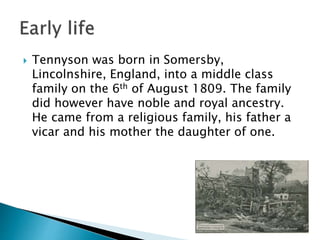
 Tennyson was born in Somersby,
Lincolnshire, England, into a middle class
family on the 6th of August 1809. The family
did however have noble and royal ancestry.
He came from a religious family, his father a
vicar and his mother the daughter of one.
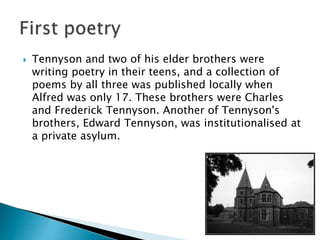
 Tennyson and two of his elder brothers were
writing poetry in their teens, and a collection of
poems by all three was published locally when
Alfred was only 17. These brothers were Charles
and Frederick Tennyson. Another of Tennyson's
brothers, Edward Tennyson, was institutionalised at
a private asylum.
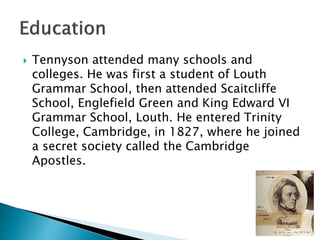
 Tennyson attended many schools and
colleges. He was first a student of Louth
Grammar School, then attended Scaitcliffe
School, Englefield Green and King Edward VI
Grammar School, Louth. He entered Trinity
College, Cambridge, in 1827, where he joined
a secret society called the Cambridge
Apostles.
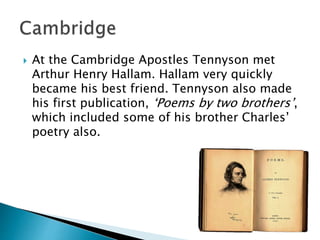
 At the Cambridge Apostles Tennyson met
Arthur Henry Hallam. Hallam very quickly
became his best friend. Tennyson also made
his first publication, ‘Poems by two brothers’,
which included some of his brother Charles’
poetry also.
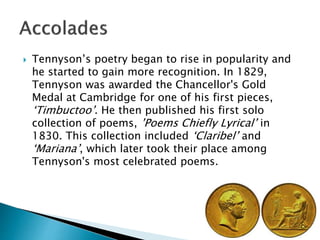
 Tennyson’s poetry began to rise in popularity and
he started to gain more recognition. In 1829,
Tennyson was awarded the Chancellor's Gold
Medal at Cambridge for one of his first pieces,
‘Timbuctoo’. He then published his first solo
collection of poems, ’Poems Chiefly Lyrical’ in
1830. This collection included ‘Claribel’ and
‘Mariana’, which later took their place among
Tennyson's most celebrated poems.
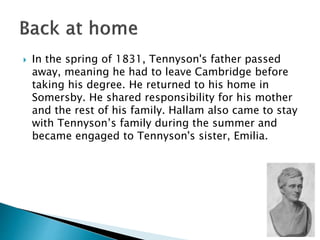
 In the spring of 1831, Tennyson's father passed
away, meaning he had to leave Cambridge before
taking his degree. He returned to his home in
Somersby. He shared responsibility for his mother
and the rest of his family. Hallam also came to stay
with Tennyson’s family during the summer and
became engaged to Tennyson's sister, Emilia.
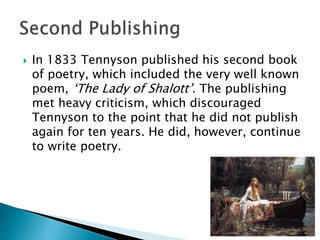
 In 1833 Tennyson published his second book
of poetry, which included the very well known
poem, ‘The Lady of Shalott’. The publishing
met heavy criticism, which discouraged
Tennyson to the point that he did not publish
again for ten years. He did, however, continue
to write poetry.
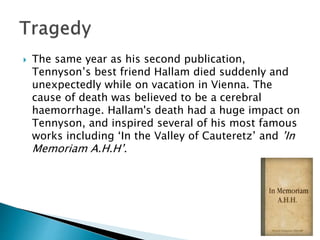
 The same year as his second publication,
Tennyson’s best friend Hallam died suddenly and
unexpectedly while on vacation in Vienna. The
cause of death was believed to be a cerebral
haemorrhage. Hallam's death had a huge impact on
Tennyson, and inspired several of his most famous
works including ‘In the Valley of Cauteretz’ and ’In
Memoriam A.H.H’.
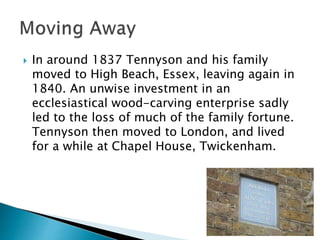
 In around 1837 Tennyson and his family
moved to High Beach, Essex, leaving again in
1840. An unwise investment in an
ecclesiastical wood-carving enterprise sadly
led to the loss of much of the family fortune.
Tennyson then moved to London, and lived
for a while at Chapel House, Twickenham.
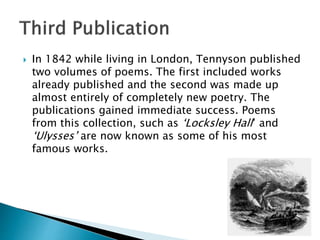
 In 1842 while living in London, Tennyson published
two volumes of poems. The first included works
already published and the second was made up
almost entirely of completely new poetry. The
publications gained immediate success. Poems
from this collection, such as ‘Locksley Hall’ and
‘Ulysses’ are now known as some of his most
famous works.
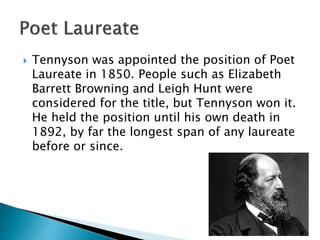
 Tennyson was appointed the position of Poet
Laureate in 1850. People such as Elizabeth
Barrett Browning and Leigh Hunt were
considered for the title, but Tennyson won it.
He held the position until his own death in
1892, by far the longest span of any laureate
before or since.
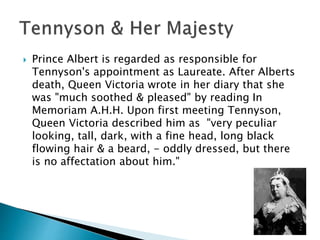
 Prince Albert is regarded as responsible for
Tennyson's appointment as Laureate. After Alberts
death, Queen Victoria wrote in her diary that she
was "much soothed & pleased" by reading In
Memoriam A.H.H. Upon first meeting Tennyson,
Queen Victoria described him as "very peculiar
looking, tall, dark, with a fine head, long black
flowing hair & a beard, - oddly dressed, but there
is no affectation about him."
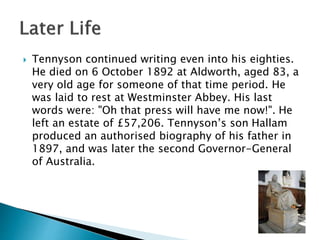
 Tennyson continued writing even into his eighties.
He died on 6 October 1892 at Aldworth, aged 83, a
very old age for someone of that time period. He
was laid to rest at Westminster Abbey. His last
words were: "Oh that press will have me now!". He
left an estate of £57,206. Tennyson’s son Hallam
produced an authorised biography of his father in
1897, and was later the second Governor-General
of Australia.

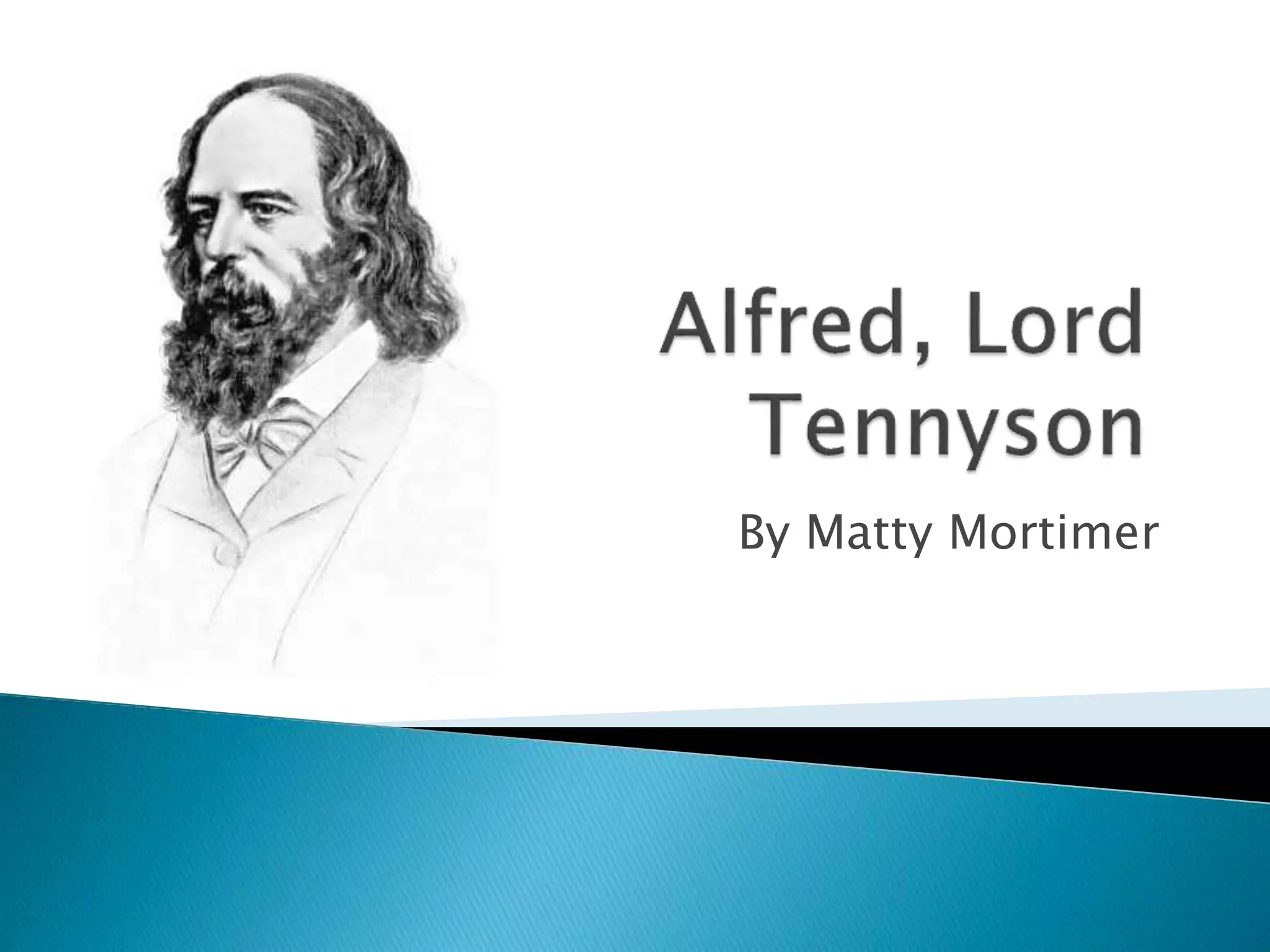
Alfred, Lord Tennyson

  • 1.
  • 2.
     Tennyson wasborn in Somersby, Lincolnshire, England, into a middle class family on the 6th of August 1809. The family did however have noble and royal ancestry. He came from a religious family, his father a vicar and his mother the daughter of one.
  • 3.
     Tennyson andtwo of his elder brothers were writing poetry in their teens, and a collection of poems by all three was published locally when Alfred was only 17. These brothers were Charles and Frederick Tennyson. Another of Tennyson's brothers, Edward Tennyson, was institutionalised at a private asylum.
  • 4.
     Tennyson attendedmany schools and colleges. He was first a student of Louth Grammar School, then attended Scaitcliffe School, Englefield Green and King Edward VI Grammar School, Louth. He entered Trinity College, Cambridge, in 1827, where he joined a secret society called the Cambridge Apostles.
  • 5.
     At theCambridge Apostles Tennyson met Arthur Henry Hallam. Hallam very quickly became his best friend. Tennyson also made his first publication, ‘Poems by two brothers’, which included some of his brother Charles’ poetry also.
  • 6.
     Tennyson’s poetrybegan to rise in popularity and he started to gain more recognition. In 1829, Tennyson was awarded the Chancellor's Gold Medal at Cambridge for one of his first pieces, ‘Timbuctoo’. He then published his first solo collection of poems, ’Poems Chiefly Lyrical’ in 1830. This collection included ‘Claribel’ and ‘Mariana’, which later took their place among Tennyson's most celebrated poems.
  • 7.
     In thespring of 1831, Tennyson's father passed away, meaning he had to leave Cambridge before taking his degree. He returned to his home in Somersby. He shared responsibility for his mother and the rest of his family. Hallam also came to stay with Tennyson’s family during the summer and became engaged to Tennyson's sister, Emilia.
  • 8.
     In 1833Tennyson published his second book of poetry, which included the very well known poem, ‘The Lady of Shalott’. The publishing met heavy criticism, which discouraged Tennyson to the point that he did not publish again for ten years. He did, however, continue to write poetry.
  • 9.
     The sameyear as his second publication, Tennyson’s best friend Hallam died suddenly and unexpectedly while on vacation in Vienna. The cause of death was believed to be a cerebral haemorrhage. Hallam's death had a huge impact on Tennyson, and inspired several of his most famous works including ‘In the Valley of Cauteretz’ and ’In Memoriam A.H.H’.
  • 10.
     In around1837 Tennyson and his family moved to High Beach, Essex, leaving again in 1840. An unwise investment in an ecclesiastical wood-carving enterprise sadly led to the loss of much of the family fortune. Tennyson then moved to London, and lived for a while at Chapel House, Twickenham.
  • 11.
     In 1842while living in London, Tennyson published two volumes of poems. The first included works already published and the second was made up almost entirely of completely new poetry. The publications gained immediate success. Poems from this collection, such as ‘Locksley Hall’ and ‘Ulysses’ are now known as some of his most famous works.
  • 12.
     Tennyson wasappointed the position of Poet Laureate in 1850. People such as Elizabeth Barrett Browning and Leigh Hunt were considered for the title, but Tennyson won it. He held the position until his own death in 1892, by far the longest span of any laureate before or since.
  • 13.
     Prince Albertis regarded as responsible for Tennyson's appointment as Laureate. After Alberts death, Queen Victoria wrote in her diary that she was "much soothed & pleased" by reading In Memoriam A.H.H. Upon first meeting Tennyson, Queen Victoria described him as "very peculiar looking, tall, dark, with a fine head, long black flowing hair & a beard, - oddly dressed, but there is no affectation about him."
  • 14.
     Tennyson continuedwriting even into his eighties. He died on 6 October 1892 at Aldworth, aged 83, a very old age for someone of that time period. He was laid to rest at Westminster Abbey. His last words were: "Oh that press will have me now!". He left an estate of £57,206. Tennyson’s son Hallam produced an authorised biography of his father in 1897, and was later the second Governor-General of Australia.