Romanticism
Period
Name :
Diaz Nugrahantio Susila
Risa Heruwati
Nur Miftahul Khoiriah
Suhaelatul Faizah Ahmad
Rinda Wahyu Fambudi
Isna Salamah
John William Waterhouse , The
Lady of Shalott , 1888
Transition To Romanticism
(1750-1800)
• The age of revolution
French revolution ( 1790’s), through
the influence his ideas, JJ Rousseau
become one of the most important
men of the last three centuries.
• Neo classicism in England was dying
while romanticism grow stronger and
stronger.
Romanticism Period
(±1800 - ± 1850)
• Peak Romantic period it was associated with
liberalism and radicalism, in the long term its
effect on the growth of nationalism was
probably more significant.
• With the outbreak of the French revolution
which is the climax of the growing mix of
objective conditions and the flow of ideas that
existed in Europe at that time the ideals had
become explicit, and in English literature
encouraged the rise of the romantic
movement sober and steady
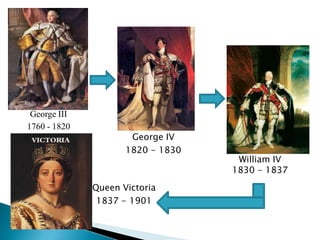
George III
1760 - 1820
George IV
1820 - 1830
William IV
1830 - 1837
Queen Victoria
1837 - 1901
 18th century (1800 to 1860) movement
emphasizing emotion and imagination, rather
than logic and scientific thought. Response to
the Enlightenment. This era literary get
inspiration from
 Natural environment
 The importance of the imagination nature
 The use of emotion
 Interest in the spiritual or supernatural, etc
 Thomas Gray was born in
Cornhill, London in 26
December 1716. He is the son
of an exchange broker and a
milliner.
 Gray began seriously writing
poems in 1742,
(26 December 1716 – 30 July
1771)
 He was an English poet, letter-writer,
classical scholar and professor at Cambridge
University.
 He is widely known for his Elegy Witten in a
Country Churchyard, published in 1751.
 Gray died on 30 July 1771 in Cambridge, and
was buried beside his mother in the
churchyard of Stoke Poges, the setting for his
famous Elegy. His grave can still be seen
there
 Burns was born two miles (3 km) south of Ayr, in
Alloway, South Avrshire, Scotland in 25 January
1759.
 He is regarded as a pioneer of the romantic
movement, and after his death he became a great
source of inspiration to the founders of both
liberalism and socialism, and a cultural icon in
Scotland
 His poem (and song) ”Auld Lang Syne" is often
sung at Hogmanay (the last day of the year), and
“Scot Wha Hae" served for a long time as an
unofficial national anthem of the country.
 Other poems and
songs of Burns that
remain well known
across the world today
include
o A red, red rose
o A man’s a man for a
that
o To a Louse
o To a mouse
o The battle of
Sherramuir
o Tam o’ Shanter
o Ae fond kiss
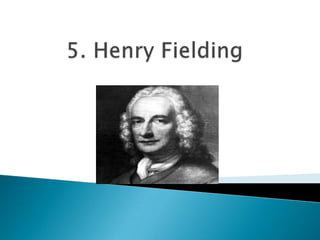
 He was born in Sharpham, 22 April 1707 – near
Lisbon, 8 October 1754.
 He had two wives, Charlotte Craddock in 1734
(she died in 1744). In 1747 he married his wife's
former maid, Mary Daniel.
 He died in Portugal in 1754 in order to find cure
for his bad health.
 He was well-known as a Playwright and Novelist.
 Fielding wrote 25 plays in the eight years after
his return to London.
 Two famous of his novels: Joseph Andrews
(1742) and The History of Tom Jones, A
Foundling (1749).
 The account of the fall and rise of Tom Jones, a
vital but imprudent young man, is essentially a
comic romance, rooted in the tried narrative
conventions of romance and epic, but with an
important difference. Tom is a bastard, 'a
foundling,' with a generous heart but a weak will;
by the standards of the time he is a rather
unheroic hero.
 He appears to have been quite enamored of his
first wife beauty and character and later modeled
the heroine of Tom Jones, Sophia Western.
(http://www.henryfielding.com/nonfiction.htm)
 Miscellanies (1743; satirical prose)
 Amelia (1751; his last novel)
 Love in Several Masques, (his first play; 1728)
 Fielding's second play, The Temple Beau, (1730) was
followed rapidly by three further plays, among them The
Author's Farce, and the Pleasures of the Town and Tragedy
of Tragedies, or the Life and Death of Tom Thumb the
Great
 He adapt adapt two works of Molière's to the English stage
to great acclaim, The Mock-Doctor, or The Dumb Lady
Cured and The Miser (1733).
 The Historical Register for the Year 1736.
 The Life of Jonathan Wild the Great (1737; the third volume
of Miscellanies was the satiric piece The Life of Jonathan
Wild the Great, which has been called one of the finest
examples of sustained irony in English fiction).
 True Patriot, and History of Our Own Time
(1745-1746)
 The Jacobite's Journal (1747-1748)
 The Covent-Garden Journal (1752)
 Journal of a Voyage to Lisbon (1755).
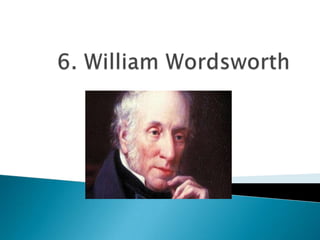
 He was the son of an attorney, born on April 7,
1770.
 He was sent away to be educated at Hawkshead
Grammar School in the Lake District after the
death of his parent.
 his debut as a writer in 1787 was a sonnet in The
European Magazine.
 He went to St. John's College, Cambridge where
he developed radical political views. Influenced
by the ideas of William Godwin, Wordsworth was
an early supporter of the French Revolution.
 after the Reign of Terror (September 1793-July
1794), He became disillusioned with radicalism.
 he had affair with Annette Vallon, the result of which was
an illegitimate daughter, Ann Caroline.
 In 1795, after receiving a legacy, Wordsworth lived with his
sister Dorothy.
In these years he wrote many of his greatest poems and also
travelled with Coleridge and Dorothy, in the winter of
1798-79, to Germany.
 He married Mary Hutchinson in 1799/1802.
 The next few years were personally difficult for
Wordsworth. Two of his children died, his brother was
drowned at sea and Dorothy suffered a mental breakdown.
 He was well-known as a conservative and patriotic poet,
succeeded Robert Southey as poet laureate in 1843.
 William Wordsworth died at Rydal Mount, Ambleside on
April 23,1850.
 Wordsworth's most famous poem, 'I Wandered Lonely as a
Cloud' was written at Dove Cottage in 1804.
 An Evening Walk and Descriptive Sketches (1793)
 Guilt and Sorrow (a poem)
 Letter to the Bishop of Llandaff (1793), a pamphlet that gave support to the
French Revolution.
 The Borderers (1796; a drama that was reflected of Wordsworth disillusion
of Radicalism)
 Lyrical Ballad (1796; His famous work, it was his collaboration work with
Samuel Taylor Coleridge)
It included Wordsworth's Tintern Abbey and Coleridge's famous poems, the
Ancient Mariner and The Nightingale.
 Poems in Two Volumes (1807; including the poems: Ode to Duty about the
death of his brother, Resolution and Independence and Intimations of
Immortality)
 Etc
Samuel Taylor Coleridge
work:
 BiographiaLiteraria (1907)
 Christabel: Kubla Khan, a
Vision; The Pains of Sleep
(1816)
 Fears in Solitude (1798)
 Confessions of an
Inquiring Spirit (1841)
 Remorse, A Tragedy, in
Five Acts (1813) , etc
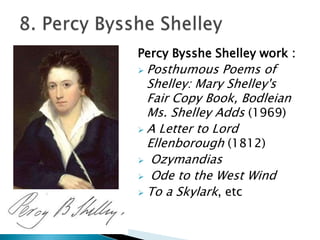
Percy Bysshe Shelley work :
 Posthumous Poems of
Shelley: Mary Shelley's
Fair Copy Book, Bodleian
Ms. Shelley Adds (1969)
 A Letter to Lord
Ellenborough (1812)
 Ozymandias
 Ode to the West Wind
 To a Skylark, etc
9. John Keats
(31 October 1795 - 23 February 1821)
Close bosom-friend of the
maturing sun;
Conspiring with him how to load
and bless
With fruit the vines that round
the thatch-eves run;
To bend with apples the moss’d
cottage-trees,
And fill all fruit with ripeness
to the core;
To swell the gourd, and plump
the hazel shells
With a sweet kernel; to set
budding more,
And still more, later flowers
for the bees,
Until they think warm days
will never cease,
for summer has o’er-brimm’d
their clammy cells…
 Although his poems were not generally well
received by critics during his life, his reputation
grew after his death, so that by the end of the
19th century he had become one of the most
beloved of all English poets. He had a significant
influence on a diverse range of poets and
writers. Jorge Luis Borges stated that his first
encounter with Keats was the most significant
literary experience of his life.
 The poetry of Keats is characterised by sensual
imagery, most notably in the series of odes.
Today his poems and letters are some of the
most popular and most analysed in English
literature.
She walks in beauty,
like the night
Of cloudless climes
and starry skies;
And all that's best of
dark and bright
Meet in her aspect
and her eyes:
Thus mellow'd to that
tender light
Which heaven to
gaudy day denies
Lord Byron was born 22 January 1788 in a
house on 24 Holles Street
in London.(wikipedia)
Byron received his early formal education
at Aberdeen Grammar School, and in August
1799 (11 age)entered the school of
Dr. William Glennie, in Dulwich
 Education
1. Aberdeen Grammar School
2. School of Dr. William Glennie, in Dulwich
 Walter Scott was a Scottish historical novelist,
playwright, and poet, popular throughout much
of the world in the 19th century.
 Literary Work :
His Famous work’s titles include Ivanhoe, Rob
Roy, The Lady of the Lake, Waverley, The Heart of
Midlothian and The Bride of Lammermoor.
 Occupation :
His occupation are Historical novelist, Poet,
Advocate, Sheriff-Depute, and Clerk of Session.
 Education :
1. Royal High School of Edinburgh (1779 _ 8 age)
2. the local grammar school
3. University of Edinburgh (1783 _ 12 age)
Education :
She was educated primarily by her father and
older brothers as well as through her own
reading.
Literary Work :
 Sense and Sensibility (1811),
 Pride and Prejudice (1813),
 Mansfield Park (1814),
 Emma (1816), etc.

Romanticism period

  • 1.
    Romanticism Period Name : Diaz NugrahantioSusila Risa Heruwati Nur Miftahul Khoiriah Suhaelatul Faizah Ahmad Rinda Wahyu Fambudi Isna Salamah John William Waterhouse , The Lady of Shalott , 1888
  • 2.
    Transition To Romanticism (1750-1800) •The age of revolution French revolution ( 1790’s), through the influence his ideas, JJ Rousseau become one of the most important men of the last three centuries. • Neo classicism in England was dying while romanticism grow stronger and stronger.
  • 3.
    Romanticism Period (±1800 -± 1850) • Peak Romantic period it was associated with liberalism and radicalism, in the long term its effect on the growth of nationalism was probably more significant. • With the outbreak of the French revolution which is the climax of the growing mix of objective conditions and the flow of ideas that existed in Europe at that time the ideals had become explicit, and in English literature encouraged the rise of the romantic movement sober and steady
  • 4.
    George III 1760 -1820 George IV 1820 - 1830 William IV 1830 - 1837 Queen Victoria 1837 - 1901
  • 5.
     18th century(1800 to 1860) movement emphasizing emotion and imagination, rather than logic and scientific thought. Response to the Enlightenment. This era literary get inspiration from  Natural environment  The importance of the imagination nature  The use of emotion  Interest in the spiritual or supernatural, etc
  • 6.
     Thomas Graywas born in Cornhill, London in 26 December 1716. He is the son of an exchange broker and a milliner.  Gray began seriously writing poems in 1742, (26 December 1716 – 30 July 1771)
  • 7.
     He wasan English poet, letter-writer, classical scholar and professor at Cambridge University.  He is widely known for his Elegy Witten in a Country Churchyard, published in 1751.  Gray died on 30 July 1771 in Cambridge, and was buried beside his mother in the churchyard of Stoke Poges, the setting for his famous Elegy. His grave can still be seen there
  • 8.
     Burns wasborn two miles (3 km) south of Ayr, in Alloway, South Avrshire, Scotland in 25 January 1759.  He is regarded as a pioneer of the romantic movement, and after his death he became a great source of inspiration to the founders of both liberalism and socialism, and a cultural icon in Scotland  His poem (and song) ”Auld Lang Syne" is often sung at Hogmanay (the last day of the year), and “Scot Wha Hae" served for a long time as an unofficial national anthem of the country.
  • 9.
     Other poemsand songs of Burns that remain well known across the world today include o A red, red rose o A man’s a man for a that o To a Louse o To a mouse o The battle of Sherramuir o Tam o’ Shanter o Ae fond kiss
  • 13.
     He wasborn in Sharpham, 22 April 1707 – near Lisbon, 8 October 1754.  He had two wives, Charlotte Craddock in 1734 (she died in 1744). In 1747 he married his wife's former maid, Mary Daniel.  He died in Portugal in 1754 in order to find cure for his bad health.  He was well-known as a Playwright and Novelist.  Fielding wrote 25 plays in the eight years after his return to London.  Two famous of his novels: Joseph Andrews (1742) and The History of Tom Jones, A Foundling (1749).
  • 14.
     The accountof the fall and rise of Tom Jones, a vital but imprudent young man, is essentially a comic romance, rooted in the tried narrative conventions of romance and epic, but with an important difference. Tom is a bastard, 'a foundling,' with a generous heart but a weak will; by the standards of the time he is a rather unheroic hero.  He appears to have been quite enamored of his first wife beauty and character and later modeled the heroine of Tom Jones, Sophia Western. (http://www.henryfielding.com/nonfiction.htm)
  • 15.
     Miscellanies (1743;satirical prose)  Amelia (1751; his last novel)  Love in Several Masques, (his first play; 1728)  Fielding's second play, The Temple Beau, (1730) was followed rapidly by three further plays, among them The Author's Farce, and the Pleasures of the Town and Tragedy of Tragedies, or the Life and Death of Tom Thumb the Great  He adapt adapt two works of Molière's to the English stage to great acclaim, The Mock-Doctor, or The Dumb Lady Cured and The Miser (1733).  The Historical Register for the Year 1736.  The Life of Jonathan Wild the Great (1737; the third volume of Miscellanies was the satiric piece The Life of Jonathan Wild the Great, which has been called one of the finest examples of sustained irony in English fiction).
  • 16.
     True Patriot,and History of Our Own Time (1745-1746)  The Jacobite's Journal (1747-1748)  The Covent-Garden Journal (1752)  Journal of a Voyage to Lisbon (1755).
  • 18.
     He wasthe son of an attorney, born on April 7, 1770.  He was sent away to be educated at Hawkshead Grammar School in the Lake District after the death of his parent.  his debut as a writer in 1787 was a sonnet in The European Magazine.  He went to St. John's College, Cambridge where he developed radical political views. Influenced by the ideas of William Godwin, Wordsworth was an early supporter of the French Revolution.  after the Reign of Terror (September 1793-July 1794), He became disillusioned with radicalism.
  • 19.
     he hadaffair with Annette Vallon, the result of which was an illegitimate daughter, Ann Caroline.  In 1795, after receiving a legacy, Wordsworth lived with his sister Dorothy. In these years he wrote many of his greatest poems and also travelled with Coleridge and Dorothy, in the winter of 1798-79, to Germany.  He married Mary Hutchinson in 1799/1802.  The next few years were personally difficult for Wordsworth. Two of his children died, his brother was drowned at sea and Dorothy suffered a mental breakdown.  He was well-known as a conservative and patriotic poet, succeeded Robert Southey as poet laureate in 1843.  William Wordsworth died at Rydal Mount, Ambleside on April 23,1850.  Wordsworth's most famous poem, 'I Wandered Lonely as a Cloud' was written at Dove Cottage in 1804.
  • 20.
     An EveningWalk and Descriptive Sketches (1793)  Guilt and Sorrow (a poem)  Letter to the Bishop of Llandaff (1793), a pamphlet that gave support to the French Revolution.  The Borderers (1796; a drama that was reflected of Wordsworth disillusion of Radicalism)  Lyrical Ballad (1796; His famous work, it was his collaboration work with Samuel Taylor Coleridge) It included Wordsworth's Tintern Abbey and Coleridge's famous poems, the Ancient Mariner and The Nightingale.  Poems in Two Volumes (1807; including the poems: Ode to Duty about the death of his brother, Resolution and Independence and Intimations of Immortality)  Etc
  • 21.
    Samuel Taylor Coleridge work: BiographiaLiteraria (1907)  Christabel: Kubla Khan, a Vision; The Pains of Sleep (1816)  Fears in Solitude (1798)  Confessions of an Inquiring Spirit (1841)  Remorse, A Tragedy, in Five Acts (1813) , etc
  • 22.
    Percy Bysshe Shelleywork :  Posthumous Poems of Shelley: Mary Shelley's Fair Copy Book, Bodleian Ms. Shelley Adds (1969)  A Letter to Lord Ellenborough (1812)  Ozymandias  Ode to the West Wind  To a Skylark, etc
  • 23.
    9. John Keats (31October 1795 - 23 February 1821) Close bosom-friend of the maturing sun; Conspiring with him how to load and bless With fruit the vines that round the thatch-eves run; To bend with apples the moss’d cottage-trees, And fill all fruit with ripeness to the core; To swell the gourd, and plump the hazel shells With a sweet kernel; to set budding more, And still more, later flowers for the bees, Until they think warm days will never cease, for summer has o’er-brimm’d their clammy cells…
  • 24.
     Although hispoems were not generally well received by critics during his life, his reputation grew after his death, so that by the end of the 19th century he had become one of the most beloved of all English poets. He had a significant influence on a diverse range of poets and writers. Jorge Luis Borges stated that his first encounter with Keats was the most significant literary experience of his life.  The poetry of Keats is characterised by sensual imagery, most notably in the series of odes. Today his poems and letters are some of the most popular and most analysed in English literature.
  • 25.
    She walks inbeauty, like the night Of cloudless climes and starry skies; And all that's best of dark and bright Meet in her aspect and her eyes: Thus mellow'd to that tender light Which heaven to gaudy day denies
  • 26.
    Lord Byron wasborn 22 January 1788 in a house on 24 Holles Street in London.(wikipedia) Byron received his early formal education at Aberdeen Grammar School, and in August 1799 (11 age)entered the school of Dr. William Glennie, in Dulwich  Education 1. Aberdeen Grammar School 2. School of Dr. William Glennie, in Dulwich
  • 28.
     Walter Scottwas a Scottish historical novelist, playwright, and poet, popular throughout much of the world in the 19th century.  Literary Work : His Famous work’s titles include Ivanhoe, Rob Roy, The Lady of the Lake, Waverley, The Heart of Midlothian and The Bride of Lammermoor.  Occupation : His occupation are Historical novelist, Poet, Advocate, Sheriff-Depute, and Clerk of Session.  Education : 1. Royal High School of Edinburgh (1779 _ 8 age) 2. the local grammar school 3. University of Edinburgh (1783 _ 12 age)
  • 30.
    Education : She waseducated primarily by her father and older brothers as well as through her own reading. Literary Work :  Sense and Sensibility (1811),  Pride and Prejudice (1813),  Mansfield Park (1814),  Emma (1816), etc.