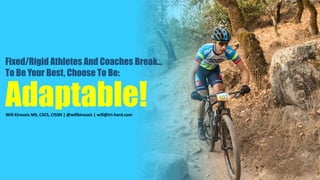



Adaptable!Will Kirousis MS, CSCS, CISSN | @willkirousis | will@tri-hard.com
Fixed/Rigid Athletes And Coaches Break…
To Be Your Best, Choose To Be:
Who am I?
• Will Kirousis, MS, CSCS, CISSN
• Live in MA with my wife Rosemary and twins Emily and William.
• Focused on coaching AG cyclists, triathletes, runners and other
endurance athletes.
• 20+ years of coaching experience.
• Coached AG and Pro athletes to world championship and national
championships podiums in 6 disciplines between triathlon, Xterra,
cycling and mountain running.
• Enjoy coaching folks from beginner to elite – anyone wanting to and
open to growing!
Athlete Centered:
it’s about them, not YOU!
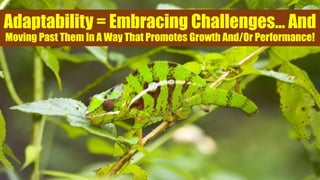
Adaptability = Embracing Challenges… And
Moving Past Them In A Way That Promotes Growth And/Or Performance!
Thoughts Control
Actions/Behavior,
Which Influences
Our Experiences
Bandura’s
Theory of Human Agency
Projection, self-regulation, self reflection.
Where Can We Be In The Future…
Projecting Forward.
Regulating Ourselves
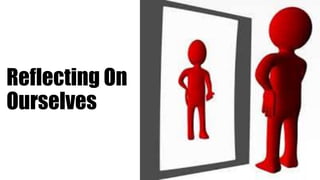
Reflecting On
Ourselves
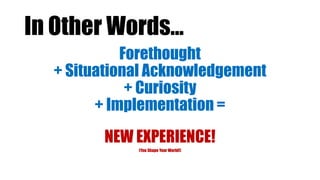
In Other Words…
Forethought
+ Situational Acknowledgement
+ Curiosity
+ Implementation =
NEW EXPERIENCE!
(You Shape Your World!)
Distal goals do not work alone, proximal goals
are needed to create tasks of focus. Goals are
simply symbolic representations of what we
choose to strive towards.
Goals – Why Don’t They Work?
Self Centered = Loss Of Task Focus…
That = Loss Of Our Best Performance
• Fear of consequence, self focused/centered. Self centered takes one
away from the task and thus hurts ones performance.
Novelty = Difficulty
Seek Similarities To Execute Best, When Things Get Sticky
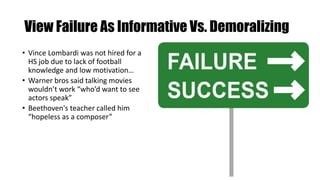
View Failure As Informative Vs. Demoralizing
• Vince Lombardi was not hired for a
HS job due to lack of football
knowledge and low motivation…
• Warner bros said talking movies
wouldn’t work “who’d want to see
actors speak”
• Beethoven's teacher called him
“hopeless as a composer”
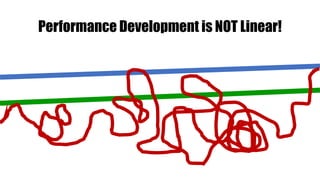
Performance Development is NOT Linear!
• Autonomy
• Relatedness
• Competence
Athletes owning their way perform best!
Adie, J. W., Duda, J. L., & Ntoumanis, N. (2008) Autonomy support, basic need satisfaction and the optimal functioning of adult
male and female sport participants: A test of basic needs theory. Motivation and Emotion. 32, 189–199. Doi: 10.1007/s11031-008-
9095-z.
Self Determination and Buy In
The KEY of SDT… Maximizing INTRINSIC
Motivation!
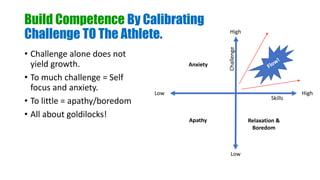
Build Competence By Calibrating
Challenge TO The Athlete.
• Challenge alone does not
yield growth.
• To much challenge = Self
focus and anxiety.
• To little = apathy/boredom
• All about goldilocks!
High
HighLow
Low
Challenge
Skills
Anxiety
Apathy Relaxation &
Boredom
Sport Isn’t Played in
a Box…
Don’t Train in ONE!
Consider a Non-
Linear Approach
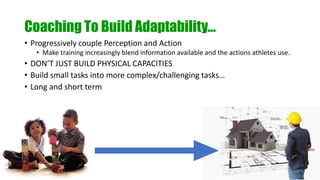
Coaching To Build Adaptability…
• Progressively couple Perception and Action
• Make training increasingly blend information available and the actions athletes use.
• DON’T JUST BUILD PHYSICAL CAPACITIES
• Build small tasks into more complex/challenging tasks…
• Long and short term
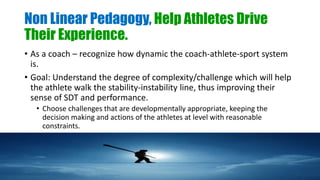
Non Linear Pedagogy, Help Athletes Drive
Their Experience.
• As a coach – recognize how dynamic the coach-athlete-sport system
is.
• Goal: Understand the degree of complexity/challenge which will help
the athlete walk the stability-instability line, thus improving their
sense of SDT and performance.
• Choose challenges that are developmentally appropriate, keeping the
decision making and actions of the athletes at level with reasonable
constraints.
Am I Coaching, If I “Let” Athletes Learn?
Guided Discovery w/ cooperative-competitive approaches.
Mistakes viewed as informative! (Thus foster competence, autonomy
and relatedness)
Regardless of level, enjoying the task/process, challenges, mistakes
and all, is required to sustain the power of self determination.
Task focus, task focus, task focus!
Hands Off… But Relatedness ON!
• Athlete choices are made based on ability for self
projection/foresight.
• Uncertainty in what athletes understand, increases self focus, draw
away from task focus, INCREASE anxiety. DECREASE performance.
• Coach can help over time, by asking questions about performances in
training and racing – guiding the athlete to greater understanding.
• Developmental level creates the opening for athlete questions.
Athletes cant ask or ponder what they cant yet imagine!
If We Let Athletes Learn… Where Do We
Focus?
• Needs of each athlete, and the interaction of the personal,
environmental and process/task orientations
• Encourage athletes to solve problems, to view sport as a fun riddle.
• Your role, GUIDE athletes to create and seek their own feedback,
creating a consultatory or facilitating role for the coach rather than a
punitive role.
Contextual Interference (CI): Blocked
Practice v Open Practice.
• Blocked, tightly structured practice improves practice, does not
improve actual performance as much!
• Open practice challenges the learner (athlete) to seek out the best
“answers” via consistent adjustment and organization of their choices
– from motor control to tactics to fueling and everything in between.
Open practice will create greater adaptability, due to
the athlete developing a broader and more durable
“data base” for future projection and task modification.
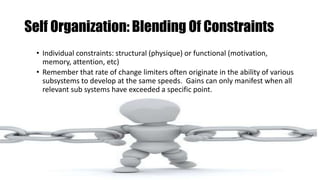
Self Organization: Blending Of Constraints
• Individual constraints: structural (physique) or functional (motivation,
memory, attention, etc)
• Remember that rate of change limiters often originate in the ability of various
subsystems to develop at the same speeds. Gains can only manifest when all
relevant sub systems have exceeded a specific point.
Create situations that re-create the exploratory and
growth focused activity…
We all experienced as children!
Questions?
Will Kirousis
will@tri-hard.com
978.466.5151
www.tri-hard.com

Adaptability

  • 1.
    Adaptable!Will Kirousis MS,CSCS, CISSN | @willkirousis | will@tri-hard.com Fixed/Rigid Athletes And Coaches Break… To Be Your Best, Choose To Be:
  • 2.
    Who am I? •Will Kirousis, MS, CSCS, CISSN • Live in MA with my wife Rosemary and twins Emily and William. • Focused on coaching AG cyclists, triathletes, runners and other endurance athletes. • 20+ years of coaching experience. • Coached AG and Pro athletes to world championship and national championships podiums in 6 disciplines between triathlon, Xterra, cycling and mountain running. • Enjoy coaching folks from beginner to elite – anyone wanting to and open to growing!
  • 3.
  • 4.
    Adaptability = EmbracingChallenges… And Moving Past Them In A Way That Promotes Growth And/Or Performance!
  • 5.
    Thoughts Control Actions/Behavior, Which Influences OurExperiences Bandura’s Theory of Human Agency Projection, self-regulation, self reflection.
  • 6.
    Where Can WeBe In The Future… Projecting Forward.
  • 7.
  • 8.
  • 9.
    In Other Words… Forethought +Situational Acknowledgement + Curiosity + Implementation = NEW EXPERIENCE! (You Shape Your World!)
  • 10.
    Distal goals donot work alone, proximal goals are needed to create tasks of focus. Goals are simply symbolic representations of what we choose to strive towards. Goals – Why Don’t They Work?
  • 11.
    Self Centered =Loss Of Task Focus… That = Loss Of Our Best Performance • Fear of consequence, self focused/centered. Self centered takes one away from the task and thus hurts ones performance.
  • 12.
    Novelty = Difficulty SeekSimilarities To Execute Best, When Things Get Sticky
  • 13.
    View Failure AsInformative Vs. Demoralizing • Vince Lombardi was not hired for a HS job due to lack of football knowledge and low motivation… • Warner bros said talking movies wouldn’t work “who’d want to see actors speak” • Beethoven's teacher called him “hopeless as a composer”
  • 14.
  • 15.
    • Autonomy • Relatedness •Competence Athletes owning their way perform best! Adie, J. W., Duda, J. L., & Ntoumanis, N. (2008) Autonomy support, basic need satisfaction and the optimal functioning of adult male and female sport participants: A test of basic needs theory. Motivation and Emotion. 32, 189–199. Doi: 10.1007/s11031-008- 9095-z. Self Determination and Buy In
  • 16.
    The KEY ofSDT… Maximizing INTRINSIC Motivation!
  • 17.
    Build Competence ByCalibrating Challenge TO The Athlete. • Challenge alone does not yield growth. • To much challenge = Self focus and anxiety. • To little = apathy/boredom • All about goldilocks! High HighLow Low Challenge Skills Anxiety Apathy Relaxation & Boredom
  • 18.
    Sport Isn’t Playedin a Box… Don’t Train in ONE! Consider a Non- Linear Approach
  • 19.
    Coaching To BuildAdaptability… • Progressively couple Perception and Action • Make training increasingly blend information available and the actions athletes use. • DON’T JUST BUILD PHYSICAL CAPACITIES • Build small tasks into more complex/challenging tasks… • Long and short term
  • 20.
    Non Linear Pedagogy,Help Athletes Drive Their Experience. • As a coach – recognize how dynamic the coach-athlete-sport system is. • Goal: Understand the degree of complexity/challenge which will help the athlete walk the stability-instability line, thus improving their sense of SDT and performance. • Choose challenges that are developmentally appropriate, keeping the decision making and actions of the athletes at level with reasonable constraints.
  • 21.
    Am I Coaching,If I “Let” Athletes Learn? Guided Discovery w/ cooperative-competitive approaches. Mistakes viewed as informative! (Thus foster competence, autonomy and relatedness) Regardless of level, enjoying the task/process, challenges, mistakes and all, is required to sustain the power of self determination. Task focus, task focus, task focus!
  • 22.
    Hands Off… ButRelatedness ON! • Athlete choices are made based on ability for self projection/foresight. • Uncertainty in what athletes understand, increases self focus, draw away from task focus, INCREASE anxiety. DECREASE performance. • Coach can help over time, by asking questions about performances in training and racing – guiding the athlete to greater understanding. • Developmental level creates the opening for athlete questions. Athletes cant ask or ponder what they cant yet imagine!
  • 23.
    If We LetAthletes Learn… Where Do We Focus? • Needs of each athlete, and the interaction of the personal, environmental and process/task orientations • Encourage athletes to solve problems, to view sport as a fun riddle. • Your role, GUIDE athletes to create and seek their own feedback, creating a consultatory or facilitating role for the coach rather than a punitive role.
  • 24.
    Contextual Interference (CI):Blocked Practice v Open Practice. • Blocked, tightly structured practice improves practice, does not improve actual performance as much! • Open practice challenges the learner (athlete) to seek out the best “answers” via consistent adjustment and organization of their choices – from motor control to tactics to fueling and everything in between. Open practice will create greater adaptability, due to the athlete developing a broader and more durable “data base” for future projection and task modification.
  • 25.
    Self Organization: BlendingOf Constraints • Individual constraints: structural (physique) or functional (motivation, memory, attention, etc) • Remember that rate of change limiters often originate in the ability of various subsystems to develop at the same speeds. Gains can only manifest when all relevant sub systems have exceeded a specific point.
  • 26.
    Create situations thatre-create the exploratory and growth focused activity… We all experienced as children!
  • 27.

Editor's Notes

  • #4 It’s important to remember that as a coach, we are best served when we are Athlete Centered. Being athlete centered implies your methodology, the eclecticism you employ to help that athlete grow is focused on what THEY need. You may have a favorite method or idea. You may love a certain strategy or concept… But if that wont work for that athlete… And you do it anyway, you are centered on yourself – not the athlete. The goal here, as a coach, is to impart information, to shorten and enhance the learning curve and stimulate growth. This is why many coaches who have been around a long time, and many in other educational and psychologically focused fields err towards becoming a generalist. You need to understand many ways – NOT just a single way or two. And you need to be willing to morph the strategies you employ to fit a specific athletes needs. Don’t be a one trick pony!
  • #8 extent you can regulate thought process, emotions behavior; need a standard to compare against to move fwd based on falling short or exceeding
  • #28 Tri-Hard | www.tri-hard.com