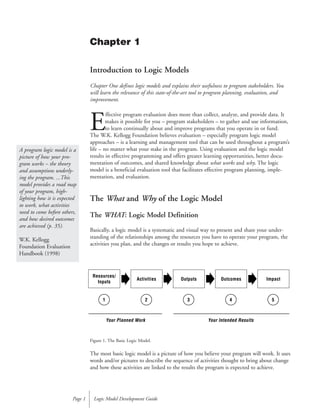
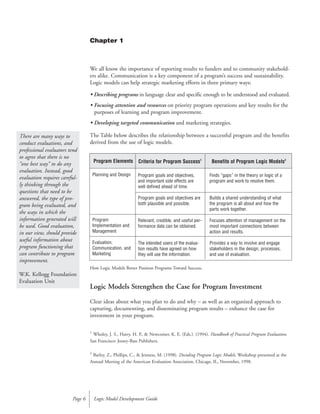
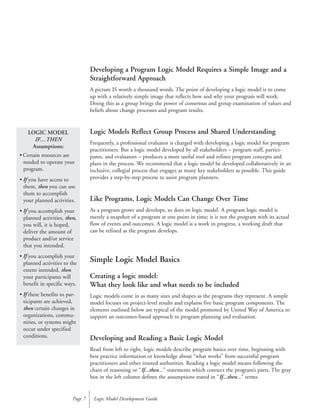
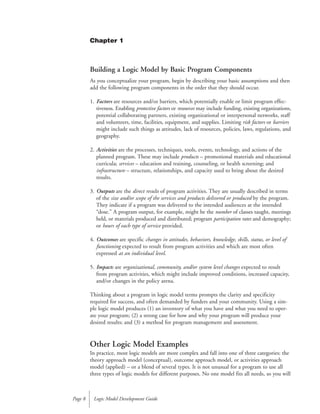
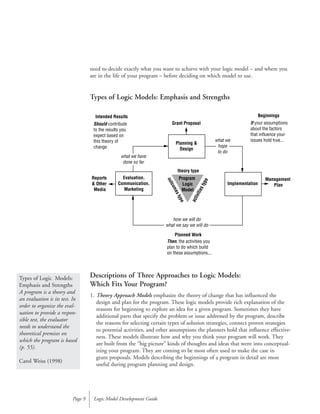
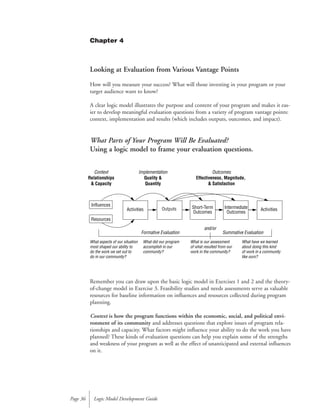
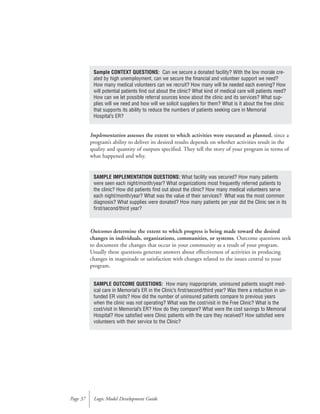
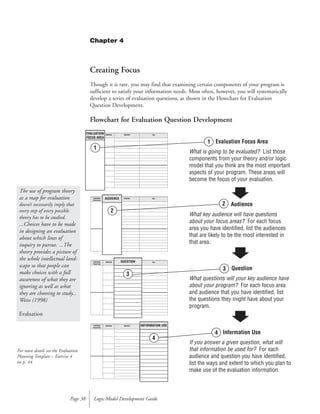
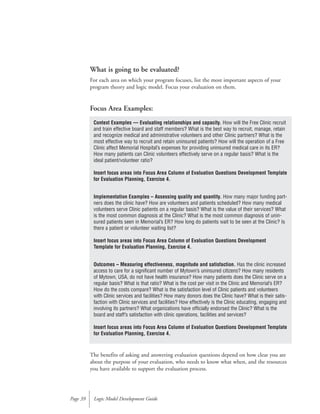
This document introduces logic models and explains their purpose and usefulness. It defines the core components of a logic model, including resources/inputs, activities, outputs, outcomes, and impact. A logic model is a visual representation that shows the relationship between the resources invested in a program and the results or changes expected to occur. It provides a roadmap to help stakeholders understand how a program is intended to work. The document uses a hypothetical example of planning a family trip to demonstrate how to develop and read a basic logic model. Logic models are useful tools for program planning, implementation, evaluation, and improvement.

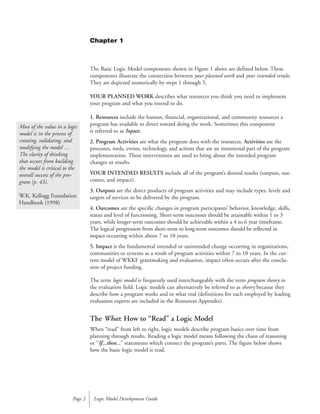
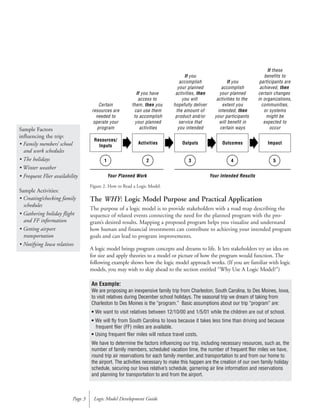
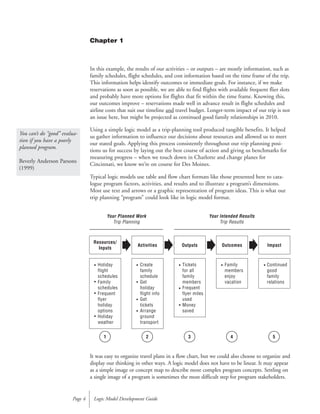
![Working with Outcome Approach Models Highlights Activities and
Program Implementation
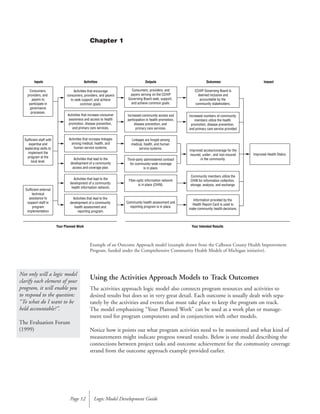
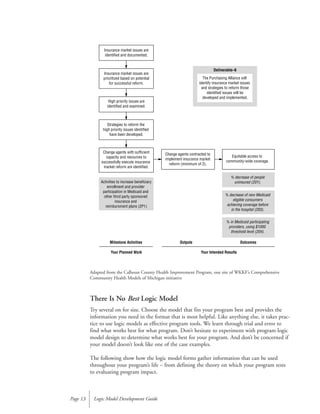
Outcome approach logic models display the interrelationships between specific program
activities and their outcomes. On the next page is an example drawn from the Calhoun
County Health Improvement Program, funded under the Comprehensive Community
Health Models of Michigan initiative.
This linear, columnar model emphasizes the causal linkages thought to exist among pro-
gram components. The arrows show which sets of activities program developers believed
would contribute to what outcomes. These statements serve as logical assertions about the
perceived relationship among program operations and desired results and are the hallmark
of the logic model process.
Notice that this model emphasizes “Your Intended Results” in the greatest relative detail
and anticipates achievement outside the time allotted for the initiative.
Logic Model Development GuidePage 11
These models help build a
common understanding
between managers and
evaluators.... Such agree-
ment is a prerequisite for
evaluation work that is
likely to be useful to man-
agement. [These models]
display the key events
(inputs, activities,
outcomes) that could be
monitored and the assumed
causal linkages that could
be tested in evaluations
of the program.
Joseph S. Wholey,
Harry P. Hatry, and
K.E. Newcomer (1994)
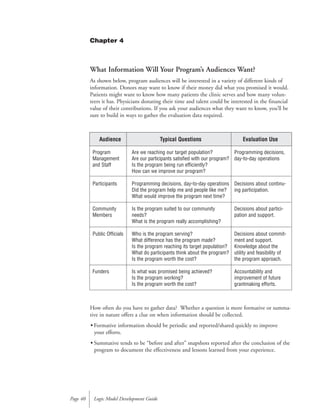
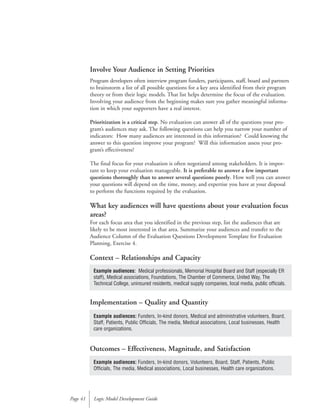
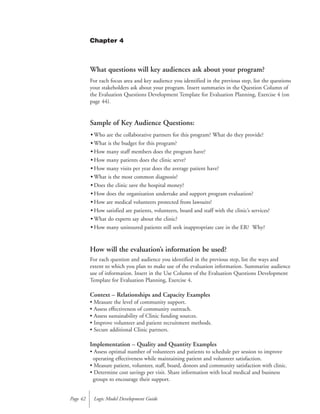
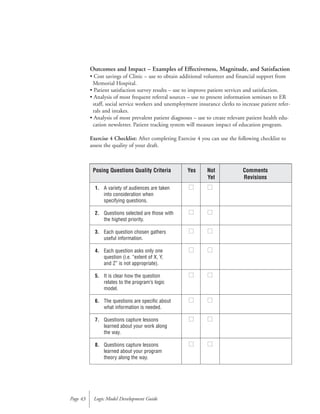
Assumptions
Health is a community issue and
communities will form partnerships
to resolve health care problems.
Commnities can influence and
shape public and market policy at
the local, state, and national levels.
External agents, working in
partnership with communities, can
serve as catalysts for change.
Shifting revenues and incentives to
primary care and prevention will
improve health status.
Information on health status and
systems is required for informed
decision making.
Your Beginnings Your Planned Work Your Intended Results
Outputs Outcomes ImpactInputs Activities
Active
Participation
in the Reform
Process
Inclusive
Community
Decision-
Making
Community-wide
Coverage and
Access
Comprehensive,
Integrated
Health Care
Delivery System
Community Health
Assessment
Community-based
Health Information
Systems
Improved
Health Status
Increased
Health Care
System
Efficiency
More Effective
Distribution of
Community
Health Care
Resources
Administrative
Processes for
Health Data,
Policy, and
Advocacy
External
Technical
Assistance
Consumers
Providers
Payers
Staff
Example of a Theory Logic model (Adapted from WKKF’s Comprehensive Community Health Models of
Michigan).](https://image.slidesharecdn.com/logicmodel-130905135934-/85/Logic-model-18-320.jpg)

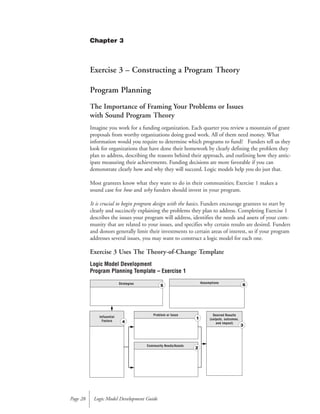





![Kellogg Logic Model Guide[1]](https://cdn.slidesharecdn.com/ss_thumbnails/kellogglogicmodelguide1-090319155708-phpapp01-thumbnail.jpg?width=640&height=640&fit=bounds)


