Photo by 'PixelPlacebo' - Creative Commons Attribution-NonCommercial-ShareAlike License https://www.flickr.com/photos/12142259@N00 Created with Haiku Deck
Lisa Glickstein, PhD
Grants Coordinator
Andover Public Schools
 Slides: www.slideshare.net/lisaglickstein
 Twitter: @LisaGlickstein
 Email: lglickstein@aps1.net
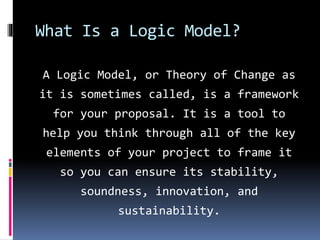
What Is a Logic Model?
A Logic Model, or Theory of Change as
it is sometimes called, is a framework
for your proposal. It is a tool to
help you think through all of the key
elements of your project to frame it
so you can ensure its stability,
soundness, innovation, and
sustainability.
Universityof Wisconsin-Extension,Program DevelopmentandEvaluation
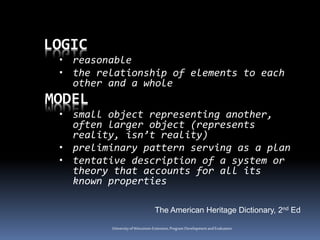
LOGIC
 reasonable
 the relationship of elements to each
other and a whole
MODEL
 small object representing another,
often larger object (represents
reality, isn’t reality)
 preliminary pattern serving as a plan
 tentative description of a system or
theory that accounts for all its
known properties
The American Heritage Dictionary, 2nd Ed
Universityof Wisconsin-Extension,Program DevelopmentandEvaluation
If-then relationships
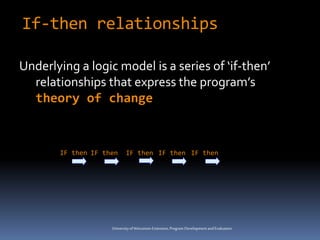
Underlying a logic model is a series of ‘if-then’
relationships that express the program’s
theory of change
IF then IF then IF then IF then IF then
Why do I need a Logic Model?
 To ensure that you have all the
proposal elements in place
 To help get everyone on the same
page with the project by thinking it
through
 To more easily see any gaps in your
project idea
Photo by WorldIslandInfo.com - Creative Commons Attribution License https://www.flickr.com/photos/76074333@N00 Created with Haiku Deck
Where are you going?
How will you get there?
What will show that you’ve arrived?
“If you don’t know
where you are going,
how are you gonna
know when you get
there?”
Yogi Berra
Universityof Wisconsin-Extension,Program DevelopmentandEvaluation
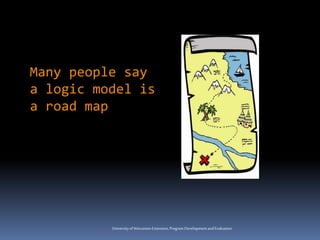
Many people say
a logic model is
a road map
Universityof Wisconsin-Extension,Program DevelopmentandEvaluation
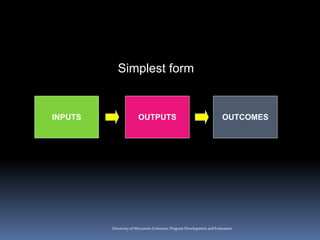
Simplest form
INPUTS OUTPUTS OUTCOMES
Universityof Wisconsin-Extension,Program DevelopmentandEvaluation
Outputs vs. outcomes
Not how many worms
the bird feeds its young,
but how well the fledgling flies
(United Way of America, 1999)
Example:
Number of patients discharged from state
mental hospital is an output
Percentage of discharged who are capable
of living independently is an outcome
Universityof Wisconsin-Extension,Program DevelopmentandEvaluation
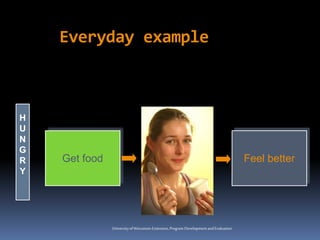
H
U
N
G
R
Y
Feel betterGet food
Everyday example
Logic Models help the Team Think From
a Different Perspective
 A grant proposal (virtually) always
requires a team planning process
 Challenge - getting people on board
 Has to be something folks are bound and
determined to do, no matter what
 Something all are committed to doing one
way or another
 What else do people need to do this work?
 Buy-in happens when the team is committed
and has committed their “things” (INPUTS)
 If not, you probably won't get the grant
Logic Models = Good Project Planning
 Challenge: How to convey the
necessity of a project approach to
folks who just want resources?
 How do we get people planning in a
real way?
 Jump right in, ask questions
 Even if you think you are not using a
logic model, its elements are the
things you would naturally think
through while designing a project
Universityof Wisconsin-Extension,Program DevelopmentandEvaluation
Logic modeling is a way of thinking…
not just a pretty graphic
“We build the road and the road builds us.”
-Sri Lankan saying
Photo by Leo Reynolds - Creative Commons Attribution-NonCommercial-ShareAlike License https://www.flickr.com/photos/49968232@N00 Created with Haiku Deck
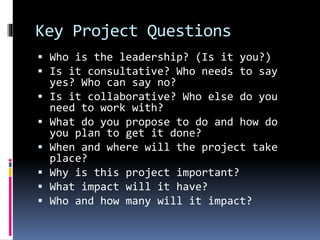
Key Project Questions
 Who is the leadership? (Is it you?)
 Is it consultative? Who needs to say
yes? Who can say no?
 Is it collaborative? Who else do you
need to work with?
 What do you propose to do and how do
you plan to get it done?
 When and where will the project take
place?
 Why is this project important?
 What impact will it have?
 Who and how many will it impact?
Universityof Wisconsin-Extension,Program DevelopmentandEvaluation
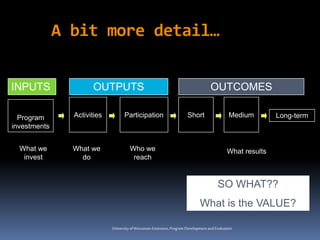
A bit more detail…
INPUTS OUTPUTS OUTCOMES
Program
investments
Activities Participation Short Medium
What we
invest
What we
do
Who we
reach
What results
SO WHAT??
What is the VALUE?
Long-term
Universityof Wisconsin-Extension,Program DevelopmentandEvaluation
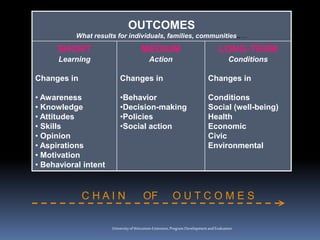
OUTCOMES
What results for individuals, families, communities..…
SHORT
Learning
Changes in
• Awareness
• Knowledge
• Attitudes
• Skills
• Opinion
• Aspirations
• Motivation
• Behavioral intent
MEDIUM
Action
Changes in
•Behavior
•Decision-making
•Policies
•Social action
LONG-TERM
Conditions
Changes in
Conditions
Social (well-being)
Health
Economic
Civic
Environmental
C H A I N OF O U T C O M E S
Photo by FlickrJunkie - Creative Commons Attribution-NonCommercial-ShareAlike License https://www.flickr.com/photos/89035753@N00 Created with Haiku Deck
Universityof Wisconsin-Extension,Program DevelopmentandEvaluation
SidneyHarrisCartoon
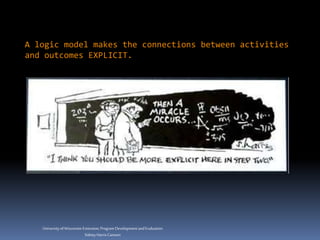
A logic model makes the connections between activities
and outcomes EXPLICIT.
More Project Planning Questions
 Data Collection (Evaluation):
 How are you going to show people
you did what you said you were
going to do?
 How are you going to figure out if
it worked? If you made a real
impact?
 Final step
 check with the team that the logic
model correctly outlines the
project plan
Photo by carnagenyc - Creative Commons Attribution-NonCommercial License https://www.flickr.com/photos/7752651@N05 Created with Haiku Deck
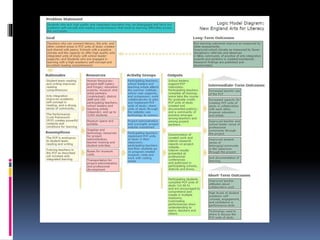
HOW TO LOGIN & GET STARTED
• http://www.innonet.org
• Click on “Point K” at the top of the page
• Register yourself and your organization (first time)
• Enter your username and password
• Under “Get Started” click on “Tools:Assess your strengths, plan &
evaluate programs”
• Under “Start Here” click on “Logic Model Builder”
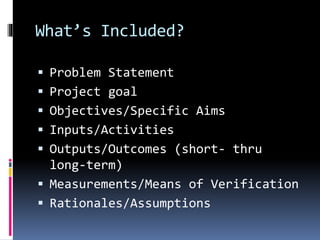
What’s Included?
 Problem Statement
 Project goal
 Objectives/Specific Aims
 Inputs/Activities
 Outputs/Outcomes (short- thru
long-term)
 Measurements/Means of Verification
 Rationales/Assumptions
Photo by JD Hancock - Creative Commons Attribution License https://www.flickr.com/photos/83346641@N00 Created with Haiku Deck
Photo by cvanstane - Creative Commons Attribution License https://www.flickr.com/photos/22901163@N03 Created with Haiku Deck
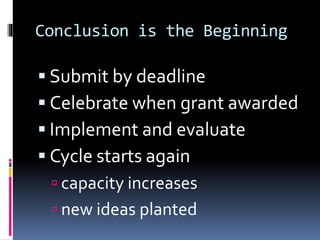
Conclusion is the Beginning
 Submit by deadline
 Celebrate when grant awarded
 Implement and evaluate
 Cycle starts again
 capacity increases
 new ideas planted

Logic Models: A New Perspective

  • 1.
    Photo by 'PixelPlacebo'- Creative Commons Attribution-NonCommercial-ShareAlike License https://www.flickr.com/photos/12142259@N00 Created with Haiku Deck
  • 2.
    Lisa Glickstein, PhD GrantsCoordinator Andover Public Schools  Slides: www.slideshare.net/lisaglickstein  Twitter: @LisaGlickstein  Email: lglickstein@aps1.net
  • 3.
    What Is aLogic Model? A Logic Model, or Theory of Change as it is sometimes called, is a framework for your proposal. It is a tool to help you think through all of the key elements of your project to frame it so you can ensure its stability, soundness, innovation, and sustainability.
  • 4.
    Universityof Wisconsin-Extension,Program DevelopmentandEvaluation LOGIC reasonable  the relationship of elements to each other and a whole MODEL  small object representing another, often larger object (represents reality, isn’t reality)  preliminary pattern serving as a plan  tentative description of a system or theory that accounts for all its known properties The American Heritage Dictionary, 2nd Ed
  • 5.
    Universityof Wisconsin-Extension,Program DevelopmentandEvaluation If-thenrelationships Underlying a logic model is a series of ‘if-then’ relationships that express the program’s theory of change IF then IF then IF then IF then IF then
  • 6.
    Why do Ineed a Logic Model?  To ensure that you have all the proposal elements in place  To help get everyone on the same page with the project by thinking it through  To more easily see any gaps in your project idea
  • 7.
    Photo by WorldIslandInfo.com- Creative Commons Attribution License https://www.flickr.com/photos/76074333@N00 Created with Haiku Deck
  • 8.
    Where are yougoing? How will you get there? What will show that you’ve arrived? “If you don’t know where you are going, how are you gonna know when you get there?” Yogi Berra
  • 9.
  • 10.
  • 11.
    Universityof Wisconsin-Extension,Program DevelopmentandEvaluation Outputsvs. outcomes Not how many worms the bird feeds its young, but how well the fledgling flies (United Way of America, 1999) Example: Number of patients discharged from state mental hospital is an output Percentage of discharged who are capable of living independently is an outcome
  • 12.
  • 13.
    Logic Models helpthe Team Think From a Different Perspective  A grant proposal (virtually) always requires a team planning process  Challenge - getting people on board  Has to be something folks are bound and determined to do, no matter what  Something all are committed to doing one way or another  What else do people need to do this work?  Buy-in happens when the team is committed and has committed their “things” (INPUTS)  If not, you probably won't get the grant
  • 14.
    Logic Models =Good Project Planning  Challenge: How to convey the necessity of a project approach to folks who just want resources?  How do we get people planning in a real way?  Jump right in, ask questions  Even if you think you are not using a logic model, its elements are the things you would naturally think through while designing a project
  • 15.
    Universityof Wisconsin-Extension,Program DevelopmentandEvaluation Logicmodeling is a way of thinking… not just a pretty graphic “We build the road and the road builds us.” -Sri Lankan saying
  • 16.
    Photo by LeoReynolds - Creative Commons Attribution-NonCommercial-ShareAlike License https://www.flickr.com/photos/49968232@N00 Created with Haiku Deck
  • 17.
    Key Project Questions Who is the leadership? (Is it you?)  Is it consultative? Who needs to say yes? Who can say no?  Is it collaborative? Who else do you need to work with?  What do you propose to do and how do you plan to get it done?  When and where will the project take place?  Why is this project important?  What impact will it have?  Who and how many will it impact?
  • 18.
    Universityof Wisconsin-Extension,Program DevelopmentandEvaluation Abit more detail… INPUTS OUTPUTS OUTCOMES Program investments Activities Participation Short Medium What we invest What we do Who we reach What results SO WHAT?? What is the VALUE? Long-term
  • 19.
    Universityof Wisconsin-Extension,Program DevelopmentandEvaluation OUTCOMES Whatresults for individuals, families, communities..… SHORT Learning Changes in • Awareness • Knowledge • Attitudes • Skills • Opinion • Aspirations • Motivation • Behavioral intent MEDIUM Action Changes in •Behavior •Decision-making •Policies •Social action LONG-TERM Conditions Changes in Conditions Social (well-being) Health Economic Civic Environmental C H A I N OF O U T C O M E S
  • 20.
    Photo by FlickrJunkie- Creative Commons Attribution-NonCommercial-ShareAlike License https://www.flickr.com/photos/89035753@N00 Created with Haiku Deck
  • 21.
    Universityof Wisconsin-Extension,Program DevelopmentandEvaluation SidneyHarrisCartoon Alogic model makes the connections between activities and outcomes EXPLICIT.
  • 22.
    More Project PlanningQuestions  Data Collection (Evaluation):  How are you going to show people you did what you said you were going to do?  How are you going to figure out if it worked? If you made a real impact?  Final step  check with the team that the logic model correctly outlines the project plan
  • 23.
    Photo by carnagenyc- Creative Commons Attribution-NonCommercial License https://www.flickr.com/photos/7752651@N05 Created with Haiku Deck
  • 24.
    HOW TO LOGIN& GET STARTED • http://www.innonet.org • Click on “Point K” at the top of the page • Register yourself and your organization (first time) • Enter your username and password • Under “Get Started” click on “Tools:Assess your strengths, plan & evaluate programs” • Under “Start Here” click on “Logic Model Builder”
  • 25.
    What’s Included?  ProblemStatement  Project goal  Objectives/Specific Aims  Inputs/Activities  Outputs/Outcomes (short- thru long-term)  Measurements/Means of Verification  Rationales/Assumptions
  • 27.
    Photo by JDHancock - Creative Commons Attribution License https://www.flickr.com/photos/83346641@N00 Created with Haiku Deck
  • 28.
    Photo by cvanstane- Creative Commons Attribution License https://www.flickr.com/photos/22901163@N03 Created with Haiku Deck
  • 29.
    Conclusion is theBeginning  Submit by deadline  Celebrate when grant awarded  Implement and evaluate  Cycle starts again  capacity increases  new ideas planted