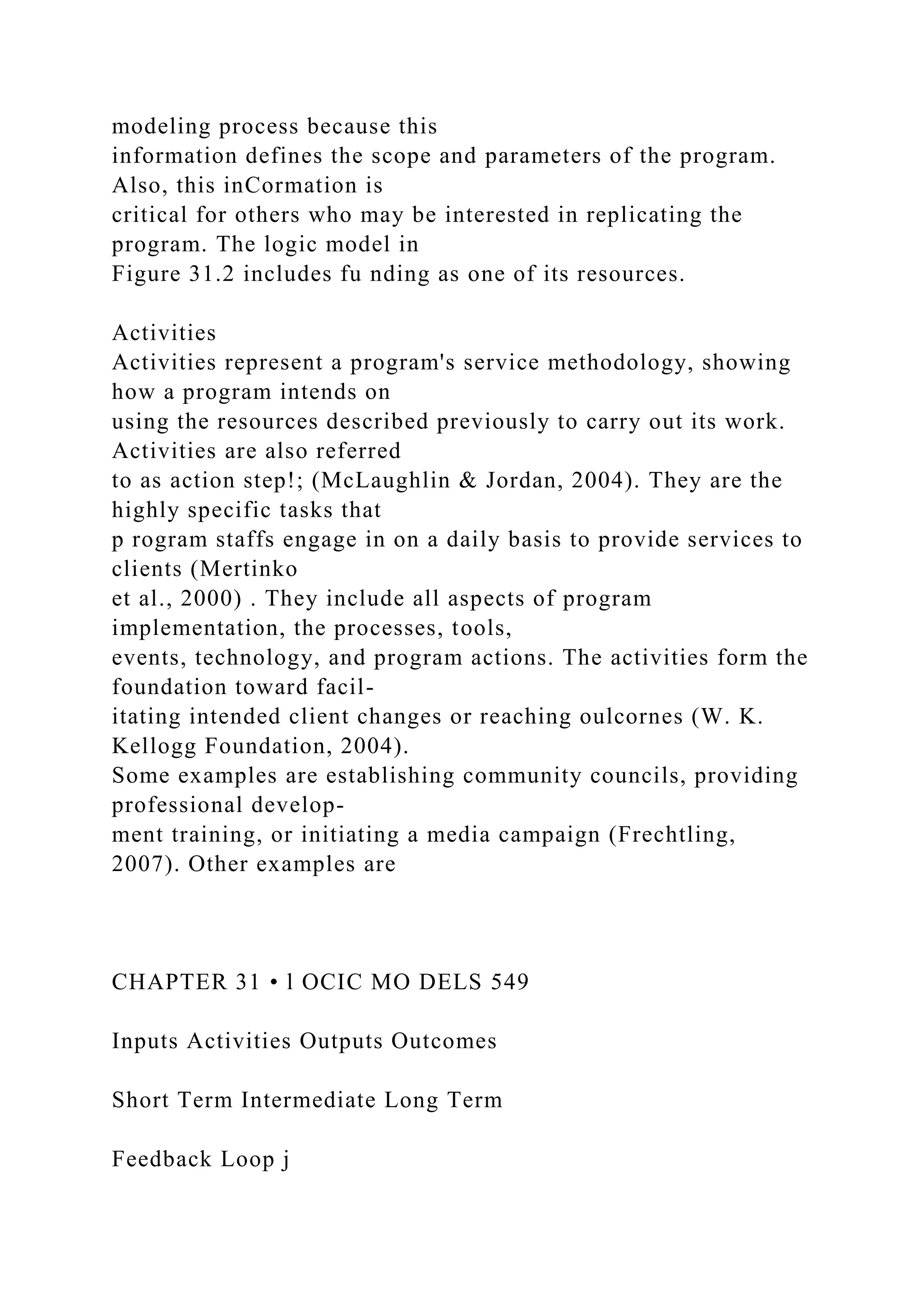
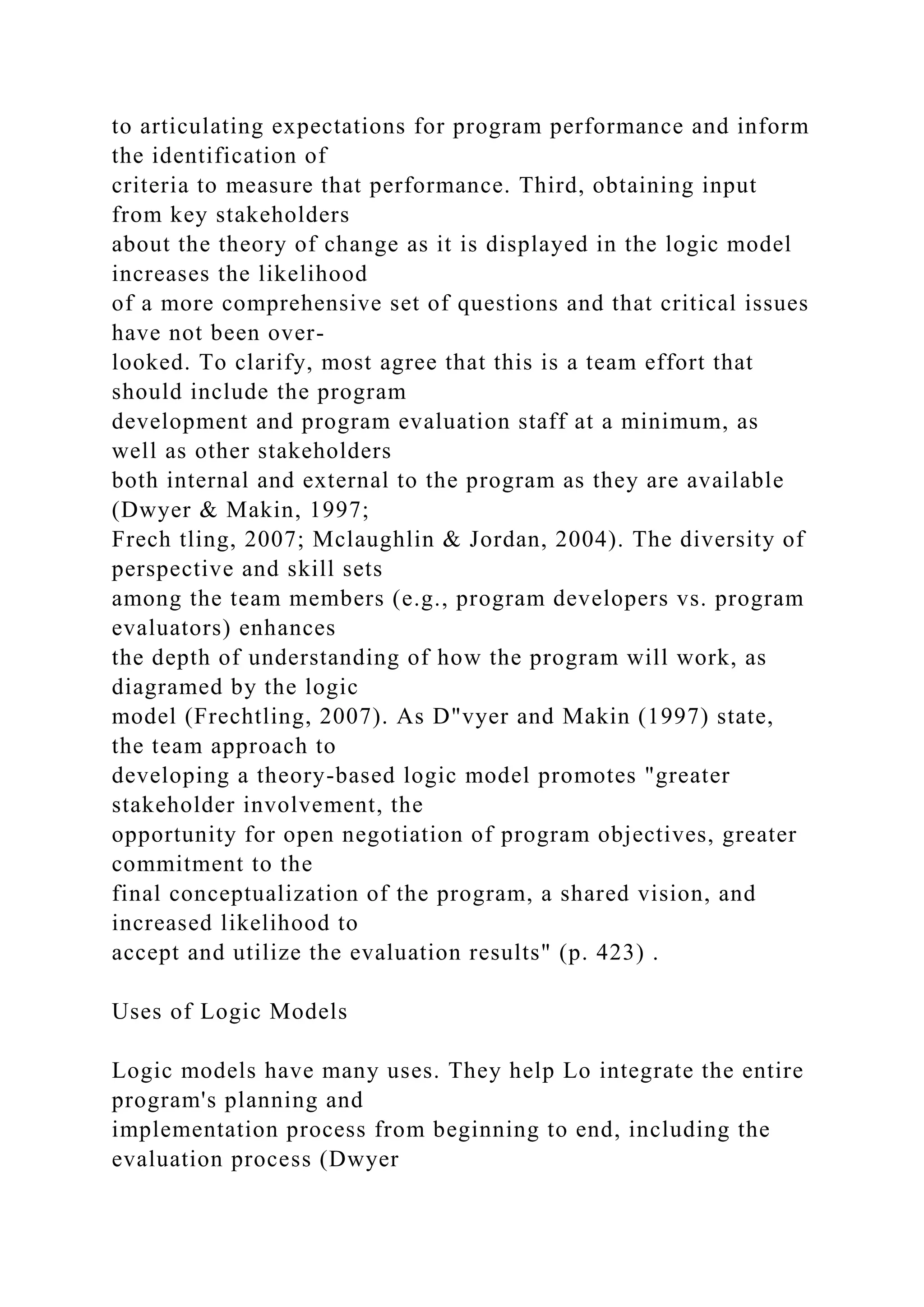
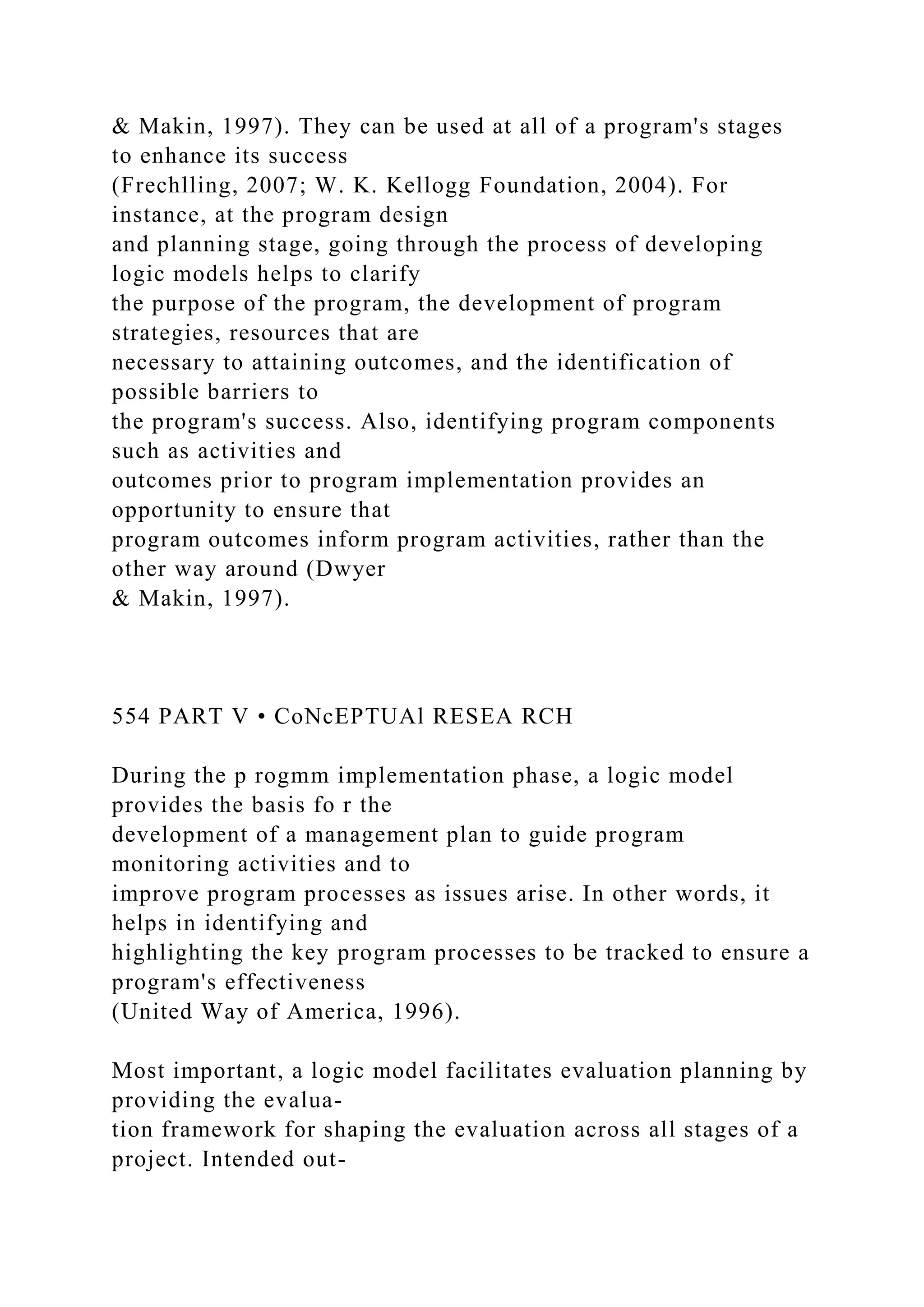
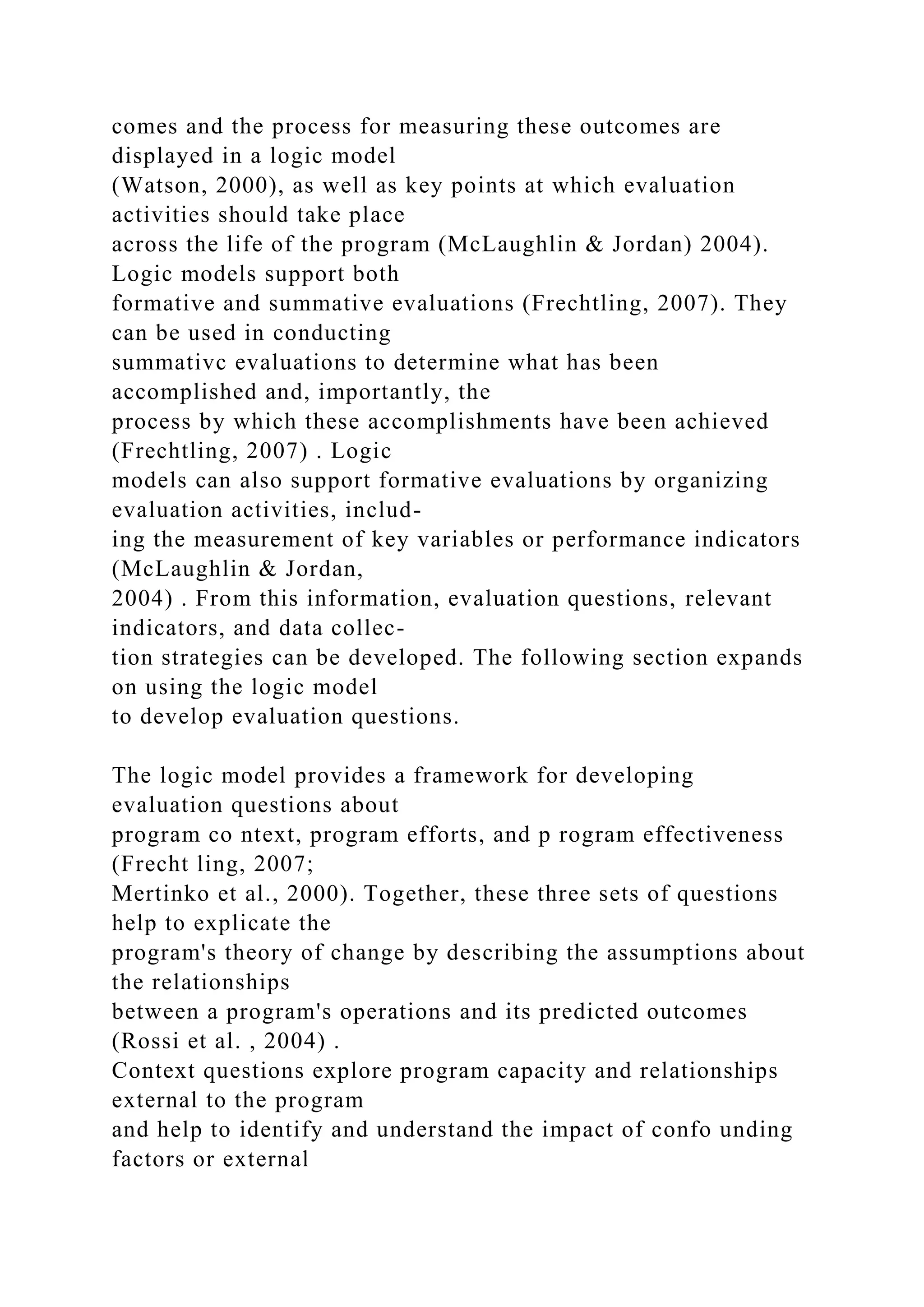
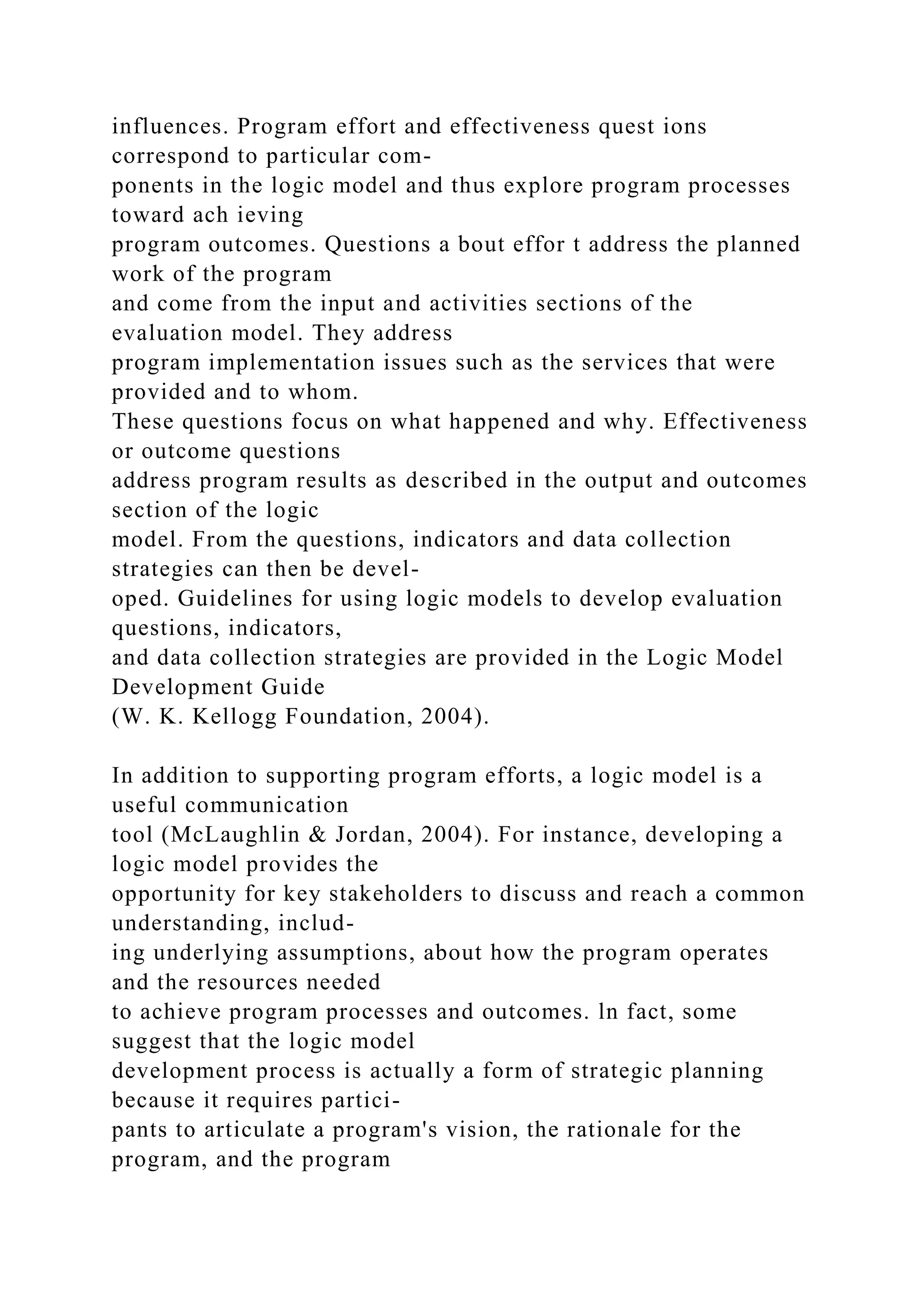
Figure 31.1
Logic Model
Logic Models
Karen A. Randolph
A
logic model is a diagram of the relationship between a need that
a
program is designed to addret>s and the actions to be taken to
address the
need and achieve program outcomes. It provides a concise, one-
page pic-
ture of program operations from beginning to end. The diagram
is made
up of a series of boxes that represent each of the program's
components,
inputs or resources, activities, outputs, and outcomes. The
diagram shows how these
components are connected or linked to one another for the
purpose of achieving
program goals. Figure 31.1 provides an example of the
framework for a basic logic model.
The program connections illustrate the logic of how program
operations will result in
client change (McLaughlin & Jordan, 1999). The connections
show the "causal" relation-
ships between each of the program components and thus are
referred to as a series of"if-
then" sequence of changes leading to the intended outcomes for
the target client group
(Chinman, hum, & Wandersman, 2004). The if-then statements
represent a program's
theory of change underlying an intervention. As such, logic
models provide a framework
that guides the evaluation process by laying out important
relationships that need to be
tested to demonstrate program results (Watson, 2000).
Logic models come from the field of program evaluation. The
idea emerged in
response to the recognition among program evaluators regarding
the need to systematize
the program evaluation process (McLaughlin & Jordan, 2004).
Since then, logic models
have become increasingly popular among program managers for
program planning and
to monitor program performance. With a growing emphasis on
accountability and out-
come measurement, logic models make explicit the entire
change process, Lhe assump-
tions that underlie this process, and the pathways to reach ing
outcomes. Researchers have
begun to use logic models for intervention research planning
(e.g., Brown, Hawkins,
Arthur, Briney, & Abbott, 2007).
The following sections provide a description of the components
of a basic logic model
and how these components are linked together, its relationship
to a p rogram's theory of
[ : Inputs 1--_.,•1 Ac~vities ,II----.~•{ .Outputs ·11---~·1
Outcomes I
AUTHOR'S NOTE: The author wishes to acknowledge Dr. Tony
Tripodi for his thoughlful comments
on a drafl of this chapter.
547
548 PART V • CONCEPTUAL RESEARCH
change, and its uses and benefits. The steps for creating a logic
model as well as the chal-
lenges of the logic modeling process will be presented. The
chapter concludes with an
example of how a logic model was u~cd to enhance program
outcomes for a family liter-
acy program.
Components of a Logic Model
Typically, a logic model has four components: inputs or
resources, activities, outputs, and
outcomes. Outcomes can be further classified into short-term
outcomes, intermediate
outcomes, and long-term outcomes based on the length of time
it takes to reach these
outcomes (McLa ughlin & Jordan, 2004) . The components
make up the connection
between the planned work and the intended results (W. K.
Kellogg Foundation, 2004).
The planned work includes the resources (the inputs) needed to
implement the program
as well as how the resources will be used (the activities). The
intended results include the
outputs and outcomes that occur as a consequence of the
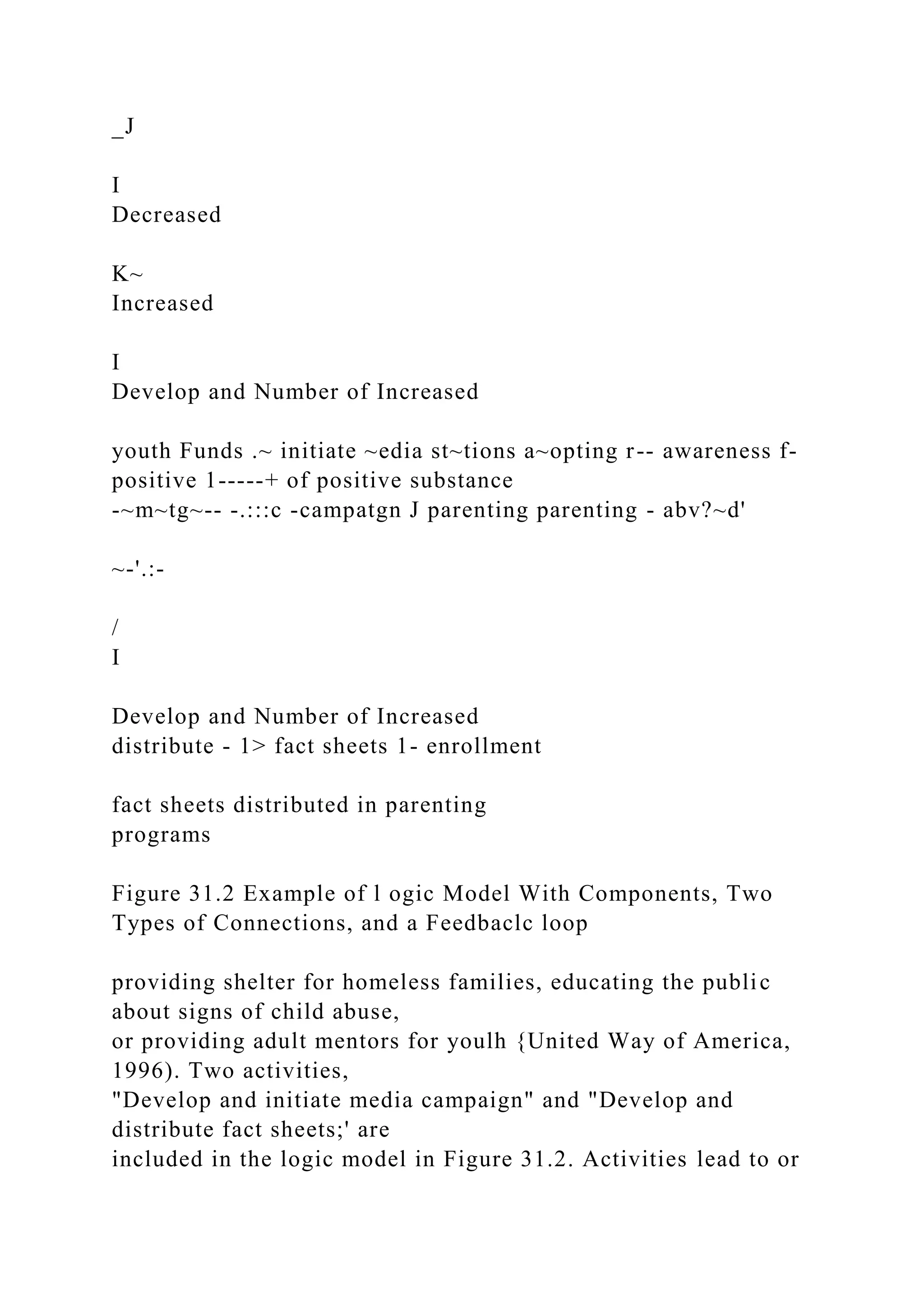
planned work. Figure 31.2
expands on the model illuslrated in Figure 3 1.1 by adding
examples of each component.
This particular logic model, adopted from frechtling (2007),
provides an illustration of
the components of an intervention designed to prevent substance
abuse and other prob-
lem behaviors among a population of youth. The intervention is
targeted toward improv-
ing parenting skills, based on the assumption that positive
parenting leads to prosocial
behaviors among youth {Bahr, Hoffman, & Yang, 2005). The
following section provides
definitions and examples of each logic model component, using
this illustration.
Resources
Resources, sometimes referred to as inputs, include the human,
financial, organizational,
and community assets that are available to a program to achieve
its objectives (W. K.
Kellogg Foundation, 2004). Resources are used to support and
facilitate the program
activities. They are usually categorized in terms of funding
resou rces or in-kind contribu-
tions (Frechtling, 2007) .
Some resources, such as laws, regulations, and funding
requirements, are external to
the agency (United Way of America, 1996). Other resources,
such as staff and money, are
easier lo quantify than others (e.g., community awareness of the
program; Mertinko,
Novotney, Baker, & Lange, 2000). As Fn.:c:htli ng (2007)
notes, it is important to clearly and
thoroughly identify the available resources during the logic
modeling process because this
information defines the scope and parameters of the program.
Also, this inCormation is
critical for others who may be interested in replicating the
program. The logic model in
Figure 31.2 includes fu nding as one of its resources.
Activities
Activities represent a program's service methodology, showing
how a program intends on
using the resources described previously to carry out its work.
Activities are also referred
to as action step!; (McLaughlin & Jordan, 2004). They are the
highly specific tasks that
p rogram staffs engage in on a daily basis to provide services to
clients (Mertinko
et al., 2000) . They include all aspects of program
implementation, the processes, tools,
events, technology, and program actions. The activities form the
foundation toward facil-
itating intended client changes or reaching oulcornes (W. K.
Kellogg Foundation, 2004).
Some examples are establishing community councils, providing
professional develop-
ment training, or initiating a media campaign (Frechtling,
2007). Other examples are
CHAPTER 31 • l OCIC MO DELS 549
Inputs Activities Outputs Outcomes
Short Term Intermediate Long Term
Feedback Loop j
_J
I
Decreased
K~
Increased
I
Develop and Number of Increased
youth Funds .~ initiate ~edia st~tions a~opting r-- awareness f-
positive 1-----+ of positive substance
-~m~tg~-- -.:::c -campatgn J parenting parenting - abv?~d'
~-'.:-
/
I
Develop and Number of Increased
distribute - 1> fact sheets 1- enrollment
fact sheets distributed in parenting
programs
Figure 31.2 Example of l ogic Model With Components, Two
Types of Connections, and a Feedbaclc loop
providing shelter for homeless families, educating the public
about signs of child abuse,
or providing adult mentors for youlh {United Way of America,
1996). Two activities,
"Develop and initiate media campaign" and "Develop and
distribute fact sheets;' are
included in the logic model in Figure 31.2. Activities lead to or
produce the program out-
puts, described in the following section.
Outputs
The planned works (resources and activities) bring about a
program's desired resul ts,
including outputs and outcomes (W. K. Kellogg Foundation,
2004) . Outputs, also referred
to as units of service, are the immediate results of program
activities in the form of types,
levels, and targets of services to be delivered by the program
(McLaughlin & Jordan ,
1999). They are tangible products, events, or serv ices. They
provide the documentation
that activities have been implemented and, as such, indicate if a
program was delivered to
the intended audience at the intended dose (W. K. Kellogg
FounJation, 2004). Outputs
arc typically described in terms of the size and/or scope of the
services and products pro-
duced by the program and thus are expressed numerically
(Frechtling, 2007). Examples of
program outputs include the number of classes taught, meetings
held, or materials p ro-
duced and distributed; program par ticipation rates and
demography; or hours of each
type of service provided (W. K. Kellogg Foundation, 2004).
Other examples are the
number of meals provided, classes taught, brochures distributed,
or participants served
(Frecht1ing, 2007) . While outputs have little inherent value in
themselves, they provide
the link between a program's activities and a program's
outcomes (United Way of
America, 1996). The logic model in Figure 31.2 includes Lhc
number of stations adopting
the media campaign and the number of fact sheets distributed as
two outputs for the pre-
vention program.
550 PART V • CONCEPTUAL RESEARCH
Outcomes
Outcomes arc Lhe specific changes experienced by the
program's clients or target group as
a consequence of participating in the program. Outcomes occur
as a result of the program
activities and outputs. These changes may be in behaviors,
attitudes, skill level, status, or
level of functioning (W. K. Kellogg Foundation, 2004).
Examples include increased knowl-
edge of nutritional needs, improved reading skills, more
effective responses to conflict,
and finding employment (United Way of America, 1996).
Outcomes are indicalors of a
program's level of success.
McLaughlin and Jordan (2004) make the point that some
programs have multiple,
sequential outcome structures in the form of short-term
outcomes, intermediate out-
comes, and long-term outcomes. In these cases, each type of
outcome is linked tempo-
rally. Short-term outcomes arc client changes or benefits that
are most immediately
associated with the program's outputs. They are usually realized
by clients within 1 to
3 years of program completion. Short-term outcomes are linked
to accomplishing inter-
mediate outcomes. Intermediate outcomes are generally
attainable in 4 to 6 years. Long-
term outcomes are also referred to as program impacts or
program goals. They occur as a
result of the intermediate outcomes, usually within 7 to 10
years. In this format, long-
term outcomes or goals are directed at macro-level change and
target organizations, com-
munities, or systems (W. K. Kellogg Foundation, 2004).
As an example, a sequen tial outcome structure with short-
term, intermediate, and
long-term outcomes for the prevention program is displayed in
Figure 31.2. As a result of
hearing the public service announcements about positive
parenting (the activity), parents
enroll in parenting programs to learn new parenting skills (the
short-term outcome).
Then they apply these newly learned skills with their children
(the intermediate out-
come), which leads to a reduction in substance abuse among
youth (the long-term impact
or goal the parenting program was designed to achieve).
Outcomes are often confused with outputs in logic models
because their correct clas-
sification depends on the context within which they are being
included. A good example
of this potential confusion, provided in the United Way of
America manual ( 1996, p. 19),
is as follows. The number of clients served is an output when it
is meant to describe the
volume of work accomplished. In this case, it does not relate
directly to client changes or
benefits. However, the number of clients served is considered to
be an outcome when the
program's intention is to encourage clients to seek services,
such as alcohol treatment.
What is important to remember is that outcomes describe
intended client changes or
benefits as a result of participating in the program while outputs
document products or
services produced as a result of activities.
Links or Connections Between Components
A critical part of a logic model is the connections or links
between the components. The
connections illustrate the relationships between the components
and the process by
which change is hypothesized to occur among program
participants. This is referred to as
the program theory (Frechtling, 2007). It is the connections
illustrating the program's
theory of change that make the logic model complicated.
Specifying the connections is
one of the more difficult aspects of developing a logic model
because the process requires
predicting the process by which client change is expected to
occur as a result of program
participation (Frechtling, 2007).
CHIII'TER 31 • lOGIC M ODtLS 551
Frechtling (2007) describes nvo types of connections in a logic
model: connections
that link items within each component and connections that
illustrate the program's
theory of change. The first type, items within a component, is
connected by a straight line.
This line shows that the items make up a
particularcomponent.As an example, in Figure 31.2,
nvo activities, "Develop and initiate media campaign" and
"Develop and distribute fact
sheets," are linked together with a straight line because they
represent the items within the
activities component. Similarly, two outputs, "Number of
stations adopting the cam-
paign" and "Number of fact sheets distributed;' arc connected as
two items within the
outputs component.
The second type of connection sh<.>ws how the components
interact with or relate to
each other to reach expected outcomes (Frechtling, 2007) . In
essence, this is the program's
theory of change. Thus, instead of straight lines, arrows are
used to show the direction of
influence. Frechtling (2007) clarifies that "these directional
connections are not just a
kind of glue anchoring the otherwise floating boxes. Rather they
portray the changes thaL
arc expected to occur after a previous acLivity has taken place,
and as a result of it" (p. 33).
She points out that the primary purpose of the evaluation is to
determine the nature of
the relationships between components (i.e., whether the
predictions are correct). A logic
model that illustrates a fully developed theory of change
includes links between every
item in each component. In other words, every item in every
component must be con-
nected to at least one item in a subsequent component. This is
illustrated in Figure 31.2,
which shows that each of the two items within the activities
component is linked to an
item within the output component.
Figure 31.2 provides an example of the predicted relationships
between the compo-
nents. This is the program theory about how the target group is
expected to change. The
input or resource, funding, is connected to the tv,ro activities,
"Develop and initiate media
campaign" and "Develop and distribute fac t sheets." Simply
put, this part of Figure 31 .2
shows that funding will be used to support the development and
initiation of PSA cam-
paigns and the distribution of fact sheets.
The sequencing of the connections between components also
shows that these steps
occur over a period of time. While this may seem obvious and
relatively inconsequential,
specifying an accurate sequence has time-based implications,
particularly when short-
term, intermediate, and long-term outcomes are proposed as a
part of the theory of
change (Frechtling, 2007). Rcca11 that the short-term outcomes
lead to achieving the
intermediate outcomes, and the intermediate outcomes lead to
achieving long-term out-
comes. Thus, the belief or underl}ing assumption is that short-
term outcomes mediate
(or come between) relationships benv-een activities and
intermediate outcomes, and
intermediate outcomes mediate relations between short-term and
long-term outcomes.
Related, sometimes logic models display feedback loops.
Feedback loops show how the
information gained from implementing one item can be used to
refine and improve other
items (Frechlling, 2007). f or instance, in Figure 31.2, the
feedback loop from the short-
term outcome, "Increased awareness of positive parenting;' back
to the activity, "Develop
and initiate media campaign;' indicates that the findings for
"Increased awareness of pos-
itive parenting" arc used to improve the PSA campaigns in the
next program cycle.
Contextual Factors
Logic models describe programs that exist and are affected by
contextual factors in the
larger environment. Contextual factors are those important
features of the environment
552 PART V • CONCEPTUAL R ESEARCH
in which the project or intervention takes place. They include
the social, cultural, and
political aspects of the environment (Frechtling, 2007). They
are typically not under the
program's control yet are likely to influence the program either
positively or negatively
(McLaughlin & Jordan, 2004 ). Thus, it is critical to identify
relevant contextual factors
and to consider their potential impact on the program.
McLaughlin and Jordan (1999)
point out that understanding and articulating contextual factors
co ntribu tes to an under-
standing of the fo undation upon which performance expectatio
ns are established.
Moreover, this knowledge helps to establish the parameters for
explaining program
results and developing program improvement strategies that are
li kely to be more mean-
ingful and thus more successful because the information is more
complete. finally, con-
textual factors clarify situations under which the program
results might be expected to
generalize and the issues that might affect replication
(Frechtling, 2007) .
Harrell, Burt, Hatry, Rossm an, and Roth (1996) identify two
types of contextual fac-
tors, antecedent and media6ng, as outside facto rs that could
influence the program's
design, implementation, and results. Antecedent factors are
those that exist prior to
program implementation, such as characteristics of the client
target population or com-
munity characteristics such as geographical and economic
conditions. Mediating factors
are the environmental influences that emerge as the program
unfolds, such as new laws
and policies, a change in economic conditions, or the startup of
other new programs pro-
viding similar services (McLaughlin & jordan, 2004).
Logic Models and a Program's Theory of Change
Definition
Logic models p rovide an illustration of the components of a
program's theot-y and how
those components are linked together. Program theory is defined
as "a plausible and sen-
sible model of how a program is supposed to work" (Bickman,
1987, p. 5). Program
theory incorporates "program resources, program activities, and
intended program out-
comes, and specifies a chain of causal assumptions linking
resources, activities, interme-
diate outcomes, and ultimate goals" (Wholey, 1987, p. 78).
Program theory e.>..-plicates the
assumptions about how the program components link together
from program star t to
goal attainment to realize the program's intended outcomes
(Frechtling, 2007). Thus, it is
often referred to as a program's theory of change. Frechtling
(2007) suggests that both
previous research and knowledge gained from practice
experience arc useful in develop-
ing a theory of change.
Relationship to logic Models
A logic model provides an illustration of a program's theory of
change. It is a useful tool
for describing program theory because it shows the connections
or if-then relationships
between program components. In other words, moving from left
to right from one com-
ponent to the next, logic models provide a diagram of the
rationale or reasoning underly-
ing the theory of change. If-then statements connect the
program's components to form
the theory of change (W. K. Kellogg Foundation, 2004). For
example, certain resources or
inputs are needed to carry out a program's activities. The first
if-then statement links
resources to activities and is stated, "If you have access to these
resources, then you can use
them to accomplish your planned activities" (W. K. Kellogg
Foundation, 2004, p. 3). Each
CHAPTER 31 • LOCIC MODELS SS3
component in a logic model is linked to the other components
using if-then statemen ts to
show a program's chain of reasoning about how client change is
predicted to occur. The
idea is that "if the right resources are transformed into the right
activities for the right
people, then these will lead to the results the program was
designed to achieve"
(McLaughlin & Jordan, 2004, p. 11). It is important to define
the components of an inter-
vention and make the connections between them explicit
(Frechtling, 2007).
Program Theory and Evaluation Planning
Chen and Rossi (1983) were among the first to suggest a
program theory-driven
approach to evaluation. A program's theory of change has
significant utility in develop-
ing and implementing a program evaluation because the theory
provides a framework
for determining the evaluation questions (Rossi, Lipsey, &
Freeman, 2004) . As such, a
logic model that illustrates a program's theory of change
provides a map to inform the
development of relevant evaluation questions at each phase of
the evaluation. Rossi
et al. (2004) explain how a program theory-based logic model
enhances the develop-
ment of evaluation questions. First, the process of articulating
the logic of the
program's change process through the development of the logic
model prompts discus-
sion of relevant and meaningful evaluation questions. Second,
these questions then lead
to articulating expectations for program performance and inform
the identification of
criteria to measure that performance. Third, obtaining input
from key stakeholders
about the theory of change as it is displayed in the logic model
increases the likelihood
of a more comprehensive set of questions and that critical issues
have not been over-
looked. To clarify, most agree that this is a team effort that
should include the program
development and program evaluation staff at a minimum, as
well as other stakeholders
both internal and external to the program as they are available
(Dwyer & Makin, 1997;
Frech tling, 2007; Mclaughlin & Jordan, 2004). The diversity of
perspective and skill sets
among the team members (e.g., program developers vs. program
evaluators) enhances
the depth of understanding of how the program will work, as
diagramed by the logic
model (Frechtling, 2007). As D"vyer and Makin (1997) state,
the team approach to
developing a theory-based logic model promotes "greater
stakeholder involvement, the
opportunity for open negotiation of program objectives, greater
commitment to the
final conceptualization of the program, a shared vision, and
increased likelihood to
accept and utilize the evaluation results" (p. 423) .
Uses of Logic Models
Logic models have many uses. They help Lo integrate the entire
program's planning and
implementation process from beginning to end, including the
evaluation process (Dwyer
& Makin, 1997). They can be used at all of a program's stages
to enhance its success
(Frechlling, 2007; W. K. Kellogg Foundation, 2004). For
instance, at the program design
and planning stage, going through the process of developing
logic models helps to clarify
the purpose of the program, the development of program
strategies, resources that are
necessary to attaining outcomes, and the identification of
possible barriers to
the program's success. Also, identifying program components
such as activities and
outcomes prior to program implementation provides an
opportunity to ensure that
program outcomes inform program activities, rather than the
other way around (Dwyer
& Makin, 1997).
554 PART V • CoNcEPTUAl RESEA RCH
During the p rogmm implementation phase, a logic model
provides the basis fo r the
development of a management plan to guide program
monitoring activities and to
improve program processes as issues arise. In other words, it
helps in identifying and
highlighting the key program processes to be tracked to ensure a
program's effectiveness
(United Way of America, 1996).
Most important, a logic model facilitates evaluation planning by
providing the evalua-
tion framework for shaping the evaluation across all stages of a
project. Intended out-
comes and the process for measuring these outcomes are
displayed in a logic model
(Watson, 2000), as well as key points at which evaluation
activities should take place
across the life of the program (McLaughlin & Jordan) 2004).
Logic models support both
formative and summative evaluations (Frechtling, 2007). They
can be used in conducting
summativc evaluations to determine what has been
accomplished and, importantly, the
process by which these accomplishments have been achieved
(Frechtling, 2007) . Logic
models can also support formative evaluations by organizing
evaluation activities, includ-
ing the measurement of key variables or performance indicators
(McLaughlin & Jordan,
2004) . From this information, evaluation questions, relevant
indicators, and data collec-
tion strategies can be developed. The following section expands
on using the logic model
to develop evaluation questions.
The logic model provides a framework for developing
evaluation questions about
program co ntext, program efforts, and p rogram effectiveness
(Frecht ling, 2007;
Mertinko et al., 2000). Together, these three sets of questions
help to explicate the
program's theory of change by describing the assumptions about
the relationships
between a program's operations and its predicted outcomes
(Rossi et al. , 2004) .
Context questions explore program capacity and relationships
external to the program
and help to identify and understand the impact of confo unding
factors or external
influences. Program effort and effectiveness quest ions
correspond to particular com-
ponents in the logic model and thus explore program processes
toward ach ieving
program outcomes. Questions a bout effor t address the planned
work of the program
and come from the input and activities sections of the
evaluation model. They address
program implementation issues such as the services that were
provided and to whom.
These questions focus on what happened and why. Effectiveness
or outcome questions
address program results as described in the output and outcomes
section of the logic
model. From the questions, indicators and data collection
strategies can then be devel-
oped. Guidelines for using logic models to develop evaluation
questions, indicators,
and data collection strategies are provided in the Logic Model
Development Guide
(W. K. Kellogg Foundation, 2004).
In addition to supporting program efforts, a logic model is a
useful communication
tool (McLaughlin & Jordan, 2004). For instance, developing a
logic model provides the
opportunity for key stakeholders to discuss and reach a common
understanding, includ-
ing underlying assumptions, about how the program operates
and the resources needed
to achieve program processes and outcomes. ln fact, some
suggest that the logic model
development process is actually a form of strategic planning
because it requires partici-
pants to articulate a program's vision, the rationale for the
program, and the program
processes and procedures ('Watson, 2000) . This also promotes
stakeholder involvement in
program planning and consensus building on the program's
design and operations.
Moreover, a logic model can be used to explain program
procedures and share a compre-
hensive yet concise picture of th e program to community
partners, funders, and others
outside of the agency (McLaughlin & Jordan, 2004).
CHAPTER 31 • LOGIC M ODF I S 555
Steps for Creating Logic Models
McLaughlin and Jordan (2004) describe a five-stage process for
developing logic models.
The first stage is to gather extensive baseline information from
multiple sources about the
nature of the problem or need and about alternative solutions.
The W. K. Kellogg
Foundation (2004) also suggests collecting information about
community needs and
assets. This information can then be used to both define the
problem (the second stage of
developing a logic model) and identify the program clements in
the form of logic model
components (the third stage of logic model development).
Possible information sources
include existing program documentation, interviews with key
stakeholders internal and
external to the program, strategic plans, annual performance
plans, previous program
evaluations, and relevant legislation and regulations. It is also
important to review the lit-
erature about factors related to the problem and to determine the
strategies others have
used in attempting to address it. This type of information
provides supportive evidence
that informs the approach to addressing the problem.
The information collected in the first stage is then used to
define the problem, the
contextual factors that relate to the problem, and Lhus the need
for the program. The
program should be conceptualized based on what is uncovered
abo ut the nature and
extent of the problem, as well as the factors that are correlated
with or cause the prob-
lem. It is also important at this stage to develop a clear idea of
the impact of the prob-
lem across micro, mezzo, and macro domains. The focus of the
program is then to
address the "causal" factors to solve the problem. In addition,
McLaughlin and Jordan
(2004, p. 17) recommend identifying the environmental factors
that are likely to affect
the program, as well as ho·w these conditions might affect
program outcomes.
Understanding the relationship between the program and
relevant environmental fac-
tors contributes to framing its parameters.
During the third stage, the elemen ts or components of the logic
model are identified,
based on the findings that emerged in the second stage.
McLaughlin and Jordan (2004)
recommend starting out by categorizing each piece of
information as a resource or input,
activity, output, short-term outcome, intermediate outcome,
long-term outcome, or con-
textual factor. While some suggest that the order in which the
components arc identified
is inconsequen tial to developing an effective logic model, most
recommend beginning
this process by identifying long-term outcomes and working
backward (United Way of
America, 1996; W. K. Kellogg Foundation, 2004) .
The logic model is drawn in the fourth stage. Figure 31.2
provi.des an example of a typ-
ical logic model. This diagram includes columns of boxes
representing the items for each
component (i.e., inputs, activities, outputs, and short-term,
intermediate, and long-term
outcomes). Text is provided in each box to describe the item.
The connections between
the items within a component are shown with straight lines. The
links or connections
between components are shown with one-way directional
arrows. Program components
may or may not have one-on-one relationships with one another.
In fact, it is likely that
components in one group (e.g., inputs) will have multiple
connections to components in
another group (e.g., activities). For example, in Figure 31.2, we
show that the funding
resource leads to two activities, "Develop and initiate media
campaign" and "Develop and
distribute fact sheets." Finally, because activities can be
described at many levels of detail,
McLaughlin and Jordan (2004) suggest simplifying the model
by grouping activities that
lead to the same outcome. They also recommend including no
more than five to seven
activity groupings in one logic model.
556 PART V • CONCEPTUAl RESEARCii
Stage 5 focuses on verifying the logic model by getting input
from all key stakeholders.
McLaughlin and Jordan (2004) recommend applying the if-then
statements presented by
United Way of America (1996) in developing hypotheses to
check the logic model in the
following manner:
given observations of key contextual factors, if resources, then
program activities; if
program activities, then outputs for targeted customer groups; if
outputs change
behavior, first short term, then intermediate outcomes occur. If
intermediate out-
comes occur, then longer-term outcomes lead to the problem
being solved. (p. 24)
They also recommend answering the following questions as a
part of the verification
process (pp. 24-25):
1. Is the level of detail sufficient to create understanding of the
elements and their
interrela ti onsh ips?
2. Is the program logic complete? That is, arc all the key
elements accounted for?
3. Is the program logic theoretically sound? Do all the elements
fit together logically?
Are there other plausible pathways to achieving the program
outcomes?
4. Have all the relevant external contextual factors been
identified and their potential
influences described?
Challenges in Developing Logic Models
Frechtling (2007) describes three sets of challenges in
developing and using logic models,
including (a) accurately portraying the basic features of the
logic model, (b) determining
the appropriate level of detail in the model, and (c) having
realistic expectations about
what logic models can and cannot contribute to program
processes. These challenges are
reviewed in more detail in the following section.
Portraying the Logic Model's Basic Features Accurately
The basic features of a logic model must be clearly understood
in order for the logic
model to be useful. In particular, logic model developers often
encounter difficulty in four
areas: confusing terms, substituting specific measures for more
general outcomes, assum-
ing unidirectionality, and failing to specify a timefrarne for
program processes (Frechtling,
2007; McLaughlin & Jordan, 2004).
One issue in developing the logic model is accurately
differentiating between an activity
or output and an outcome. Frequently, activities and outputs are
confused witl1 outcomes
(Frechtling, 2007). They can be distinguished by remembering
that activities are steps or
actions taken in pursuit of producing the output and thus
achieving the outcome. Outputs
are products that come as a result of completing activities. They
are typically expressed
numerically (e.g., the number of training sessions held).
Outputs provide the documenta-
tion that activities have occurred. They also link activities to
outcomes. Outcomes are
statements about participant change as a result of experiencing
the intervention.
Outcomes describe how participants will be different after they
finish the program.
Another issue in portraying the basic features of logic models
accurately is not confus-
ing outcomes with the instruments used to measure whether the
outcomes were achieved.
C HAP t ER 31 • l OGIC M ODHS 557
For example, the outcome may be decreased depression, as
measured by an instrument
assessing a participant's level of depression (Center for
Epidemiological Studies-
Depression Scale; Radloff, 1977). Some may confuse the
outcome (i.e., decreased depres-
sion) with the instrument (i.e., Center for Epidemiological
Studies- Depression Scale) that
was used to determine whether the outcome was met. To
minimize the potential for this
confusion, Frechtling (2007) recommends developing the
outcome lirsl and then identify-
ing the appropriate instrument for determ ining that the outcome
has been reached.
A thiru issue in logic model development is avoiding the
assumption that the logic
model and, by implication, the theory of change that the logic
model portrays move in a
unidirectional progression from left to right {Frechtling, 2007;
McLaughlin & Jordan,
2004). While the visual display may compel users to think about
logjc models in this way,
logic models and the programs they represent are much more
dynamic, with feedback
loops and interactions among components. The feedback loop is
illustrated in Figure 31.2,
showing that the experiences and information generated from
reaching short-term out-
comes are used to refine and, it is hoped, improve the activities
in the next program cycle
that are expected to lead to these outcomes. Also, assuming
uniform directionality can
enforce the belief that the inputs dTive the project, rather than
attaining the outcomes.
This underscores the importance of starting with the
development of outcomes when
putting together a logic modeL
The final issue is including a timeframe for carrying out the
processes depicted in the
logic model. The lack of a tirneframe results in an incomplete
theory of change as well as
problematic expectations about when outcomes will be reached
(Frechtling, 2007).
Whether outcomes are expected too soon or not soon enough,
key stakeholders may
assume that the theory of change was not accurate. Developing
accurate predictions of
when outcomes will be reached is often d ifficu lt, especially
with new projects in which
very li ttle is known abou t program processes and so forth. In
this case, as more clarity
emerges about the amount of time it will take to complete
activities, tirneframes should
be revisited and modified to reflect the new information.
Determining the Appropriate Level of Detail
A second set of challenges is to determine how much detail to
include in the logic model.
The underlying dilemma is the level of complexity. Models that
are too complex, with too
much detail, are lime-consuming to develop and difficult to
interpret. Thus, they are
likely to be cumbersome to use. Models that lack enough
information may depict an
incomplete theory of change by leaving out important
information. For instance, if activ-
ities are combined into particular groups, it is possible that
important links between spe-
cific activities, outputs, and outcomes wiJJ not be represented.
This increases Lhe
possibility of making faulty assumptions about program opera
lions and how these oper-
ations lead to positive participant outcomes.
Realistic Expectations
The fmal set of challenges in using logic models is not
expecting more from logic models
than what they are intended to provide. Frechtling (2007, p. 92)
notes that some may
inaccurately view the logic model as a "cure-ali" and that, just
by its mere existence, the
logic model will ensure the success of the program and the
evaluation. Of course, the effi-
cacy of a logic model depends on the quality of its design and
components. A logic model
cannot overcome these types of problems. Frcchtling identifies
four common issues
here. First, sometimes new programs are such that applying the
theory of change and a
558 P11RT V • CoNctPI'UAl RESEARCH
representative logic model is premature. This is the case for
programs in which a priori
expectations about relationships between activities and
outcomes do not exist.
A second risk in this area is fai ling to consider alternative
theories of change.
Alternative explanations and competing hypotheses should be
explored. Focusing on only
one theory of change may result in not recognizing and
including important factors that
fall outside of the theorys domain. Ignoring these competing fac
tors may result in the
failure of the logic model and the program.
Third and related, it is critical to acknowledge the influence of
contextual factors that
arc likely to affect the program. Interventions always exist and
function wiLhin a larger
environment. Contextual factors influence the success or failure
of these interventions.
For instance, one contextual factor that might affect outcomes
of the program diagrammed
in Figure 31.2 is the diversity of the target group. As Frechtling
(2007) observes, this diver-
sity may include language differences among subgroups, which
need to be accounted for
in developing program materials.
finally, logic models cannot fully compensate for the rigor of
experimental design
when testing the impact of interventions on outcomes
(Frechtling, 2007) . The logic
model explicates the critical components of a program and the
processes that lead to
desired outcomes (the program theory of change). The
implementation of the model
provides a test of the accuracy of the theory. However,
validation of the logic model is not
as rigorous a proof as what is established through study designs
employing experimental
or quasi-experimental methodologies. Causality cannot be
determined through logic
models. Alhen possible, an evaluation can be strengthened by
combining the advantages
of logic modeling with experimental design.
Logic Modeling in Practice: Building
Blocks Family Literacy Program
The following provides an example of logic modeling in
practice. The example describes the
use of a program logic model in developing, implementing, and
evaluating the Building
Blocks family literacy program and how client exit data were
then used to revise the model in
a way that more explicitly illustrated the program's path•.vays
to achieving intended outcomes
(i.e., feedback loop; Unrau, 2001, p. 355). The original program
outcomes were to increase
(a) children's literacy skills and (b) parents' abilities to assist
their children in developing lit-
eracy skills. The sample included 89 families who participated
in the 4-week program during
its initial year of operation. The following describes the process
by which the logic model was
developed and how the client outcome data were used to fme-
tune the logic model.
The family literacy program's logic model was created at a one-
day workshop facili-
tated by the evaluator. Twenty key stakeholders representing
various constituencies,
including program staff (i.e., steering committee members,
administration, and literacy
workers), representatives from other programs (i.e., public
school teachers, child welfare,
and workers and clients from other literacy programs), and
other interested citizens, par-
ticipated in the workshop (Unrau, 2001, p. 354). A consensus
decision-making process
was used to reach an agreement on all aspects of the process,
including the program pur-
pose, the program objectives, and the program activities.
During the workshop, stakeholders created five products that
defined the program
parameters and informed the focus of the evaluation. These
products included an organi-
zational chart, the beliefs and assumptions of stakeholders about
client service delivery,
the questions for the evaluation, the program's goals and
objectives, and the program
CHAPTER 31 • l OGIC MoDElS 559
activities. The program goals, objectives, and activities were
then used to develop the orig-
inallogic model.
One of the evaluation methods used to assess client outcomes
was to conduct semi-
structured phone interviews with the parents after families
completed the program.
Random selection procedures were used to identify a subset (n =
35 or 40o/o) from the
list of all parents to participate in the interviews. Random
selection procedures were used
to ensure that the ex-periences of the interviewees represented
those of all clients served
during the evaluation time period. Relative to the two program
outcomes, respondents
were asked to provide examples of any observed changes in
both their children's literacy
skills (Outcome 1) and their ability to assist their children in
developing literacy skills
(Outcome 2; Unrau, 2001, p. 357). The constant comparison
method was used to analyze
the data (Patton, 2002). In this method, meaningful units of
texi: are assigned to similar
categories to identify common themes.
What emerged from the parent interviews was more detailed
information about how
the two intended outcomes were achieved. Parent experiences in
the program suggested
four additional processes that link to reaching the two final
outcomes. This information
was added to the original logic model to more fully develop the
pathways to improving
children's literacy skills through the family literacy program.
These additional outcomes
were actually steps toward meeting the two originally intended
outcomes and thus iden-
tified as intermediate outcomes and ne-cessary steps toward
achieving the originally stated
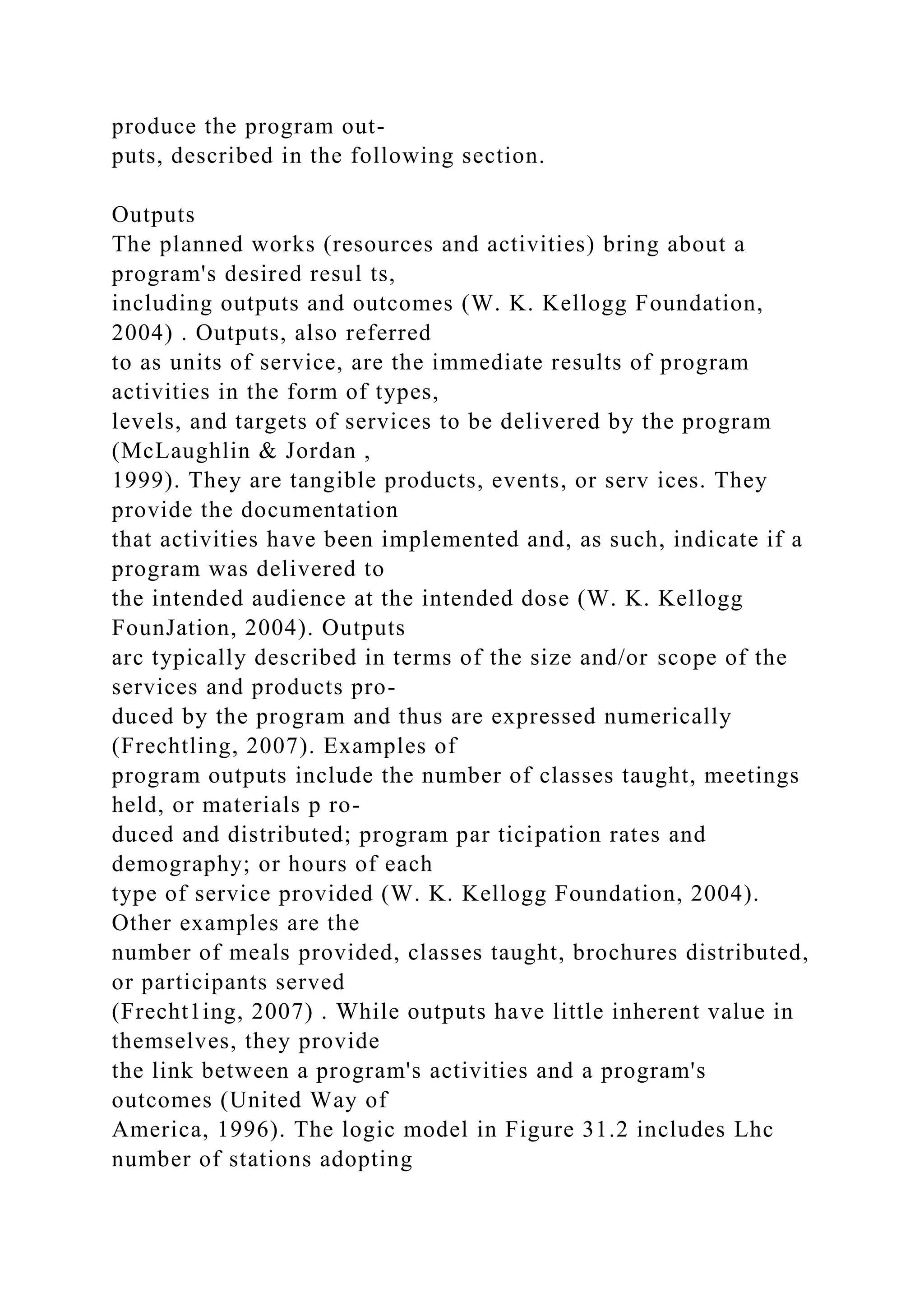
long-term outcomes. Figure 31.3 provides a diagram of the
revised logic model. The
shaded boxes represent the components of the original logic
model. The other compo-
nents were added as a result of the parent exit interview data.
Input j I Activities I Short-Term Outcomes I [ Intermediate
Outcomes J I Long-Term :Outcomes j
Improve child's
behavior
Increase parent's
own literacy skills
Figure 31.3 Example of a Revised Program Logic Model for a
Family Literacy Program
SOURCE: Unrau (2001}. Copyright November 21, 2007 by
Elsevier limited. Reprinted with permission.
NOTE: The shaded boxes represent the logic model's original
components. The other boxes were added as a result of feedback
from clients
after program completion.
560 PART V • CONCEPTUAL RESEARCH
While the parent interview data were useful in revising the
program logic about client
change, it is important to interpret this process within the
appropriate context. This part
of the evaluation does not provide evidence that the program
caused client change (Rossi
et al., 2004). This can only be determined through the use of
experimental methods with
random assignment. Nonetheless, these paren t data contribute
to developing a more fully
developed model for understanding how family literacy
programs work to improve out-
comes for children. Experimental methods can then be used to
test the revised model for
the purpose of establishing the causal pathways to the intended
outcomes.
Conclusion
The purpose of this chapter was to introduce the reader to logic
models and to the logic
modeling process. Logic models present an illustration of the
components of a program
(inputs, activities, outputs, and outcomes) and how these
components connect with one
another to facilitate participant change (program theory). They
are tools to assist key
stakeholders in program planning, program implementation and
monitoring, and espe-
cially program evaluation. They can also be used as
communication tools in explaining
program processes to key stakeholders external to the program.
Creating a logic model is
a time-consuming process with a number of potential
challenges. Nonetheless, a well-
developed and thoughtful logic model is likely to ensure a
program's success in reaching
its intended outcomes.
References
Bahr, S., Hoffman, J., & Yang, X. (2005). Parental and peer
influence on the risks of adolescent drug
use. journal ofPrirnary Prevention, 26, 529- 551.
Bickman, L. (1987). The function of program theory. In L.
Bickman (Ed.), New directions in evalu-
ation: Vol. 33. Using program theory in evaluation (pp. 1- 16).
San Francisco: Jossey-Bass.
Brown, E. C., Hawkins, J. D., Arthur, M. W., Briney, J. S., &
Abbot t, R. D. (2007). Effects of
Communities that Care on prevention services systems:
Findings from the Community Youth
Devcloprnenl sLudy at 1.5 years. Prevention Science, 8, 180-
191.
Chen, H.-I., & Rossi, P. H. (1983). Evaluating with sense: The
theory-driven approach. Evaluation
Review, 7, 283- 302.
Chinrnan, M., Imrn, P., & Wandersman, A. (2004). Geuing to
outcomes 2004. Santa Monica, CA:
RAND Corporation.
Dvvyer, J. J. M., & Makin, S. (1997). Using a program logic
model that focuses on performance mea-
surement to develop a program. Canadian journal of Public
Health, 88, 421-425.
Frechtling, J. A. (2007). Logic modeling methods in program
evaluat.ion. San Francisco: Jossey-Bass.
Harrell, A., Burt, M., Hatry, H ., Rossman, S., & I"l.oth, J.
(1996). Evaluation strategies for human
services programs: A guide for policy make1·s and providers.
Wash ington, DC: The Urban
Institute.
McLaughlin, J. A. , & Jordan, G. B. (1999). Logic models: A
tool fo r tell ing your program's perfor-
mance story. Evaluation and Program Plar~ning, 22, 65- 72.
McLaughlin, J. A., & Jordan, G. B. (2004). Using logic models.
In J. S. Wholey, H. P. Hatry, & K. E.
Newcomer (Eds.), Handbook of program evaluatiOn (pp. 7- 32).
San Francisco: )ossey-Bass.
Mertinko, E., Novotney, L. C., Baker, T. K., & Lange, J.
(2000). Evalual'ing your program: A beginner's
self-evaluation workbook for mentoring programs. Potomac,
MD: Information Technology
International.
CHAPTER 3 I • l OviC Moons 561
Patton, M. (2002). Qualitative research and evaluation methods
(3rd ed.). Thousand Oaks, CA: Sage.
Radloff, L. S. (1977). The CES-D scale: A self-report
depression scale for research in the general
popuJation. Applied Psychological Measurement, 3, 385-401.
Rossi, P. H., Lipsey, M. W., & Freeman, I I. E. (2004).
Evaluation: A systematic approach. Thousand
Oaks, CA: Sage.
United Way of America. (1996). Measuring program outcomes:
A practical approach. Retrieved
November I I, 2007, from
ww·w.unitedway.org/Outcomes/Resources/MPO/iudcx.cfm
Unrau, Y. A. (2001). Using client exit interviews to illuminate
outcomes in program logic models: A
case example. Evaluation and Program Planning, 24, 353-361.
Watson, S. (2000). Using results to improve the lives of
children and families: A guide for public-private
child care partnerships. Retrieved ~ovember 11, 2007, from
www.nccic.acf.hhs.gov/ccpart:nerships/
resource.htm
Wholey,). S. (1987). Evaluability assessment: Developing
program theory. In L. Bickman ( Ed.),
New directions in evaluation: Vol. 33. Using program theory in
evalua.tio11 (pp. 77 92). San
Francisco: Jossey-Bass.
W. K. Kellogg Foundation. (2001). Logic model development
guide. Retrieved November Jl, 2007,
fr om h ttp://www.wkkf.org/default.aspx?tabid= l 01 &Cm
=28l&Catl0=28 l &ltemTD- 2813669&
N ID=20&La nguageiD=O
http:/ /www.wkkf.org
Web site from theW. K. Kellogg Foundation containing useful
templates and exercises in developing
a logic model for a research project.
http:/
/www.unitedway.org/Outcomes/Resources/MPO/index.cfm
Web site from the United Way's Outcome Measurement
Resource Network, demonstra ting the use of
logic models in clarifying and communicating outcomes.
http:/ /www.cdc.gov/eval/resources.htm#logic%20modcl
Web site from the Centers for Disease Control and Prevention's
Evaluatio1 Working Group, containing
logic model resources.
1. Define the term logic model.
2. Describe the difference between program activities, program
outputs, and program outcomes.
3. Discuss the purpose of including lines with arrows in logic
models.
4. Discuss the relationship between a program's theory of
change and its logic model.
5. Describe the uses of logic models.
Assignment 2
Top of Form
Question 1
Best practices are effective When applied in combination with
real world common sense, intelligence, and innovation, while
always keeping in mind the company’s culture, situation, and
requirements
True
False
Question 2
Which of the following must be incorporated in the continuity
program:
Hazard assessment and mitigation
Response
Recovery/continuity
All of above
Question 3
Mitigation is the action to eliminate threats and risks
True
False
Question 4
Redundancy is not a mitigating action
True
False
Question 5
One element of preparedness is writing and testing plans
True
False
Question 6
Ownership and oversight must be assigned to an individual who
reports directly to senior
management
True
False
Question 7
A project manager is not necessary for guiding the project
True
False
Question 8
A team approach is effective in the program
True
False
Question 9
Establishing the programs process, scope, goals and
deliverables are a must in developing the plan
True
False
Question 10
If a consultant is used, it is acceptable for them to have
ownership of the documents
True
False
Question 11
Software is available and should drive the project
True
False
Question 12
During the development of the continuity plan, two focal issues
are (1) the organization
as it exists, (2) the risks that currently pose a potential threat to
the organization’s operation
True
False
Question 13
The sequence of the on-going planning process is: hazard
assessment and mitigation>Business Impact Analysis
(BIA)>Develop Business continuity strategy>Develop
plans>test and implement
True
False
Question 14
The “hazard assessment” involves: identifying threats (what can
go wrong), identify vulnerabilities (likelihood it will go wrong),
the impact (consequences if it goes bad)
True
False
Question 15
A hazard assessment graph is of value in sorting out the greatest
risks
True
False
Question 16
The business impact analysis (BIA) is a process to identify
mission-critical business functions
True
False
Question 17
The BIA identifies both internal and external dependencies of
each function
True
False
Question 18
Strategy development approaches it from “need-to-survive” and
not “business-as-usual”
True
False
Question 19
Strategy development includes:
Alternate people to step in
Alternate facilities
Substitute processes
All of above
Question 20
Plan development is the operations manual and states
What and how it will be done
Where and when it will be done
Who will do it
All of above
Question 21
Different plans exist for multi-location corporations. In
addition, a corporate plan is developed as an umbrella plan
True
False
Question 22
The different plans are: corporate; division; site or
geographical; department; and field
operations
True
False
Question 23
There is a trend to combine business continuity, disaster
recovery, risk management/insurance and safety into one
department
True
False
Question 24
Challenges in manufacturing continuity include: 6 things, one of
which is should extra pay be
given for developing a plan?
True
False
Question 25
Procurement has several areas of concern in continuity, one of
which is generator and other
equipment rentals
True
False
Question 26
Although, not ideal, department centric plans can be an example
for the corporation
True
False
Question 27
Audits of a plan ensure its viability, even without testing
True
False
Bottom of Form
Week7: Developing a Logic Model Outline Handout
Complete the tables below to develop both a practice-level logic
model and a program-level logic model to address the needs of
Helen in the Petrakis case history.
Practice-Level Logic Model Outline
Problem
Needs
Underlying Causes
Intervention Activities
Outcomes
Program-Level Logic Model Outline
Problem
Needs
Underlying Causes
Intervention Activities
Outcomes
© 2014 Laureate Education, Inc.
Page 1 of 1

Figure 31.1 Logic Model Logic Models Karen A. Rand.docx

  • 1.
    Figure 31.1 Logic Model LogicModels Karen A. Randolph A logic model is a diagram of the relationship between a need that a program is designed to addret>s and the actions to be taken to address the need and achieve program outcomes. It provides a concise, one- page pic- ture of program operations from beginning to end. The diagram is made up of a series of boxes that represent each of the program's components, inputs or resources, activities, outputs, and outcomes. The diagram shows how these components are connected or linked to one another for the purpose of achieving program goals. Figure 31.1 provides an example of the framework for a basic logic model. The program connections illustrate the logic of how program operations will result in client change (McLaughlin & Jordan, 1999). The connections show the "causal" relation-
  • 2.
    ships between eachof the program components and thus are referred to as a series of"if- then" sequence of changes leading to the intended outcomes for the target client group (Chinman, hum, & Wandersman, 2004). The if-then statements represent a program's theory of change underlying an intervention. As such, logic models provide a framework that guides the evaluation process by laying out important relationships that need to be tested to demonstrate program results (Watson, 2000). Logic models come from the field of program evaluation. The idea emerged in response to the recognition among program evaluators regarding the need to systematize the program evaluation process (McLaughlin & Jordan, 2004). Since then, logic models have become increasingly popular among program managers for program planning and to monitor program performance. With a growing emphasis on accountability and out- come measurement, logic models make explicit the entire change process, Lhe assump- tions that underlie this process, and the pathways to reach ing outcomes. Researchers have begun to use logic models for intervention research planning (e.g., Brown, Hawkins, Arthur, Briney, & Abbott, 2007). The following sections provide a description of the components of a basic logic model and how these components are linked together, its relationship to a p rogram's theory of [ : Inputs 1--_.,•1 Ac~vities ,II----.~•{ .Outputs ·11---~·1
  • 3.
    Outcomes I AUTHOR'S NOTE:The author wishes to acknowledge Dr. Tony Tripodi for his thoughlful comments on a drafl of this chapter. 547 548 PART V • CONCEPTUAL RESEARCH change, and its uses and benefits. The steps for creating a logic model as well as the chal- lenges of the logic modeling process will be presented. The chapter concludes with an example of how a logic model was u~cd to enhance program outcomes for a family liter- acy program. Components of a Logic Model Typically, a logic model has four components: inputs or resources, activities, outputs, and outcomes. Outcomes can be further classified into short-term outcomes, intermediate outcomes, and long-term outcomes based on the length of time it takes to reach these outcomes (McLa ughlin & Jordan, 2004) . The components make up the connection between the planned work and the intended results (W. K. Kellogg Foundation, 2004). The planned work includes the resources (the inputs) needed to implement the program as well as how the resources will be used (the activities). The intended results include the outputs and outcomes that occur as a consequence of the
  • 4.
    planned work. Figure31.2 expands on the model illuslrated in Figure 3 1.1 by adding examples of each component. This particular logic model, adopted from frechtling (2007), provides an illustration of the components of an intervention designed to prevent substance abuse and other prob- lem behaviors among a population of youth. The intervention is targeted toward improv- ing parenting skills, based on the assumption that positive parenting leads to prosocial behaviors among youth {Bahr, Hoffman, & Yang, 2005). The following section provides definitions and examples of each logic model component, using this illustration. Resources Resources, sometimes referred to as inputs, include the human, financial, organizational, and community assets that are available to a program to achieve its objectives (W. K. Kellogg Foundation, 2004). Resources are used to support and facilitate the program activities. They are usually categorized in terms of funding resou rces or in-kind contribu- tions (Frechtling, 2007) . Some resources, such as laws, regulations, and funding requirements, are external to the agency (United Way of America, 1996). Other resources, such as staff and money, are easier lo quantify than others (e.g., community awareness of the program; Mertinko, Novotney, Baker, & Lange, 2000). As Fn.:c:htli ng (2007) notes, it is important to clearly and thoroughly identify the available resources during the logic
  • 5.
    modeling process becausethis information defines the scope and parameters of the program. Also, this inCormation is critical for others who may be interested in replicating the program. The logic model in Figure 31.2 includes fu nding as one of its resources. Activities Activities represent a program's service methodology, showing how a program intends on using the resources described previously to carry out its work. Activities are also referred to as action step!; (McLaughlin & Jordan, 2004). They are the highly specific tasks that p rogram staffs engage in on a daily basis to provide services to clients (Mertinko et al., 2000) . They include all aspects of program implementation, the processes, tools, events, technology, and program actions. The activities form the foundation toward facil- itating intended client changes or reaching oulcornes (W. K. Kellogg Foundation, 2004). Some examples are establishing community councils, providing professional develop- ment training, or initiating a media campaign (Frechtling, 2007). Other examples are CHAPTER 31 • l OCIC MO DELS 549 Inputs Activities Outputs Outcomes Short Term Intermediate Long Term Feedback Loop j
  • 6.
    _J I Decreased K~ Increased I Develop and Numberof Increased youth Funds .~ initiate ~edia st~tions a~opting r-- awareness f- positive 1-----+ of positive substance -~m~tg~-- -.:::c -campatgn J parenting parenting - abv?~d' ~-'.:- / I Develop and Number of Increased distribute - 1> fact sheets 1- enrollment fact sheets distributed in parenting programs Figure 31.2 Example of l ogic Model With Components, Two Types of Connections, and a Feedbaclc loop providing shelter for homeless families, educating the public about signs of child abuse, or providing adult mentors for youlh {United Way of America, 1996). Two activities, "Develop and initiate media campaign" and "Develop and distribute fact sheets;' are included in the logic model in Figure 31.2. Activities lead to or
  • 7.
    produce the programout- puts, described in the following section. Outputs The planned works (resources and activities) bring about a program's desired resul ts, including outputs and outcomes (W. K. Kellogg Foundation, 2004) . Outputs, also referred to as units of service, are the immediate results of program activities in the form of types, levels, and targets of services to be delivered by the program (McLaughlin & Jordan , 1999). They are tangible products, events, or serv ices. They provide the documentation that activities have been implemented and, as such, indicate if a program was delivered to the intended audience at the intended dose (W. K. Kellogg FounJation, 2004). Outputs arc typically described in terms of the size and/or scope of the services and products pro- duced by the program and thus are expressed numerically (Frechtling, 2007). Examples of program outputs include the number of classes taught, meetings held, or materials p ro- duced and distributed; program par ticipation rates and demography; or hours of each type of service provided (W. K. Kellogg Foundation, 2004). Other examples are the number of meals provided, classes taught, brochures distributed, or participants served (Frecht1ing, 2007) . While outputs have little inherent value in themselves, they provide the link between a program's activities and a program's outcomes (United Way of America, 1996). The logic model in Figure 31.2 includes Lhc number of stations adopting
  • 8.
    the media campaignand the number of fact sheets distributed as two outputs for the pre- vention program. 550 PART V • CONCEPTUAL RESEARCH Outcomes Outcomes arc Lhe specific changes experienced by the program's clients or target group as a consequence of participating in the program. Outcomes occur as a result of the program activities and outputs. These changes may be in behaviors, attitudes, skill level, status, or level of functioning (W. K. Kellogg Foundation, 2004). Examples include increased knowl- edge of nutritional needs, improved reading skills, more effective responses to conflict, and finding employment (United Way of America, 1996). Outcomes are indicalors of a program's level of success. McLaughlin and Jordan (2004) make the point that some programs have multiple, sequential outcome structures in the form of short-term outcomes, intermediate out- comes, and long-term outcomes. In these cases, each type of outcome is linked tempo- rally. Short-term outcomes arc client changes or benefits that are most immediately associated with the program's outputs. They are usually realized by clients within 1 to 3 years of program completion. Short-term outcomes are linked to accomplishing inter- mediate outcomes. Intermediate outcomes are generally
  • 9.
    attainable in 4to 6 years. Long- term outcomes are also referred to as program impacts or program goals. They occur as a result of the intermediate outcomes, usually within 7 to 10 years. In this format, long- term outcomes or goals are directed at macro-level change and target organizations, com- munities, or systems (W. K. Kellogg Foundation, 2004). As an example, a sequen tial outcome structure with short- term, intermediate, and long-term outcomes for the prevention program is displayed in Figure 31.2. As a result of hearing the public service announcements about positive parenting (the activity), parents enroll in parenting programs to learn new parenting skills (the short-term outcome). Then they apply these newly learned skills with their children (the intermediate out- come), which leads to a reduction in substance abuse among youth (the long-term impact or goal the parenting program was designed to achieve). Outcomes are often confused with outputs in logic models because their correct clas- sification depends on the context within which they are being included. A good example of this potential confusion, provided in the United Way of America manual ( 1996, p. 19), is as follows. The number of clients served is an output when it is meant to describe the volume of work accomplished. In this case, it does not relate directly to client changes or benefits. However, the number of clients served is considered to be an outcome when the program's intention is to encourage clients to seek services,
  • 10.
    such as alcoholtreatment. What is important to remember is that outcomes describe intended client changes or benefits as a result of participating in the program while outputs document products or services produced as a result of activities. Links or Connections Between Components A critical part of a logic model is the connections or links between the components. The connections illustrate the relationships between the components and the process by which change is hypothesized to occur among program participants. This is referred to as the program theory (Frechtling, 2007). It is the connections illustrating the program's theory of change that make the logic model complicated. Specifying the connections is one of the more difficult aspects of developing a logic model because the process requires predicting the process by which client change is expected to occur as a result of program participation (Frechtling, 2007). CHIII'TER 31 • lOGIC M ODtLS 551 Frechtling (2007) describes nvo types of connections in a logic model: connections that link items within each component and connections that illustrate the program's theory of change. The first type, items within a component, is connected by a straight line. This line shows that the items make up a
  • 11.
    particularcomponent.As an example,in Figure 31.2, nvo activities, "Develop and initiate media campaign" and "Develop and distribute fact sheets," are linked together with a straight line because they represent the items within the activities component. Similarly, two outputs, "Number of stations adopting the cam- paign" and "Number of fact sheets distributed;' arc connected as two items within the outputs component. The second type of connection sh<.>ws how the components interact with or relate to each other to reach expected outcomes (Frechtling, 2007) . In essence, this is the program's theory of change. Thus, instead of straight lines, arrows are used to show the direction of influence. Frechtling (2007) clarifies that "these directional connections are not just a kind of glue anchoring the otherwise floating boxes. Rather they portray the changes thaL arc expected to occur after a previous acLivity has taken place, and as a result of it" (p. 33). She points out that the primary purpose of the evaluation is to determine the nature of the relationships between components (i.e., whether the predictions are correct). A logic model that illustrates a fully developed theory of change includes links between every item in each component. In other words, every item in every component must be con- nected to at least one item in a subsequent component. This is illustrated in Figure 31.2, which shows that each of the two items within the activities component is linked to an item within the output component.
  • 12.
    Figure 31.2 providesan example of the predicted relationships between the compo- nents. This is the program theory about how the target group is expected to change. The input or resource, funding, is connected to the tv,ro activities, "Develop and initiate media campaign" and "Develop and distribute fac t sheets." Simply put, this part of Figure 31 .2 shows that funding will be used to support the development and initiation of PSA cam- paigns and the distribution of fact sheets. The sequencing of the connections between components also shows that these steps occur over a period of time. While this may seem obvious and relatively inconsequential, specifying an accurate sequence has time-based implications, particularly when short- term, intermediate, and long-term outcomes are proposed as a part of the theory of change (Frechtling, 2007). Rcca11 that the short-term outcomes lead to achieving the intermediate outcomes, and the intermediate outcomes lead to achieving long-term out- comes. Thus, the belief or underl}ing assumption is that short- term outcomes mediate (or come between) relationships benv-een activities and intermediate outcomes, and intermediate outcomes mediate relations between short-term and long-term outcomes. Related, sometimes logic models display feedback loops. Feedback loops show how the information gained from implementing one item can be used to refine and improve other
  • 13.
    items (Frechlling, 2007).f or instance, in Figure 31.2, the feedback loop from the short- term outcome, "Increased awareness of positive parenting;' back to the activity, "Develop and initiate media campaign;' indicates that the findings for "Increased awareness of pos- itive parenting" arc used to improve the PSA campaigns in the next program cycle. Contextual Factors Logic models describe programs that exist and are affected by contextual factors in the larger environment. Contextual factors are those important features of the environment 552 PART V • CONCEPTUAL R ESEARCH in which the project or intervention takes place. They include the social, cultural, and political aspects of the environment (Frechtling, 2007). They are typically not under the program's control yet are likely to influence the program either positively or negatively (McLaughlin & Jordan, 2004 ). Thus, it is critical to identify relevant contextual factors and to consider their potential impact on the program. McLaughlin and Jordan (1999) point out that understanding and articulating contextual factors co ntribu tes to an under- standing of the fo undation upon which performance expectatio ns are established. Moreover, this knowledge helps to establish the parameters for explaining program
  • 14.
    results and developingprogram improvement strategies that are li kely to be more mean- ingful and thus more successful because the information is more complete. finally, con- textual factors clarify situations under which the program results might be expected to generalize and the issues that might affect replication (Frechtling, 2007) . Harrell, Burt, Hatry, Rossm an, and Roth (1996) identify two types of contextual fac- tors, antecedent and media6ng, as outside facto rs that could influence the program's design, implementation, and results. Antecedent factors are those that exist prior to program implementation, such as characteristics of the client target population or com- munity characteristics such as geographical and economic conditions. Mediating factors are the environmental influences that emerge as the program unfolds, such as new laws and policies, a change in economic conditions, or the startup of other new programs pro- viding similar services (McLaughlin & jordan, 2004). Logic Models and a Program's Theory of Change Definition Logic models p rovide an illustration of the components of a program's theot-y and how those components are linked together. Program theory is defined as "a plausible and sen- sible model of how a program is supposed to work" (Bickman, 1987, p. 5). Program theory incorporates "program resources, program activities, and intended program out-
  • 15.
    comes, and specifiesa chain of causal assumptions linking resources, activities, interme- diate outcomes, and ultimate goals" (Wholey, 1987, p. 78). Program theory e.>..-plicates the assumptions about how the program components link together from program star t to goal attainment to realize the program's intended outcomes (Frechtling, 2007). Thus, it is often referred to as a program's theory of change. Frechtling (2007) suggests that both previous research and knowledge gained from practice experience arc useful in develop- ing a theory of change. Relationship to logic Models A logic model provides an illustration of a program's theory of change. It is a useful tool for describing program theory because it shows the connections or if-then relationships between program components. In other words, moving from left to right from one com- ponent to the next, logic models provide a diagram of the rationale or reasoning underly- ing the theory of change. If-then statements connect the program's components to form the theory of change (W. K. Kellogg Foundation, 2004). For example, certain resources or inputs are needed to carry out a program's activities. The first if-then statement links resources to activities and is stated, "If you have access to these resources, then you can use them to accomplish your planned activities" (W. K. Kellogg Foundation, 2004, p. 3). Each
  • 16.
    CHAPTER 31 •LOCIC MODELS SS3 component in a logic model is linked to the other components using if-then statemen ts to show a program's chain of reasoning about how client change is predicted to occur. The idea is that "if the right resources are transformed into the right activities for the right people, then these will lead to the results the program was designed to achieve" (McLaughlin & Jordan, 2004, p. 11). It is important to define the components of an inter- vention and make the connections between them explicit (Frechtling, 2007). Program Theory and Evaluation Planning Chen and Rossi (1983) were among the first to suggest a program theory-driven approach to evaluation. A program's theory of change has significant utility in develop- ing and implementing a program evaluation because the theory provides a framework for determining the evaluation questions (Rossi, Lipsey, & Freeman, 2004) . As such, a logic model that illustrates a program's theory of change provides a map to inform the development of relevant evaluation questions at each phase of the evaluation. Rossi et al. (2004) explain how a program theory-based logic model enhances the develop- ment of evaluation questions. First, the process of articulating the logic of the program's change process through the development of the logic model prompts discus- sion of relevant and meaningful evaluation questions. Second, these questions then lead
  • 17.
    to articulating expectationsfor program performance and inform the identification of criteria to measure that performance. Third, obtaining input from key stakeholders about the theory of change as it is displayed in the logic model increases the likelihood of a more comprehensive set of questions and that critical issues have not been over- looked. To clarify, most agree that this is a team effort that should include the program development and program evaluation staff at a minimum, as well as other stakeholders both internal and external to the program as they are available (Dwyer & Makin, 1997; Frech tling, 2007; Mclaughlin & Jordan, 2004). The diversity of perspective and skill sets among the team members (e.g., program developers vs. program evaluators) enhances the depth of understanding of how the program will work, as diagramed by the logic model (Frechtling, 2007). As D"vyer and Makin (1997) state, the team approach to developing a theory-based logic model promotes "greater stakeholder involvement, the opportunity for open negotiation of program objectives, greater commitment to the final conceptualization of the program, a shared vision, and increased likelihood to accept and utilize the evaluation results" (p. 423) . Uses of Logic Models Logic models have many uses. They help Lo integrate the entire program's planning and implementation process from beginning to end, including the evaluation process (Dwyer
  • 18.
    & Makin, 1997).They can be used at all of a program's stages to enhance its success (Frechlling, 2007; W. K. Kellogg Foundation, 2004). For instance, at the program design and planning stage, going through the process of developing logic models helps to clarify the purpose of the program, the development of program strategies, resources that are necessary to attaining outcomes, and the identification of possible barriers to the program's success. Also, identifying program components such as activities and outcomes prior to program implementation provides an opportunity to ensure that program outcomes inform program activities, rather than the other way around (Dwyer & Makin, 1997). 554 PART V • CoNcEPTUAl RESEA RCH During the p rogmm implementation phase, a logic model provides the basis fo r the development of a management plan to guide program monitoring activities and to improve program processes as issues arise. In other words, it helps in identifying and highlighting the key program processes to be tracked to ensure a program's effectiveness (United Way of America, 1996). Most important, a logic model facilitates evaluation planning by providing the evalua- tion framework for shaping the evaluation across all stages of a project. Intended out-
  • 19.
    comes and theprocess for measuring these outcomes are displayed in a logic model (Watson, 2000), as well as key points at which evaluation activities should take place across the life of the program (McLaughlin & Jordan) 2004). Logic models support both formative and summative evaluations (Frechtling, 2007). They can be used in conducting summativc evaluations to determine what has been accomplished and, importantly, the process by which these accomplishments have been achieved (Frechtling, 2007) . Logic models can also support formative evaluations by organizing evaluation activities, includ- ing the measurement of key variables or performance indicators (McLaughlin & Jordan, 2004) . From this information, evaluation questions, relevant indicators, and data collec- tion strategies can be developed. The following section expands on using the logic model to develop evaluation questions. The logic model provides a framework for developing evaluation questions about program co ntext, program efforts, and p rogram effectiveness (Frecht ling, 2007; Mertinko et al., 2000). Together, these three sets of questions help to explicate the program's theory of change by describing the assumptions about the relationships between a program's operations and its predicted outcomes (Rossi et al. , 2004) . Context questions explore program capacity and relationships external to the program and help to identify and understand the impact of confo unding factors or external
  • 20.
    influences. Program effortand effectiveness quest ions correspond to particular com- ponents in the logic model and thus explore program processes toward ach ieving program outcomes. Questions a bout effor t address the planned work of the program and come from the input and activities sections of the evaluation model. They address program implementation issues such as the services that were provided and to whom. These questions focus on what happened and why. Effectiveness or outcome questions address program results as described in the output and outcomes section of the logic model. From the questions, indicators and data collection strategies can then be devel- oped. Guidelines for using logic models to develop evaluation questions, indicators, and data collection strategies are provided in the Logic Model Development Guide (W. K. Kellogg Foundation, 2004). In addition to supporting program efforts, a logic model is a useful communication tool (McLaughlin & Jordan, 2004). For instance, developing a logic model provides the opportunity for key stakeholders to discuss and reach a common understanding, includ- ing underlying assumptions, about how the program operates and the resources needed to achieve program processes and outcomes. ln fact, some suggest that the logic model development process is actually a form of strategic planning because it requires partici- pants to articulate a program's vision, the rationale for the program, and the program
  • 21.
    processes and procedures('Watson, 2000) . This also promotes stakeholder involvement in program planning and consensus building on the program's design and operations. Moreover, a logic model can be used to explain program procedures and share a compre- hensive yet concise picture of th e program to community partners, funders, and others outside of the agency (McLaughlin & Jordan, 2004). CHAPTER 31 • LOGIC M ODF I S 555 Steps for Creating Logic Models McLaughlin and Jordan (2004) describe a five-stage process for developing logic models. The first stage is to gather extensive baseline information from multiple sources about the nature of the problem or need and about alternative solutions. The W. K. Kellogg Foundation (2004) also suggests collecting information about community needs and assets. This information can then be used to both define the problem (the second stage of developing a logic model) and identify the program clements in the form of logic model components (the third stage of logic model development). Possible information sources include existing program documentation, interviews with key stakeholders internal and external to the program, strategic plans, annual performance plans, previous program evaluations, and relevant legislation and regulations. It is also important to review the lit-
  • 22.
    erature about factorsrelated to the problem and to determine the strategies others have used in attempting to address it. This type of information provides supportive evidence that informs the approach to addressing the problem. The information collected in the first stage is then used to define the problem, the contextual factors that relate to the problem, and Lhus the need for the program. The program should be conceptualized based on what is uncovered abo ut the nature and extent of the problem, as well as the factors that are correlated with or cause the prob- lem. It is also important at this stage to develop a clear idea of the impact of the prob- lem across micro, mezzo, and macro domains. The focus of the program is then to address the "causal" factors to solve the problem. In addition, McLaughlin and Jordan (2004, p. 17) recommend identifying the environmental factors that are likely to affect the program, as well as ho·w these conditions might affect program outcomes. Understanding the relationship between the program and relevant environmental fac- tors contributes to framing its parameters. During the third stage, the elemen ts or components of the logic model are identified, based on the findings that emerged in the second stage. McLaughlin and Jordan (2004) recommend starting out by categorizing each piece of information as a resource or input, activity, output, short-term outcome, intermediate outcome, long-term outcome, or con-
  • 23.
    textual factor. Whilesome suggest that the order in which the components arc identified is inconsequen tial to developing an effective logic model, most recommend beginning this process by identifying long-term outcomes and working backward (United Way of America, 1996; W. K. Kellogg Foundation, 2004) . The logic model is drawn in the fourth stage. Figure 31.2 provi.des an example of a typ- ical logic model. This diagram includes columns of boxes representing the items for each component (i.e., inputs, activities, outputs, and short-term, intermediate, and long-term outcomes). Text is provided in each box to describe the item. The connections between the items within a component are shown with straight lines. The links or connections between components are shown with one-way directional arrows. Program components may or may not have one-on-one relationships with one another. In fact, it is likely that components in one group (e.g., inputs) will have multiple connections to components in another group (e.g., activities). For example, in Figure 31.2, we show that the funding resource leads to two activities, "Develop and initiate media campaign" and "Develop and distribute fact sheets." Finally, because activities can be described at many levels of detail, McLaughlin and Jordan (2004) suggest simplifying the model by grouping activities that lead to the same outcome. They also recommend including no more than five to seven activity groupings in one logic model.
  • 24.
    556 PART V• CONCEPTUAl RESEARCii Stage 5 focuses on verifying the logic model by getting input from all key stakeholders. McLaughlin and Jordan (2004) recommend applying the if-then statements presented by United Way of America (1996) in developing hypotheses to check the logic model in the following manner: given observations of key contextual factors, if resources, then program activities; if program activities, then outputs for targeted customer groups; if outputs change behavior, first short term, then intermediate outcomes occur. If intermediate out- comes occur, then longer-term outcomes lead to the problem being solved. (p. 24) They also recommend answering the following questions as a part of the verification process (pp. 24-25): 1. Is the level of detail sufficient to create understanding of the elements and their interrela ti onsh ips? 2. Is the program logic complete? That is, arc all the key elements accounted for? 3. Is the program logic theoretically sound? Do all the elements fit together logically? Are there other plausible pathways to achieving the program outcomes?
  • 25.
    4. Have allthe relevant external contextual factors been identified and their potential influences described? Challenges in Developing Logic Models Frechtling (2007) describes three sets of challenges in developing and using logic models, including (a) accurately portraying the basic features of the logic model, (b) determining the appropriate level of detail in the model, and (c) having realistic expectations about what logic models can and cannot contribute to program processes. These challenges are reviewed in more detail in the following section. Portraying the Logic Model's Basic Features Accurately The basic features of a logic model must be clearly understood in order for the logic model to be useful. In particular, logic model developers often encounter difficulty in four areas: confusing terms, substituting specific measures for more general outcomes, assum- ing unidirectionality, and failing to specify a timefrarne for program processes (Frechtling, 2007; McLaughlin & Jordan, 2004). One issue in developing the logic model is accurately differentiating between an activity or output and an outcome. Frequently, activities and outputs are confused witl1 outcomes (Frechtling, 2007). They can be distinguished by remembering that activities are steps or actions taken in pursuit of producing the output and thus achieving the outcome. Outputs
  • 26.
    are products thatcome as a result of completing activities. They are typically expressed numerically (e.g., the number of training sessions held). Outputs provide the documenta- tion that activities have occurred. They also link activities to outcomes. Outcomes are statements about participant change as a result of experiencing the intervention. Outcomes describe how participants will be different after they finish the program. Another issue in portraying the basic features of logic models accurately is not confus- ing outcomes with the instruments used to measure whether the outcomes were achieved. C HAP t ER 31 • l OGIC M ODHS 557 For example, the outcome may be decreased depression, as measured by an instrument assessing a participant's level of depression (Center for Epidemiological Studies- Depression Scale; Radloff, 1977). Some may confuse the outcome (i.e., decreased depres- sion) with the instrument (i.e., Center for Epidemiological Studies- Depression Scale) that was used to determine whether the outcome was met. To minimize the potential for this confusion, Frechtling (2007) recommends developing the outcome lirsl and then identify- ing the appropriate instrument for determ ining that the outcome has been reached. A thiru issue in logic model development is avoiding the
  • 27.
    assumption that thelogic model and, by implication, the theory of change that the logic model portrays move in a unidirectional progression from left to right {Frechtling, 2007; McLaughlin & Jordan, 2004). While the visual display may compel users to think about logjc models in this way, logic models and the programs they represent are much more dynamic, with feedback loops and interactions among components. The feedback loop is illustrated in Figure 31.2, showing that the experiences and information generated from reaching short-term out- comes are used to refine and, it is hoped, improve the activities in the next program cycle that are expected to lead to these outcomes. Also, assuming uniform directionality can enforce the belief that the inputs dTive the project, rather than attaining the outcomes. This underscores the importance of starting with the development of outcomes when putting together a logic modeL The final issue is including a timeframe for carrying out the processes depicted in the logic model. The lack of a tirneframe results in an incomplete theory of change as well as problematic expectations about when outcomes will be reached (Frechtling, 2007). Whether outcomes are expected too soon or not soon enough, key stakeholders may assume that the theory of change was not accurate. Developing accurate predictions of when outcomes will be reached is often d ifficu lt, especially with new projects in which very li ttle is known abou t program processes and so forth. In
  • 28.
    this case, asmore clarity emerges about the amount of time it will take to complete activities, tirneframes should be revisited and modified to reflect the new information. Determining the Appropriate Level of Detail A second set of challenges is to determine how much detail to include in the logic model. The underlying dilemma is the level of complexity. Models that are too complex, with too much detail, are lime-consuming to develop and difficult to interpret. Thus, they are likely to be cumbersome to use. Models that lack enough information may depict an incomplete theory of change by leaving out important information. For instance, if activ- ities are combined into particular groups, it is possible that important links between spe- cific activities, outputs, and outcomes wiJJ not be represented. This increases Lhe possibility of making faulty assumptions about program opera lions and how these oper- ations lead to positive participant outcomes. Realistic Expectations The fmal set of challenges in using logic models is not expecting more from logic models than what they are intended to provide. Frechtling (2007, p. 92) notes that some may inaccurately view the logic model as a "cure-ali" and that, just by its mere existence, the logic model will ensure the success of the program and the evaluation. Of course, the effi- cacy of a logic model depends on the quality of its design and components. A logic model cannot overcome these types of problems. Frcchtling identifies
  • 29.
    four common issues here.First, sometimes new programs are such that applying the theory of change and a 558 P11RT V • CoNctPI'UAl RESEARCH representative logic model is premature. This is the case for programs in which a priori expectations about relationships between activities and outcomes do not exist. A second risk in this area is fai ling to consider alternative theories of change. Alternative explanations and competing hypotheses should be explored. Focusing on only one theory of change may result in not recognizing and including important factors that fall outside of the theorys domain. Ignoring these competing fac tors may result in the failure of the logic model and the program. Third and related, it is critical to acknowledge the influence of contextual factors that arc likely to affect the program. Interventions always exist and function wiLhin a larger environment. Contextual factors influence the success or failure of these interventions. For instance, one contextual factor that might affect outcomes of the program diagrammed in Figure 31.2 is the diversity of the target group. As Frechtling (2007) observes, this diver- sity may include language differences among subgroups, which need to be accounted for in developing program materials.
  • 30.
    finally, logic modelscannot fully compensate for the rigor of experimental design when testing the impact of interventions on outcomes (Frechtling, 2007) . The logic model explicates the critical components of a program and the processes that lead to desired outcomes (the program theory of change). The implementation of the model provides a test of the accuracy of the theory. However, validation of the logic model is not as rigorous a proof as what is established through study designs employing experimental or quasi-experimental methodologies. Causality cannot be determined through logic models. Alhen possible, an evaluation can be strengthened by combining the advantages of logic modeling with experimental design. Logic Modeling in Practice: Building Blocks Family Literacy Program The following provides an example of logic modeling in practice. The example describes the use of a program logic model in developing, implementing, and evaluating the Building Blocks family literacy program and how client exit data were then used to revise the model in a way that more explicitly illustrated the program's path•.vays to achieving intended outcomes (i.e., feedback loop; Unrau, 2001, p. 355). The original program outcomes were to increase (a) children's literacy skills and (b) parents' abilities to assist their children in developing lit- eracy skills. The sample included 89 families who participated in the 4-week program during
  • 31.
    its initial yearof operation. The following describes the process by which the logic model was developed and how the client outcome data were used to fme- tune the logic model. The family literacy program's logic model was created at a one- day workshop facili- tated by the evaluator. Twenty key stakeholders representing various constituencies, including program staff (i.e., steering committee members, administration, and literacy workers), representatives from other programs (i.e., public school teachers, child welfare, and workers and clients from other literacy programs), and other interested citizens, par- ticipated in the workshop (Unrau, 2001, p. 354). A consensus decision-making process was used to reach an agreement on all aspects of the process, including the program pur- pose, the program objectives, and the program activities. During the workshop, stakeholders created five products that defined the program parameters and informed the focus of the evaluation. These products included an organi- zational chart, the beliefs and assumptions of stakeholders about client service delivery, the questions for the evaluation, the program's goals and objectives, and the program CHAPTER 31 • l OGIC MoDElS 559 activities. The program goals, objectives, and activities were then used to develop the orig-
  • 32.
    inallogic model. One ofthe evaluation methods used to assess client outcomes was to conduct semi- structured phone interviews with the parents after families completed the program. Random selection procedures were used to identify a subset (n = 35 or 40o/o) from the list of all parents to participate in the interviews. Random selection procedures were used to ensure that the ex-periences of the interviewees represented those of all clients served during the evaluation time period. Relative to the two program outcomes, respondents were asked to provide examples of any observed changes in both their children's literacy skills (Outcome 1) and their ability to assist their children in developing literacy skills (Outcome 2; Unrau, 2001, p. 357). The constant comparison method was used to analyze the data (Patton, 2002). In this method, meaningful units of texi: are assigned to similar categories to identify common themes. What emerged from the parent interviews was more detailed information about how the two intended outcomes were achieved. Parent experiences in the program suggested four additional processes that link to reaching the two final outcomes. This information was added to the original logic model to more fully develop the pathways to improving children's literacy skills through the family literacy program. These additional outcomes were actually steps toward meeting the two originally intended outcomes and thus iden-
  • 33.
    tified as intermediateoutcomes and ne-cessary steps toward achieving the originally stated long-term outcomes. Figure 31.3 provides a diagram of the revised logic model. The shaded boxes represent the components of the original logic model. The other compo- nents were added as a result of the parent exit interview data. Input j I Activities I Short-Term Outcomes I [ Intermediate Outcomes J I Long-Term :Outcomes j Improve child's behavior Increase parent's own literacy skills Figure 31.3 Example of a Revised Program Logic Model for a Family Literacy Program SOURCE: Unrau (2001}. Copyright November 21, 2007 by Elsevier limited. Reprinted with permission. NOTE: The shaded boxes represent the logic model's original components. The other boxes were added as a result of feedback from clients after program completion. 560 PART V • CONCEPTUAL RESEARCH While the parent interview data were useful in revising the program logic about client change, it is important to interpret this process within the appropriate context. This part
  • 34.
    of the evaluationdoes not provide evidence that the program caused client change (Rossi et al., 2004). This can only be determined through the use of experimental methods with random assignment. Nonetheless, these paren t data contribute to developing a more fully developed model for understanding how family literacy programs work to improve out- comes for children. Experimental methods can then be used to test the revised model for the purpose of establishing the causal pathways to the intended outcomes. Conclusion The purpose of this chapter was to introduce the reader to logic models and to the logic modeling process. Logic models present an illustration of the components of a program (inputs, activities, outputs, and outcomes) and how these components connect with one another to facilitate participant change (program theory). They are tools to assist key stakeholders in program planning, program implementation and monitoring, and espe- cially program evaluation. They can also be used as communication tools in explaining program processes to key stakeholders external to the program. Creating a logic model is a time-consuming process with a number of potential challenges. Nonetheless, a well- developed and thoughtful logic model is likely to ensure a program's success in reaching its intended outcomes. References
  • 35.
    Bahr, S., Hoffman,J., & Yang, X. (2005). Parental and peer influence on the risks of adolescent drug use. journal ofPrirnary Prevention, 26, 529- 551. Bickman, L. (1987). The function of program theory. In L. Bickman (Ed.), New directions in evalu- ation: Vol. 33. Using program theory in evaluation (pp. 1- 16). San Francisco: Jossey-Bass. Brown, E. C., Hawkins, J. D., Arthur, M. W., Briney, J. S., & Abbot t, R. D. (2007). Effects of Communities that Care on prevention services systems: Findings from the Community Youth Devcloprnenl sLudy at 1.5 years. Prevention Science, 8, 180- 191. Chen, H.-I., & Rossi, P. H. (1983). Evaluating with sense: The theory-driven approach. Evaluation Review, 7, 283- 302. Chinrnan, M., Imrn, P., & Wandersman, A. (2004). Geuing to outcomes 2004. Santa Monica, CA: RAND Corporation. Dvvyer, J. J. M., & Makin, S. (1997). Using a program logic model that focuses on performance mea- surement to develop a program. Canadian journal of Public Health, 88, 421-425. Frechtling, J. A. (2007). Logic modeling methods in program evaluat.ion. San Francisco: Jossey-Bass. Harrell, A., Burt, M., Hatry, H ., Rossman, S., & I"l.oth, J. (1996). Evaluation strategies for human services programs: A guide for policy make1·s and providers.
  • 36.
    Wash ington, DC:The Urban Institute. McLaughlin, J. A. , & Jordan, G. B. (1999). Logic models: A tool fo r tell ing your program's perfor- mance story. Evaluation and Program Plar~ning, 22, 65- 72. McLaughlin, J. A., & Jordan, G. B. (2004). Using logic models. In J. S. Wholey, H. P. Hatry, & K. E. Newcomer (Eds.), Handbook of program evaluatiOn (pp. 7- 32). San Francisco: )ossey-Bass. Mertinko, E., Novotney, L. C., Baker, T. K., & Lange, J. (2000). Evalual'ing your program: A beginner's self-evaluation workbook for mentoring programs. Potomac, MD: Information Technology International. CHAPTER 3 I • l OviC Moons 561 Patton, M. (2002). Qualitative research and evaluation methods (3rd ed.). Thousand Oaks, CA: Sage. Radloff, L. S. (1977). The CES-D scale: A self-report depression scale for research in the general popuJation. Applied Psychological Measurement, 3, 385-401. Rossi, P. H., Lipsey, M. W., & Freeman, I I. E. (2004). Evaluation: A systematic approach. Thousand Oaks, CA: Sage. United Way of America. (1996). Measuring program outcomes: A practical approach. Retrieved November I I, 2007, from
  • 37.
    ww·w.unitedway.org/Outcomes/Resources/MPO/iudcx.cfm Unrau, Y. A.(2001). Using client exit interviews to illuminate outcomes in program logic models: A case example. Evaluation and Program Planning, 24, 353-361. Watson, S. (2000). Using results to improve the lives of children and families: A guide for public-private child care partnerships. Retrieved ~ovember 11, 2007, from www.nccic.acf.hhs.gov/ccpart:nerships/ resource.htm Wholey,). S. (1987). Evaluability assessment: Developing program theory. In L. Bickman ( Ed.), New directions in evaluation: Vol. 33. Using program theory in evalua.tio11 (pp. 77 92). San Francisco: Jossey-Bass. W. K. Kellogg Foundation. (2001). Logic model development guide. Retrieved November Jl, 2007, fr om h ttp://www.wkkf.org/default.aspx?tabid= l 01 &Cm =28l&Catl0=28 l &ltemTD- 2813669& N ID=20&La nguageiD=O http:/ /www.wkkf.org Web site from theW. K. Kellogg Foundation containing useful templates and exercises in developing a logic model for a research project. http:/ /www.unitedway.org/Outcomes/Resources/MPO/index.cfm Web site from the United Way's Outcome Measurement Resource Network, demonstra ting the use of logic models in clarifying and communicating outcomes. http:/ /www.cdc.gov/eval/resources.htm#logic%20modcl
  • 38.
    Web site fromthe Centers for Disease Control and Prevention's Evaluatio1 Working Group, containing logic model resources. 1. Define the term logic model. 2. Describe the difference between program activities, program outputs, and program outcomes. 3. Discuss the purpose of including lines with arrows in logic models. 4. Discuss the relationship between a program's theory of change and its logic model. 5. Describe the uses of logic models. Assignment 2 Top of Form Question 1 Best practices are effective When applied in combination with real world common sense, intelligence, and innovation, while always keeping in mind the company’s culture, situation, and requirements True False Question 2 Which of the following must be incorporated in the continuity program:
  • 39.
    Hazard assessment andmitigation Response Recovery/continuity All of above Question 3 Mitigation is the action to eliminate threats and risks True False Question 4 Redundancy is not a mitigating action True False Question 5 One element of preparedness is writing and testing plans True False Question 6 Ownership and oversight must be assigned to an individual who reports directly to senior management True
  • 40.
    False Question 7 A projectmanager is not necessary for guiding the project True False Question 8 A team approach is effective in the program True False Question 9 Establishing the programs process, scope, goals and deliverables are a must in developing the plan True False Question 10 If a consultant is used, it is acceptable for them to have ownership of the documents True False Question 11 Software is available and should drive the project True
  • 41.
    False Question 12 During thedevelopment of the continuity plan, two focal issues are (1) the organization as it exists, (2) the risks that currently pose a potential threat to the organization’s operation True False Question 13 The sequence of the on-going planning process is: hazard assessment and mitigation>Business Impact Analysis (BIA)>Develop Business continuity strategy>Develop plans>test and implement True False Question 14 The “hazard assessment” involves: identifying threats (what can go wrong), identify vulnerabilities (likelihood it will go wrong), the impact (consequences if it goes bad) True False Question 15 A hazard assessment graph is of value in sorting out the greatest risks True
  • 42.
    False Question 16 The businessimpact analysis (BIA) is a process to identify mission-critical business functions True False Question 17 The BIA identifies both internal and external dependencies of each function True False Question 18 Strategy development approaches it from “need-to-survive” and not “business-as-usual” True False Question 19 Strategy development includes: Alternate people to step in Alternate facilities Substitute processes
  • 43.
    All of above Question20 Plan development is the operations manual and states What and how it will be done Where and when it will be done Who will do it All of above Question 21 Different plans exist for multi-location corporations. In addition, a corporate plan is developed as an umbrella plan True False Question 22 The different plans are: corporate; division; site or geographical; department; and field operations True False Question 23
  • 44.
    There is atrend to combine business continuity, disaster recovery, risk management/insurance and safety into one department True False Question 24 Challenges in manufacturing continuity include: 6 things, one of which is should extra pay be given for developing a plan? True False Question 25 Procurement has several areas of concern in continuity, one of which is generator and other equipment rentals True False Question 26 Although, not ideal, department centric plans can be an example for the corporation True False Question 27
  • 45.
    Audits of aplan ensure its viability, even without testing True False Bottom of Form Week7: Developing a Logic Model Outline Handout Complete the tables below to develop both a practice-level logic model and a program-level logic model to address the needs of Helen in the Petrakis case history. Practice-Level Logic Model Outline Problem Needs Underlying Causes Intervention Activities Outcomes Program-Level Logic Model Outline Problem Needs Underlying Causes Intervention Activities Outcomes © 2014 Laureate Education, Inc.
  • 46.