Lockout / Tagout
        TRAINING


SM
What is 1910.147?

• OSHA standard for Lockout /Tagout
• Goal: Control the release of hazardous energy
  during maintenance and servicing
• Many types of energy:
   – Mechanical
   – Hydraulic
   – Electrical
   – Gas
   – Pneumatic
   – Water
   – Chemical
   – Thermal
       SM
Agenda


• Why We Do It?
• What is required for
  compliance?
• How to get started with
  Lockout/Tagout?
• References


      SM
Risk Mitigation

Employee Safety                     Legal
                        Risk
                     Mitigation

                     Financial


          SM
Employee Safety

• Approximately 3 million workers in the
  US service equipment and face the
  greatest risk of injury if Lockout/Tagout is
  not properly implemented
• Lockout/Tagout prevents an estimated
  120 fatalities and 50,000 injuries each
  year in the US.


       SM


 Source: http://www.osha.gov/SLTC/controlhazardousenergy/index.html
Legal Risk


• Created under the Occupational Safety
  and Health Act of 1970
• Only government regulatory agency for
  workplace safety
• Instructs, conducts inspections and
  enforces workplace safety
• Does not apply to government facilities
     SM
Legal Risk

OSHA General Duty Clause States:

“each employer shall furnish to each of his employees
 employment and a place of employment which are free
 from recognized hazards that are causing or are likely to
 cause death or serious physical harm to his employees.”


                   Source: OSHA 29 USC 654
      SM
Legal Risk

OSHA Standard 29 CFR 1910.147:

                    • 29 CFR 1910.147 was adopted in 1989
                      and established minimum
                      performance requirements for the
                      control of hazardous energy
                    • The lockout/tagout standard applies
                      to general industry employment
                    • It covers the servicing and
                      maintenance of machines and
                      equipment in which the unexpected
                      start-up or the release of stored
                      energy could cause injury
                    • It covers about 39 million workers
        SM
Legal Risk

NFPA 70E – Chapter 1 Article 110 States:
    “covers electrical safety-related work practices and
     procedures for employees who work on or near exposed
     energized electrical conductors or circuit parts in
     workplaces that are included in the scope of this standard”
    “Intended to provide for employee safety relative to
     electrical hazards in the workplace”


          Source: NFPA Regulations – Chapter 1, Article 110, 2004
          SM
Legal Risk


• Required by law for employers to follow
• Requirements in General Terms
• Lots of details but also rely on consensus
  industry standards for guidelines
        NFPA 70E – 2004 (Originated 1976):

• Details – safe installation, maintenance and
  work practices, signs, PPE (Personal
  Protective Equipment)
   SM
Financial Risk
 Downtime
   • Personnel
   • Equipment
 Legal Action
   • Liability and Injury
   • Cost of outside counsel
 Fines and Penalties:
   • LOTO is #3 most cited by OSHA
   • Fiscal Year 2006
        38,579 federal OSHA site inspections
        58,058 state OSHA site inspections
                                                        Source: Occupational Hazards, February 2008
        3,659 violations for LOTO totaling about $6M

             SM
Financial Risk


SM
Risk Mitigation
Conclusion:
“The costs in terms of human suffering,
  lost productivity, worker’s
  compensation claims and lawsuits can
  far outweigh the investment in a
  comprehensive program.”
        Source: Occupational Health&Safety Volume 76, Number 10


            SM
What is required?

Elements of an effective Lockout/Tagout
  program:

    Procedures
    Training
    Device requirements
    Inspections

        SM
Procedures


 OSHA 1910.147(c)(4)(i)
 “Procedures shall be developed, documented and utilized
  for the control of potentially hazardous energy when
  employees are engaged in the activities covered by this
  section”
 NFPA 70E 120.2 (F) / Ch. 5-4
 “The employer shall maintain a copy of the procedures
  required by this section and shall make procedures
  available to all employees”

        SM
Procedures
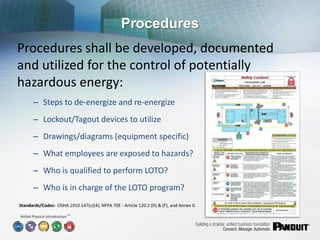
Procedures shall be developed, documented
and utilized for the control of potentially
hazardous energy:
      – Steps to de-energize and re-energize
      – Lockout/Tagout devices to utilize
      – Drawings/diagrams (equipment specific)
      – What employees are exposed to hazards?
      – Who is qualified to perform LOTO?
      – Who is in charge of the LOTO program?
Standards/Codes: OSHA 1910.147(c)(4); NFPA 70E - Article 120.2 (D) & (F), and Annex G
                       SM
Procedures


Steps for equipment shutdown
    1. Prepare for and announce shutdown
    2. Shutdown equipment
    3. Disconnect energy sources / test for isolation
    4. Lockout and/or Tagout
    5. Release stored energy
    6. Verify isolation

       SM
Procedures

Steps for equipment startup
  1. Verify equipment operationally intact - Clear all
      personnel and tools
  2. Ensure employees are safely positioned
  3. Remove lockout/tagout devices from each
      energy-isolating device
  4. Notify all affected employees of Lockout/Tagout
      removal and that work has been completed
  5. Start equipment
        SM
Training


OSHA 1910.147(c)(7)(i)
 “The employer shall provide training to ensure that the purpose and
  function of the energy control program are understood by
  employees and that the knowledge and skills required for the safe
  application, usage, and removal of the energy controls are
  acquired by employees”


NFPA 70E 120.2 (B) (2)
 “Each employer shall provide training as required to ensure
  employees’ understanding of the lockout/tagout procedure
  content and their duty in executing such procedures”
           SM
Training

Authorized employees – person who locks out or
tags out machines or equipment in order to perform
servicing or maintenance on that machine or
equipment

Affected employees – employee whose job requires
him/her to operate or use a machine or equipment
on which servicing or maintenance is being
performed under Lockout or Tagout, or whose job
requires him/her to work in an area in which such
servicing or maintenance is being performed
      SM
Training
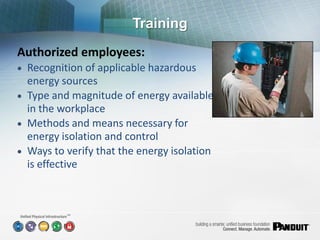
Authorized employees:
 Recognition of applicable hazardous
  energy sources
 Type and magnitude of energy available
  in the workplace
 Methods and means necessary for
  energy isolation and control
 Ways to verify that the energy isolation
  is effective


          SM
Training

Affected employees:
 Instructed in the purpose and use of energy control
  procedure
 Should never attempt to restart or re-energize
  machines or equipment which are locked out or tagged
  out
 Respect use of warning tags


           SM
Q: When Should a Company Retrain?

 New employees, or change in employee
  responsibilities
 New equipment, or change in machines,
  equipment or processes that present a
  new hazard or change to energy control
  procedures
 Deviations from, or inadequacies in, the
  employee’s knowledge or use of the
  energy control procedure


         SM
Device Requirements

OSHA 1910.147(c)(7)(i)
 “Lockout device – a device that utilizes a positive means such as
  a lock, either key or combination type, to hold an energy
  isolating device in a safe position and prevent the energizing of
  a machine or equipment”

NFPA 70E 120.2 (E) (2)
 “Each employer shall supply, and employees shall use,
  lockout/tagout devices and equipment necessary to execute
  the requirements of 120.3(E). Locks and tags used for control
  of exposure to electrical energy hazards shall be unique, shall
  be readily identifiable as lockout/tagout devices, and shall be
  used for no other purpose.”
         SM
Device Requirements

Lockouts must be:
   Used only to control energy
   Durable enough for use in their
    environment
   Standardized by either color, shape or size
   Substantial – withstand all but excessive
    force
   Identify the employee applying the device


        SM
Device Requirements

Tags must be:

   Durable enough for use in their
    environment
   Substantial – enough to resist accidental or
    inadvertent removal
   Standardized by either color, shape or size
   Identify the employee responsible for the
    Tagout
   Non-reusable attachment device &
    attachable by hand
   Withstand 50 lbs of force


          SM
Inspection

OSHA 1910.147(c)(6)(i)
 “The employer shall conduct a periodic inspection of the energy
  control procedure at least annually to ensure that the procedure
  and the requirements of this standard are being followed.”


NFPA 70E 120.2 (C) (3)
 “An audit shall be conducted at least annually by a qualified person
  and shall cover at least one Lockout/Tagout in progress and the
  procedure details. The audit shall be designed to correct
  deficiencies in the procedure or in employee understanding.”


         SM
Inspection

 At least annually
 Performed by authorized employee, other than the one(s)
  using the energy control procedure
 Cover Lockout/Tagout in progress
 Between inspector and authorized/affected employees
   • Lockout – review employees responsibilities under the
     energy control procedure inspected
   • Tagout – review employee responsibilities and Tagout
     limitations
 Document inspection
 Correct any deviations or inadequacies identified
         SM
Outside Personnel

• Example: Contractors
• “On-site employer and outside employer shall inform each
  other of their respective lockout or tagout procedures”
• “On-site employer shall ensure that his/her employees
  understand and comply with the restrictions and prohibitions
  of the outside employer’s energy control program”


           SM
Group Lockout/Tagout

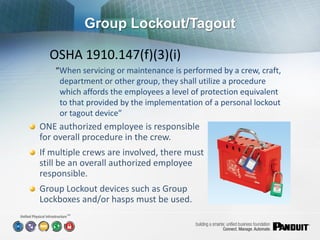
  OSHA 1910.147(f)(3)(i)
    “When servicing or maintenance is performed by a crew, craft,
     department or other group, they shall utilize a procedure
     which affords the employees a level of protection equivalent
     to that provided by the implementation of a personal lockout
     or tagout device”
ONE authorized employee is responsible
for overall procedure in the crew.
If multiple crews are involved, there must
still be an overall authorized employee
responsible.
Group Lockout devices such as Group
Lockboxes and/or hasps must be used.
       SM
Shift or Personnel Changes

• “Ensure continuity of lockout
  or tagout protection”
• Employee from incoming shift
  MUST apply his/her lockout
  device before employee from
  outgoing shift removes
  his/her device.
• Communicate about the work
  that has been done
        SM
Unavailable Employee

• If authorized employee is not available to
  remove his device, then the employer may
  remove it IF:
  – Employer has procedures and training for such
    removal in energy control program
  – Verification that authorized employee is not at
    the facility
  – Making all reasonable efforts to contact
    authorized employee to inform him/her that
    lockout device has been removed
  – Ensuring that authorized employee is aware
    that his device was removed before resuming
    work at that facility
      SM
How to establish an energy
    control program?


  SM
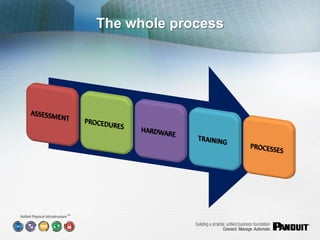
The whole process


SM
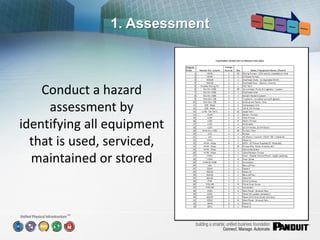
1. Assessment


    Conduct a hazard
     assessment by
identifying all equipment
  that is used, serviced,
  maintained or stored


        SM
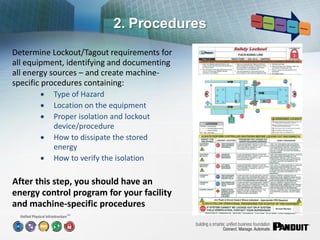
2. Procedures
Determine Lockout/Tagout requirements for
all equipment, identifying and documenting
all energy sources – and create machine-
specific procedures containing:
          Type of Hazard
          Location on the equipment
          Proper isolation and lockout
           device/procedure
          How to dissipate the stored
           energy
          How to verify the isolation

After this step, you should have an
energy control program for your facility
and machine-specific procedures
              SM
3. Devices

Circuit Breakers        Electric Plug     Toggle Switch   Rocker Switch    Cable Lockout


  Pneumatic              Ball valve        Gate Valve     Group Lock Box       Tags


LOTO Stations            LOTO Kits           Hasps           Padlocks         Other


                   SM
4. Training

A.   Train all employees in facility
        Authorized employees:
         •   Recognition of applicable hazardous energy
             sources
         •   Type and magnitude of energy available in the
             workplace
         •   Methods and means necessary for energy
             isolation and control
         •   Ways to verify that the energy isolation is
             effective
        Affected and Other employees:
         •   Instruction in the purpose and use of energy
             control procedure
         •   Should never attempt to restart or re-energize
             machines or equipment which are locked out
             or tagged out
         •   Respect use of warning tags

B.   Document the training
             SM
5. Processes

Processes need to be put in place to
maintain the comprehensive
program for the following:
    Periodic Inspections must take
      place at least annually to
      identify and correct any
      deviations or inadequacies.
    Retraining must take place
     anytime there is a change in
     responsibilities, equipment or
     procedures along with new
     employees
           SM
In conclusion…


SM
Key Take-Aways


1. Only work on equipment “hot” or “live” if it absolutely
   unavoidable
2. Lockout over Tagout
3. Facility specific and machine specific
4. Don’t forget about secondary energy sources or stored energy
5. Use annual inspections, regular training (annually suggested),
   and discipline to avoid complacency
6. Lockout/Tagout is only one part of a complete and effective
   safety program (safety ID, PPE, etc.)

           SM
References

   OSHA 1910.147
   NFPA 70E (2009)
   NEC 2008
   www.osha.gov
   www.nfpa.org
   Your company Lockout/Tagout procedure


         SM

Lockout/Tagout Training (OEM Version)

  • 1.
    Lockout / Tagout TRAINING SM
  • 2.
    What is 1910.147? •OSHA standard for Lockout /Tagout • Goal: Control the release of hazardous energy during maintenance and servicing • Many types of energy: – Mechanical – Hydraulic – Electrical – Gas – Pneumatic – Water – Chemical – Thermal SM
  • 3.
    Agenda • Why WeDo It? • What is required for compliance? • How to get started with Lockout/Tagout? • References SM
  • 4.
    Risk Mitigation Employee Safety Legal Risk Mitigation Financial SM
  • 5.
    Employee Safety • Approximately3 million workers in the US service equipment and face the greatest risk of injury if Lockout/Tagout is not properly implemented • Lockout/Tagout prevents an estimated 120 fatalities and 50,000 injuries each year in the US. SM Source: http://www.osha.gov/SLTC/controlhazardousenergy/index.html
  • 6.
    Legal Risk • Createdunder the Occupational Safety and Health Act of 1970 • Only government regulatory agency for workplace safety • Instructs, conducts inspections and enforces workplace safety • Does not apply to government facilities SM
  • 7.
    Legal Risk OSHA GeneralDuty Clause States: “each employer shall furnish to each of his employees employment and a place of employment which are free from recognized hazards that are causing or are likely to cause death or serious physical harm to his employees.” Source: OSHA 29 USC 654 SM
  • 8.
    Legal Risk OSHA Standard29 CFR 1910.147: • 29 CFR 1910.147 was adopted in 1989 and established minimum performance requirements for the control of hazardous energy • The lockout/tagout standard applies to general industry employment • It covers the servicing and maintenance of machines and equipment in which the unexpected start-up or the release of stored energy could cause injury • It covers about 39 million workers SM
  • 9.
    Legal Risk NFPA 70E– Chapter 1 Article 110 States: “covers electrical safety-related work practices and procedures for employees who work on or near exposed energized electrical conductors or circuit parts in workplaces that are included in the scope of this standard” “Intended to provide for employee safety relative to electrical hazards in the workplace” Source: NFPA Regulations – Chapter 1, Article 110, 2004 SM
  • 10.
    Legal Risk • Requiredby law for employers to follow • Requirements in General Terms • Lots of details but also rely on consensus industry standards for guidelines NFPA 70E – 2004 (Originated 1976): • Details – safe installation, maintenance and work practices, signs, PPE (Personal Protective Equipment) SM
  • 11.
    Financial Risk  Downtime • Personnel • Equipment  Legal Action • Liability and Injury • Cost of outside counsel  Fines and Penalties: • LOTO is #3 most cited by OSHA • Fiscal Year 2006  38,579 federal OSHA site inspections  58,058 state OSHA site inspections Source: Occupational Hazards, February 2008  3,659 violations for LOTO totaling about $6M SM
  • 12.
  • 13.
    Risk Mitigation Conclusion: “The costsin terms of human suffering, lost productivity, worker’s compensation claims and lawsuits can far outweigh the investment in a comprehensive program.” Source: Occupational Health&Safety Volume 76, Number 10 SM
  • 14.
    What is required? Elementsof an effective Lockout/Tagout program:  Procedures  Training  Device requirements  Inspections SM
  • 15.
    Procedures  OSHA 1910.147(c)(4)(i) “Procedures shall be developed, documented and utilized for the control of potentially hazardous energy when employees are engaged in the activities covered by this section”  NFPA 70E 120.2 (F) / Ch. 5-4 “The employer shall maintain a copy of the procedures required by this section and shall make procedures available to all employees” SM
  • 16.
    Procedures Procedures shall bedeveloped, documented and utilized for the control of potentially hazardous energy: – Steps to de-energize and re-energize – Lockout/Tagout devices to utilize – Drawings/diagrams (equipment specific) – What employees are exposed to hazards? – Who is qualified to perform LOTO? – Who is in charge of the LOTO program? Standards/Codes: OSHA 1910.147(c)(4); NFPA 70E - Article 120.2 (D) & (F), and Annex G SM
  • 17.
    Procedures Steps for equipmentshutdown 1. Prepare for and announce shutdown 2. Shutdown equipment 3. Disconnect energy sources / test for isolation 4. Lockout and/or Tagout 5. Release stored energy 6. Verify isolation SM
  • 18.
    Procedures Steps for equipmentstartup 1. Verify equipment operationally intact - Clear all personnel and tools 2. Ensure employees are safely positioned 3. Remove lockout/tagout devices from each energy-isolating device 4. Notify all affected employees of Lockout/Tagout removal and that work has been completed 5. Start equipment SM
  • 19.
    Training OSHA 1910.147(c)(7)(i) “Theemployer shall provide training to ensure that the purpose and function of the energy control program are understood by employees and that the knowledge and skills required for the safe application, usage, and removal of the energy controls are acquired by employees” NFPA 70E 120.2 (B) (2) “Each employer shall provide training as required to ensure employees’ understanding of the lockout/tagout procedure content and their duty in executing such procedures” SM
  • 20.
    Training Authorized employees –person who locks out or tags out machines or equipment in order to perform servicing or maintenance on that machine or equipment Affected employees – employee whose job requires him/her to operate or use a machine or equipment on which servicing or maintenance is being performed under Lockout or Tagout, or whose job requires him/her to work in an area in which such servicing or maintenance is being performed SM
  • 21.
    Training Authorized employees:  Recognitionof applicable hazardous energy sources  Type and magnitude of energy available in the workplace  Methods and means necessary for energy isolation and control  Ways to verify that the energy isolation is effective SM
  • 22.
    Training Affected employees:  Instructedin the purpose and use of energy control procedure  Should never attempt to restart or re-energize machines or equipment which are locked out or tagged out  Respect use of warning tags SM
  • 23.
    Q: When Shoulda Company Retrain?  New employees, or change in employee responsibilities  New equipment, or change in machines, equipment or processes that present a new hazard or change to energy control procedures  Deviations from, or inadequacies in, the employee’s knowledge or use of the energy control procedure SM
  • 24.
    Device Requirements OSHA 1910.147(c)(7)(i) “Lockout device – a device that utilizes a positive means such as a lock, either key or combination type, to hold an energy isolating device in a safe position and prevent the energizing of a machine or equipment” NFPA 70E 120.2 (E) (2) “Each employer shall supply, and employees shall use, lockout/tagout devices and equipment necessary to execute the requirements of 120.3(E). Locks and tags used for control of exposure to electrical energy hazards shall be unique, shall be readily identifiable as lockout/tagout devices, and shall be used for no other purpose.” SM
  • 25.
    Device Requirements Lockouts mustbe:  Used only to control energy  Durable enough for use in their environment  Standardized by either color, shape or size  Substantial – withstand all but excessive force  Identify the employee applying the device SM
  • 26.
    Device Requirements Tags mustbe:  Durable enough for use in their environment  Substantial – enough to resist accidental or inadvertent removal  Standardized by either color, shape or size  Identify the employee responsible for the Tagout  Non-reusable attachment device & attachable by hand  Withstand 50 lbs of force SM
  • 27.
    Inspection OSHA 1910.147(c)(6)(i) “Theemployer shall conduct a periodic inspection of the energy control procedure at least annually to ensure that the procedure and the requirements of this standard are being followed.” NFPA 70E 120.2 (C) (3) “An audit shall be conducted at least annually by a qualified person and shall cover at least one Lockout/Tagout in progress and the procedure details. The audit shall be designed to correct deficiencies in the procedure or in employee understanding.” SM
  • 28.
    Inspection  At leastannually  Performed by authorized employee, other than the one(s) using the energy control procedure  Cover Lockout/Tagout in progress  Between inspector and authorized/affected employees • Lockout – review employees responsibilities under the energy control procedure inspected • Tagout – review employee responsibilities and Tagout limitations  Document inspection  Correct any deviations or inadequacies identified SM
  • 29.
    Outside Personnel • Example:Contractors • “On-site employer and outside employer shall inform each other of their respective lockout or tagout procedures” • “On-site employer shall ensure that his/her employees understand and comply with the restrictions and prohibitions of the outside employer’s energy control program” SM
  • 30.
    Group Lockout/Tagout OSHA 1910.147(f)(3)(i) “When servicing or maintenance is performed by a crew, craft, department or other group, they shall utilize a procedure which affords the employees a level of protection equivalent to that provided by the implementation of a personal lockout or tagout device” ONE authorized employee is responsible for overall procedure in the crew. If multiple crews are involved, there must still be an overall authorized employee responsible. Group Lockout devices such as Group Lockboxes and/or hasps must be used. SM
  • 31.
    Shift or PersonnelChanges • “Ensure continuity of lockout or tagout protection” • Employee from incoming shift MUST apply his/her lockout device before employee from outgoing shift removes his/her device. • Communicate about the work that has been done SM
  • 32.
    Unavailable Employee • Ifauthorized employee is not available to remove his device, then the employer may remove it IF: – Employer has procedures and training for such removal in energy control program – Verification that authorized employee is not at the facility – Making all reasonable efforts to contact authorized employee to inform him/her that lockout device has been removed – Ensuring that authorized employee is aware that his device was removed before resuming work at that facility SM
  • 33.
    How to establishan energy control program? SM
  • 34.
  • 35.
    1. Assessment Conduct a hazard assessment by identifying all equipment that is used, serviced, maintained or stored SM
  • 36.
    2. Procedures Determine Lockout/Tagoutrequirements for all equipment, identifying and documenting all energy sources – and create machine- specific procedures containing:  Type of Hazard  Location on the equipment  Proper isolation and lockout device/procedure  How to dissipate the stored energy  How to verify the isolation After this step, you should have an energy control program for your facility and machine-specific procedures SM
  • 37.
    3. Devices Circuit Breakers Electric Plug Toggle Switch Rocker Switch Cable Lockout Pneumatic Ball valve Gate Valve Group Lock Box Tags LOTO Stations LOTO Kits Hasps Padlocks Other SM
  • 38.
    4. Training A. Train all employees in facility  Authorized employees: • Recognition of applicable hazardous energy sources • Type and magnitude of energy available in the workplace • Methods and means necessary for energy isolation and control • Ways to verify that the energy isolation is effective  Affected and Other employees: • Instruction in the purpose and use of energy control procedure • Should never attempt to restart or re-energize machines or equipment which are locked out or tagged out • Respect use of warning tags B. Document the training SM
  • 39.
    5. Processes Processes needto be put in place to maintain the comprehensive program for the following:  Periodic Inspections must take place at least annually to identify and correct any deviations or inadequacies.  Retraining must take place anytime there is a change in responsibilities, equipment or procedures along with new employees SM
  • 40.
  • 41.
    Key Take-Aways 1. Onlywork on equipment “hot” or “live” if it absolutely unavoidable 2. Lockout over Tagout 3. Facility specific and machine specific 4. Don’t forget about secondary energy sources or stored energy 5. Use annual inspections, regular training (annually suggested), and discipline to avoid complacency 6. Lockout/Tagout is only one part of a complete and effective safety program (safety ID, PPE, etc.) SM
  • 42.
    References  OSHA 1910.147  NFPA 70E (2009)  NEC 2008  www.osha.gov  www.nfpa.org  Your company Lockout/Tagout procedure SM