ggim.un.org
Positioning geospatial information to address global challenges
Update on activities with
UNGGIM for
JAG Meeting
OGC 104th Technical Meeting
Denise McKenzie
Executive Director
Open Geospatial Consortium
Positioning geospatial information to address global challenges
ggim.un.org
Positioning geospatial information to address global challenges
What is the UN-GGIM?
• United Nations Global Geospatial Information Management (UN-
GGIM)
• A global initiative started in 2011
• An Inter-Governmental Mechanism spearheaded by the United
Nations which seeks to guide the making of joint decisions and set
directions on the production and use of geospatial information within
national and global policy frameworks.
• Purpose of UN-GGIM
– Working with Governments to improve policy, institutional arrangements, and
legal frameworks;
– Addressing global issues and contributing collective knowledge as a community
with shared interests and concerns
– Developing effective strategies to build geospatial capacity in the developing
countries
ggim.un.org
Positioning geospatial information to address global challenges
ggim.un.org
Positioning geospatial information to address global challenges
Purpose
• Articulate the critical role of standards in geospatial
information management;
• Inform policy makers and program managers in
Member States of the value in using and investing in
geospatial standardization; and
• Describe the benefits of using “open” geospatial
standards to achieve standardization, data sharing,
and interoperability goals.
• To help everyone better understand what
standards to use, when and why.
ggim.un.org
Positioning geospatial information to address global challenges
What, Why & How
What is a Standard?
Why are Standards important?
What is an “open standard”?
Why are Open Standards valuable?
How are standards developed?
ggim.un.org
Positioning geospatial information to address global challenges
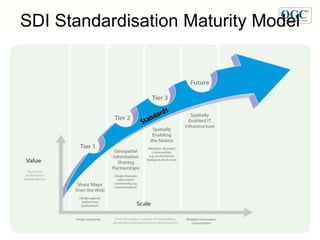
SDI Standardisation Maturity Model
ggim.un.org
Positioning geospatial information to address global challenges
Download at
• www.opengeospatial.org/unggim
and
• http://ggim.un.org/UN%20Resource%20D
ocuments.html
ggim.un.org
Positioning geospatial information to address global challenges
5/108 – August 2015
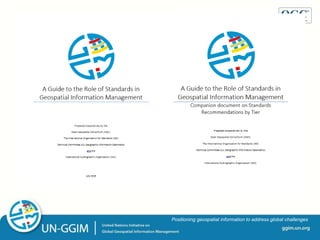
• (b) Adopted the final published “Guide to the
Role of Standards in Geospatial Information
Management” and the “Technical Compendium”
as the international geospatial standards best
practice for spatial data infrastructure, and
encouraged all Member States to adopt and
implement the recommended standards
appropriate to their countries’ level of spatial
data infrastructure (SDI) maturity.
ggim.un.org
Positioning geospatial information to address global challenges
Revision - Timeline
• Kicked-off work with JAG today
• Finalise survey and work with Secretariat
to distribute, 4 weeks from end September
• Call to IHO, ISO TC211 and OGC
members to participate in the working
group
• Collate results of survey October
ggim.un.org
Positioning geospatial information to address global challenges
Timeline – cont.
• 3rd week October – first working group
teleconference
• Goal – draft for member review by March
OGC meeting, share with other SDOs
• Finalise by end April 2018 for delivery to
GGIM Secretariat
• Present at 2018 Committee of Experts
meeting for endorsement
ggim.un.org
Positioning geospatial information to address global challenges
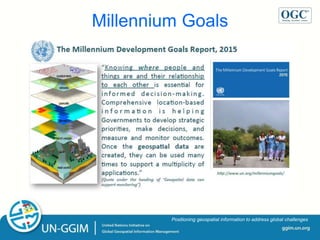
Millennium Goals
ggim.un.org
Positioning geospatial information to address global challenges
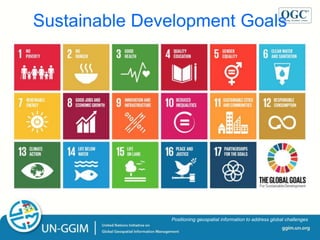
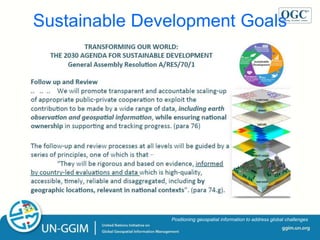
Sustainable Development Goals
ggim.un.org
Positioning geospatial information to address global challenges
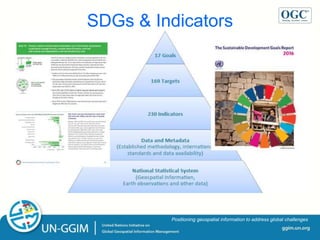
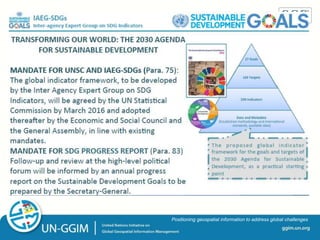
SDGs & Indicators
ggim.un.org
Positioning geospatial information to address global challenges
Sustainable Development Goals
ggim.un.org
Positioning geospatial information to address global challenges
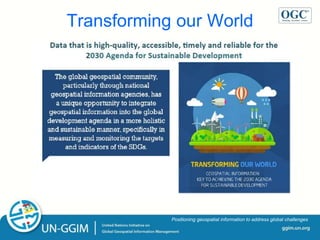
Transforming our World
ggim.un.org
Positioning geospatial information to address global challenges
ggim.un.org
Positioning geospatial information to address global challenges
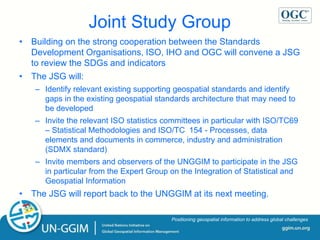
• Building on the strong cooperation between the Standards
Development Organisations, ISO, IHO and OGC will convene a JSG
to review the SDGs and indicators
• The JSG will:
– Identify relevant existing supporting geospatial standards and identify
gaps in the existing geospatial standards architecture that may need to
be developed
– Invite the relevant ISO statistics committees in particular with ISO/TC69
– Statistical Methodologies and ISO/TC 154 - Processes, data
elements and documents in commerce, industry and administration
(SDMX standard)
– Invite members and observers of the UNGGIM to participate in the JSG
in particular from the Expert Group on the Integration of Statistical and
Geospatial Information
• The JSG will report back to the UNGGIM at its next meeting.
Joint Study Group
ggim.un.org
Positioning geospatial information to address global challenges
Goals, Targets, Indicators - Geospatial
• Why are they relevant for the geospatial
community?
• More natural and built environment goals
• Approx. 25 indicators that have a relevant
Geospatial requirement
• With at least 15 of these having a
essential and direct geospatial
requirement
ggim.un.org
Positioning geospatial information to address global challenges
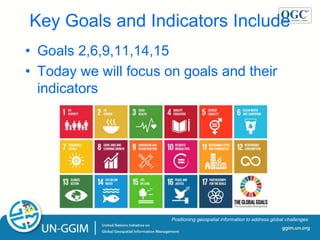
Key Goals and Indicators Include
• Goals 2,6,9,11,14,15
• Today we will focus on goals and their
indicators
ggim.un.org
Positioning geospatial information to address global challenges
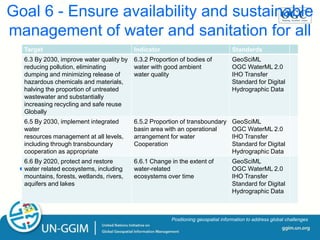
Goal 6 - Ensure availability and sustainable
management of water and sanitation for all
• Example Dar es Salaam, participatory
mapping
Target Indicator Standards
6.3 By 2030, improve water quality by
reducing pollution, eliminating
dumping and minimizing release of
hazardous chemicals and materials,
halving the proportion of untreated
wastewater and substantially
increasing recycling and safe reuse
Globally
6.3.2 Proportion of bodies of
water with good ambient
water quality
GeoSciML
OGC WaterML 2.0
IHO Transfer
Standard for Digital
Hydrographic Data
6.5 By 2030, implement integrated
water
resources management at all levels,
including through transboundary
cooperation as appropriate
6.5.2 Proportion of transboundary
basin area with an operational
arrangement for water
Cooperation
GeoSciML
OGC WaterML 2.0
IHO Transfer
Standard for Digital
Hydrographic Data
6.6 By 2020, protect and restore
water related ecosystems, including
mountains, forests, wetlands, rivers,
aquifers and lakes
6.6.1 Change in the extent of
water-related
ecosystems over time
GeoSciML
OGC WaterML 2.0
IHO Transfer
Standard for Digital
Hydrographic Data
ggim.un.org
Positioning geospatial information to address global challenges
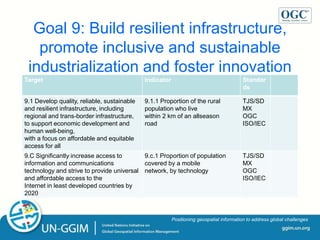
Goal 9: Build resilient infrastructure,
promote inclusive and sustainable
industrialization and foster innovation
Target Indicator Standar
ds
9.1 Develop quality, reliable, sustainable
and resilient infrastructure, including
regional and trans-border infrastructure,
to support economic development and
human well-being,
with a focus on affordable and equitable
access for all
9.1.1 Proportion of the rural
population who live
within 2 km of an allseason
road
TJS/SD
MX
OGC
ISO/IEC
9.C Significantly increase access to
information and communications
technology and strive to provide universal
and affordable access to the
Internet in least developed countries by
2020
9.c.1 Proportion of population
covered by a mobile
network, by technology
TJS/SD
MX
OGC
ISO/IEC
ggim.un.org
Positioning geospatial information to address global challenges
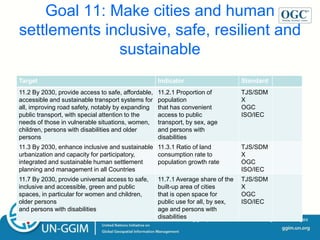
Goal 11: Make cities and human
settlements inclusive, safe, resilient and
sustainable
Target Indicator Standard
11.2 By 2030, provide access to safe, affordable,
accessible and sustainable transport systems for
all, improving road safety, notably by expanding
public transport, with special attention to the
needs of those in vulnerable situations, women,
children, persons with disabilities and older
persons
11.2.1 Proportion of
population
that has convenient
access to public
transport, by sex, age
and persons with
disabilities
TJS/SDM
X
OGC
ISO/IEC
11.3 By 2030, enhance inclusive and sustainable
urbanization and capacity for participatory,
integrated and sustainable human settlement
planning and management in all Countries
11.3.1 Ratio of land
consumption rate to
population growth rate
TJS/SDM
X
OGC
ISO/IEC
11.7 By 2030, provide universal access to safe,
inclusive and accessible, green and public
spaces, in particular for women and children,
older persons
and persons with disabilities
11.7.1 Average share of the
built-up area of cities
that is open space for
public use for all, by sex,
age and persons with
disabilities
TJS/SDM
X
OGC
ISO/IEC
ggim.un.org
Positioning geospatial information to address global challenges
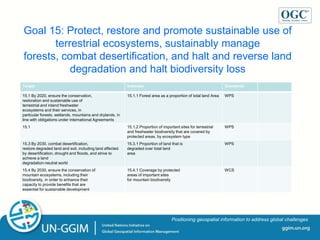
Goal 15: Protect, restore and promote sustainable use of
terrestrial ecosystems, sustainably manage
forests, combat desertification, and halt and reverse land
degradation and halt biodiversity loss
Target Indicator Standards
15.1 By 2020, ensure the conservation,
restoration and sustainable use of
terrestrial and inland freshwater
ecosystems and their services, in
particular forests, wetlands, mountains and drylands, in
line with obligations under international Agreements
15.1.1 Forest area as a proportion of total land Area WPS
15.1 15.1.2 Proportion of important sites for terrestrial
and freshwater biodiversity that are covered by
protected areas, by ecosystem type
WPS
15.3 By 2030, combat desertification,
restore degraded land and soil, including land affected
by desertification, drought and floods, and strive to
achieve a land
degradation-neutral world
15.3.1 Proportion of land that is
degraded over total land
area
WPS
15.4 By 2030, ensure the conservation of
mountain ecosystems, including their
biodiversity, in order to enhance their
capacity to provide benefits that are
essential for sustainable development
15.4.1 Coverage by protected
areas of important sites
for mountain biodiversity
WCS
ggim.un.org
Positioning geospatial information to address global challenges
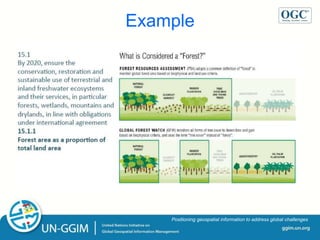
Example
ggim.un.org
Positioning geospatial information to address global challenges
What standards exist already that can
be used?
• Reference to the Guide & Companion
Document
• General geospatial webservice standards
• General ICT standards
ggim.un.org
Positioning geospatial information to address global challenges
Next Steps
• Geospatial Working Group for Inter-
Agency Expert Group on SDGs Indicators
• Data identification process
• Develop standards for the data identified
• Decisions – process, structure, content,
working group
ggim.un.org
Positioning geospatial information to address global challenges
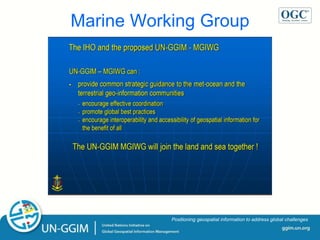
Marine Working Group
ggim.un.org
Positioning geospatial information to address global challenges
Thank you
Positioning geospatial information to address global challenges

2017 ISO / OGC Joint Advisory Group

  • 1.
    ggim.un.org Positioning geospatial informationto address global challenges Update on activities with UNGGIM for JAG Meeting OGC 104th Technical Meeting Denise McKenzie Executive Director Open Geospatial Consortium Positioning geospatial information to address global challenges
  • 2.
    ggim.un.org Positioning geospatial informationto address global challenges What is the UN-GGIM? • United Nations Global Geospatial Information Management (UN- GGIM) • A global initiative started in 2011 • An Inter-Governmental Mechanism spearheaded by the United Nations which seeks to guide the making of joint decisions and set directions on the production and use of geospatial information within national and global policy frameworks. • Purpose of UN-GGIM – Working with Governments to improve policy, institutional arrangements, and legal frameworks; – Addressing global issues and contributing collective knowledge as a community with shared interests and concerns – Developing effective strategies to build geospatial capacity in the developing countries
  • 3.
  • 4.
    ggim.un.org Positioning geospatial informationto address global challenges Purpose • Articulate the critical role of standards in geospatial information management; • Inform policy makers and program managers in Member States of the value in using and investing in geospatial standardization; and • Describe the benefits of using “open” geospatial standards to achieve standardization, data sharing, and interoperability goals. • To help everyone better understand what standards to use, when and why.
  • 5.
    ggim.un.org Positioning geospatial informationto address global challenges What, Why & How What is a Standard? Why are Standards important? What is an “open standard”? Why are Open Standards valuable? How are standards developed?
  • 6.
    ggim.un.org Positioning geospatial informationto address global challenges SDI Standardisation Maturity Model
  • 7.
    ggim.un.org Positioning geospatial informationto address global challenges Download at • www.opengeospatial.org/unggim and • http://ggim.un.org/UN%20Resource%20D ocuments.html
  • 8.
    ggim.un.org Positioning geospatial informationto address global challenges 5/108 – August 2015 • (b) Adopted the final published “Guide to the Role of Standards in Geospatial Information Management” and the “Technical Compendium” as the international geospatial standards best practice for spatial data infrastructure, and encouraged all Member States to adopt and implement the recommended standards appropriate to their countries’ level of spatial data infrastructure (SDI) maturity.
  • 9.
    ggim.un.org Positioning geospatial informationto address global challenges Revision - Timeline • Kicked-off work with JAG today • Finalise survey and work with Secretariat to distribute, 4 weeks from end September • Call to IHO, ISO TC211 and OGC members to participate in the working group • Collate results of survey October
  • 10.
    ggim.un.org Positioning geospatial informationto address global challenges Timeline – cont. • 3rd week October – first working group teleconference • Goal – draft for member review by March OGC meeting, share with other SDOs • Finalise by end April 2018 for delivery to GGIM Secretariat • Present at 2018 Committee of Experts meeting for endorsement
  • 11.
    ggim.un.org Positioning geospatial informationto address global challenges Millennium Goals
  • 12.
    ggim.un.org Positioning geospatial informationto address global challenges Sustainable Development Goals
  • 13.
    ggim.un.org Positioning geospatial informationto address global challenges SDGs & Indicators
  • 14.
    ggim.un.org Positioning geospatial informationto address global challenges Sustainable Development Goals
  • 15.
    ggim.un.org Positioning geospatial informationto address global challenges Transforming our World
  • 16.
  • 17.
    ggim.un.org Positioning geospatial informationto address global challenges • Building on the strong cooperation between the Standards Development Organisations, ISO, IHO and OGC will convene a JSG to review the SDGs and indicators • The JSG will: – Identify relevant existing supporting geospatial standards and identify gaps in the existing geospatial standards architecture that may need to be developed – Invite the relevant ISO statistics committees in particular with ISO/TC69 – Statistical Methodologies and ISO/TC 154 - Processes, data elements and documents in commerce, industry and administration (SDMX standard) – Invite members and observers of the UNGGIM to participate in the JSG in particular from the Expert Group on the Integration of Statistical and Geospatial Information • The JSG will report back to the UNGGIM at its next meeting. Joint Study Group
  • 18.
    ggim.un.org Positioning geospatial informationto address global challenges Goals, Targets, Indicators - Geospatial • Why are they relevant for the geospatial community? • More natural and built environment goals • Approx. 25 indicators that have a relevant Geospatial requirement • With at least 15 of these having a essential and direct geospatial requirement
  • 19.
    ggim.un.org Positioning geospatial informationto address global challenges Key Goals and Indicators Include • Goals 2,6,9,11,14,15 • Today we will focus on goals and their indicators
  • 20.
    ggim.un.org Positioning geospatial informationto address global challenges Goal 6 - Ensure availability and sustainable management of water and sanitation for all • Example Dar es Salaam, participatory mapping Target Indicator Standards 6.3 By 2030, improve water quality by reducing pollution, eliminating dumping and minimizing release of hazardous chemicals and materials, halving the proportion of untreated wastewater and substantially increasing recycling and safe reuse Globally 6.3.2 Proportion of bodies of water with good ambient water quality GeoSciML OGC WaterML 2.0 IHO Transfer Standard for Digital Hydrographic Data 6.5 By 2030, implement integrated water resources management at all levels, including through transboundary cooperation as appropriate 6.5.2 Proportion of transboundary basin area with an operational arrangement for water Cooperation GeoSciML OGC WaterML 2.0 IHO Transfer Standard for Digital Hydrographic Data 6.6 By 2020, protect and restore water related ecosystems, including mountains, forests, wetlands, rivers, aquifers and lakes 6.6.1 Change in the extent of water-related ecosystems over time GeoSciML OGC WaterML 2.0 IHO Transfer Standard for Digital Hydrographic Data
  • 21.
    ggim.un.org Positioning geospatial informationto address global challenges Goal 9: Build resilient infrastructure, promote inclusive and sustainable industrialization and foster innovation Target Indicator Standar ds 9.1 Develop quality, reliable, sustainable and resilient infrastructure, including regional and trans-border infrastructure, to support economic development and human well-being, with a focus on affordable and equitable access for all 9.1.1 Proportion of the rural population who live within 2 km of an allseason road TJS/SD MX OGC ISO/IEC 9.C Significantly increase access to information and communications technology and strive to provide universal and affordable access to the Internet in least developed countries by 2020 9.c.1 Proportion of population covered by a mobile network, by technology TJS/SD MX OGC ISO/IEC
  • 22.
    ggim.un.org Positioning geospatial informationto address global challenges Goal 11: Make cities and human settlements inclusive, safe, resilient and sustainable Target Indicator Standard 11.2 By 2030, provide access to safe, affordable, accessible and sustainable transport systems for all, improving road safety, notably by expanding public transport, with special attention to the needs of those in vulnerable situations, women, children, persons with disabilities and older persons 11.2.1 Proportion of population that has convenient access to public transport, by sex, age and persons with disabilities TJS/SDM X OGC ISO/IEC 11.3 By 2030, enhance inclusive and sustainable urbanization and capacity for participatory, integrated and sustainable human settlement planning and management in all Countries 11.3.1 Ratio of land consumption rate to population growth rate TJS/SDM X OGC ISO/IEC 11.7 By 2030, provide universal access to safe, inclusive and accessible, green and public spaces, in particular for women and children, older persons and persons with disabilities 11.7.1 Average share of the built-up area of cities that is open space for public use for all, by sex, age and persons with disabilities TJS/SDM X OGC ISO/IEC
  • 23.
    ggim.un.org Positioning geospatial informationto address global challenges Goal 15: Protect, restore and promote sustainable use of terrestrial ecosystems, sustainably manage forests, combat desertification, and halt and reverse land degradation and halt biodiversity loss Target Indicator Standards 15.1 By 2020, ensure the conservation, restoration and sustainable use of terrestrial and inland freshwater ecosystems and their services, in particular forests, wetlands, mountains and drylands, in line with obligations under international Agreements 15.1.1 Forest area as a proportion of total land Area WPS 15.1 15.1.2 Proportion of important sites for terrestrial and freshwater biodiversity that are covered by protected areas, by ecosystem type WPS 15.3 By 2030, combat desertification, restore degraded land and soil, including land affected by desertification, drought and floods, and strive to achieve a land degradation-neutral world 15.3.1 Proportion of land that is degraded over total land area WPS 15.4 By 2030, ensure the conservation of mountain ecosystems, including their biodiversity, in order to enhance their capacity to provide benefits that are essential for sustainable development 15.4.1 Coverage by protected areas of important sites for mountain biodiversity WCS
  • 24.
    ggim.un.org Positioning geospatial informationto address global challenges Example
  • 25.
    ggim.un.org Positioning geospatial informationto address global challenges What standards exist already that can be used? • Reference to the Guide & Companion Document • General geospatial webservice standards • General ICT standards
  • 26.
    ggim.un.org Positioning geospatial informationto address global challenges Next Steps • Geospatial Working Group for Inter- Agency Expert Group on SDGs Indicators • Data identification process • Develop standards for the data identified • Decisions – process, structure, content, working group
  • 27.
    ggim.un.org Positioning geospatial informationto address global challenges Marine Working Group
  • 28.
    ggim.un.org Positioning geospatial informationto address global challenges Thank you Positioning geospatial information to address global challenges