Copyright © 2017 OGC
OGC
“Communicating Globally”
Denise McKenzie
OGC Outreach
Copyright © 2017 OGC
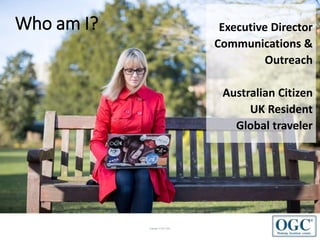
Who am I? Executive Director
Communications &
Outreach
Australian Citizen
UK Resident
Global traveler
Copyright © 2017 OGC
So what’s OGC’s role?
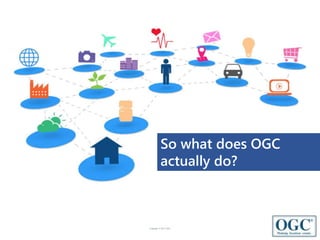
So what does OGC
actually do?
Copyright © 2017 OGC
We make location standards that help us
understand……
Copyright © 2017 OGC
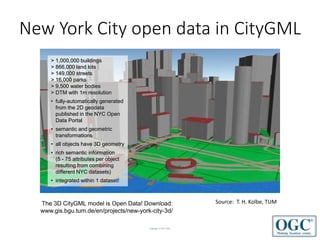
New York City open data in CityGML
> 1,000,000 buildings
> 866,000 land lots
> 149,000 streets
> 16,000 parks
> 9,500 water bodies
> DTM with 1m resolution
• fully-automatically generated
from the 2D geodata
published in the NYC Open
Data Portal
• semantic and geometric
transformations
• all objects have 3D geometry
• rich semantic information
(5 - 75 attributes per object
resulting from combining
different NYC datasets)
• integrated within 1 dataset!
The 3D CityGML model is Open Data! Download:
www.gis.bgu.tum.de/en/projects/new-york-city-3d/
Source: T. H. Kolbe, TUM
Copyright © 2017 OGC
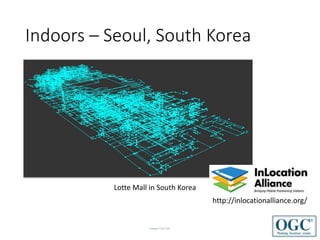
Indoors – Seoul, South Korea
Lotte Mall in South Korea
http://inlocationalliance.org/
Copyright © 2017 OGC
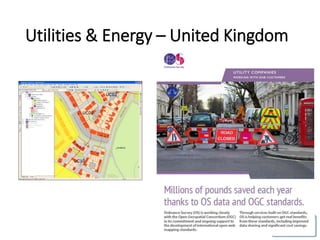
Utilities & Energy – United Kingdom
Copyright © 2017 OGC
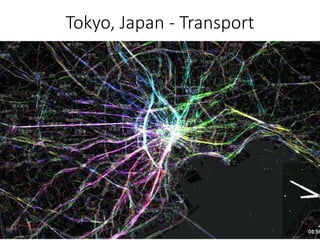
Tokyo, Japan - Transport
Copyright © 2017 OGC
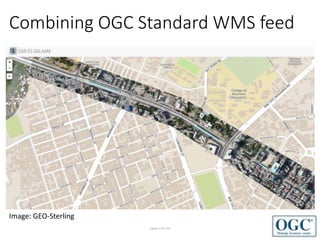
Combining OGC Standard WMS feed
Image: GEO-Sterling
Copyright © 2017 OGC
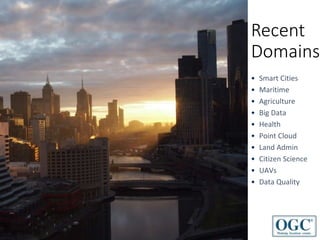
Recent
Domains
Copyright © 2016 Open Geospatial Consortium
• Smart Cities
• Maritime
• Agriculture
• Big Data
• Health
• Point Cloud
• Land Admin
• Citizen Science
• UAVs
• Data Quality
Copyright © 2017 OGC
OGC Innovation Statement
In 2014, the OGC Planning Committee endorsed the OGC Innovation Statement:
In order to simplify technical complexity and reduce implementation costs, the OGC strives to
ensure harmonization within the OGC standards baseline. In an unchanging world harmonization
would be easy. However, given the realities of the diversity that comes about due to changing
technology and markets, OGC must address the innovator’s dilemma of maintaining the current
OGC standards baseline while simultaneously developing standards to support evolving and
potentially disruptive technologies, community needs and market trends. The OGC must balance
maintenance, adaptation and evolution of its standards and associated Best Practices in order to
address technology change, market change, and the complexity of collaboration between different
communities.
• To support this challenging environment, OGC:
• • Will encourage harmonization of its standards;
• Will extend or adapt its present standards baseline, or work with its partners to adapt or
extend their standards;
• May advance new standards that overlap with or diverge from existing standards, along with
guidance regarding how to evaluate and select among these options;
• May develop harmonization techniques such as bridging, brokers, or facades to achieve
interoperability within and across communities of interest;
• Will foster an environment that encourages fair consideration of all submissions.
Copyright © 2017 OGC
Moving to Github
Copyright © 2017 OGC
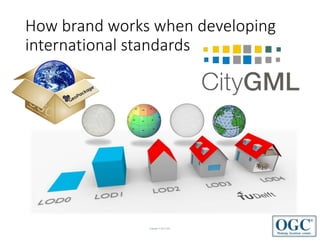
How brand works when developing
international standards
Copyright © 2017 OGC
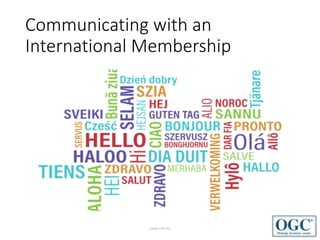
Communicating with an
International Membership
Copyright © 2017 OGC
Join together, Don’t reinvent
Copyright © 2017 OGC
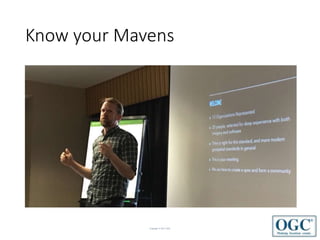
Know your Mavens
Copyright © 2017 OGC
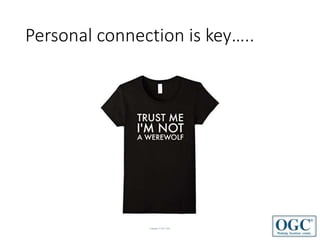
Personal connection is key…..
Copyright © 2017 OGC
Standards
should be
driven by
innovation
and achieved
through
collaboration
Copyright © 2017 OGC
Denise McKenzie
OGC Outreach
+44 7581118189
dmckenzie@opengeospatial.org
@spatialred
@opengeospatial
www.opengeospatial.org

OGC Transformation Journey

  • 1.
    Copyright © 2017OGC OGC “Communicating Globally” Denise McKenzie OGC Outreach
  • 2.
    Copyright © 2017OGC Who am I? Executive Director Communications & Outreach Australian Citizen UK Resident Global traveler
  • 3.
    Copyright © 2017OGC So what’s OGC’s role? So what does OGC actually do?
  • 4.
    Copyright © 2017OGC We make location standards that help us understand……
  • 5.
    Copyright © 2017OGC New York City open data in CityGML > 1,000,000 buildings > 866,000 land lots > 149,000 streets > 16,000 parks > 9,500 water bodies > DTM with 1m resolution • fully-automatically generated from the 2D geodata published in the NYC Open Data Portal • semantic and geometric transformations • all objects have 3D geometry • rich semantic information (5 - 75 attributes per object resulting from combining different NYC datasets) • integrated within 1 dataset! The 3D CityGML model is Open Data! Download: www.gis.bgu.tum.de/en/projects/new-york-city-3d/ Source: T. H. Kolbe, TUM
  • 6.
    Copyright © 2017OGC Indoors – Seoul, South Korea Lotte Mall in South Korea http://inlocationalliance.org/
  • 7.
    Copyright © 2017OGC Utilities & Energy – United Kingdom
  • 8.
    Copyright © 2017OGC Tokyo, Japan - Transport
  • 9.
    Copyright © 2017OGC Combining OGC Standard WMS feed Image: GEO-Sterling
  • 10.
    Copyright © 2017OGC Recent Domains Copyright © 2016 Open Geospatial Consortium • Smart Cities • Maritime • Agriculture • Big Data • Health • Point Cloud • Land Admin • Citizen Science • UAVs • Data Quality
  • 11.
    Copyright © 2017OGC OGC Innovation Statement In 2014, the OGC Planning Committee endorsed the OGC Innovation Statement: In order to simplify technical complexity and reduce implementation costs, the OGC strives to ensure harmonization within the OGC standards baseline. In an unchanging world harmonization would be easy. However, given the realities of the diversity that comes about due to changing technology and markets, OGC must address the innovator’s dilemma of maintaining the current OGC standards baseline while simultaneously developing standards to support evolving and potentially disruptive technologies, community needs and market trends. The OGC must balance maintenance, adaptation and evolution of its standards and associated Best Practices in order to address technology change, market change, and the complexity of collaboration between different communities. • To support this challenging environment, OGC: • • Will encourage harmonization of its standards; • Will extend or adapt its present standards baseline, or work with its partners to adapt or extend their standards; • May advance new standards that overlap with or diverge from existing standards, along with guidance regarding how to evaluate and select among these options; • May develop harmonization techniques such as bridging, brokers, or facades to achieve interoperability within and across communities of interest; • Will foster an environment that encourages fair consideration of all submissions.
  • 12.
    Copyright © 2017OGC Moving to Github
  • 13.
    Copyright © 2017OGC How brand works when developing international standards
  • 14.
    Copyright © 2017OGC Communicating with an International Membership
  • 15.
    Copyright © 2017OGC Join together, Don’t reinvent
  • 16.
    Copyright © 2017OGC Know your Mavens
  • 17.
    Copyright © 2017OGC Personal connection is key…..
  • 18.
    Copyright © 2017OGC Standards should be driven by innovation and achieved through collaboration
  • 19.
    Copyright © 2017OGC Denise McKenzie OGC Outreach +44 7581118189 dmckenzie@opengeospatial.org @spatialred @opengeospatial www.opengeospatial.org

Editor's Notes

  • #2  Denise McKenzie, Executive Director, Communications and Outreach, Open Geospatial Consortium
  • #4 We help agree on how we should share our data We bring together users, technical & policy people to agree on how we share data. Learning, education and sharing, knowledge and experience
  • #7 Mention the recent survey results published on use of indoor mapping technology – In-Location alliance
  • #9 City of Tokyo – 2012
  • #10 Ramani Huria Drone Maps via Web Map Service to England This is your data
  • #13 In terms of the content, it would be interesting to hear how you have to adapt your approach to communication for an international audience. In addition, how brand works for OGC when developing and promoting international standards, touching on the compliance programme. Also worth a slide on the importance of standards for interoperability and how integrated OGC are with things like WMO, INSPIRE, w3c, UN, Europe etc…   I will focus on the journey that OGC has taken in how we support and communicate with an international membership and users of open geospatial standards and how we have changed some of our online tools and processes in recent times in response to our user community.
  • #15 Adapting for an international audience What do we do differently where?
  • #16 Getting rid of OGC Network, Looking more to Stack exchange
  • #19 The Standards of organisations such as the OGC belong to all