Geospatial Standards for the
Sustainable Development Goals
Denise McKenzie, OGC
Chris Body, ISO TC211
Greg Scott, UNGGIM Secretariat
Introductions
• Denise McKenzie
• Chris Body
• Greg Scott
• Others?
Questions for today?
• What are the SDGs?
• Why are they so relevant to the geospatial community?
• What standards exist already that we can use now?
• Which goals do they relate to?
• What standards are under construction?
• What standards do we still need?
Any other questions people would like answered today?
Background
• Standards and the UNGGIM
International Hydrographic Organization (IHO)
• Intergovernmental consultative and technical organization
• Established in 1921
• To support safety of navigation and the protection of the
marine environment
• One of the IHO objectives
• to bring about the greatest possible uniformity in
nautical charts and documents (i.e. standardization)
www.iho.int
International Organization for Standardization
(ISO)
• ISO = equal
• World's largest developer of standards
• Network of national standards institutes from 163 countries
• 19 500 standards published
• Established in 1946-1947
• Recognized by the UN
• Principal activity is developing technical standards
• Technical Committees (TCs)
• From From food safety to computers, and agriculture to healthcare, ISO International
Standards impact all our lives
• ISO/TC 211, Geographic information/geomatics
• Lawrence D. Eicher Leadership Award in 2010
www.iso.org www.isotc211.org
Open Geospatial Consortium
• Industry consortium of around 500 members
• 2000+ implementations of standards and specifications, some
certified to be compliant
• Focus
• to define, document and test implementation standards for
use with geospatial content and services
• integration of geospatial content and services into
applications for the benefit of mankind
www.opengeospatial.org
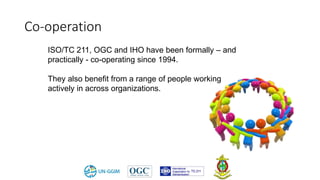
Co-operation
ISO/TC 211, OGC and IHO have been formally – and
practically - co-operating since 1994.
They also benefit from a range of people working
actively in across organizations.
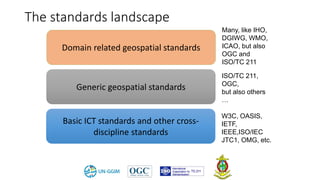
The standards landscape
Basic ICT standards and other cross-
discipline standards
Generic geospatial standards
Domain related geospatial standards
W3C, OASIS,
IETF,
IEEE,ISO/IEC
JTC1, OMG, etc.
ISO/TC 211,
OGC,
but also others
…
Many, like IHO,
DGIWG, WMO,
ICAO, but also
OGC and
ISO/TC 211
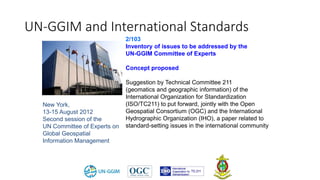
UN-GGIM and International Standards
New York,
13-15 August 2012
Second session of the
UN Committee of Experts on
Global Geospatial
Information Management
2/103
Inventory of issues to be addressed by the
UN-GGIM Committee of Experts
Concept proposed
Suggestion by Technical Committee 211
(geomatics and geographic information) of the
International Organization for Standardization
(ISO/TC211) to put forward, jointly with the Open
Geospatial Consortium (OGC) and the International
Hydrographic Organization (IHO), a paper related to
standard-setting issues in the international community
UN-GGIM and International Standards
Draft report submitted
Second High Level Forum on Global
Geospatial Information Management
Qatar National Convention Centre, Doha,
Qatar, 4-6 February 2013
Full report
Third Session of UN-GGIM
Committee of Experts
Cambridge, UK,
24-27 July 2013
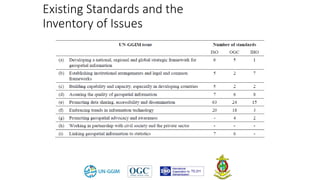
Existing Standards and the
Inventory of Issues
4th Meeting of UNGGIM – New York
• 4/110 Implementation and adoption of standards for the global geospatial information community The Committee of
Experts:
• (c) Agreed that the ‘Guide to the Role of Standards in Geospatial Information Management’ and the ‘Companion
Document on Standards Recommendations by Tier’ are important methodological guidelines to assist Member States in
implementing and adopting geospatial standards within their national frameworks.
• (d) Noted that there is still a need to continue to raise the awareness of standards and related policies to e-government
agendas, and that relevant case studies and best practices are an important means to demonstrating the value to decision
makers.
• (e) Took note of the suggestions by a number of Member States to build on the Guide and Companion Document to
include the following areas; case studies, business value proposition, data capture and quality issues, and related policies.
Purpose
• Articulate the critical role of standards in geospatial
information management;
• Inform policy makers and program managers in Member
States of the value in using and investing in geospatial
standardization; and
• Describe the benefits of using “open” geospatial
standards to achieve standardization, data sharing, and
interoperability goals.
• To help everyone better understand what standards to
use, when and why.
What, Why & How
What is a Standard?
Why are Standards important?
What is an “open standard”?
Why are Open Standards valuable?
How are standards developed?
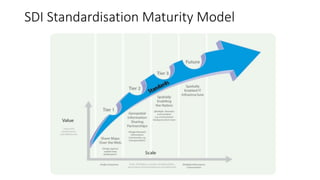
SDI Standardisation Maturity Model
Download at
• www.opengeospatial.org/unggim
and
• http://ggim.un.org/UN%20Resource%20Documents.html
5/108 – August 2015
• (b) Adopted the final published “Guide to the Role of Standards in
Geospatial Information Management” and the “Technical
Compendium” as the international geospatial standards best practice
for spatial data infrastructure, and encouraged all Member States to
adopt and implement the recommended standards appropriate to
their countries’ level of spatial data infrastructure (SDI) maturity.
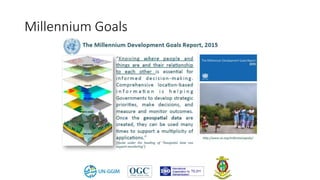
Millennium Goals
Sustainable Development Goals
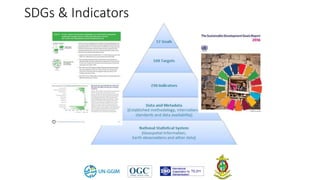
SDGs & Indicators
Sustainable Development Goals
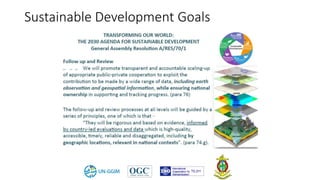
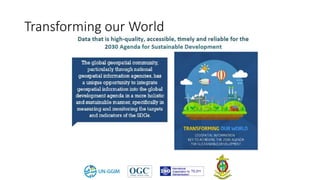
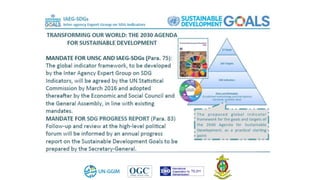
Transforming our World
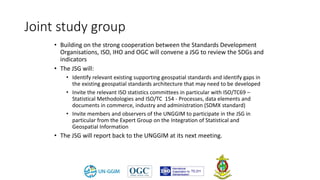
• Building on the strong cooperation between the Standards Development
Organisations, ISO, IHO and OGC will convene a JSG to review the SDGs and
indicators
• The JSG will:
• Identify relevant existing supporting geospatial standards and identify gaps in
the existing geospatial standards architecture that may need to be developed
• Invite the relevant ISO statistics committees in particular with ISO/TC69 –
Statistical Methodologies and ISO/TC 154 - Processes, data elements and
documents in commerce, industry and administration (SDMX standard)
• Invite members and observers of the UNGGIM to participate in the JSG in
particular from the Expert Group on the Integration of Statistical and
Geospatial Information
• The JSG will report back to the UNGGIM at its next meeting.
Joint study group
Goals, Targets, Indicators - Geospatial
• Why are they relevant for the geospatial community?
• More natural and built environment goals
• Approx. 25 indicators that have Geospatial relevance
• With at least 15 of these having a direct geospatial requirement
Key Goals and Indicators Include
• Goals 2,6,9,11,14,15
• Today we will focus on 4 indicators
Goal 6 - Ensure availability and sustainable
management of water and sanitation for all
• 6.3.2
• 6.5.2
• 6.6.1
• Example Dar es Salaam, participatory mapping
Goal 9: Build resilient infrastructure, promote
inclusive and sustainable industrialization and
foster innovation
• 9.1.1
• 9.c.1
• Eg.
Goal 11: Make cities and human settlements
inclusive, safe, resilient and sustainable
• 11.2.1
• 11.3.1
• 11.7.1
• Eg. JTC 1 Smart Cities activities, ESPRESSO,
Goal 15: Protect, restore and promote sustainable
use of terrestrial ecosystems, sustainably manage
forests, combat desertification, and halt and
reverse land degradation and halt biodiversity loss• 15.1.1
• 15.1.2
• 15.3.1
• 15.4.1
• Eg. Good one for Earth Observations
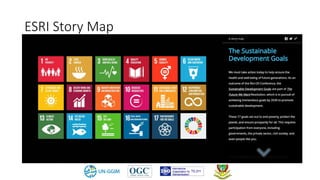
ESRI Story Map
• Use as example of pulling data together
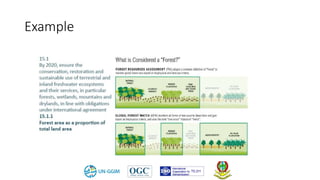
Example
What standards exist already that can be
used?
• Reference to the Guide & Companion Document
Which goals do they relate to?
What standards are under development?
• DGGS
• LADM revision
INSPIRE
ArcticSDP
Best practice examples
• ESRI SDGs Map
• Health & Statistics Maps from Geonovum
What does the document need?
• Audience – Technical/Policy
• Type of document – Guidebook?
Interested to get involved? Contact us
Denise McKenzie
Head of Outreach
0417350716
dmckenzie@opengeospatial.org
Chris Body

2017 Geospatial standards for the sustainable development goals

  • 1.
    Geospatial Standards forthe Sustainable Development Goals Denise McKenzie, OGC Chris Body, ISO TC211 Greg Scott, UNGGIM Secretariat
  • 2.
    Introductions • Denise McKenzie •Chris Body • Greg Scott • Others?
  • 3.
    Questions for today? •What are the SDGs? • Why are they so relevant to the geospatial community? • What standards exist already that we can use now? • Which goals do they relate to? • What standards are under construction? • What standards do we still need? Any other questions people would like answered today?
  • 4.
  • 5.
    International Hydrographic Organization(IHO) • Intergovernmental consultative and technical organization • Established in 1921 • To support safety of navigation and the protection of the marine environment • One of the IHO objectives • to bring about the greatest possible uniformity in nautical charts and documents (i.e. standardization) www.iho.int

  • 6.
    International Organization forStandardization (ISO) • ISO = equal • World's largest developer of standards • Network of national standards institutes from 163 countries • 19 500 standards published • Established in 1946-1947 • Recognized by the UN • Principal activity is developing technical standards • Technical Committees (TCs) • From From food safety to computers, and agriculture to healthcare, ISO International Standards impact all our lives • ISO/TC 211, Geographic information/geomatics • Lawrence D. Eicher Leadership Award in 2010 www.iso.org www.isotc211.org
  • 7.
    Open Geospatial Consortium •Industry consortium of around 500 members • 2000+ implementations of standards and specifications, some certified to be compliant • Focus • to define, document and test implementation standards for use with geospatial content and services • integration of geospatial content and services into applications for the benefit of mankind www.opengeospatial.org
  • 8.
    Co-operation ISO/TC 211, OGCand IHO have been formally – and practically - co-operating since 1994. They also benefit from a range of people working actively in across organizations.
  • 9.
    The standards landscape BasicICT standards and other cross- discipline standards Generic geospatial standards Domain related geospatial standards W3C, OASIS, IETF, IEEE,ISO/IEC JTC1, OMG, etc. ISO/TC 211, OGC, but also others … Many, like IHO, DGIWG, WMO, ICAO, but also OGC and ISO/TC 211
  • 10.
    UN-GGIM and InternationalStandards New York, 13-15 August 2012 Second session of the UN Committee of Experts on Global Geospatial Information Management 2/103 Inventory of issues to be addressed by the UN-GGIM Committee of Experts Concept proposed Suggestion by Technical Committee 211 (geomatics and geographic information) of the International Organization for Standardization (ISO/TC211) to put forward, jointly with the Open Geospatial Consortium (OGC) and the International Hydrographic Organization (IHO), a paper related to standard-setting issues in the international community
  • 11.
    UN-GGIM and InternationalStandards Draft report submitted Second High Level Forum on Global Geospatial Information Management Qatar National Convention Centre, Doha, Qatar, 4-6 February 2013 Full report Third Session of UN-GGIM Committee of Experts Cambridge, UK, 24-27 July 2013
  • 12.
    Existing Standards andthe Inventory of Issues
  • 13.
    4th Meeting ofUNGGIM – New York • 4/110 Implementation and adoption of standards for the global geospatial information community The Committee of Experts: • (c) Agreed that the ‘Guide to the Role of Standards in Geospatial Information Management’ and the ‘Companion Document on Standards Recommendations by Tier’ are important methodological guidelines to assist Member States in implementing and adopting geospatial standards within their national frameworks. • (d) Noted that there is still a need to continue to raise the awareness of standards and related policies to e-government agendas, and that relevant case studies and best practices are an important means to demonstrating the value to decision makers. • (e) Took note of the suggestions by a number of Member States to build on the Guide and Companion Document to include the following areas; case studies, business value proposition, data capture and quality issues, and related policies.
  • 15.
    Purpose • Articulate thecritical role of standards in geospatial information management; • Inform policy makers and program managers in Member States of the value in using and investing in geospatial standardization; and • Describe the benefits of using “open” geospatial standards to achieve standardization, data sharing, and interoperability goals. • To help everyone better understand what standards to use, when and why.
  • 16.
    What, Why &How What is a Standard? Why are Standards important? What is an “open standard”? Why are Open Standards valuable? How are standards developed?
  • 17.
  • 18.
    Download at • www.opengeospatial.org/unggim and •http://ggim.un.org/UN%20Resource%20Documents.html
  • 19.
    5/108 – August2015 • (b) Adopted the final published “Guide to the Role of Standards in Geospatial Information Management” and the “Technical Compendium” as the international geospatial standards best practice for spatial data infrastructure, and encouraged all Member States to adopt and implement the recommended standards appropriate to their countries’ level of spatial data infrastructure (SDI) maturity.
  • 20.
  • 21.
  • 22.
  • 23.
  • 24.
  • 26.
    • Building onthe strong cooperation between the Standards Development Organisations, ISO, IHO and OGC will convene a JSG to review the SDGs and indicators • The JSG will: • Identify relevant existing supporting geospatial standards and identify gaps in the existing geospatial standards architecture that may need to be developed • Invite the relevant ISO statistics committees in particular with ISO/TC69 – Statistical Methodologies and ISO/TC 154 - Processes, data elements and documents in commerce, industry and administration (SDMX standard) • Invite members and observers of the UNGGIM to participate in the JSG in particular from the Expert Group on the Integration of Statistical and Geospatial Information • The JSG will report back to the UNGGIM at its next meeting. Joint study group
  • 27.
    Goals, Targets, Indicators- Geospatial • Why are they relevant for the geospatial community? • More natural and built environment goals • Approx. 25 indicators that have Geospatial relevance • With at least 15 of these having a direct geospatial requirement
  • 28.
    Key Goals andIndicators Include • Goals 2,6,9,11,14,15 • Today we will focus on 4 indicators
  • 29.
    Goal 6 -Ensure availability and sustainable management of water and sanitation for all • 6.3.2 • 6.5.2 • 6.6.1 • Example Dar es Salaam, participatory mapping
  • 30.
    Goal 9: Buildresilient infrastructure, promote inclusive and sustainable industrialization and foster innovation • 9.1.1 • 9.c.1 • Eg.
  • 31.
    Goal 11: Makecities and human settlements inclusive, safe, resilient and sustainable • 11.2.1 • 11.3.1 • 11.7.1 • Eg. JTC 1 Smart Cities activities, ESPRESSO,
  • 32.
    Goal 15: Protect,restore and promote sustainable use of terrestrial ecosystems, sustainably manage forests, combat desertification, and halt and reverse land degradation and halt biodiversity loss• 15.1.1 • 15.1.2 • 15.3.1 • 15.4.1 • Eg. Good one for Earth Observations
  • 33.
    ESRI Story Map •Use as example of pulling data together
  • 34.
  • 35.
    What standards existalready that can be used? • Reference to the Guide & Companion Document
  • 36.
    Which goals dothey relate to?
  • 37.
    What standards areunder development? • DGGS • LADM revision
  • 38.
  • 39.
  • 40.
    Best practice examples •ESRI SDGs Map • Health & Statistics Maps from Geonovum
  • 42.
    What does thedocument need? • Audience – Technical/Policy • Type of document – Guidebook?
  • 43.
    Interested to getinvolved? Contact us Denise McKenzie Head of Outreach 0417350716 dmckenzie@opengeospatial.org Chris Body

Editor's Notes

  • #9 ISO, OGC and IHO have been fomally co-operating since the birth of of IS/TC 211 and OGC in 1994. Co-ordination is secured both through formal mechanisms – like coordination groups – but, equally important, by common people working actively across the standards organizations.
  • #10 As with real landscapes, the SDO landscape is complex and not easy to describe, but we can make a try … The good thing for all of you and many domains there is a lot of cooperation and liasion working together.
  • #15 Thanks to Saudi Arabia for Printing Thanks to Canadian Government for French Translation Thanks to the United Kingdom for the formatting for printing and publication Will be made available for access on the Knowledge Management website and through the SDO webpages
  • #25 http://ggim.un.org/docs/meetings/GGIM6/TRANSFORMING%20OUR%20WORLD.pdf