TAP 320 - 2: Phase difference and superposition

This question helps you check your understanding of phase difference and gives you further
practice in superposing waves.


Graphs of waves


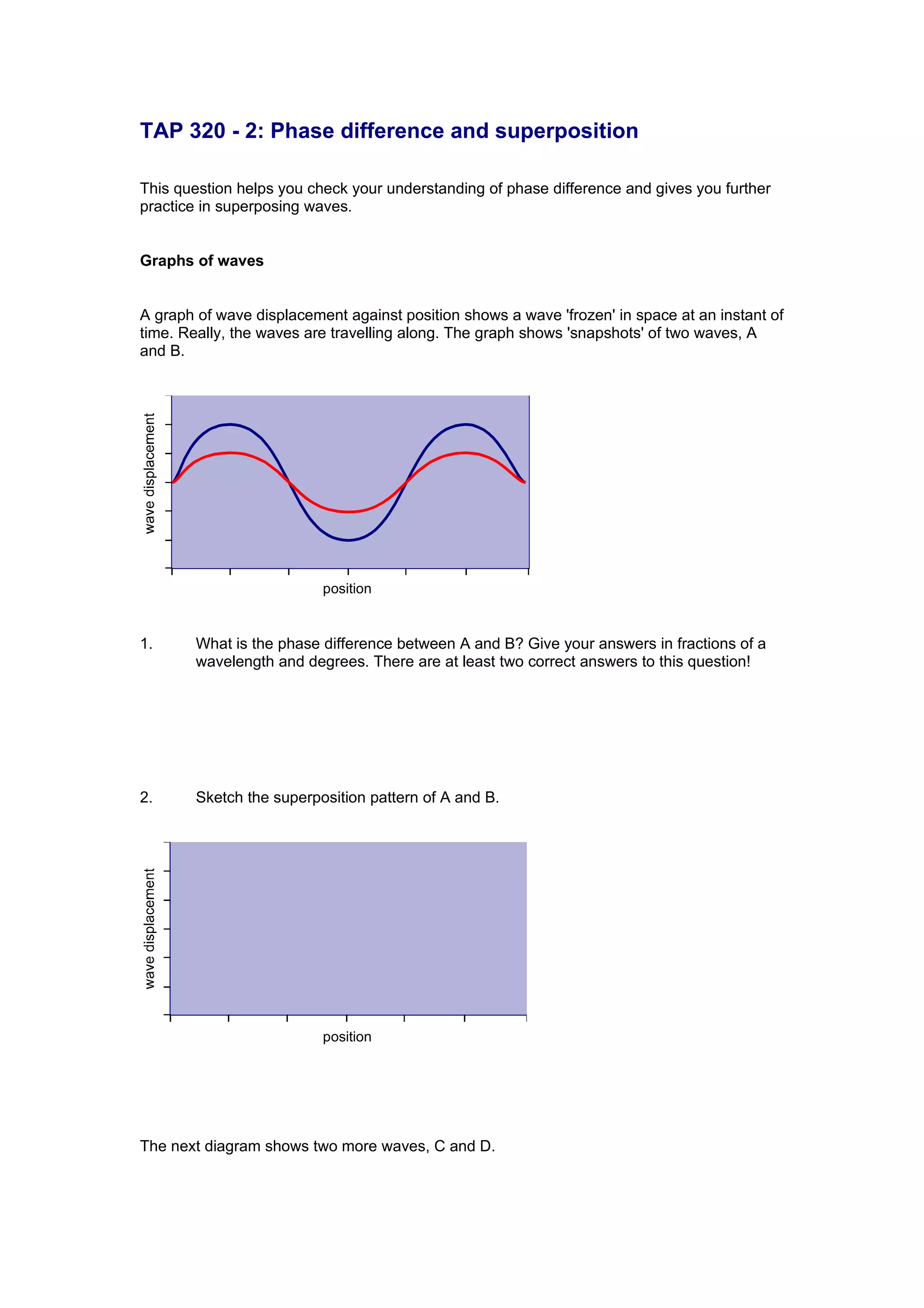
A graph of wave displacement against position shows a wave 'frozen' in space at an instant of
time. Really, the waves are travelling along. The graph shows 'snapshots' of two waves, A
and B.


                          position


1.      What is the phase difference between A and B? Give your answers in fractions of a
        wavelength and degrees. There are at least two correct answers to this question!


2.      Sketch the superposition pattern of A and B.


                          position


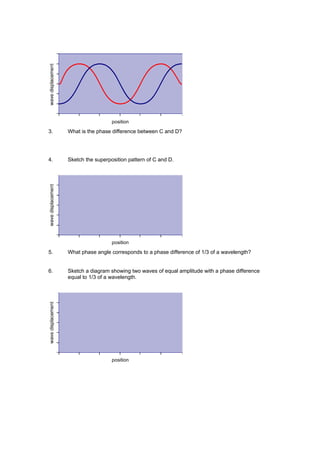
The next diagram shows two more waves, C and D.
position
3.   What is the phase difference between C and D?


4.   Sketch the superposition pattern of C and D.


                       position
5.   What phase angle corresponds to a phase difference of 1/3 of a wavelength?


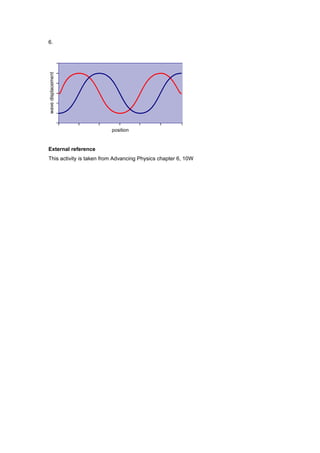
6.   Sketch a diagram showing two waves of equal amplitude with a phase difference
     equal to 1/3 of a wavelength.


                       position
Practical advice
A suitable question to support demonstrations of superposition, phase and path difference.


Answers and worked solutions


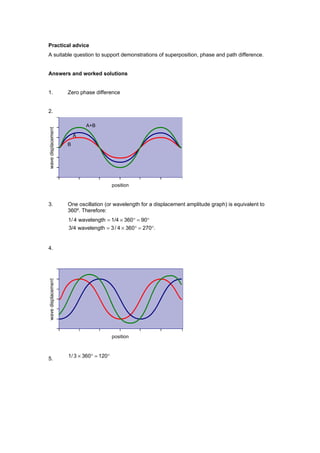
1.      Zero phase difference


2.

                A+B

            A
        B


                             position


3.      One oscillation (or wavelength for a displacement amplitude graph) is equivalent to
        360º. Therefore:
        1/ 4 wavelength = 1/4 × 360° = 90°
        3/4 wavelength = 3 / 4 × 360° = 270°.


4.


                             position


        1/ 3 × 360° = 120°
5.
6.


                          position


External reference
This activity is taken from Advancing Physics chapter 6, 10W

Super Superpostion

  • 1.
    TAP 320 -2: Phase difference and superposition This question helps you check your understanding of phase difference and gives you further practice in superposing waves. Graphs of waves A graph of wave displacement against position shows a wave 'frozen' in space at an instant of time. Really, the waves are travelling along. The graph shows 'snapshots' of two waves, A and B. position 1. What is the phase difference between A and B? Give your answers in fractions of a wavelength and degrees. There are at least two correct answers to this question! 2. Sketch the superposition pattern of A and B. position The next diagram shows two more waves, C and D.
  • 2.
    position 3. What is the phase difference between C and D? 4. Sketch the superposition pattern of C and D. position 5. What phase angle corresponds to a phase difference of 1/3 of a wavelength? 6. Sketch a diagram showing two waves of equal amplitude with a phase difference equal to 1/3 of a wavelength. position
  • 3.
    Practical advice A suitablequestion to support demonstrations of superposition, phase and path difference. Answers and worked solutions 1. Zero phase difference 2. A+B A B position 3. One oscillation (or wavelength for a displacement amplitude graph) is equivalent to 360º. Therefore: 1/ 4 wavelength = 1/4 × 360° = 90° 3/4 wavelength = 3 / 4 × 360° = 270°. 4. position 1/ 3 × 360° = 120° 5.
  • 4.
    6. position External reference This activity is taken from Advancing Physics chapter 6, 10W