Sustaining Online Program Growth and Opportunities for Traditional Program LMS Integration
Edward B. Villanueva | Lead Instructional Systems Designer & LMS Administrator
February | 2015 | evillanueva@ict.edu 1
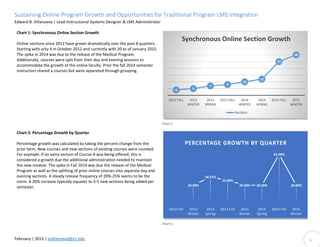
Chart 1: Synchronous Online Section Growth
Online sections since 2012 have grown dramatically over the past 8 quarters.
Starting with only 4 in October 2012 and currently with 20 as of January 2015.
The spike in 2014 was due to the release of the Medical Program.
Additionally, courses were split from their day and evening sessions to
accommodate the growth of the online faculty. Prior the fall 2014 semester
instructors shared a courses but were separated through grouping.
Chart 1
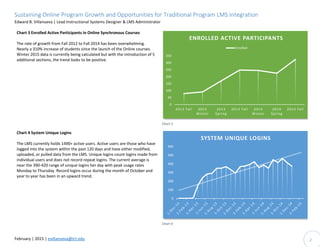
Chart 2: Percentage Growth by Quarter
Percentage growth was calculated by taking the percent change from the
prior term. New courses and new sections of existing courses were counted.
For example. If an extra section of Course A was being offered, this is
considered a growth due the additional administration needed to maintain
the new module. The spike in Fall 2014 was due the release of the Medical
Program as well as the splitting of prior online courses into separate day and
evening sections. A steady release frequency of 20%-25% seems to be the
norm. A 20% increase typically equates to 3-5 new sections being added per
semester.
Chart 2
4 5
7 8
10
12
25
30
2012 FALL 2013
WINTER
2013
SPRING
2013 FALL 2014
WINTER
2014
SPRING
2014 FALL 2015
WINTER
Synchronous Online Section Growth
Sections
20.00%
28.57%
25.00%
20.00% 20.00%
52.00%
20.00%
2012 Fall 2013
Winter
2013
Spring
2013 Fall 2014
Winter
2014
Spring
2014 Fall 2015
Winter
PERCENTAGE GROWTH BY QUARTER
Sustaining Online Program Growth and Opportunities for Traditional Program LMS Integration
Edward B. Villanueva | Lead Instructional Systems Designer & LMS Administrator
February | 2015 | evillanueva@ict.edu 2
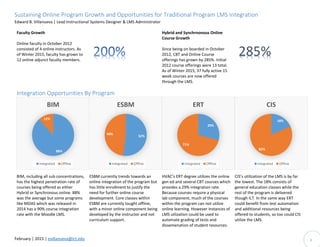
Chart 3 Enrolled Active Participants in Online Synchronous Courses
The rate of growth from Fall 2012 to Fall 2014 has been overwhelming.
Nearly a 310% increase of students since the launch of the Online courses.
Winter 2015 data is currently being calculated but with the introduction of 5
additional sections, the trend looks to be positive.
Chart 3
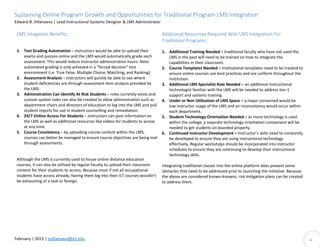
Chart 4 System Unique Logins
The LMS currently holds 1490+ active users. Active users are those who have
logged into the system within the past 120 days and have either modified,
uploaded, or pulled data from the LMS. Unique logins count logins made from
individual users and does not record repeat logins. The current average is
near the 390-420 range of unique logins her day with peak usage rates
Monday to Thursday. Record logins occur during the month of October and
year to year has been in an upward trend.
Chart 4
0
50
100
150
200
250
300
350
2012 Fall 2013
Winter
2013
Spring
2013 Fall 2014
Winter
2014
Spring
2014 Fall
ENROLLED ACTIVE PARTICIPANTS
Enrolled
0
100
200
300
400
500
600
SYSTEM UNIQUE LOGINS
Sustaining Online Program Growth and Opportunities for Traditional Program LMS Integration
Edward B. Villanueva | Lead Instructional Systems Designer & LMS Administrator
February | 2015 | evillanueva@ict.edu 3
Faculty Growth
Online faculty in October 2012
consisted of 4 online instructors. As
of Winter 2015, faculty has grown to
12 online adjunct faculty members.
Hybrid and Synchrnonous Online
Course Growth
Since being on boarded in October
2012, CBT and Online Course
offerings has grown by 285%. Initial
2012 course offerings were 13 total.
As of Winter 2015, 37 fully active 15
week courses are now offered
through the LMS.
Integration Opportunities By Program
BIM, including all sub concentrations,
has the highest penetration rate of
courses being offered as either
Hybrid or Synchronous online. 88%
was the average but some programs
like MOAS which was released in
2014 has a 90% course integration
rate with the Moodle LMS.
ESBM currently trends towards an
online integration of the program but
has little enrollment to justify the
need for further online course
development. Core classes within
ESBM are currently tought offline,
with a minor online component being
developed by the instructor and not
curriculum support.
HVAC’s ERT degree utilizes the online
gen ed and several CBT courses which
provides a 29% integration rate.
Because courses require a physical
lab component, much of the courses
within the program can not utilize
online learning. However instances of
LMS utlization could be used to
automate grading of tests and
dissemenation of student resources.
CIS’s utilization of the LMS is by far
the lowest. The 18% consists of
general education classes while the
rest of the program is delivered
though ILT. In the same way ERT
could benefit from test automation
and additional resources being
offered to students, so too could CIS
utilize the LMS.
88%
12%
BIM
Integrated Offline
52%
48%
ESBM
Integrated Offline
29%
71%
ERT
Integrated Offline
18%
82%
CIS
Integrated Offline
285%
Sustaining Online Program Growth and Opportunities for Traditional Program LMS Integration
Edward B. Villanueva | Lead Instructional Systems Designer & LMS Administrator
February | 2015 | evillanueva@ict.edu 4
LMS Integation Benefits:
1. Test Grading Automation – instructors would be able to upload their
exams and quizzes online and the LMS would automatically grade each
assessment. This would reduce instructor administration hours. Note:
automated grading is only achieved in a “forced decision” test
environment (i.e. True False, Multiple Choice, Matching, and Ranking).
2. Assessment Analysis – instructors will quickly be able to see where
student deficiencies are through assessment item analysis provided by
the LMS.
3. Administration Can Identify At Risk Students – roles currently exists and
custom system roles can also be created to allow administration such as
department chairs and directors of education to log into the LMS and pull
student reports for use in student counselling and remediation.
4. 24/7 Online Access For Students – instructors can post information on
the LMS as well as additional resources like videos for students to access
at any time.
5. Course Consistency – by uploading course content within the LMS,
courses can better be managed to ensure course objectives are being met
through assessments.
Although the LMS is currently used to house online distance education
courses, it can also be utilized by regular faculty to upload their classroom
content for their students to access. Because most if not all occupational
students have access already, having them log into their ILT courses wouldn’t
be exhausting of a task or foreign.
Additional Resources Required With LMS Integration For
Traditional Programs:
1. Additional Training Needed – traditional faculty who have not used the
LMS in the past will need to be trained on how to integrate the
capabilities in their classroom.
2. Course Templates Needed – institutional templates need to be created to
ensure online courses use best practices and are uniform throughout the
institution.
3. Additional LMS Specialist Role Needed – an additional instructional
technologist familiar with the LMS will be needed to address tier-1
support and systems training.
4. Under or Non Utilization of LMS Space – a major concerned would be
low instructor usage of the LMS and an inconsistency would occur within
each department.
5. Student Technology Orientation Needed – as more technology is used
within the college, a separate technology orientation component will be
needed to get students on boarded properly.
6. Continued Instructor Development – instructor’s skills need to constantly
be developed to ensure they are using instructional technology
effectively. Regular workshops should be incorporated into instructor
schedules to ensure they are continuing to develop their instructional
technology skills.
Integrating traditional classes into the online platform does present some
obstacles that need to be addressed prior to launching the initiative. Because
the above are considered known-knowns, risk mitigation plans can be created
to address them.

Online Program Growth & Opportunities for Traditional Program LMS Integration

  • 1.
    Sustaining Online ProgramGrowth and Opportunities for Traditional Program LMS Integration Edward B. Villanueva | Lead Instructional Systems Designer & LMS Administrator February | 2015 | evillanueva@ict.edu 1 Chart 1: Synchronous Online Section Growth Online sections since 2012 have grown dramatically over the past 8 quarters. Starting with only 4 in October 2012 and currently with 20 as of January 2015. The spike in 2014 was due to the release of the Medical Program. Additionally, courses were split from their day and evening sessions to accommodate the growth of the online faculty. Prior the fall 2014 semester instructors shared a courses but were separated through grouping. Chart 1 Chart 2: Percentage Growth by Quarter Percentage growth was calculated by taking the percent change from the prior term. New courses and new sections of existing courses were counted. For example. If an extra section of Course A was being offered, this is considered a growth due the additional administration needed to maintain the new module. The spike in Fall 2014 was due the release of the Medical Program as well as the splitting of prior online courses into separate day and evening sections. A steady release frequency of 20%-25% seems to be the norm. A 20% increase typically equates to 3-5 new sections being added per semester. Chart 2 4 5 7 8 10 12 25 30 2012 FALL 2013 WINTER 2013 SPRING 2013 FALL 2014 WINTER 2014 SPRING 2014 FALL 2015 WINTER Synchronous Online Section Growth Sections 20.00% 28.57% 25.00% 20.00% 20.00% 52.00% 20.00% 2012 Fall 2013 Winter 2013 Spring 2013 Fall 2014 Winter 2014 Spring 2014 Fall 2015 Winter PERCENTAGE GROWTH BY QUARTER
  • 2.
    Sustaining Online ProgramGrowth and Opportunities for Traditional Program LMS Integration Edward B. Villanueva | Lead Instructional Systems Designer & LMS Administrator February | 2015 | evillanueva@ict.edu 2 Chart 3 Enrolled Active Participants in Online Synchronous Courses The rate of growth from Fall 2012 to Fall 2014 has been overwhelming. Nearly a 310% increase of students since the launch of the Online courses. Winter 2015 data is currently being calculated but with the introduction of 5 additional sections, the trend looks to be positive. Chart 3 Chart 4 System Unique Logins The LMS currently holds 1490+ active users. Active users are those who have logged into the system within the past 120 days and have either modified, uploaded, or pulled data from the LMS. Unique logins count logins made from individual users and does not record repeat logins. The current average is near the 390-420 range of unique logins her day with peak usage rates Monday to Thursday. Record logins occur during the month of October and year to year has been in an upward trend. Chart 4 0 50 100 150 200 250 300 350 2012 Fall 2013 Winter 2013 Spring 2013 Fall 2014 Winter 2014 Spring 2014 Fall ENROLLED ACTIVE PARTICIPANTS Enrolled 0 100 200 300 400 500 600 SYSTEM UNIQUE LOGINS
  • 3.
    Sustaining Online ProgramGrowth and Opportunities for Traditional Program LMS Integration Edward B. Villanueva | Lead Instructional Systems Designer & LMS Administrator February | 2015 | evillanueva@ict.edu 3 Faculty Growth Online faculty in October 2012 consisted of 4 online instructors. As of Winter 2015, faculty has grown to 12 online adjunct faculty members. Hybrid and Synchrnonous Online Course Growth Since being on boarded in October 2012, CBT and Online Course offerings has grown by 285%. Initial 2012 course offerings were 13 total. As of Winter 2015, 37 fully active 15 week courses are now offered through the LMS. Integration Opportunities By Program BIM, including all sub concentrations, has the highest penetration rate of courses being offered as either Hybrid or Synchronous online. 88% was the average but some programs like MOAS which was released in 2014 has a 90% course integration rate with the Moodle LMS. ESBM currently trends towards an online integration of the program but has little enrollment to justify the need for further online course development. Core classes within ESBM are currently tought offline, with a minor online component being developed by the instructor and not curriculum support. HVAC’s ERT degree utilizes the online gen ed and several CBT courses which provides a 29% integration rate. Because courses require a physical lab component, much of the courses within the program can not utilize online learning. However instances of LMS utlization could be used to automate grading of tests and dissemenation of student resources. CIS’s utilization of the LMS is by far the lowest. The 18% consists of general education classes while the rest of the program is delivered though ILT. In the same way ERT could benefit from test automation and additional resources being offered to students, so too could CIS utilize the LMS. 88% 12% BIM Integrated Offline 52% 48% ESBM Integrated Offline 29% 71% ERT Integrated Offline 18% 82% CIS Integrated Offline 285%
  • 4.
    Sustaining Online ProgramGrowth and Opportunities for Traditional Program LMS Integration Edward B. Villanueva | Lead Instructional Systems Designer & LMS Administrator February | 2015 | evillanueva@ict.edu 4 LMS Integation Benefits: 1. Test Grading Automation – instructors would be able to upload their exams and quizzes online and the LMS would automatically grade each assessment. This would reduce instructor administration hours. Note: automated grading is only achieved in a “forced decision” test environment (i.e. True False, Multiple Choice, Matching, and Ranking). 2. Assessment Analysis – instructors will quickly be able to see where student deficiencies are through assessment item analysis provided by the LMS. 3. Administration Can Identify At Risk Students – roles currently exists and custom system roles can also be created to allow administration such as department chairs and directors of education to log into the LMS and pull student reports for use in student counselling and remediation. 4. 24/7 Online Access For Students – instructors can post information on the LMS as well as additional resources like videos for students to access at any time. 5. Course Consistency – by uploading course content within the LMS, courses can better be managed to ensure course objectives are being met through assessments. Although the LMS is currently used to house online distance education courses, it can also be utilized by regular faculty to upload their classroom content for their students to access. Because most if not all occupational students have access already, having them log into their ILT courses wouldn’t be exhausting of a task or foreign. Additional Resources Required With LMS Integration For Traditional Programs: 1. Additional Training Needed – traditional faculty who have not used the LMS in the past will need to be trained on how to integrate the capabilities in their classroom. 2. Course Templates Needed – institutional templates need to be created to ensure online courses use best practices and are uniform throughout the institution. 3. Additional LMS Specialist Role Needed – an additional instructional technologist familiar with the LMS will be needed to address tier-1 support and systems training. 4. Under or Non Utilization of LMS Space – a major concerned would be low instructor usage of the LMS and an inconsistency would occur within each department. 5. Student Technology Orientation Needed – as more technology is used within the college, a separate technology orientation component will be needed to get students on boarded properly. 6. Continued Instructor Development – instructor’s skills need to constantly be developed to ensure they are using instructional technology effectively. Regular workshops should be incorporated into instructor schedules to ensure they are continuing to develop their instructional technology skills. Integrating traditional classes into the online platform does present some obstacles that need to be addressed prior to launching the initiative. Because the above are considered known-knowns, risk mitigation plans can be created to address them.