DIFFERENCES IN
LEARNERS
Language Acquisition
Andrea Campaña
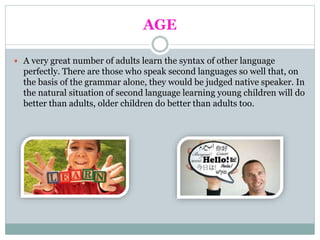
AGE
 A very great number of adults learn the syntax of other language
perfectly. There are those who speak second languages so well that, on
the basis of the grammar alone, they would be judged native speaker. In
the natural situation of second language learning young children will do
better than adults, older children do better than adults too.
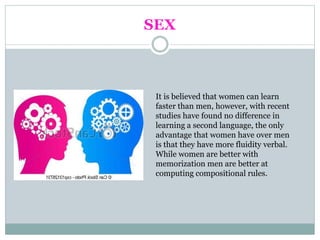
SEX
It is believed that women can learn
faster than men, however, with recent
studies have found no difference in
learning a second language, the only
advantage that women have over men
is that they have more fluidity verbal.
While women are better with
memorization men are better at
computing compositional rules.
APTITUDE
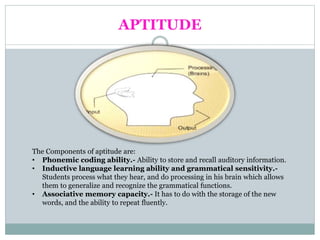
The Components of aptitude are:
• Phonemic coding ability.- Ability to store and recall auditory information.
• Inductive language learning ability and grammatical sensitivity.-
Students process what they hear, and do processing in his brain which allows
them to generalize and recognize the grammatical functions.
• Associative memory capacity.- It has to do with the storage of the new
words, and the ability to repeat fluently.
MOTIVATION
There are a large number of
variables involved in second-
language learning, such as
intergroup attitudes, desire to
communicate with a particular
person. Teachers are generally
well aware of this possibility and
often devise ways to increase
positive motivation and attitudes.
Motivation includes at least the following
component:
• Significant goal or need
• Desire to attain the goal
• Perception that learning L2 is relevant
to fulfilling the goal or meeting the need
• Belief in the likely success or failure of
learning L2
• Value of potential outcomes/rewards
COGNITIVE STYLE
This is related to the preference of
the learner to process information
The cognitive styles are:
• Field-independent
• Particular
• Analytic
• Inductive
• Focus on form
• Field-dependent
• Global
• Holistic
• Deductive
• Focus on meaning
PERSONALITY
Personality plays a very important role in language
learning, and this is closely related to learning style.
A student with a positive personality feels more
motivated to learn, as one who has a little negative
and optimistic personality will notice the effect on
their learning.
• Anxious
• Risk-avoiding
• Shy
• Introverted
• Inner-directed
• Reflective
• Imaginative
• Creative
• Empathethic
• Tolerant of
ambiguity
• Selft-confident
• Risk-taking
• Adventuresome
• Extroverted
• Other-directed
• Impulsive
• Uniquisitive
• Uncreative
• Insensitive to
others
• Closure-oriented
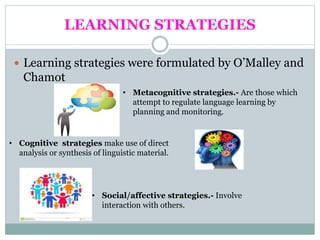
LEARNING STRATEGIES
 Learning strategies were formulated by O’Malley and
Chamot
• Metacognitive strategies.- Are those which
attempt to regulate language learning by
planning and monitoring.
• Cognitive strategies make use of direct
analysis or synthesis of linguistic material.
• Social/affective strategies.- Involve
interaction with others.

Act1.4.campaña mejiaandrea.languageacquisition

  • 1.
  • 2.
    AGE  A verygreat number of adults learn the syntax of other language perfectly. There are those who speak second languages so well that, on the basis of the grammar alone, they would be judged native speaker. In the natural situation of second language learning young children will do better than adults, older children do better than adults too.
  • 3.
    SEX It is believedthat women can learn faster than men, however, with recent studies have found no difference in learning a second language, the only advantage that women have over men is that they have more fluidity verbal. While women are better with memorization men are better at computing compositional rules.
  • 4.
    APTITUDE The Components ofaptitude are: • Phonemic coding ability.- Ability to store and recall auditory information. • Inductive language learning ability and grammatical sensitivity.- Students process what they hear, and do processing in his brain which allows them to generalize and recognize the grammatical functions. • Associative memory capacity.- It has to do with the storage of the new words, and the ability to repeat fluently.
  • 5.
    MOTIVATION There are alarge number of variables involved in second- language learning, such as intergroup attitudes, desire to communicate with a particular person. Teachers are generally well aware of this possibility and often devise ways to increase positive motivation and attitudes. Motivation includes at least the following component: • Significant goal or need • Desire to attain the goal • Perception that learning L2 is relevant to fulfilling the goal or meeting the need • Belief in the likely success or failure of learning L2 • Value of potential outcomes/rewards
  • 6.
    COGNITIVE STYLE This isrelated to the preference of the learner to process information The cognitive styles are: • Field-independent • Particular • Analytic • Inductive • Focus on form • Field-dependent • Global • Holistic • Deductive • Focus on meaning
  • 7.
    PERSONALITY Personality plays avery important role in language learning, and this is closely related to learning style. A student with a positive personality feels more motivated to learn, as one who has a little negative and optimistic personality will notice the effect on their learning. • Anxious • Risk-avoiding • Shy • Introverted • Inner-directed • Reflective • Imaginative • Creative • Empathethic • Tolerant of ambiguity • Selft-confident • Risk-taking • Adventuresome • Extroverted • Other-directed • Impulsive • Uniquisitive • Uncreative • Insensitive to others • Closure-oriented
  • 8.
    LEARNING STRATEGIES  Learningstrategies were formulated by O’Malley and Chamot • Metacognitive strategies.- Are those which attempt to regulate language learning by planning and monitoring. • Cognitive strategies make use of direct analysis or synthesis of linguistic material. • Social/affective strategies.- Involve interaction with others.