LIVER HYDATIDLIVER HYDATID
DISEASE:ETHIOLOGY,DISEASE:ETHIOLOGY,
DIAGNOSTIC & SURGICALDIAGNOSTIC & SURGICAL
TREATMENTTREATMENT
prof.prof. Boyukkishi AgayevBoyukkishi Agayev
Azerbaijan Medical UniversityAzerbaijan Medical University
Institute of Clinical Medicine,Institute of Clinical Medicine,
BakuBaku
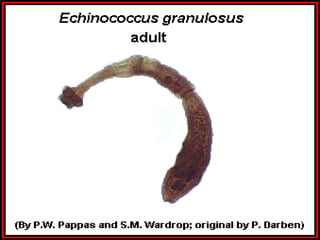
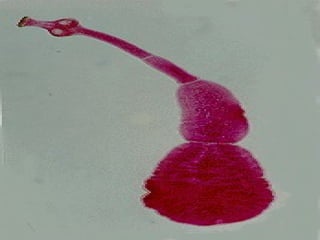
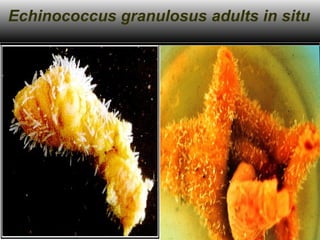
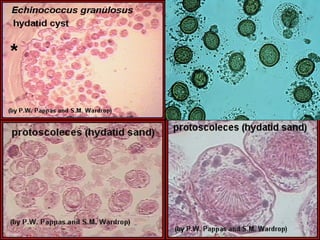
Echinococcus granulosus adults in situ
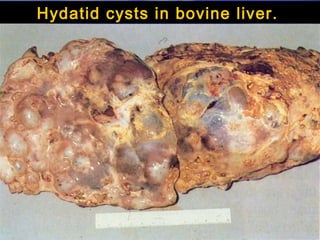
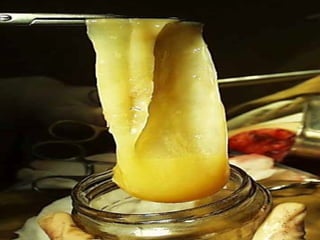
Hydatid cysts in bovine liver.
Ways of Contamination:Ways of Contamination:
• Through Gastrointestinal tractThrough Gastrointestinal tract
• Through Respiratory tractThrough Respiratory tract
• Through Wound SurfaceThrough Wound Surface
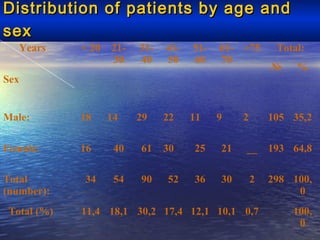
Distribution of patients by age andDistribution of patients by age and
sexsex
Years
Sex
< 20 21-
30
31-
40
41-
50
51-
60
61-
70
>75 Total:
№ %
Male: 18 14 29 22 11 9 2 105 35,2
Female: 16 40 61 30 25 21 __ 193 64,8
Total
(number):
34 54 90 52 36 30 2 298 100,
0
Total (%) 11,4 18,1 30,2 17,4 12,1 10,1 0,7 100,
0
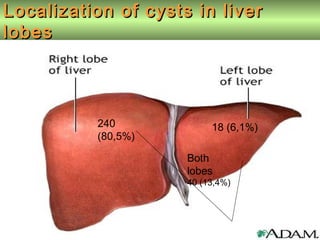
Localization of cysts in liverLocalization of cysts in liver
lobeslobes
240
(80,5%)
18 (6,1%)
Both lobes –
40 (13,4%)
Both
lobes
40 (13,4%)
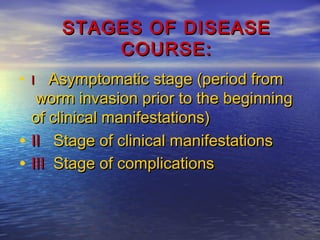
STAGES OF DISEASESTAGES OF DISEASE
COURSE:COURSE:
• II Asymptomatic stage (period fromAsymptomatic stage (period from
worm invasion prior to the beginningworm invasion prior to the beginning
of clinical manifestations)of clinical manifestations)
• IIII Stage of clinical manifestationsStage of clinical manifestations
• IIIIII Stage of complicationsStage of complications
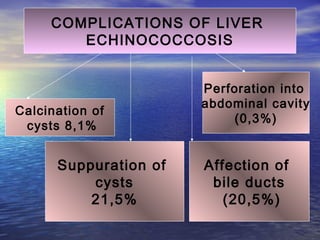
COMPLICATIONS OF LIVER
ECHINOCOCCOSIS
Calcination of
cysts 8,1%
Suppuration of
cysts
21,5%
Affection of
bile ducts
(20,5%)
Perforation into
abdominal cavity
(0,3%)
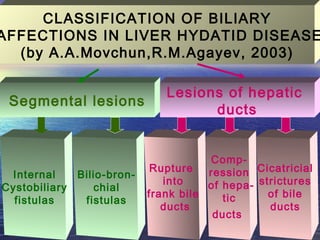
CLASSIFICATION OF BILIARY
AFFECTIONS IN LIVER HYDATID DISEASE
(by A.A.Movchun,R.M.Agayev, 2003)
Segmental lesions
Lesions of hepatic
ducts
Internal
Cystobiliary
fistulas
Bilio-bron-
chial
fistulas
Rupture
into
frank bile
ducts
Comp-
ression
of hepa-
tic
ducts
Cicatricial
strictures
of bile
ducts
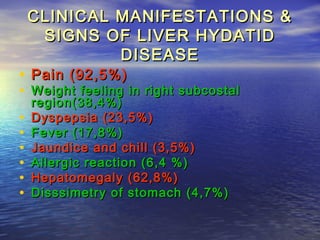
CLINICAL MANIFESTATIONS &CLINICAL MANIFESTATIONS &
SIGNS OF LIVER HYDATIDSIGNS OF LIVER HYDATID
DISEASEDISEASE
• Pain (92,5%)Pain (92,5%)
• Weight feeling in right subcostalWeight feeling in right subcostal
region(38,4%)region(38,4%)
• Dyspepsia (23,5%)Dyspepsia (23,5%)
• Fever (17,8%)Fever (17,8%)
• Jaundice and chill (3,5%)Jaundice and chill (3,5%)
• Allergic reaction (6,4 %)Allergic reaction (6,4 %)
• Hepatomegaly (62,8%)Hepatomegaly (62,8%)
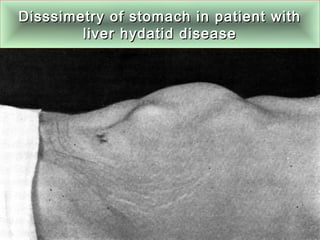
• Disssimetry of stomach (4,7%)Disssimetry of stomach (4,7%)
Disssimetry of stomach in patient withDisssimetry of stomach in patient with
liver hydatid diseaseliver hydatid disease
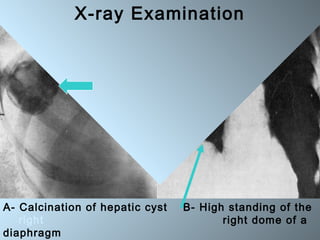
A- Calcination of hepatic cyst B- High standing of the
right right dome of a
diaphragm
X-ray Examination
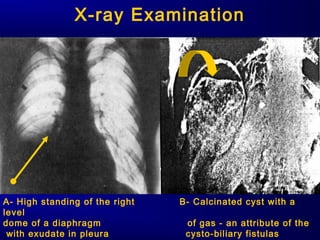
X-ray Examination
A- High standing of the right B- Calcinated cyst with a
level
dome of a diaphragm of gas - an attribute of the
with exudate in pleura cysto-biliary fistulas
UltrasonographyUltrasonography
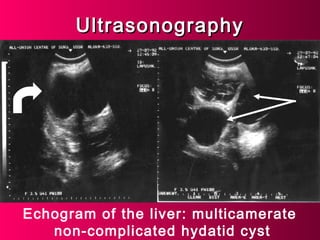
Echogram of the liver: multicamerate
non-complicated hydatid cyst
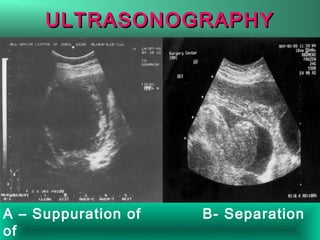
ULTRASONOGRAPHYULTRASONOGRAPHY
A – Suppuration of B- Separation
of
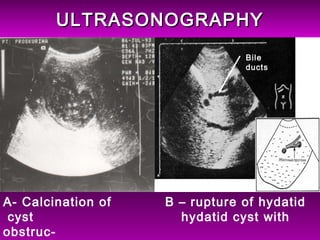
ULTRASONOGRAPHYULTRASONOGRAPHY
A- Calcination of B – rupture of hydatid
cyst hydatid cyst with
obstruc-
Bile
ducts
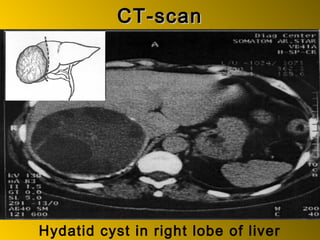
CT-scanCT-scan
Hydatid cyst in right lobe of liver
CT-scanCT-scan
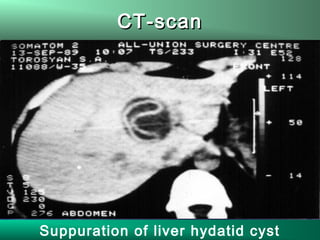
Suppuration of liver hydatid cyst
CT-scanCT-scan
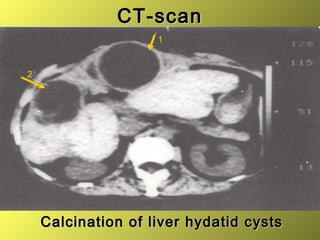
Calcination of liver hydatid cystsCalcination of liver hydatid cysts
1
2
CT-scanCT-scan
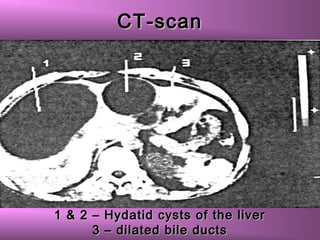
1 & 2 – Hydatid cysts of the liver1 & 2 – Hydatid cysts of the liver
3 – dilated bile ducts3 – dilated bile ducts
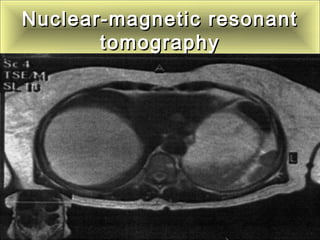
Nuclear-magnetic resonantNuclear-magnetic resonant
tomographytomography
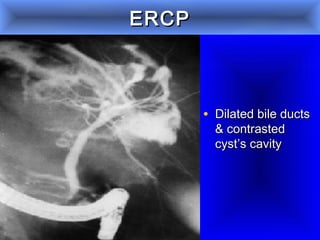
ERCPERCP
• Dilated bile ductsDilated bile ducts
& contrasted& contrasted
cyst’s cavitycyst’s cavity
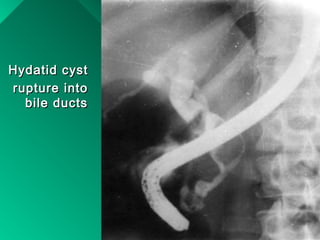
ERCPERCP
Hydatid cystHydatid cyst
rupture intorupture into
bile ductsbile ducts
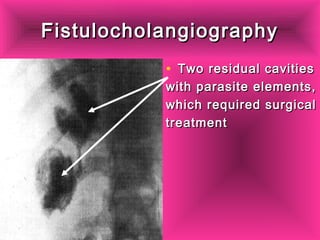
FistulocholangiographyFistulocholangiography
• Two residual cavitiesTwo residual cavities
with parasite elements,with parasite elements,
which required surgicalwhich required surgical
treatmenttreatment
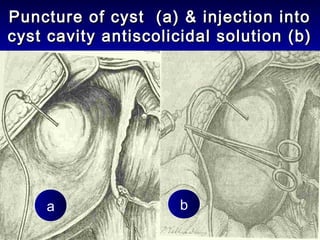
Puncture of cyst (a) & injection intoPuncture of cyst (a) & injection into
cyst cavity antiscolicidal solution (b)cyst cavity antiscolicidal solution (b)
a b
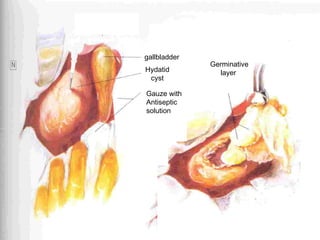
Germinative
layer
Gauze with
Antiseptic
solution
Hydatid
cyst
gallbladder
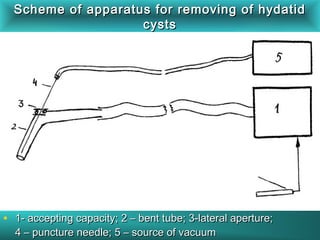
Scheme of apparatus for removing of hydatidScheme of apparatus for removing of hydatid
cystscysts
• 1- accepting capacity; 2 – bent tube; 3-lateral aperture;1- accepting capacity; 2 – bent tube; 3-lateral aperture;
4 – puncture needle; 5 – source of vacuum4 – puncture needle; 5 – source of vacuum
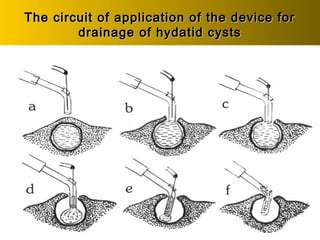
The circuit of application of the device forThe circuit of application of the device for
drainage of hydatid cystsdrainage of hydatid cysts
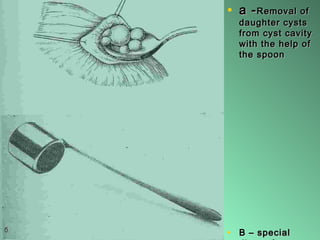
• a -a -Removal ofRemoval of
daughter cystsdaughter cysts
from cyst cavityfrom cyst cavity
with the help ofwith the help of
the spoonthe spoon
• B – specialB – special
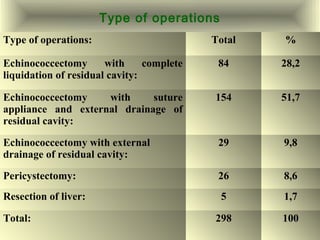
Type of operations
Type of operations: Total %
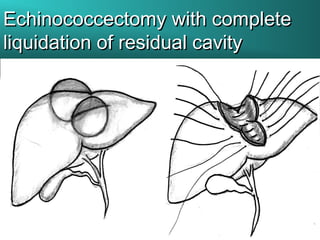
Echinococcectomy with complete
liquidation of residual cavity:
84 28,2
Echinococcectomy with suture
appliance and external drainage of
residual cavity:
154 51,7
Echinococcectomy with external
drainage of residual cavity:
29 9,8
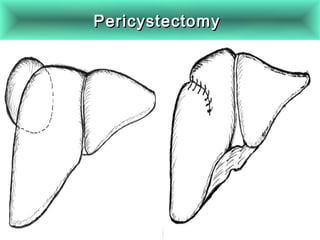
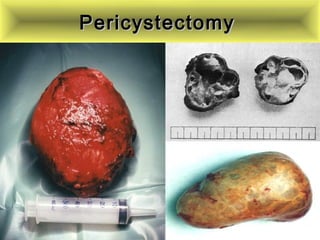
Pericystectomy: 26 8,6
Resection of liver: 5 1,7
Total: 298 100
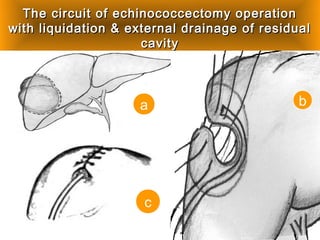
The circuit of echinococcectomy operationThe circuit of echinococcectomy operation
with liquidation & external drainage of residualwith liquidation & external drainage of residual
cavitycavity
a b
c
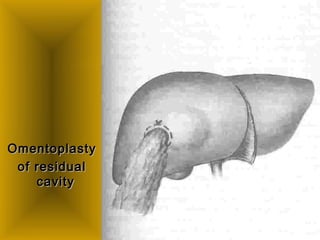
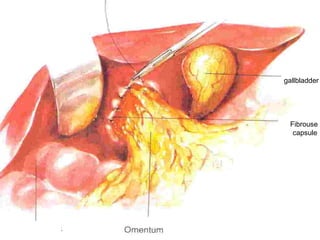
OmentoplastyOmentoplasty
of residualof residual
cavitycavity
gallbladder
Fibrouse
capsule
Echinococcectomy with completeEchinococcectomy with complete
liquidation of residual cavityliquidation of residual cavity
PericystectomyPericystectomy
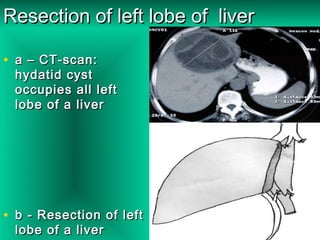
Resection of left lobe of liverResection of left lobe of liver
• a – CT-scan:a – CT-scan:
hydatid cysthydatid cyst
occupies all leftoccupies all left
lobe of a liverlobe of a liver
• b - Resection of leftb - Resection of left
lobe of a liverlobe of a liver
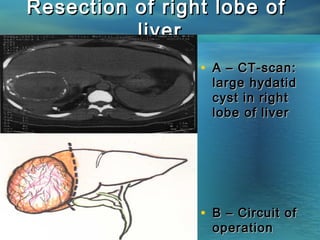
Resection of right lobe ofResection of right lobe of
liverliver
• A – CT-scan:A – CT-scan:
large hydatidlarge hydatid
cyst in rightcyst in right
lobe of liverlobe of liver
• B – Circuit ofB – Circuit of
operationoperation
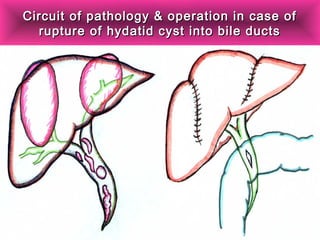
Circuit of pathology & operation in case ofCircuit of pathology & operation in case of
rupture of hydatid cyst into bile ductsrupture of hydatid cyst into bile ducts
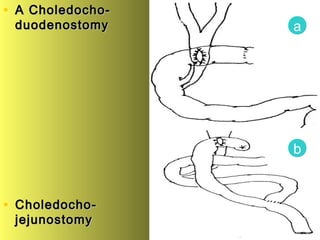
• A Choledocho-A Choledocho-
duodenostomyduodenostomy
• Choledocho-Choledocho-
jejunostomyjejunostomy
a
b
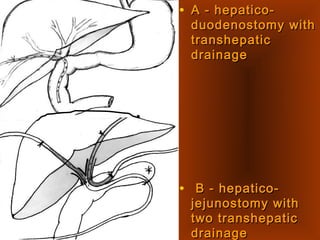
• A - hepatico-A - hepatico-
duodenostomy withduodenostomy with
transhepatictranshepatic
drainagedrainage
• B - hepatico-B - hepatico-
jejunostomy withjejunostomy with
two transhepatictwo transhepatic
drainagedrainage
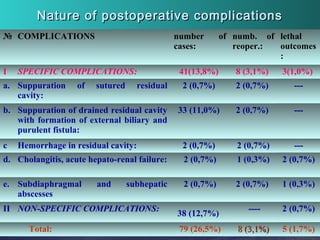
Nature of postoperative complicationsNature of postoperative complications
№ COMPLICATIONS number of
cases:
numb. of
reoper.:
lethal
outcomes
:
I SPECIFIC COMPLICATIONS: 41(13,8%) 8 (3,1%) 3(1,0%)
a. Suppuration of sutured residual
cavity:
2 (0,7%) 2 (0,7%) ---
b. Suppuration of drained residual cavity
with formation of external biliary and
purulent fistula:
33 (11,0%) 2 (0,7%) ---
c Hemorrhage in residual cavity: 2 (0,7%) 2 (0,7%) ---
d. Cholangitis, acute hepato-renal failure: 2 (0,7%) 1 (0,3%) 2 (0,7%)
e. Subdiaphragmal and subhepatic
abscesses
2 (0,7%) 2 (0,7%) 1 (0,3%)
II NON-SPECIFIC COMPLICATIONS:
38 (12,7%)
---- 2 (0,7%)
Total: 79 (26,5%) 8 (3,1%)8 (3,1%) 5 (1,7%)
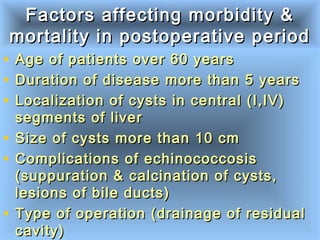
Factors affecting morbidity &Factors affecting morbidity &
mortality in postoperative periodmortality in postoperative period
• Age of patients over 60 yearsAge of patients over 60 years
• Duration of disease more than 5 yearsDuration of disease more than 5 years
• Localization of cysts in central (I,IV)Localization of cysts in central (I,IV)
segments of liversegments of liver
• Size of cysts more than 10 cmSize of cysts more than 10 cm
• Complications of echinococcosisComplications of echinococcosis
(suppuration & calcination of cysts,(suppuration & calcination of cysts,
lesions of bile ducts)lesions of bile ducts)
• Type of operation (drainage of residualType of operation (drainage of residual
cavity)cavity)
Thanks for your attention
Looking forward
to see you in
Baku

Liver Hydadit disease. Akad. B.Agaev

  • 1.
    LIVER HYDATIDLIVER HYDATID DISEASE:ETHIOLOGY,DISEASE:ETHIOLOGY, DIAGNOSTIC& SURGICALDIAGNOSTIC & SURGICAL TREATMENTTREATMENT prof.prof. Boyukkishi AgayevBoyukkishi Agayev Azerbaijan Medical UniversityAzerbaijan Medical University Institute of Clinical Medicine,Institute of Clinical Medicine, BakuBaku
  • 4.
  • 6.
    Hydatid cysts inbovine liver.
  • 9.
    Ways of Contamination:Waysof Contamination: • Through Gastrointestinal tractThrough Gastrointestinal tract • Through Respiratory tractThrough Respiratory tract • Through Wound SurfaceThrough Wound Surface
  • 11.
    Distribution of patientsby age andDistribution of patients by age and sexsex Years Sex < 20 21- 30 31- 40 41- 50 51- 60 61- 70 >75 Total: № % Male: 18 14 29 22 11 9 2 105 35,2 Female: 16 40 61 30 25 21 __ 193 64,8 Total (number): 34 54 90 52 36 30 2 298 100, 0 Total (%) 11,4 18,1 30,2 17,4 12,1 10,1 0,7 100, 0
  • 12.
    Localization of cystsin liverLocalization of cysts in liver lobeslobes 240 (80,5%) 18 (6,1%) Both lobes – 40 (13,4%) Both lobes 40 (13,4%)
  • 13.
    STAGES OF DISEASESTAGESOF DISEASE COURSE:COURSE: • II Asymptomatic stage (period fromAsymptomatic stage (period from worm invasion prior to the beginningworm invasion prior to the beginning of clinical manifestations)of clinical manifestations) • IIII Stage of clinical manifestationsStage of clinical manifestations • IIIIII Stage of complicationsStage of complications
  • 14.
    COMPLICATIONS OF LIVER ECHINOCOCCOSIS Calcinationof cysts 8,1% Suppuration of cysts 21,5% Affection of bile ducts (20,5%) Perforation into abdominal cavity (0,3%)
  • 15.
    CLASSIFICATION OF BILIARY AFFECTIONSIN LIVER HYDATID DISEASE (by A.A.Movchun,R.M.Agayev, 2003) Segmental lesions Lesions of hepatic ducts Internal Cystobiliary fistulas Bilio-bron- chial fistulas Rupture into frank bile ducts Comp- ression of hepa- tic ducts Cicatricial strictures of bile ducts
  • 16.
    CLINICAL MANIFESTATIONS &CLINICALMANIFESTATIONS & SIGNS OF LIVER HYDATIDSIGNS OF LIVER HYDATID DISEASEDISEASE • Pain (92,5%)Pain (92,5%) • Weight feeling in right subcostalWeight feeling in right subcostal region(38,4%)region(38,4%) • Dyspepsia (23,5%)Dyspepsia (23,5%) • Fever (17,8%)Fever (17,8%) • Jaundice and chill (3,5%)Jaundice and chill (3,5%) • Allergic reaction (6,4 %)Allergic reaction (6,4 %) • Hepatomegaly (62,8%)Hepatomegaly (62,8%) • Disssimetry of stomach (4,7%)Disssimetry of stomach (4,7%)
  • 17.
    Disssimetry of stomachin patient withDisssimetry of stomach in patient with liver hydatid diseaseliver hydatid disease
  • 18.
    A- Calcination ofhepatic cyst B- High standing of the right right dome of a diaphragm X-ray Examination
  • 19.
    X-ray Examination A- Highstanding of the right B- Calcinated cyst with a level dome of a diaphragm of gas - an attribute of the with exudate in pleura cysto-biliary fistulas
  • 20.
    UltrasonographyUltrasonography Echogram of theliver: multicamerate non-complicated hydatid cyst
  • 21.
  • 22.
    ULTRASONOGRAPHYULTRASONOGRAPHY A- Calcination ofB – rupture of hydatid cyst hydatid cyst with obstruc- Bile ducts
  • 23.
    CT-scanCT-scan Hydatid cyst inright lobe of liver
  • 24.
  • 25.
    CT-scanCT-scan Calcination of liverhydatid cystsCalcination of liver hydatid cysts 1 2
  • 26.
    CT-scanCT-scan 1 & 2– Hydatid cysts of the liver1 & 2 – Hydatid cysts of the liver 3 – dilated bile ducts3 – dilated bile ducts
  • 27.
  • 28.
    ERCPERCP • Dilated bileductsDilated bile ducts & contrasted& contrasted cyst’s cavitycyst’s cavity
  • 29.
    ERCPERCP Hydatid cystHydatid cyst ruptureintorupture into bile ductsbile ducts
  • 30.
    FistulocholangiographyFistulocholangiography • Two residualcavitiesTwo residual cavities with parasite elements,with parasite elements, which required surgicalwhich required surgical treatmenttreatment
  • 31.
    Puncture of cyst(a) & injection intoPuncture of cyst (a) & injection into cyst cavity antiscolicidal solution (b)cyst cavity antiscolicidal solution (b) a b
  • 32.
  • 33.
    Scheme of apparatusfor removing of hydatidScheme of apparatus for removing of hydatid cystscysts • 1- accepting capacity; 2 – bent tube; 3-lateral aperture;1- accepting capacity; 2 – bent tube; 3-lateral aperture; 4 – puncture needle; 5 – source of vacuum4 – puncture needle; 5 – source of vacuum
  • 34.
    The circuit ofapplication of the device forThe circuit of application of the device for drainage of hydatid cystsdrainage of hydatid cysts
  • 37.
    • a -a-Removal ofRemoval of daughter cystsdaughter cysts from cyst cavityfrom cyst cavity with the help ofwith the help of the spoonthe spoon • B – specialB – special
  • 38.
    Type of operations Typeof operations: Total % Echinococcectomy with complete liquidation of residual cavity: 84 28,2 Echinococcectomy with suture appliance and external drainage of residual cavity: 154 51,7 Echinococcectomy with external drainage of residual cavity: 29 9,8 Pericystectomy: 26 8,6 Resection of liver: 5 1,7 Total: 298 100
  • 39.
    The circuit ofechinococcectomy operationThe circuit of echinococcectomy operation with liquidation & external drainage of residualwith liquidation & external drainage of residual cavitycavity a b c
  • 40.
  • 41.
  • 42.
    Echinococcectomy with completeEchinococcectomywith complete liquidation of residual cavityliquidation of residual cavity
  • 43.
  • 44.
  • 45.
    Resection of leftlobe of liverResection of left lobe of liver • a – CT-scan:a – CT-scan: hydatid cysthydatid cyst occupies all leftoccupies all left lobe of a liverlobe of a liver • b - Resection of leftb - Resection of left lobe of a liverlobe of a liver
  • 46.
    Resection of rightlobe ofResection of right lobe of liverliver • A – CT-scan:A – CT-scan: large hydatidlarge hydatid cyst in rightcyst in right lobe of liverlobe of liver • B – Circuit ofB – Circuit of operationoperation
  • 47.
    Circuit of pathology& operation in case ofCircuit of pathology & operation in case of rupture of hydatid cyst into bile ductsrupture of hydatid cyst into bile ducts
  • 48.
    • A Choledocho-ACholedocho- duodenostomyduodenostomy • Choledocho-Choledocho- jejunostomyjejunostomy a b
  • 49.
    • A -hepatico-A - hepatico- duodenostomy withduodenostomy with transhepatictranshepatic drainagedrainage • B - hepatico-B - hepatico- jejunostomy withjejunostomy with two transhepatictwo transhepatic drainagedrainage
  • 50.
    Nature of postoperativecomplicationsNature of postoperative complications № COMPLICATIONS number of cases: numb. of reoper.: lethal outcomes : I SPECIFIC COMPLICATIONS: 41(13,8%) 8 (3,1%) 3(1,0%) a. Suppuration of sutured residual cavity: 2 (0,7%) 2 (0,7%) --- b. Suppuration of drained residual cavity with formation of external biliary and purulent fistula: 33 (11,0%) 2 (0,7%) --- c Hemorrhage in residual cavity: 2 (0,7%) 2 (0,7%) --- d. Cholangitis, acute hepato-renal failure: 2 (0,7%) 1 (0,3%) 2 (0,7%) e. Subdiaphragmal and subhepatic abscesses 2 (0,7%) 2 (0,7%) 1 (0,3%) II NON-SPECIFIC COMPLICATIONS: 38 (12,7%) ---- 2 (0,7%) Total: 79 (26,5%) 8 (3,1%)8 (3,1%) 5 (1,7%)
  • 51.
    Factors affecting morbidity&Factors affecting morbidity & mortality in postoperative periodmortality in postoperative period • Age of patients over 60 yearsAge of patients over 60 years • Duration of disease more than 5 yearsDuration of disease more than 5 years • Localization of cysts in central (I,IV)Localization of cysts in central (I,IV) segments of liversegments of liver • Size of cysts more than 10 cmSize of cysts more than 10 cm • Complications of echinococcosisComplications of echinococcosis (suppuration & calcination of cysts,(suppuration & calcination of cysts, lesions of bile ducts)lesions of bile ducts) • Type of operation (drainage of residualType of operation (drainage of residual cavity)cavity)
  • 52.
    Thanks for yourattention
  • 61.