LANGUAGE SKILLS
• LISTENING
• SPEAKING
• READING
• WRITING
LSRW
Skill Of Listening
• Most effective modes of learning
• In the words of Brown, “ Listening ability lies
at the very heart of all growth , from birth
through the years of formal education”.
• Listening is the ability to understand what
others speak or say.
• Two skills- ‘listening’ and ‘speaking’ are
interdependent.
• There cannot be any listening without
someone speaking.
• The listener understands the message of the
speaker and grasps the stress, pause,
intonation, and the pattern of pronunciation
in his speech.
• There is a clear distinction between ‘listening’
and ‘hearing’.
• Listening is said to be a basic skill in the
process of learning a language.
Hearing process
• Hearing must precede listening.
• Therefore it is essential to have a clear
understanding of the structure of the human
ear.
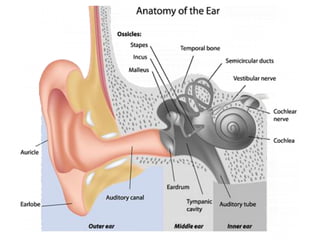
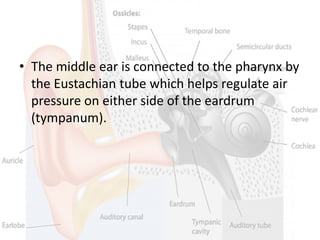
• The ear has three parts.
• They are 1) the outer ear
2) the middle ear
3) the inner ear
The outer ear
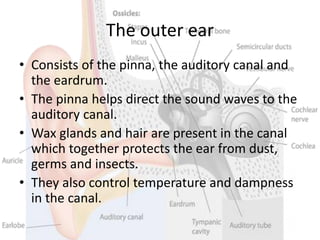
• Consists of the pinna, the auditory canal and
the eardrum.
• The pinna helps direct the sound waves to the
auditory canal.
• Wax glands and hair are present in the canal
which together protects the ear from dust,
germs and insects.
• They also control temperature and dampness
in the canal.
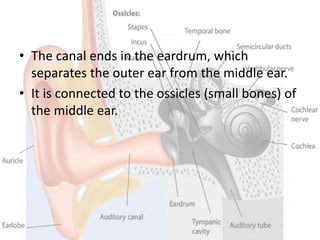
• The canal ends in the eardrum, which
separates the outer ear from the middle ear.
• It is connected to the ossicles (small bones) of
the middle ear.
The middle ear
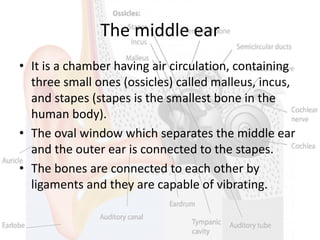
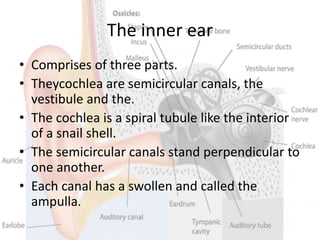
• It is a chamber having air circulation, containing
three small ones (ossicles) called malleus, incus,
and stapes (stapes is the smallest bone in the
human body).
• The oval window which separates the middle ear
and the outer ear is connected to the stapes.
• The bones are connected to each other by
ligaments and they are capable of vibrating.
• The middle ear is connected to the pharynx by
the Eustachian tube which helps regulate air
pressure on either side of the eardrum
(tympanum).
The inner ear
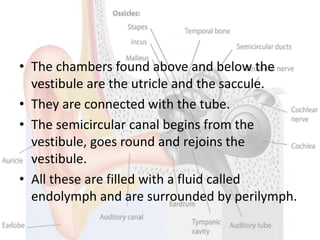
• Comprises of three parts.
• Theycochlea are semicircular canals, the
vestibule and the.
• The cochlea is a spiral tubule like the interior
of a snail shell.
• The semicircular canals stand perpendicular to
one another.
• Each canal has a swollen and called the
ampulla.
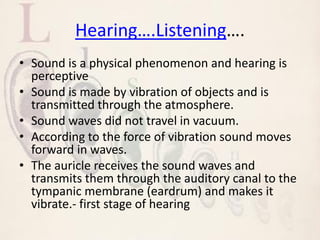
• The chambers found above and below the
vestibule are the utricle and the saccule.
• They are connected with the tube.
• The semicircular canal begins from the
vestibule, goes round and rejoins the
vestibule.
• All these are filled with a fluid called
endolymph and are surrounded by perilymph.
Hearing….Listening….
• Sound is a physical phenomenon and hearing is
perceptive
• Sound is made by vibration of objects and is
transmitted through the atmosphere.
• Sound waves did not travel in vacuum.
• According to the force of vibration sound moves
forward in waves.
• The auricle receives the sound waves and
transmits them through the auditory canal to the
tympanic membrane (eardrum) and makes it
vibrate.- first stage of hearing
• When the membrane vibrates the ossicles vibrate
together.
• The vibrations of the ossicles converts sound energy
into mechanical energy and the waves of mechanical
energy reach the inner ear.
• The mechanical energy is again converted into
hydraulic energy and again electric impulses are made.
• Thus sound energy through several stages is converted
to electric energy by the cochlear microphonic process.
• The electric impulses reaching the hair cells move to
the auditory nerves and they carry them to the
auditory cortex.
• Thus we experience sound as hearing.
Sub–skills of Listening
• Pupil’s competencies expressed in behavioral
terms.
• Also known as enabling skills
• Richards (1983) identified 50 micro-level sub-
skills
Some of the sub-skills of listening:
• understand the meanings of words, phrases and
sentences
• follow directions commands given by the speaker
• understand intonation patterns, stress, pauses in
speech etc., which provide clues to understand the
speaker’s tone and intentions
• understand simple descriptions and narrations
• understand the meaning of inverted statements
• understand questions and respond to them suitably
• recognize cohesive devices like ‘such as’ , ‘in addition
to’, ‘in fact’, ‘in tune with’ etc., used by the speaker
In order to make the pupils acquire these
skills in listening, the teachers should ensure
that their pupils..
• Realize the need of for listening to English in thee
classroom attentively
• Realize that they can speak words, phrases or
sentences properly when they listen to them
intensively
• Listen to good models of pronunciation in English
• Understands when the speaker says through gestures,
actions, activities, blackboard drawings etc.
• Enjoy and appreciate the rhyme and rhythm pattern
when they listen to simple poems, songs etc.
Barriers affecting
listening
• Linguistic
• Use of hard words/ registers
• Noisy environment
• Psychological
• Negative attitude
• Physiological
Good listeners will overcome the barriers.
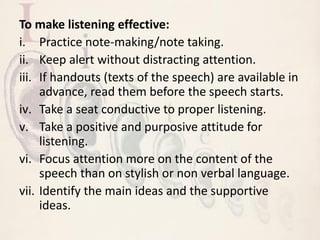
To make listening effective:
i. Practice note-making/note taking.
ii. Keep alert without distracting attention.
iii. If handouts (texts of the speech) are available in
advance, read them before the speech starts.
iv. Take a seat conductive to proper listening.
v. Take a positive and purposive attitude for
listening.
vi. Focus attention more on the content of the
speech than on stylish or non verbal language.
vii. Identify the main ideas and the supportive
ideas.
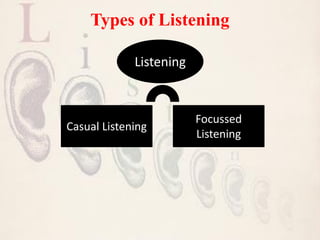
Types of Listening
Casual Listening
Focussed
Listening
Listening
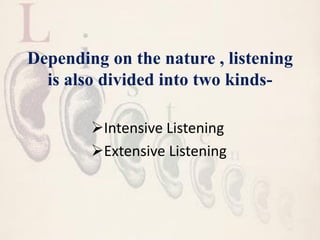
Depending on the nature , listening
is also divided into two kinds-
Intensive Listening
Extensive Listening
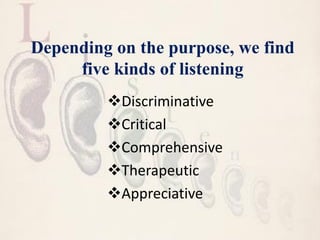
Depending on the purpose, we find
five kinds of listening
Discriminative
Critical
Comprehensive
Therapeutic
Appreciative
Discriminative listening
Critical listening
Comprehensive listening
Therapeutic listening
Appreciative listening
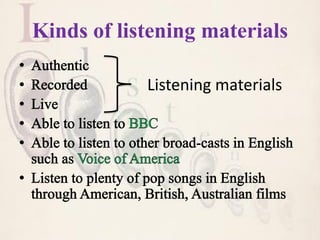
Kinds of listening materials
Listening materials
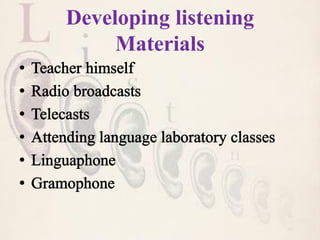
Developing listening
Materials
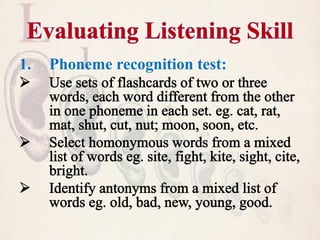
1. Phoneme recognition test:
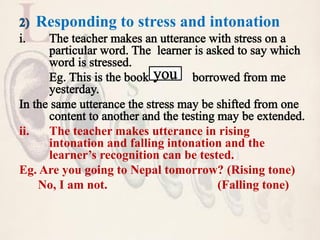
Responding to stress and intonation
ii. The teacher makes utterance in rising
intonation and falling intonation and the
learner’s recognition can be tested.
Eg. Are you going to Nepal tomorrow? (Rising tone)
No, I am not. (Falling tone)
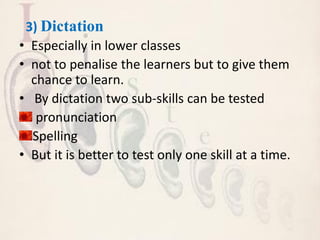
3) Dictation
• Especially in lower classes
• not to penalise the learners but to give them
chance to learn.
• By dictation two sub-skills can be tested
pronunciation
Spelling
• But it is better to test only one skill at a time.
4) Simulation
• A simulated conversation over telephone
between learners in turn and the teacher will be
a useful test for listening skill.
5) Extended Communication
• Interpreting maps and charts, narrating an
incident or describing a process with the help of
pictures etc.
6) Polite forms
• Two modes
To use words like – please, kindly, excuse me, I
am sorry, etc.
Related to tone
Prepared by ANJU A
KSTC

Listening skills

  • 2.
    LANGUAGE SKILLS • LISTENING •SPEAKING • READING • WRITING LSRW
  • 3.
    Skill Of Listening •Most effective modes of learning • In the words of Brown, “ Listening ability lies at the very heart of all growth , from birth through the years of formal education”. • Listening is the ability to understand what others speak or say. • Two skills- ‘listening’ and ‘speaking’ are interdependent.
  • 4.
    • There cannotbe any listening without someone speaking. • The listener understands the message of the speaker and grasps the stress, pause, intonation, and the pattern of pronunciation in his speech. • There is a clear distinction between ‘listening’ and ‘hearing’. • Listening is said to be a basic skill in the process of learning a language.
  • 5.
    Hearing process • Hearingmust precede listening. • Therefore it is essential to have a clear understanding of the structure of the human ear. • The ear has three parts. • They are 1) the outer ear 2) the middle ear 3) the inner ear
  • 7.
    The outer ear •Consists of the pinna, the auditory canal and the eardrum. • The pinna helps direct the sound waves to the auditory canal. • Wax glands and hair are present in the canal which together protects the ear from dust, germs and insects. • They also control temperature and dampness in the canal.
  • 8.
    • The canalends in the eardrum, which separates the outer ear from the middle ear. • It is connected to the ossicles (small bones) of the middle ear.
  • 9.
    The middle ear •It is a chamber having air circulation, containing three small ones (ossicles) called malleus, incus, and stapes (stapes is the smallest bone in the human body). • The oval window which separates the middle ear and the outer ear is connected to the stapes. • The bones are connected to each other by ligaments and they are capable of vibrating.
  • 10.
    • The middleear is connected to the pharynx by the Eustachian tube which helps regulate air pressure on either side of the eardrum (tympanum).
  • 11.
    The inner ear •Comprises of three parts. • Theycochlea are semicircular canals, the vestibule and the. • The cochlea is a spiral tubule like the interior of a snail shell. • The semicircular canals stand perpendicular to one another. • Each canal has a swollen and called the ampulla.
  • 12.
    • The chambersfound above and below the vestibule are the utricle and the saccule. • They are connected with the tube. • The semicircular canal begins from the vestibule, goes round and rejoins the vestibule. • All these are filled with a fluid called endolymph and are surrounded by perilymph.
  • 13.
    Hearing….Listening…. • Sound isa physical phenomenon and hearing is perceptive • Sound is made by vibration of objects and is transmitted through the atmosphere. • Sound waves did not travel in vacuum. • According to the force of vibration sound moves forward in waves. • The auricle receives the sound waves and transmits them through the auditory canal to the tympanic membrane (eardrum) and makes it vibrate.- first stage of hearing
  • 14.
    • When themembrane vibrates the ossicles vibrate together. • The vibrations of the ossicles converts sound energy into mechanical energy and the waves of mechanical energy reach the inner ear. • The mechanical energy is again converted into hydraulic energy and again electric impulses are made. • Thus sound energy through several stages is converted to electric energy by the cochlear microphonic process. • The electric impulses reaching the hair cells move to the auditory nerves and they carry them to the auditory cortex. • Thus we experience sound as hearing.
  • 15.
    Sub–skills of Listening •Pupil’s competencies expressed in behavioral terms. • Also known as enabling skills • Richards (1983) identified 50 micro-level sub- skills
  • 16.
    Some of thesub-skills of listening: • understand the meanings of words, phrases and sentences • follow directions commands given by the speaker • understand intonation patterns, stress, pauses in speech etc., which provide clues to understand the speaker’s tone and intentions • understand simple descriptions and narrations • understand the meaning of inverted statements • understand questions and respond to them suitably • recognize cohesive devices like ‘such as’ , ‘in addition to’, ‘in fact’, ‘in tune with’ etc., used by the speaker
  • 17.
    In order tomake the pupils acquire these skills in listening, the teachers should ensure that their pupils.. • Realize the need of for listening to English in thee classroom attentively • Realize that they can speak words, phrases or sentences properly when they listen to them intensively • Listen to good models of pronunciation in English • Understands when the speaker says through gestures, actions, activities, blackboard drawings etc. • Enjoy and appreciate the rhyme and rhythm pattern when they listen to simple poems, songs etc.
  • 18.
    Barriers affecting listening • Linguistic •Use of hard words/ registers • Noisy environment • Psychological • Negative attitude • Physiological Good listeners will overcome the barriers.
  • 19.
    To make listeningeffective: i. Practice note-making/note taking. ii. Keep alert without distracting attention. iii. If handouts (texts of the speech) are available in advance, read them before the speech starts. iv. Take a seat conductive to proper listening. v. Take a positive and purposive attitude for listening. vi. Focus attention more on the content of the speech than on stylish or non verbal language. vii. Identify the main ideas and the supportive ideas.
  • 20.
    Types of Listening CasualListening Focussed Listening Listening
  • 21.
    Depending on thenature , listening is also divided into two kinds- Intensive Listening Extensive Listening
  • 22.
    Depending on thepurpose, we find five kinds of listening Discriminative Critical Comprehensive Therapeutic Appreciative
  • 23.
  • 24.
  • 25.
  • 26.
  • 27.
  • 28.
    Kinds of listeningmaterials Listening materials
  • 30.
  • 32.
  • 33.
    Responding to stressand intonation ii. The teacher makes utterance in rising intonation and falling intonation and the learner’s recognition can be tested. Eg. Are you going to Nepal tomorrow? (Rising tone) No, I am not. (Falling tone)
  • 34.
    3) Dictation • Especiallyin lower classes • not to penalise the learners but to give them chance to learn. • By dictation two sub-skills can be tested pronunciation Spelling • But it is better to test only one skill at a time.
  • 35.
    4) Simulation • Asimulated conversation over telephone between learners in turn and the teacher will be a useful test for listening skill. 5) Extended Communication • Interpreting maps and charts, narrating an incident or describing a process with the help of pictures etc. 6) Polite forms • Two modes To use words like – please, kindly, excuse me, I am sorry, etc. Related to tone
  • 36.