Linkages   Starter activity Explain ‘Mendel’s law of segregation’ In monohybrid inheritance the F2 generation gives a 3:1 ratio because of the segregation of the alleles during meiosis and their random fusion during fertilisation
Learning objectives Explain the inheritance of 2 non-interacting unlinked genes Understand the autosomal linkage and recombinants during stages of meiosis
Mendel Recap…….In dihybrid inheritance the F2 generation gives a 9:3:3:1 ratio because of the independent assortment of the pairs of alleles on their homologous chromosomes during meiosis I and their random fusion during fertilisation. (Mendel 's Law of  Independent Assortment) A back cross with a heterozygote for both pairs of alleles (AaBb) gives a ratio of 1:1:1:1
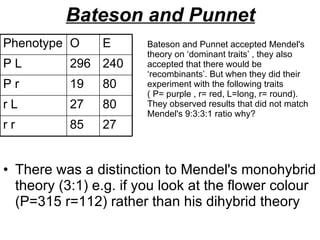
Bateson and Punnet There was a distinction to Mendel's monohybrid theory (3:1) e.g. if you look at the flower colour (P=315 r=112) rather than his dihybrid theory  Bateson and Punnet accepted Mendel's theory on ‘dominant traits’ , they also accepted that there would be ‘recombinants’. But when they did their experiment with the following traits ( P= purple , r= red, L=long, r= round). They observed results that did not match Mendel's 9:3:3:1 ratio why? 27 85 r r 80 27 r L 80 19 P r 240 296 P L E O Phenotype
Cont… With the results  observed  this led geneticists to believe that some characters tend to be inherited together if they are on the same chromosome. It is now known that Mendel picked characters that were on separate chromosomes which had a haploid number of chromosomes (7 garden pea)
Genes Genes that are located on the same chromosome are said to be linked.  Linkage group  is all the genes on a single chromosome and we refer to this as being the autosomal linkage. This rule is an exception to the chromosome which determines the sex of the individual Sex Linkage If a gene is located on the X chromosome, the male has the problem that he does not have a homologue for this chromosome. He has a Y chromosome that doesn't have the same information on it as the X. Therefore, whatever allele he inherits from his mother's X chromosome, he expresses that allele. (Remember he must get his X from his mother, not his father - he had to get the Y chromosome from his father.) Females will show normal mendelian genetics for this trait, as they do have homologues for the X chromosome, one from the mother and one from the father.
Cont…. In Bateson's and Punnnet’s experiment the genes for flower colour and pollen shape were on the same chromosome and there fore were inherited together. You will see a large portion of the  F 2   generation being the same as the  F 1  generation, but there were a small proportion of recombinants due to there being a crossing over during the  prophase 1  stage of meiosis Chiastma
Linkage Complete linkage  is rare to occur during meiosis and is where the complete chromosome is duplicated, it can occur in some flowering plants and some insects.  Partial linkage  is the usual occurrence because at least 1 chiasma is formed somewhere within a bivalent. This is when you will have 2 kinds of recombinants in equal numbers, this is due to the way the non-sister chromatids break and rejoin, but this will not always be the case. Due to the fact that chiasmata occurrence and location cannot be determined, this is why the number of recombinants is small always fewer than 50% of the progeny
Chiasmata formation Multiple Chiasmata formation

Linkages 6

  • 1.
    Linkages Starter activity Explain ‘Mendel’s law of segregation’ In monohybrid inheritance the F2 generation gives a 3:1 ratio because of the segregation of the alleles during meiosis and their random fusion during fertilisation
  • 2.
    Learning objectives Explainthe inheritance of 2 non-interacting unlinked genes Understand the autosomal linkage and recombinants during stages of meiosis
  • 3.
    Mendel Recap…….In dihybridinheritance the F2 generation gives a 9:3:3:1 ratio because of the independent assortment of the pairs of alleles on their homologous chromosomes during meiosis I and their random fusion during fertilisation. (Mendel 's Law of Independent Assortment) A back cross with a heterozygote for both pairs of alleles (AaBb) gives a ratio of 1:1:1:1
  • 4.
    Bateson and PunnetThere was a distinction to Mendel's monohybrid theory (3:1) e.g. if you look at the flower colour (P=315 r=112) rather than his dihybrid theory Bateson and Punnet accepted Mendel's theory on ‘dominant traits’ , they also accepted that there would be ‘recombinants’. But when they did their experiment with the following traits ( P= purple , r= red, L=long, r= round). They observed results that did not match Mendel's 9:3:3:1 ratio why? 27 85 r r 80 27 r L 80 19 P r 240 296 P L E O Phenotype
  • 5.
    Cont… With theresults observed this led geneticists to believe that some characters tend to be inherited together if they are on the same chromosome. It is now known that Mendel picked characters that were on separate chromosomes which had a haploid number of chromosomes (7 garden pea)
  • 6.
    Genes Genes thatare located on the same chromosome are said to be linked. Linkage group is all the genes on a single chromosome and we refer to this as being the autosomal linkage. This rule is an exception to the chromosome which determines the sex of the individual Sex Linkage If a gene is located on the X chromosome, the male has the problem that he does not have a homologue for this chromosome. He has a Y chromosome that doesn't have the same information on it as the X. Therefore, whatever allele he inherits from his mother's X chromosome, he expresses that allele. (Remember he must get his X from his mother, not his father - he had to get the Y chromosome from his father.) Females will show normal mendelian genetics for this trait, as they do have homologues for the X chromosome, one from the mother and one from the father.
  • 7.
    Cont…. In Bateson'sand Punnnet’s experiment the genes for flower colour and pollen shape were on the same chromosome and there fore were inherited together. You will see a large portion of the F 2 generation being the same as the F 1 generation, but there were a small proportion of recombinants due to there being a crossing over during the prophase 1 stage of meiosis Chiastma
  • 8.
    Linkage Complete linkage is rare to occur during meiosis and is where the complete chromosome is duplicated, it can occur in some flowering plants and some insects. Partial linkage is the usual occurrence because at least 1 chiasma is formed somewhere within a bivalent. This is when you will have 2 kinds of recombinants in equal numbers, this is due to the way the non-sister chromatids break and rejoin, but this will not always be the case. Due to the fact that chiasmata occurrence and location cannot be determined, this is why the number of recombinants is small always fewer than 50% of the progeny
  • 9.
    Chiasmata formation MultipleChiasmata formation