MENDEL’S THIRD LAW:
LAW OF INDEPENDENT ASSORTMENT
Presented By:
Pravin Adhikari
GREGOR MENDEL
Gregor Mendel, an Austrian scientist born in 1822, is hailed as the father of modern genetics for his pioneering
work with pea plants in the mid-19th century. His groundbreaking research laid the foundation for our
understanding of heredity. Mendel meticulously crossed pea plants with distinct traits and observed their
offspring, discovering three fundamental laws of inheritance:
1.Law of Segregation:
Traits are determined by discrete units (genes), and each parent contributes one allele to the offspring.
2.Law of Independent Assortment:
Genes for different traits segregate independently during the formation of gametes, leading to a
variety of genetic combinations.
3.Law of Dominance:
In a pair of alleles, one may mask the expression of the other, establishing the concept of dominant
and recessive traits.
Mendel's work, initially overlooked, gained recognition posthumously and revolutionized genetics, becoming
the cornerstone of modern genetic research.
RECAP OF MENDEL’S FIRST AND
SECOND LAWS
1. Mendel’s First Law: Law of Dominance:
In a pair of alleles for a specific trait, one allele (dominant) may mask the expression of the other (recessive).
Only when an individual carries two recessive alleles will the recessive trait be expressed; otherwise, the dominant trait
will prevail.
The offspring's phenotypic ratios depend on the combination of dominant and recessive alleles,
illustrating the visible traits in the next generation.
2. Mendel’s Second Law: Law of Segregation:
Mendel observed that an individual inherits a pair of alleles for each trait, one from each parent.
The two alleles segregate (separate) during the formation of gametes (sperm and egg).
Each gamete carries only one allele for a given trait.
When fertilization occurs, the offspring receives one allele from each parent, restoring the paired condition.
In simpler terms, the Law of Segregation states that alleles for a trait separate during gamete formation, ensuring
genetic diversity in offspring.
 REASONS FOR USING PEA PLANT :
They have very short life cycle. So, several generations
can be obtained or experimented with in a single year.
They are bisexual plants. That’s why they can be either
self-pollinated or cross-pollinated.
They produce large number of offspring after each
generation.
They contain large number of pair of contrasting
characteristics. E.g.: tall-dwarf, axial-terminal, etc.
They are easy to cultivate.
CHARACTERISTICS OF A PEA PLANT:
Size of the plant: tall and dwarf
Position of flowers: axial and terminal
Shape of the mature seeds: round and
wrinkled
Color of the seed: green and yellow
Color of the flower: purple and white
Shape of the mature pods: inflated and
constricted
Color of the mature pods: yellow and green
MENDEL’S EXPERIMENT
The law of independent assortment states that, “The different characters
in hybrid union are inherited independently and when two pairs of traits
are followed in the same cross, they assort independently”.
Mendel's Law of Independent Assortment describes how genes for different traits segregate
independently of one another during the formation of gametes. This means that the inheritance
of an allele for one trait does not influence the inheritance of an allele for another trait. The
assortment of alleles for different traits occurs randomly, leading to a variety of genetic
combinations in offspring. This law highlights the independent behavior of different gene pairs
and contributes to the genetic variation observed in populations. The Law of Independent
Assortment is a key principle in understanding the complexity of genetic inheritance patterns.
MENDEL’S THIRD LAW OF INDEPENDENT
ASSORTMENT
A dihybrid cross is a genetic cross between two individuals that differ in two traits,
each controlled by different genes. Gregor Mendel, in his pea plant experiments,
conducted dihybrid crosses to study the inheritance of two traits simultaneously.
For example, consider a cross between pea plants with yellow, round seeds (YYRR) and green, wrinkled
seeds (yyrr). The resulting dihybrid cross involves examining the inheritance of seed color (controlled by
the gene pair Yy) and seed texture (controlled by the gene pair Rr) in the offspring.
Mendel's Law of Independent Assortment is evident in dihybrid crosses, as the alleles for each trait
segregate independently during gamete formation. This results in a variety of possible combinations in
the offspring, demonstrating the random assortment of alleles for different traits. Dihybrid crosses
provide insights into the inheritance patterns of multiple traits and contribute to our understanding of
genetic diversity.
DIHYBRID CROSS
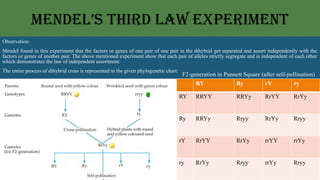
Observation:
Mendel found in this experiment that the factors or genes of one pair of one pair in the dihybrid get separated and assort independently with the
factors or genes of another pair. The above mentioned experiment show that each pair of alleles strictly segregate and is independent of each other
which demonstrates the law of independent assortment.
The entire process of dihybrid cross is represented in the given phylogenetic chart:
MENDEL’S THIRD LAW EXPERIMENT
F2-generation in Punnett Square (after self-pollination)
RY Ry rY ry
RY RRYY RRYy RrYY RrYy
Ry RRYy Rryy RrYy Rryy
rY RrYY RrYy rrYY rrYy
ry RrYy Rryy rrYy Rryy
Number of
individuals
Genotype Class Phenotype Class
1
2
2
4
RRYY Homozygous Yellow Round
Heterozygous Yellow Round (Hybrid)
Yellow Round = 9
1
2
rrYY Homozygous Yellow Wrinkled
Heterozygous Yellow Wrinkled
Yellow Wrinkled = 3
RRyy Homozygous Green Round
Heterozygous Green Round
Green Round = 3
1 rryy Homozygous Green Wrinkled
Green Wrinkled = 1
16 9:3:3:1
GENOTYPE, PHENOTYPE AND RESULT
Result:
As a result of the dihybrid
cross, Mendel found the
phenotypic ratio 9:3:3:1 ( 9
round with yellow, 3 round
with green, 3 wrinkled with
yellow and 1 wrinkled with
green ). Similarly, he found
the genotypic ratio
1:2:2:4:1:2:1:2:1 shown in
the adjoining table.
Conclusion:
In F2- generation, besides the original two parental combinations of round with yellow and wrinkled
with green, two new combinations, round with green and wrinkled with yellow, were also formed.
Which shows that the characteristics can arrange themselves in new combination independently. And,
this is the law of independent assortment.
This dihybrid experiment that there is no rule that any two or three characteristics should always
remain together. They can separate from each other and can form a new combination of characteristics.
That’s why hybridization is in practice, in the agricultural field, so that different varieties of
advantageous characteristics are formed in farm animals and agricultural crops.
Limitations:
This law is not applicable everywhere. There are cases in which two or more characteristics are
transmitted together rather than independently. For example: if the genes are present very near to each
other in a same chromosome then they will move together as a unit. This is called linkage.
CONCLUSION AND LIMITATIONS
The inheritance of a trait (phenotype) that is
determined by a gene located on one of the sex
chromosomes is called sex linked inheritance.
The genes controlled by genes located on the sex
chromosomes is called sex-linked inheritance.
It was discovered by T.H. Morgan in 1910.
SEX - LINKED INHERITANCE
1. X-linked characteristics/traits:
If the genes for non-sexual characteristics are located in X-chromosome. Example: Hemophilia. These type of
characteristics are transmitted to the male whereas females are carrier. Many of the non-sex determining X-linked
genes are responsible for abnormal conditions such as hemophilia, Duchenne muscular dystrophy, congenital night
blindness, male pattern baldness, etc.
2. Y-linked characteristics/traits:
If the genes for non-sexual characteristics are located in Y-chromosome. Example: hairy ear (Hypertrichosis). These
types of characteristics are transmitted from male to male.
3. X-Y linked characteristics/traits:
If the genes for non-sexual characteristics are located in both homologous chromosomes X and Y. Examples:
Complete color blindness, skin cancer, etc.
SEX LINKED INHERITANCE TYPES
The characteristic features of inheritance for a sex–linked trait can summarized as
follows:
1. The genes responsible for the sex linked traits are not transmitted from male parent directly to their male
progeny because the progeny also receives X-chromosome from its mother whereas Y-chromosomes from it’s
father.
2. A male transmits his sex linked genes to all his daughters since daughters receive one X-chromosome from
their father which get further transmitted to daughter’s male progeny. i.e. All sex-linked genes therefore
passes from male to female and then comeback to a male of F2-generation. Suffer (father)
Grandson
3. Carrier mother transmits her sex linked genes to her male progeny which get further transmitted to son’s
female progeny. i.e. All recessive sex linked genes pass from female to male and then come back to a female
of F2 generation.
The cause of sex-linkage can therefore be shown with two reasons:
I. The location of a gene in X chromosome.
II. The absence of its allele in the Y chromosome.
SEX LINKED INHERITANCE IN HUMAN
The defect in which person cannot differentiate between two colours
like red colour with green colour is called colour blindness.
COLOUR BLINDNESS IN MAN
Haemophilia is a disorder in which blood fails to clot on exposure to
air, cause prolonged bleeding even from the minor injuries.
HAEMOPHILIA IN
MAN
Twins are two
offspring produce
by the same
pregnancy.
Twins are either
identical (if they
are developed from
single zygote) or
fraternal (if they
are developed from
two different from
two different
zygotes).
TWINS
TYPES OF TWINS:
Factors that increase the probability of having twins
1. Advancing age of the mother:
Mother in their 30s and 40s have higher level of the sex hormone oestrogen than younger woman, which means that
their ovaries are stimulated to produce more than one egg at a time.
2. Number of precious pregnancies:
The greater the number of pregnancies a woman has already had, the higher her odds of conceiving twins.
3. Heredity:
A woman is more likely to conceive fraternal twins if she is a fraternal twin, has already had fraternal twins, or has
siblings who are fraternal twins.
4. Race:
Black African women have the highest incidence of twins, while Asian woman have the lowest.
5. Assisted Reproductive Techniques:
Many procedures rely on stimulating the ovaries with fertility drugs to produce eggs and, often, several eggs are
released per ovulation.
MORE TWINS IN TODAYS LIFE
THANK YOU!!!

Mendels-third-law.pptx.. ...............

  • 1.
    MENDEL’S THIRD LAW: LAWOF INDEPENDENT ASSORTMENT Presented By: Pravin Adhikari
  • 2.
    GREGOR MENDEL Gregor Mendel,an Austrian scientist born in 1822, is hailed as the father of modern genetics for his pioneering work with pea plants in the mid-19th century. His groundbreaking research laid the foundation for our understanding of heredity. Mendel meticulously crossed pea plants with distinct traits and observed their offspring, discovering three fundamental laws of inheritance: 1.Law of Segregation: Traits are determined by discrete units (genes), and each parent contributes one allele to the offspring. 2.Law of Independent Assortment: Genes for different traits segregate independently during the formation of gametes, leading to a variety of genetic combinations. 3.Law of Dominance: In a pair of alleles, one may mask the expression of the other, establishing the concept of dominant and recessive traits. Mendel's work, initially overlooked, gained recognition posthumously and revolutionized genetics, becoming the cornerstone of modern genetic research.
  • 3.
    RECAP OF MENDEL’SFIRST AND SECOND LAWS 1. Mendel’s First Law: Law of Dominance: In a pair of alleles for a specific trait, one allele (dominant) may mask the expression of the other (recessive). Only when an individual carries two recessive alleles will the recessive trait be expressed; otherwise, the dominant trait will prevail. The offspring's phenotypic ratios depend on the combination of dominant and recessive alleles, illustrating the visible traits in the next generation. 2. Mendel’s Second Law: Law of Segregation: Mendel observed that an individual inherits a pair of alleles for each trait, one from each parent. The two alleles segregate (separate) during the formation of gametes (sperm and egg). Each gamete carries only one allele for a given trait. When fertilization occurs, the offspring receives one allele from each parent, restoring the paired condition. In simpler terms, the Law of Segregation states that alleles for a trait separate during gamete formation, ensuring genetic diversity in offspring.
  • 4.
     REASONS FORUSING PEA PLANT : They have very short life cycle. So, several generations can be obtained or experimented with in a single year. They are bisexual plants. That’s why they can be either self-pollinated or cross-pollinated. They produce large number of offspring after each generation. They contain large number of pair of contrasting characteristics. E.g.: tall-dwarf, axial-terminal, etc. They are easy to cultivate. CHARACTERISTICS OF A PEA PLANT: Size of the plant: tall and dwarf Position of flowers: axial and terminal Shape of the mature seeds: round and wrinkled Color of the seed: green and yellow Color of the flower: purple and white Shape of the mature pods: inflated and constricted Color of the mature pods: yellow and green MENDEL’S EXPERIMENT
  • 5.
    The law ofindependent assortment states that, “The different characters in hybrid union are inherited independently and when two pairs of traits are followed in the same cross, they assort independently”. Mendel's Law of Independent Assortment describes how genes for different traits segregate independently of one another during the formation of gametes. This means that the inheritance of an allele for one trait does not influence the inheritance of an allele for another trait. The assortment of alleles for different traits occurs randomly, leading to a variety of genetic combinations in offspring. This law highlights the independent behavior of different gene pairs and contributes to the genetic variation observed in populations. The Law of Independent Assortment is a key principle in understanding the complexity of genetic inheritance patterns. MENDEL’S THIRD LAW OF INDEPENDENT ASSORTMENT
  • 6.
    A dihybrid crossis a genetic cross between two individuals that differ in two traits, each controlled by different genes. Gregor Mendel, in his pea plant experiments, conducted dihybrid crosses to study the inheritance of two traits simultaneously. For example, consider a cross between pea plants with yellow, round seeds (YYRR) and green, wrinkled seeds (yyrr). The resulting dihybrid cross involves examining the inheritance of seed color (controlled by the gene pair Yy) and seed texture (controlled by the gene pair Rr) in the offspring. Mendel's Law of Independent Assortment is evident in dihybrid crosses, as the alleles for each trait segregate independently during gamete formation. This results in a variety of possible combinations in the offspring, demonstrating the random assortment of alleles for different traits. Dihybrid crosses provide insights into the inheritance patterns of multiple traits and contribute to our understanding of genetic diversity. DIHYBRID CROSS
  • 7.
    Observation: Mendel found inthis experiment that the factors or genes of one pair of one pair in the dihybrid get separated and assort independently with the factors or genes of another pair. The above mentioned experiment show that each pair of alleles strictly segregate and is independent of each other which demonstrates the law of independent assortment. The entire process of dihybrid cross is represented in the given phylogenetic chart: MENDEL’S THIRD LAW EXPERIMENT F2-generation in Punnett Square (after self-pollination) RY Ry rY ry RY RRYY RRYy RrYY RrYy Ry RRYy Rryy RrYy Rryy rY RrYY RrYy rrYY rrYy ry RrYy Rryy rrYy Rryy
  • 8.
    Number of individuals Genotype ClassPhenotype Class 1 2 2 4 RRYY Homozygous Yellow Round Heterozygous Yellow Round (Hybrid) Yellow Round = 9 1 2 rrYY Homozygous Yellow Wrinkled Heterozygous Yellow Wrinkled Yellow Wrinkled = 3 RRyy Homozygous Green Round Heterozygous Green Round Green Round = 3 1 rryy Homozygous Green Wrinkled Green Wrinkled = 1 16 9:3:3:1 GENOTYPE, PHENOTYPE AND RESULT Result: As a result of the dihybrid cross, Mendel found the phenotypic ratio 9:3:3:1 ( 9 round with yellow, 3 round with green, 3 wrinkled with yellow and 1 wrinkled with green ). Similarly, he found the genotypic ratio 1:2:2:4:1:2:1:2:1 shown in the adjoining table.
  • 9.
    Conclusion: In F2- generation,besides the original two parental combinations of round with yellow and wrinkled with green, two new combinations, round with green and wrinkled with yellow, were also formed. Which shows that the characteristics can arrange themselves in new combination independently. And, this is the law of independent assortment. This dihybrid experiment that there is no rule that any two or three characteristics should always remain together. They can separate from each other and can form a new combination of characteristics. That’s why hybridization is in practice, in the agricultural field, so that different varieties of advantageous characteristics are formed in farm animals and agricultural crops. Limitations: This law is not applicable everywhere. There are cases in which two or more characteristics are transmitted together rather than independently. For example: if the genes are present very near to each other in a same chromosome then they will move together as a unit. This is called linkage. CONCLUSION AND LIMITATIONS
  • 10.
    The inheritance ofa trait (phenotype) that is determined by a gene located on one of the sex chromosomes is called sex linked inheritance. The genes controlled by genes located on the sex chromosomes is called sex-linked inheritance. It was discovered by T.H. Morgan in 1910. SEX - LINKED INHERITANCE
  • 11.
    1. X-linked characteristics/traits: Ifthe genes for non-sexual characteristics are located in X-chromosome. Example: Hemophilia. These type of characteristics are transmitted to the male whereas females are carrier. Many of the non-sex determining X-linked genes are responsible for abnormal conditions such as hemophilia, Duchenne muscular dystrophy, congenital night blindness, male pattern baldness, etc. 2. Y-linked characteristics/traits: If the genes for non-sexual characteristics are located in Y-chromosome. Example: hairy ear (Hypertrichosis). These types of characteristics are transmitted from male to male. 3. X-Y linked characteristics/traits: If the genes for non-sexual characteristics are located in both homologous chromosomes X and Y. Examples: Complete color blindness, skin cancer, etc. SEX LINKED INHERITANCE TYPES
  • 12.
    The characteristic featuresof inheritance for a sex–linked trait can summarized as follows: 1. The genes responsible for the sex linked traits are not transmitted from male parent directly to their male progeny because the progeny also receives X-chromosome from its mother whereas Y-chromosomes from it’s father. 2. A male transmits his sex linked genes to all his daughters since daughters receive one X-chromosome from their father which get further transmitted to daughter’s male progeny. i.e. All sex-linked genes therefore passes from male to female and then comeback to a male of F2-generation. Suffer (father) Grandson 3. Carrier mother transmits her sex linked genes to her male progeny which get further transmitted to son’s female progeny. i.e. All recessive sex linked genes pass from female to male and then come back to a female of F2 generation. The cause of sex-linkage can therefore be shown with two reasons: I. The location of a gene in X chromosome. II. The absence of its allele in the Y chromosome. SEX LINKED INHERITANCE IN HUMAN
  • 13.
    The defect inwhich person cannot differentiate between two colours like red colour with green colour is called colour blindness. COLOUR BLINDNESS IN MAN
  • 14.
    Haemophilia is adisorder in which blood fails to clot on exposure to air, cause prolonged bleeding even from the minor injuries. HAEMOPHILIA IN MAN
  • 15.
    Twins are two offspringproduce by the same pregnancy. Twins are either identical (if they are developed from single zygote) or fraternal (if they are developed from two different from two different zygotes). TWINS
  • 16.
  • 17.
    Factors that increasethe probability of having twins 1. Advancing age of the mother: Mother in their 30s and 40s have higher level of the sex hormone oestrogen than younger woman, which means that their ovaries are stimulated to produce more than one egg at a time. 2. Number of precious pregnancies: The greater the number of pregnancies a woman has already had, the higher her odds of conceiving twins. 3. Heredity: A woman is more likely to conceive fraternal twins if she is a fraternal twin, has already had fraternal twins, or has siblings who are fraternal twins. 4. Race: Black African women have the highest incidence of twins, while Asian woman have the lowest. 5. Assisted Reproductive Techniques: Many procedures rely on stimulating the ovaries with fertility drugs to produce eggs and, often, several eggs are released per ovulation. MORE TWINS IN TODAYS LIFE
  • 18.