WORD FORMATION PROCESSES
WORD FORMATION
PROCESSES
1. Affixation
• suffixation
• prefixation
• infixation
• circumfixation
be able to identify examples of
each!
Example of infixation
Bonto Igorot (Philippines)
(infixation is common in languages of Southeast Asia and the
Phillipines; see example in your book from Tagalog)
kayu ‘wood’ kinayu ‘gathered wood’
tengao ‘to celebrate a holiday’ tumengao-ak ‘I will celebrate a holiday’
Example of cirumfixation
Samoan
finau ‘to quarrel’ fefinauai ‘to quarrel with each other’
2. Compounding
Compounds consist of two more
free morphemes or words
consisting of free morphemes.
Examples:
blackbird, clock work, light bulb,
notebook, bittersweet
Compounds in English generally
have stress on the first syllable.
2. Compounding
In English, when two words are of
different grammatical categories, the
class of the second or final word
becomes the category of the compound
Example: blackbird.
Compounds formed with a preposition
are in the category of the
nonprepositional part of the compound.
Examples: undertake, uphill
Index
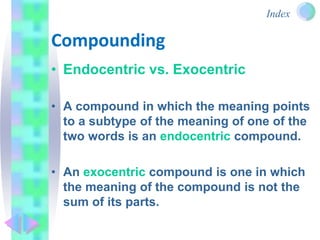
Compounding
• Endocentric vs. Exocentric
• A compound in which the meaning points
to a subtype of the meaning of one of the
two words is an endocentric compound.
• An exocentric compound is one in which
the meaning of the compound is not the
sum of its parts.
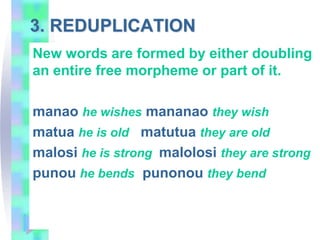
3. REDUPLICATION
New words are formed by either doubling
an entire free morpheme or part of it.
manao he wishes mananao they wish
matua he is old matutua they are old
malosi he is strong malolosi they are strong
punou he bends punonou they bend
4. Morpheme internal changes
Examples in English:
ring-rang-rung
tooth-teeth
breath-breathe
Also called ablaut when
change is in the vowel.
5. Suppletion
Irregular forms which follow no patterns
ask - asked
call - called
go - went
NO systematic similarity between past
and present tense forms of these verbs.
5. Suppletion
Example from Italian…...
lavorare - lavoro
aprire - apro
andare - vado
6. BLEND
Something “less” than a
compound…..
smog = smoke + fog
motel = motor + hotel
Parts of two or more different words
join- usually 1st part of one and 2nd
part of other.
7.Back formations
A new word is created by
removing what is mistakenly
considered to be an affix
edit from editor;
peddle from peddler;
enthuse from enthusiasm
orientate from orientation
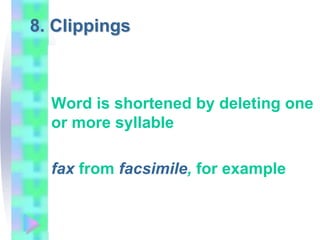
8. Clippings
Word is shortened by deleting one
or more syllable
fax from facsimile, for example
9. Coinage
Reconstruction and addition of
new words. Words created from
scratch or derived from names of
individuals, places, or product
names.
Index
10. Acronyms
• Initial letters taken from several
words and new word is created from
that string.
• NATO
Index
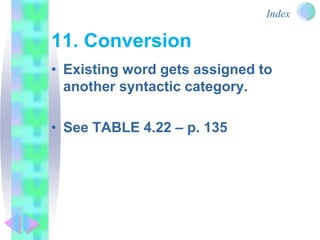
11. Conversion
• Existing word gets assigned to
another syntactic category.
• See TABLE 4.22 – p. 135
Index
Crosslinguistic differences in use of
morphological processes –OMIT
• ANALYTIC vs. SYNTHETIC
• Analytic (or isolating) languages use sequences
of monomorphemic words. Grammatical
concepts are separate words rather than
derviational and inflectional affixes
EXAMPLE: Chinese
• Synthetic languages make use of processes of
affixation. Bound morphemes used, in other
words.
Index
SYNTHETIC LANGUAGES -OMIT
• A. agglutinating: words can have several prefixes and
suffixes, but they are typically distinct and easy to segment.
That is, it’s easy to determine morpheme boundaries and
each bound morpheme has a single meaning.
• B. fusional: affixes not always easily separable from stem.
“fused” with stem. Stem itself may not exist as free
morpheme. Also, a morpheme may carry more than one
meaning.
• C. polysynthetic: many affixes combined to make new
word. Often nouns are converted into pieces of verb forms.
Segmentation is difficult and stems inside of words may not
correspond to stems in free forms.
Morphological Analysis 1
[palu] ‘stick’ [spalube] ‘his stick’ [spalulu] ‘your stick’
[ku:ba] ‘dough’ [sku:babe] ‘his dough’ [sku:balu] ‘your dough’
[tapa] ‘flour’ [stapabe] ‘his four’ [stapalu] ‘your four’
[geta] ‘tortilla’ [sketabe] ‘his tortilla’ [sketalu] ‘your tortilla’
[bere] ‘chicken’ [sperebe] ‘his chicken’ [sperelu] ‘your chicken’
[doo] ‘rope’ [stoobe] ‘his rope’ [stoolu] ‘your rope’
Isolate the morphemes corresponding to: _________possession (gen)
_________3rd person sg. ____________2nd person plural
List the allomorphs for the following translations:
tortilla, rope, chicken
Morphological Analysis 2
Turkish nouns
kitap ‘book’ elmalar ‘apples’ saplar ‘stalks’
at ‘horse’ masa ‘table’ kiz ‘girl’
oda ‘room’ odalar ‘rooms’ masalar ‘tables’
sap ‘stalk’ atlar ‘horses’ sonlar ‘ends’
elma ‘apple’ adamlar ‘men’ meyvar ‘fruit’
(1) Provide the Turkish words for: books, man, girls, end, fruit (pl)
(2) Given Turkish odalarda ‘in the rooms’ and masalarda ‘on the tables’, provide the Turkish
words meaning ‘in the books’ and ‘on the horse’.

Morphology_word_formation_processes..ppt

  • 1.
    WORD FORMATION PROCESSES WORDFORMATION PROCESSES
  • 2.
    1. Affixation • suffixation •prefixation • infixation • circumfixation be able to identify examples of each!
  • 3.
    Example of infixation BontoIgorot (Philippines) (infixation is common in languages of Southeast Asia and the Phillipines; see example in your book from Tagalog) kayu ‘wood’ kinayu ‘gathered wood’ tengao ‘to celebrate a holiday’ tumengao-ak ‘I will celebrate a holiday’ Example of cirumfixation Samoan finau ‘to quarrel’ fefinauai ‘to quarrel with each other’
  • 4.
    2. Compounding Compounds consistof two more free morphemes or words consisting of free morphemes. Examples: blackbird, clock work, light bulb, notebook, bittersweet Compounds in English generally have stress on the first syllable.
  • 5.
    2. Compounding In English,when two words are of different grammatical categories, the class of the second or final word becomes the category of the compound Example: blackbird. Compounds formed with a preposition are in the category of the nonprepositional part of the compound. Examples: undertake, uphill
  • 6.
    Index Compounding • Endocentric vs.Exocentric • A compound in which the meaning points to a subtype of the meaning of one of the two words is an endocentric compound. • An exocentric compound is one in which the meaning of the compound is not the sum of its parts.
  • 7.
    3. REDUPLICATION New wordsare formed by either doubling an entire free morpheme or part of it. manao he wishes mananao they wish matua he is old matutua they are old malosi he is strong malolosi they are strong punou he bends punonou they bend
  • 8.
    4. Morpheme internalchanges Examples in English: ring-rang-rung tooth-teeth breath-breathe Also called ablaut when change is in the vowel.
  • 9.
    5. Suppletion Irregular formswhich follow no patterns ask - asked call - called go - went NO systematic similarity between past and present tense forms of these verbs.
  • 10.
    5. Suppletion Example fromItalian…... lavorare - lavoro aprire - apro andare - vado
  • 11.
    6. BLEND Something “less”than a compound….. smog = smoke + fog motel = motor + hotel Parts of two or more different words join- usually 1st part of one and 2nd part of other.
  • 12.
    7.Back formations A newword is created by removing what is mistakenly considered to be an affix edit from editor; peddle from peddler; enthuse from enthusiasm orientate from orientation
  • 13.
    8. Clippings Word isshortened by deleting one or more syllable fax from facsimile, for example
  • 14.
    9. Coinage Reconstruction andaddition of new words. Words created from scratch or derived from names of individuals, places, or product names.
  • 15.
    Index 10. Acronyms • Initialletters taken from several words and new word is created from that string. • NATO
  • 16.
    Index 11. Conversion • Existingword gets assigned to another syntactic category. • See TABLE 4.22 – p. 135
  • 17.
    Index Crosslinguistic differences inuse of morphological processes –OMIT • ANALYTIC vs. SYNTHETIC • Analytic (or isolating) languages use sequences of monomorphemic words. Grammatical concepts are separate words rather than derviational and inflectional affixes EXAMPLE: Chinese • Synthetic languages make use of processes of affixation. Bound morphemes used, in other words.
  • 18.
    Index SYNTHETIC LANGUAGES -OMIT •A. agglutinating: words can have several prefixes and suffixes, but they are typically distinct and easy to segment. That is, it’s easy to determine morpheme boundaries and each bound morpheme has a single meaning. • B. fusional: affixes not always easily separable from stem. “fused” with stem. Stem itself may not exist as free morpheme. Also, a morpheme may carry more than one meaning. • C. polysynthetic: many affixes combined to make new word. Often nouns are converted into pieces of verb forms. Segmentation is difficult and stems inside of words may not correspond to stems in free forms.
  • 19.
    Morphological Analysis 1 [palu]‘stick’ [spalube] ‘his stick’ [spalulu] ‘your stick’ [ku:ba] ‘dough’ [sku:babe] ‘his dough’ [sku:balu] ‘your dough’ [tapa] ‘flour’ [stapabe] ‘his four’ [stapalu] ‘your four’ [geta] ‘tortilla’ [sketabe] ‘his tortilla’ [sketalu] ‘your tortilla’ [bere] ‘chicken’ [sperebe] ‘his chicken’ [sperelu] ‘your chicken’ [doo] ‘rope’ [stoobe] ‘his rope’ [stoolu] ‘your rope’ Isolate the morphemes corresponding to: _________possession (gen) _________3rd person sg. ____________2nd person plural List the allomorphs for the following translations: tortilla, rope, chicken
  • 20.
    Morphological Analysis 2 Turkishnouns kitap ‘book’ elmalar ‘apples’ saplar ‘stalks’ at ‘horse’ masa ‘table’ kiz ‘girl’ oda ‘room’ odalar ‘rooms’ masalar ‘tables’ sap ‘stalk’ atlar ‘horses’ sonlar ‘ends’ elma ‘apple’ adamlar ‘men’ meyvar ‘fruit’ (1) Provide the Turkish words for: books, man, girls, end, fruit (pl) (2) Given Turkish odalarda ‘in the rooms’ and masalarda ‘on the tables’, provide the Turkish words meaning ‘in the books’ and ‘on the horse’.