
















INTRODUCTION
TO
LINGUISTICS
BRANCHES OF LINGUISTICS
• Phonetics
• Phonology
• Morphology
• Syntax
• Semantics
• Pragmatics
• Lexicography
MORPHOLOGY
• Morpheme
• Neologism
• Etymology
• Barrowing
• Compounding
• Clipping – exam, promo, ad, fan,…
• Backformation – Mixture,
• Free
• Bound
• Lexical morphemes (content)
• Functional
• Derivational (changes grammatical)
• Inflectional (singular/plural, comparative, Tense, Possessive)
• S, ‘s, s, ing, ed, en, er, est
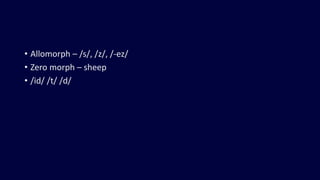
• Allomorph – /s/, /z/, /-ez/
• Zero morph – sheep
• /id/ /t/ /d/
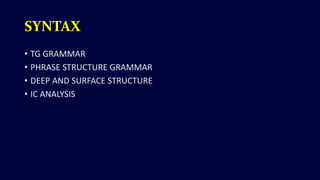
SYNTAX
• TG GRAMMAR
• PHRASE STRUCTURE GRAMMAR
• DEEP AND SURFACE STRUCTURE
• IC ANALYSIS
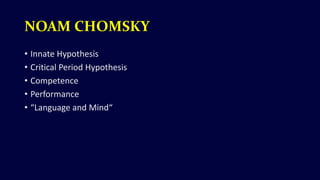
NOAM CHOMSKY
• Innate Hypothesis
• Critical Period Hypothesis
• Competence
• Performance
• “Language and Mind“
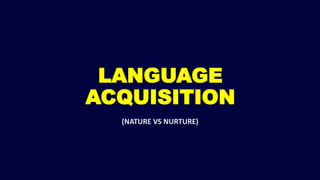
LANGUAGE
ACQUISITION
(NATURE VS NURTURE)
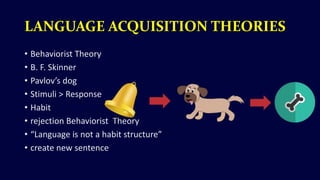
LANGUAGE ACQUISITION THEORIES
• Behaviorist Theory
• B. F. Skinner
• Pavlov’s dog
• Stimuli > Response
• Habit
• rejection Behaviorist Theory
• “Language is not a habit structure”
• create new sentence
UNIVERSAL GRAMMAR
• Innate biological grammatical categories
• “Nativism or generativism” – innate language
• LAD
• First (Child)Language Acquisition – L1
• Labial consonants sound made by lip
• Second Language Acquisition – L2
• Stephen Krashan – Language vs Acquisition
Second language development – 4 stages
• Pre – production (silent period)
• Early production (blabbering) (6 months)
• Speech emergence (not grammatically correct)
• Intermediate and advanced fluency – active vocabulary – they are
trying – they fail – they have doubts – ready to master
Second language vs Foreign Language
• First language is acquired and Second Language is Learned
• Native language – easy leaned – coz it’s acquired
• existing knowledge of native language
• Interlanguage (Selinker)
• Language Transfer – Chomsky (1959)
THEORIES OF SLA
• UNIVERSALIST THEORY
• BEHAVIOURIST THEORY
• NATIVIST THEORY
• COGNITIVIST THEORY (Jean Pieget)
• SOCIAL INTERACTIONIST THEORY
• ACCULTURATION THEORY (Ego boundaries)
• CONTRASTIVE THEORY - “positive transfer” or “negative transfer” or
“interference”.
• IDENTITY THEORY - language learn second language by same law
• MONITOR THEORY
THEORIES OF ORIGIN OF LANGUAGE
• BOW – WOW THEORY
• (Onomatopoeia)
• POOH-POOH THEORY
• YO-HE-YO THEORY
• THE DING-DONG THEORY (Max Muller)
• INNATENESS HYPOTHESIS (Chomsky)
• GESTURE THEORY (Wilhelm Wundt & Richard Paget)
• TA-TA THEORY
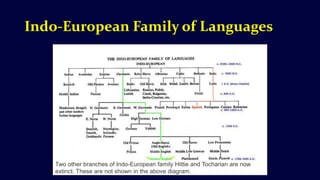
Indo-European Family of Languages
Two other branches of Indo-European family Hittie and Tocharian are now
extinct. These are not shown in the above diagram.
USA
1 9 , 4 5 0 0 0 0
BRASIL
1 9 , 4 5 0 0 0 0
GERMAN
1 9 , 4 5 0 0 0 0
World Map
HISTORY OF ENGLISH LANGUAGE
• From Celts to William the Conqueror
• 3 Major Languages – Latin, English, and French.
• OLD ENGLISH (Anglo Saxon) - from 450 to 1150
• MIDDLE ENGLISH (Anglo Norman) - From 1150 to 1500
• MODERN ENGLISH - since 1500 – (loss of inflection)
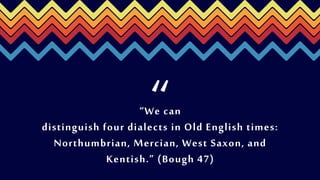
“We can
distinguish four dialects in Old English times:
Northumbrian, Mercian, West Saxon, and
Kentish.” (Bough 47)
“
Characteristics of Old English
• Old English word stān is the same word as Modern English stone,
• but the vowel is different.
• the sound of th: þ and ð
• Old English is almost purely Germanic (before French influence)
• Grammar: “There is no ablative, and generally no locative or
instrumental case, these having been merged with the dative. In the
same way the vocative of direct address is generally identical with the
nominative form. Thus the Old English noun has only four cases.” (50)
“Thus in Latin the nominative murus (wall) is distinguished
from the genitive muri (of the wall), dative muro (to the wall),
accusative murum, etc. A single verb form conveys the idea of
person, number, and tense along with the meaning of the root,
a conception that we require three words for in English.”
(Bough 50)
“
Grammatical Gender of Old English
• “Stān (stone) is masculine, mōna (moon) is masculine, but sunne (sun)
is feminine, as in German. In French the corresponding words have just the
opposite
genders: pierre (stone) and lune (moon) are feminine while soleil (sun) is
masculine.
Often the gender of Old English nouns is quite illogical. Words like moegden
(girl), wīf
(wife), bearn (child, son), and cild (child), which we should expect to be
feminine or
masculine, are in fact neuter, while wīfmann (woman) is masculine because
the second
element of the compound is masculine.” (51)
Old English Verb and Inflection
• Old English distinguished only two simple tenses by inflection, a
present and a past.
• division of the verb into two great classes, the weak and the strong,
often known in Modern English as regular and irregular verbs.
• The strong verbs, like sing, sang, sung
• weak verbs, such as walk, walked, walked
• In the principal parts of Old English strong verbs, therefore, we have
four forms: the infmitive, the preterite singular (first and third
person), the preterite plural, and the past participle.
The Norman Conquest and After
• The Origin of Normandy
• Normans had soon absorbed the most important elements of French
civilization
• The Year 1066
• Knowledge of French among the Middle Class
Middle English (1150–1500)
• Decay of Inflectional Endings
• Loss of Grammatical Gender
• Middle English Syntax
• French Influence on the Vocabulary
• Prefixes – for, with
• Suffixes –
• Aureate Terms
• Four principal dialects of Middle English: Northern, East
• Midland, West Midland, and Southern
• London Standard Language
-en Plural inflection
• Most inflectional syllables in Old
• English ended in an, or am. As a rule
• all such endings have disappeared. Yet the ending -en remains in
• two or three plurals, as oxen, children, breathren, and in a few past
participles like driven, risen.
Vocabulary (French)
• Wed – Marry
• Sheep – mutton
• Pig – Pork
• Cow – Beef
• Villein
•
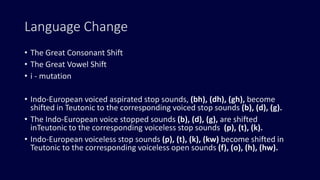
Language Change
• The Great Consonant Shift
• The Great Vowel Shift
• i - mutation
• Indo-European voiced aspirated stop sounds, (bh), (dh), (gh), become
shifted in Teutonic to the corresponding voiced stop sounds (b), (d), (g).
• The Indo-European voice stopped sounds (b), (d), (g), are shifted
inTeutonic to the corresponding voiceless stop sounds (p), (t), (k).
• Indo-European voiceless stop sounds (p), (t), (k), (kw) become shifted in
Teutonic to the corresponding voiceless open sounds (f), (o), (h), (hw).
LINGUISTIC TERMS
PHONETICS
• Articulatory Phonetics
• Acoustic Phonetics
• Auditory Phonetics
• The place of articulation
• the manner of articulation
• Voicing
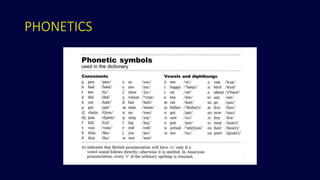
PHONETICS
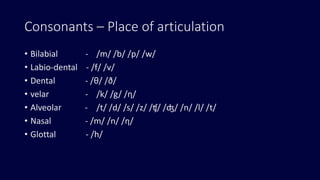
Consonants – Place of articulation
• Bilabial - /m/ /b/ /p/ /w/
• Labio-dental - /f/ /v/
• Dental - /θ/ /ð/
• velar - /k/ /g/ /η/
• Alveolar - /t/ /d/ /s/ /z/ /ʧ/ /ʤ/ /n/ /l/ /t/
• Nasal - /m/ /n/ /η/
• Glottal - /h/
PHONOLOGY
1.
SEMANTICS
2.
PRAGMATICS
3.
LEXICOGRAPHY
4.
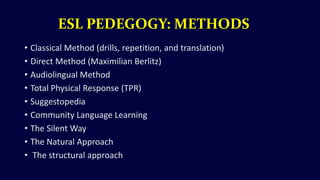
ESL PEDEGOGY: METHODS
• Classical Method (drills, repetition, and translation)
• Direct Method (Maximilian Berlitz)
• Audiolingual Method
• Total Physical Response (TPR)
• Suggestopedia
• Community Language Learning
• The Silent Way
• The Natural Approach
• The structural approach
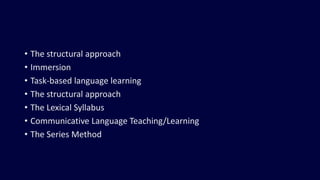
• Immersion
• Task-based language learning
• The structural approach
• The Lexical Syllabus
• Communicative Language Teaching/Learning
• The Series Method
SEMIOTICS
You can find me at:
garretraja
@gmail.com
Any questions?
Thanks!
More about your project.
Write here a list of features
Here you can write more
Content itself is what the end-user derives value from also
can refer.
Your Slide Title
More about your project.
Write here a list of features
Here you can write more
Content itself is what the end-user derives value from also
can refer.
Your Slide Title
GARRET RAJA
IMMANUEL
I am here because I love to design
presentations.
Hello!
I am Jane Doe
You can contact me at @username
PHONOLOGY
1.
PHONOLOGY
1.
PHONOLOGY
1.
The marketing mix is a business
tool used in marketing and by
marketers.
Big Title
Content itself is what the end-user
derives value from also can refer to
the information provided through the
medium, the way in which
Content B
Content in two columns
Content itself is what the end-user
derives value from also can refer to
the information provided through the
medium, the way in which
Content A
Content itself is what the
end-user derives value
from also can refer to the
information provided
through the medium,
Content C
Content in three columns
Content itself is what the
end-user derives value
from also can refer to the
information provided
through the medium,
Content A
Content itself is what the
end-user derives value
from also can refer to the
information provided
through the medium,
Content B
A Picture Is Worth A
Thousand Words
Itself is what the end-user derives
value from also.
USE BIG IMAGES TO SHOW
YOUR IDEAS
Title01
Yourgreat
description here
Title02
Yourgreat
description here
Title03
Yourgreat
description here
Title04
Yourgreat
description here
Shapes to explain ideas
Service 03Service 01 Service 02
Features WithIcons
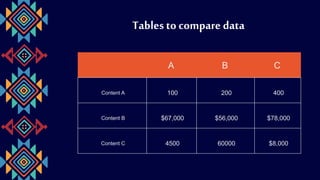
A B C
Content A 100 200 400
Content B $67,000 $56,000 $78,000
Content C 4500 60000 $8,000
Tablesto compare data
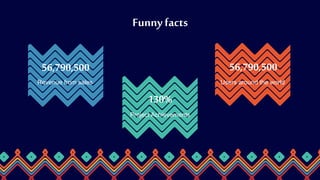
56,790,500
Write here your big numbers
Funnyfacts
Project Achievements
130%
Revenue from sales
56,790,500
Users around the world
56,790,500
Write here yourdescription
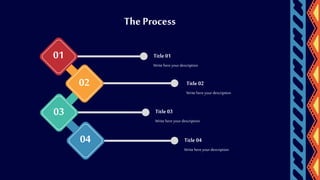
Title 01
Write here yourdescription
Title 02
04
02
01
03
Write here yourdescription
Title 03
Write here yourdescription
Title 04
The Process
Itself is what the end-user
derives value from also can
refer to the information
Content D
Itself is what the end-user
derives value from also can
refer to the information
Content C
Itself is what the end-user
derives value from also can
refer to the information
Content B
Itself is what the end-user
derives value from also can
refer to the information
Content A
Itself is what the end-user
derives value from also can
refer to the information
Content D
Itself is what the end-user
derives value from also can
refer to the information
Content B
Features with icons
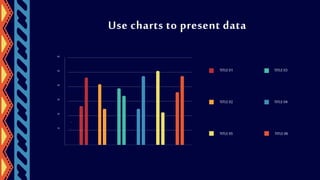
Use charts to present data
10
20
30
40
50
60
TITLE 01
TITLE 02
TITLE 03
TITLE 04
TITLE 05 TITLE 06
Mobile
App
Itself is what the end-user
derives value from also can
refer is what
Laptop
Project
Itself is what the end-user
derives value from also can
refer.
Desktop
Project
Itself is what the end-user
derives value from also can
refer is what.
Presentation template designed by powerpointify.com
Tribal graphics by freepik.com
Special thanks to all people who made and shared these awesome
resources for free:
Credits
Photographs by unsplash.com
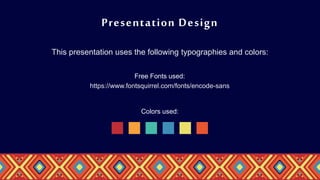
This presentation uses the following typographies and colors:
Colors used:
Free Fonts used:
https://www.fontsquirrel.com/fonts/encode-sans
Presentation Design

Linguistics

  • 1.
  • 2.
    BRANCHES OF LINGUISTICS •Phonetics • Phonology • Morphology • Syntax • Semantics • Pragmatics • Lexicography
  • 3.
    MORPHOLOGY • Morpheme • Neologism •Etymology • Barrowing • Compounding • Clipping – exam, promo, ad, fan,… • Backformation – Mixture,
  • 4.
    • Free • Bound •Lexical morphemes (content) • Functional • Derivational (changes grammatical) • Inflectional (singular/plural, comparative, Tense, Possessive) • S, ‘s, s, ing, ed, en, er, est
  • 5.
    • Allomorph –/s/, /z/, /-ez/ • Zero morph – sheep • /id/ /t/ /d/
  • 6.
    SYNTAX • TG GRAMMAR •PHRASE STRUCTURE GRAMMAR • DEEP AND SURFACE STRUCTURE • IC ANALYSIS
  • 7.
    NOAM CHOMSKY • InnateHypothesis • Critical Period Hypothesis • Competence • Performance • “Language and Mind“
  • 8.
  • 9.
    LANGUAGE ACQUISITION THEORIES •Behaviorist Theory • B. F. Skinner • Pavlov’s dog • Stimuli > Response • Habit • rejection Behaviorist Theory • “Language is not a habit structure” • create new sentence
  • 10.
    UNIVERSAL GRAMMAR • Innatebiological grammatical categories • “Nativism or generativism” – innate language • LAD • First (Child)Language Acquisition – L1 • Labial consonants sound made by lip • Second Language Acquisition – L2 • Stephen Krashan – Language vs Acquisition
  • 11.
    Second language development– 4 stages • Pre – production (silent period) • Early production (blabbering) (6 months) • Speech emergence (not grammatically correct) • Intermediate and advanced fluency – active vocabulary – they are trying – they fail – they have doubts – ready to master
  • 12.
    Second language vsForeign Language • First language is acquired and Second Language is Learned • Native language – easy leaned – coz it’s acquired • existing knowledge of native language • Interlanguage (Selinker) • Language Transfer – Chomsky (1959)
  • 13.
    THEORIES OF SLA •UNIVERSALIST THEORY • BEHAVIOURIST THEORY • NATIVIST THEORY • COGNITIVIST THEORY (Jean Pieget) • SOCIAL INTERACTIONIST THEORY • ACCULTURATION THEORY (Ego boundaries) • CONTRASTIVE THEORY - “positive transfer” or “negative transfer” or “interference”. • IDENTITY THEORY - language learn second language by same law • MONITOR THEORY
  • 14.
    THEORIES OF ORIGINOF LANGUAGE • BOW – WOW THEORY • (Onomatopoeia) • POOH-POOH THEORY • YO-HE-YO THEORY • THE DING-DONG THEORY (Max Muller) • INNATENESS HYPOTHESIS (Chomsky) • GESTURE THEORY (Wilhelm Wundt & Richard Paget) • TA-TA THEORY
  • 15.
    Indo-European Family ofLanguages Two other branches of Indo-European family Hittie and Tocharian are now extinct. These are not shown in the above diagram.
  • 16.
    USA 1 9 ,4 5 0 0 0 0 BRASIL 1 9 , 4 5 0 0 0 0 GERMAN 1 9 , 4 5 0 0 0 0 World Map
  • 17.
    HISTORY OF ENGLISHLANGUAGE • From Celts to William the Conqueror • 3 Major Languages – Latin, English, and French. • OLD ENGLISH (Anglo Saxon) - from 450 to 1150 • MIDDLE ENGLISH (Anglo Norman) - From 1150 to 1500 • MODERN ENGLISH - since 1500 – (loss of inflection)
  • 18.
    “We can distinguish fourdialects in Old English times: Northumbrian, Mercian, West Saxon, and Kentish.” (Bough 47) “
  • 19.
    Characteristics of OldEnglish • Old English word stān is the same word as Modern English stone, • but the vowel is different. • the sound of th: þ and ð • Old English is almost purely Germanic (before French influence) • Grammar: “There is no ablative, and generally no locative or instrumental case, these having been merged with the dative. In the same way the vocative of direct address is generally identical with the nominative form. Thus the Old English noun has only four cases.” (50)
  • 20.
    “Thus in Latinthe nominative murus (wall) is distinguished from the genitive muri (of the wall), dative muro (to the wall), accusative murum, etc. A single verb form conveys the idea of person, number, and tense along with the meaning of the root, a conception that we require three words for in English.” (Bough 50) “
  • 21.
    Grammatical Gender ofOld English • “Stān (stone) is masculine, mōna (moon) is masculine, but sunne (sun) is feminine, as in German. In French the corresponding words have just the opposite genders: pierre (stone) and lune (moon) are feminine while soleil (sun) is masculine. Often the gender of Old English nouns is quite illogical. Words like moegden (girl), wīf (wife), bearn (child, son), and cild (child), which we should expect to be feminine or masculine, are in fact neuter, while wīfmann (woman) is masculine because the second element of the compound is masculine.” (51)
  • 22.
    Old English Verband Inflection • Old English distinguished only two simple tenses by inflection, a present and a past. • division of the verb into two great classes, the weak and the strong, often known in Modern English as regular and irregular verbs. • The strong verbs, like sing, sang, sung • weak verbs, such as walk, walked, walked • In the principal parts of Old English strong verbs, therefore, we have four forms: the infmitive, the preterite singular (first and third person), the preterite plural, and the past participle.
  • 23.
    The Norman Conquestand After • The Origin of Normandy • Normans had soon absorbed the most important elements of French civilization • The Year 1066 • Knowledge of French among the Middle Class
  • 24.
    Middle English (1150–1500) •Decay of Inflectional Endings • Loss of Grammatical Gender • Middle English Syntax • French Influence on the Vocabulary • Prefixes – for, with • Suffixes – • Aureate Terms • Four principal dialects of Middle English: Northern, East • Midland, West Midland, and Southern • London Standard Language
  • 25.
    -en Plural inflection •Most inflectional syllables in Old • English ended in an, or am. As a rule • all such endings have disappeared. Yet the ending -en remains in • two or three plurals, as oxen, children, breathren, and in a few past participles like driven, risen.
  • 26.
    Vocabulary (French) • Wed– Marry • Sheep – mutton • Pig – Pork • Cow – Beef • Villein •
  • 27.
    Language Change • TheGreat Consonant Shift • The Great Vowel Shift • i - mutation • Indo-European voiced aspirated stop sounds, (bh), (dh), (gh), become shifted in Teutonic to the corresponding voiced stop sounds (b), (d), (g). • The Indo-European voice stopped sounds (b), (d), (g), are shifted inTeutonic to the corresponding voiceless stop sounds (p), (t), (k). • Indo-European voiceless stop sounds (p), (t), (k), (kw) become shifted in Teutonic to the corresponding voiceless open sounds (f), (o), (h), (hw).
  • 28.
  • 29.
    PHONETICS • Articulatory Phonetics •Acoustic Phonetics • Auditory Phonetics • The place of articulation • the manner of articulation • Voicing
  • 30.
  • 31.
    Consonants – Placeof articulation • Bilabial - /m/ /b/ /p/ /w/ • Labio-dental - /f/ /v/ • Dental - /θ/ /ð/ • velar - /k/ /g/ /η/ • Alveolar - /t/ /d/ /s/ /z/ /ʧ/ /ʤ/ /n/ /l/ /t/ • Nasal - /m/ /n/ /η/ • Glottal - /h/
  • 32.
  • 33.
  • 34.
  • 35.
  • 36.
    ESL PEDEGOGY: METHODS •Classical Method (drills, repetition, and translation) • Direct Method (Maximilian Berlitz) • Audiolingual Method • Total Physical Response (TPR) • Suggestopedia • Community Language Learning • The Silent Way • The Natural Approach • The structural approach
  • 37.
    • The structuralapproach • Immersion • Task-based language learning • The structural approach • The Lexical Syllabus • Communicative Language Teaching/Learning • The Series Method
  • 38.
  • 39.
    You can findme at: garretraja @gmail.com Any questions? Thanks!
  • 40.
    More about yourproject. Write here a list of features Here you can write more Content itself is what the end-user derives value from also can refer. Your Slide Title
  • 42.
    More about yourproject. Write here a list of features Here you can write more Content itself is what the end-user derives value from also can refer. Your Slide Title
  • 43.
  • 44.
    I am herebecause I love to design presentations. Hello! I am Jane Doe You can contact me at @username
  • 45.
  • 46.
  • 47.
  • 49.
    The marketing mixis a business tool used in marketing and by marketers. Big Title
  • 50.
    Content itself iswhat the end-user derives value from also can refer to the information provided through the medium, the way in which Content B Content in two columns Content itself is what the end-user derives value from also can refer to the information provided through the medium, the way in which Content A
  • 51.
    Content itself iswhat the end-user derives value from also can refer to the information provided through the medium, Content C Content in three columns Content itself is what the end-user derives value from also can refer to the information provided through the medium, Content A Content itself is what the end-user derives value from also can refer to the information provided through the medium, Content B
  • 52.
    A Picture IsWorth A Thousand Words Itself is what the end-user derives value from also.
  • 53.
    USE BIG IMAGESTO SHOW YOUR IDEAS
  • 54.
  • 55.
    Service 03Service 01Service 02 Features WithIcons
  • 56.
    A B C ContentA 100 200 400 Content B $67,000 $56,000 $78,000 Content C 4500 60000 $8,000 Tablesto compare data
  • 57.
  • 58.
    Funnyfacts Project Achievements 130% Revenue fromsales 56,790,500 Users around the world 56,790,500
  • 59.
    Write here yourdescription Title01 Write here yourdescription Title 02 04 02 01 03 Write here yourdescription Title 03 Write here yourdescription Title 04 The Process
  • 60.
    Itself is whatthe end-user derives value from also can refer to the information Content D Itself is what the end-user derives value from also can refer to the information Content C Itself is what the end-user derives value from also can refer to the information Content B Itself is what the end-user derives value from also can refer to the information Content A Itself is what the end-user derives value from also can refer to the information Content D Itself is what the end-user derives value from also can refer to the information Content B Features with icons
  • 61.
    Use charts topresent data 10 20 30 40 50 60 TITLE 01 TITLE 02 TITLE 03 TITLE 04 TITLE 05 TITLE 06
  • 62.
    Mobile App Itself is whatthe end-user derives value from also can refer is what
  • 63.
    Laptop Project Itself is whatthe end-user derives value from also can refer.
  • 64.
    Desktop Project Itself is whatthe end-user derives value from also can refer is what.
  • 65.
    Presentation template designedby powerpointify.com Tribal graphics by freepik.com Special thanks to all people who made and shared these awesome resources for free: Credits Photographs by unsplash.com
  • 66.
    This presentation usesthe following typographies and colors: Colors used: Free Fonts used: https://www.fontsquirrel.com/fonts/encode-sans Presentation Design