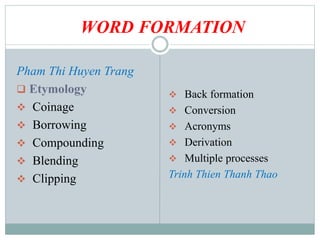
WORD FORMATION
Pham Thi Huyen Trang
 Etymology
 Coinage
 Borrowing
 Compounding
 Blending
 Clipping
 Back formation
 Conversion
 Acronyms
 Derivation
 Multiple processes
Trinh Thien Thanh Thao
ETYMOLOGY
 Definition:
- The study of the origin and history of a word.
 Example:
- Compassion
- Money
http://www.etymonline.com
COINAGE
 Definition:
- The invention of totally new term.
 Example
- Aspirin, nylon, zipper,...(commercial product)
- Jeans, volt, watt,...(eponyms)
BORROWING
 Definition:
- The taking over of words from other languages.
 Example:
- Typhoon.
- Tattoo.
- Suupaamaaketto.
o Loan transition = calque (a special type of borrowing)
- Boy friend  nan pengyu.
COMPOUNDING
 Definition:
- The joining of two separate words to produce a single
form.
 Example:
- Nouns: waterfall, newspaper
- Adjectives: heartbreaking, sugar-free, airsick
- Verbs: oven-bake, baby-sit, chain-smoke
- Adverbs: good-naturedly, nevertheless
BLENDING.
 Definition:
- The combination of two or more separate forms to
produce a single new term.
 Example:
- Bruch
- Motel.
- Smurk.
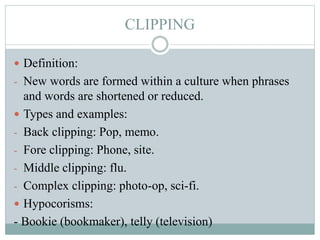
CLIPPING
 Definition:
- New words are formed within a culture when phrases
and words are shortened or reduced.
 Types and examples:
- Back clipping: Pop, memo.
- Fore clipping: Phone, site.
- Middle clipping: flu.
- Complex clipping: photo-op, sci-fi.
 Hypocorisms:
- Bookie (bookmaker), telly (television)
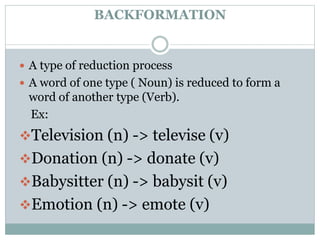
BACKFORMATION
 A type of reduction process
 A word of one type ( Noun) is reduced to form a
word of another type (Verb).
Ex:
Television (n) -> televise (v)
Donation (n) -> donate (v)
Babysitter (n) -> babysit (v)
Emotion (n) -> emote (v)
 A regular source of backformed verbs is based on
the pattern:
Ex:
Editor (n) -> edit (v)
Sculptor (n) -> sculpt (v)
Burglars (n) -> burgle (v)
Peddlers (n) -> peddle (v)
Swindlers (n) -> swindle (v)
N +ER -- V
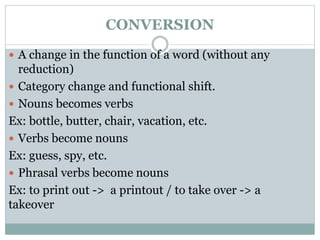
CONVERSION
 A change in the function of a word (without any
reduction)
 Category change and functional shift.
 Nouns becomes verbs
Ex: bottle, butter, chair, vacation, etc.
 Verbs become nouns
Ex: guess, spy, etc.
 Phrasal verbs become nouns
Ex: to print out -> a printout / to take over -> a
takeover
 Verbs become adjectives
Ex: see through (material), (a) stand up (comedian)
 Adjectives become verbs or nouns
Ex: dirty(adj->v), empty (adj->v),
crazy (adj->n), nasty (adj-> n)
 Compound nouns perform adjectival or verbal
functions
Ballpark: a ball-park figure/ to ball-park of an estimate
of the cost
-> mastermind, microwave, etc.
ACRONYMS
 New words are formed from the initial letters of a set
of other words.
 The pronunciation consists of saying each letter
Ex: CD (compact disk), VCR (video cassette recorder),
FBI ( Federal Bureau of Investigation)
 Pronounced as new single words ( capitalized/
uncapitalized)
Ex:
o NATO, NASA, UNESCO, GIF, etc.
o laser, radar, scuba, zip, etc.
 Names of organizations:
Ex: WAR ( women against rape)
 Abbreviations whose last abbreviated word is
often redundantly included
Ex: ATM (automatic teller machine), PIN ( personal
identification number)
 I sometimes forget my PIN number when I go to
the ATM machine.
 HIV virus: human immunodeficiency virus virus
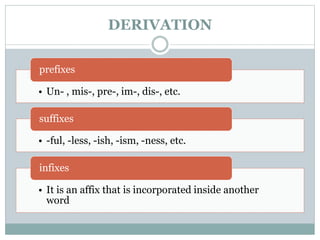
DERIVATION
• Un- , mis-, pre-, im-, dis-, etc.
prefixes
• -ful, -less, -ish, -ism, -ness, etc.
suffixes
• It is an affix that is incorporated inside another
word
infixes
 Prefixes and suffixes
Ex: mislead, unhappy, prejudge, joyful, careless,
disrespectful, unkindness, foolishness, biodegradable,
etc.
 Infixes
Ex: Hallebloodylujah!, fandamntastic, etc.

Linguistic 1

  • 1.
    WORD FORMATION Pham ThiHuyen Trang  Etymology  Coinage  Borrowing  Compounding  Blending  Clipping  Back formation  Conversion  Acronyms  Derivation  Multiple processes Trinh Thien Thanh Thao
  • 2.
    ETYMOLOGY  Definition: - Thestudy of the origin and history of a word.  Example: - Compassion - Money http://www.etymonline.com
  • 3.
    COINAGE  Definition: - Theinvention of totally new term.  Example - Aspirin, nylon, zipper,...(commercial product) - Jeans, volt, watt,...(eponyms)
  • 4.
    BORROWING  Definition: - Thetaking over of words from other languages.  Example: - Typhoon. - Tattoo. - Suupaamaaketto. o Loan transition = calque (a special type of borrowing) - Boy friend  nan pengyu.
  • 5.
    COMPOUNDING  Definition: - Thejoining of two separate words to produce a single form.  Example: - Nouns: waterfall, newspaper - Adjectives: heartbreaking, sugar-free, airsick - Verbs: oven-bake, baby-sit, chain-smoke - Adverbs: good-naturedly, nevertheless
  • 6.
    BLENDING.  Definition: - Thecombination of two or more separate forms to produce a single new term.  Example: - Bruch - Motel. - Smurk.
  • 7.
    CLIPPING  Definition: - Newwords are formed within a culture when phrases and words are shortened or reduced.  Types and examples: - Back clipping: Pop, memo. - Fore clipping: Phone, site. - Middle clipping: flu. - Complex clipping: photo-op, sci-fi.  Hypocorisms: - Bookie (bookmaker), telly (television)
  • 8.
    BACKFORMATION  A typeof reduction process  A word of one type ( Noun) is reduced to form a word of another type (Verb). Ex: Television (n) -> televise (v) Donation (n) -> donate (v) Babysitter (n) -> babysit (v) Emotion (n) -> emote (v)
  • 9.
     A regularsource of backformed verbs is based on the pattern: Ex: Editor (n) -> edit (v) Sculptor (n) -> sculpt (v) Burglars (n) -> burgle (v) Peddlers (n) -> peddle (v) Swindlers (n) -> swindle (v) N +ER -- V
  • 10.
    CONVERSION  A changein the function of a word (without any reduction)  Category change and functional shift.  Nouns becomes verbs Ex: bottle, butter, chair, vacation, etc.  Verbs become nouns Ex: guess, spy, etc.  Phrasal verbs become nouns Ex: to print out -> a printout / to take over -> a takeover
  • 11.
     Verbs becomeadjectives Ex: see through (material), (a) stand up (comedian)  Adjectives become verbs or nouns Ex: dirty(adj->v), empty (adj->v), crazy (adj->n), nasty (adj-> n)  Compound nouns perform adjectival or verbal functions Ballpark: a ball-park figure/ to ball-park of an estimate of the cost -> mastermind, microwave, etc.
  • 12.
    ACRONYMS  New wordsare formed from the initial letters of a set of other words.  The pronunciation consists of saying each letter Ex: CD (compact disk), VCR (video cassette recorder), FBI ( Federal Bureau of Investigation)  Pronounced as new single words ( capitalized/ uncapitalized) Ex: o NATO, NASA, UNESCO, GIF, etc. o laser, radar, scuba, zip, etc.
  • 13.
     Names oforganizations: Ex: WAR ( women against rape)  Abbreviations whose last abbreviated word is often redundantly included Ex: ATM (automatic teller machine), PIN ( personal identification number)  I sometimes forget my PIN number when I go to the ATM machine.  HIV virus: human immunodeficiency virus virus
  • 14.
    DERIVATION • Un- ,mis-, pre-, im-, dis-, etc. prefixes • -ful, -less, -ish, -ism, -ness, etc. suffixes • It is an affix that is incorporated inside another word infixes
  • 15.
     Prefixes andsuffixes Ex: mislead, unhappy, prejudge, joyful, careless, disrespectful, unkindness, foolishness, biodegradable, etc.  Infixes Ex: Hallebloodylujah!, fandamntastic, etc.