
LINES AND
  ANGLES
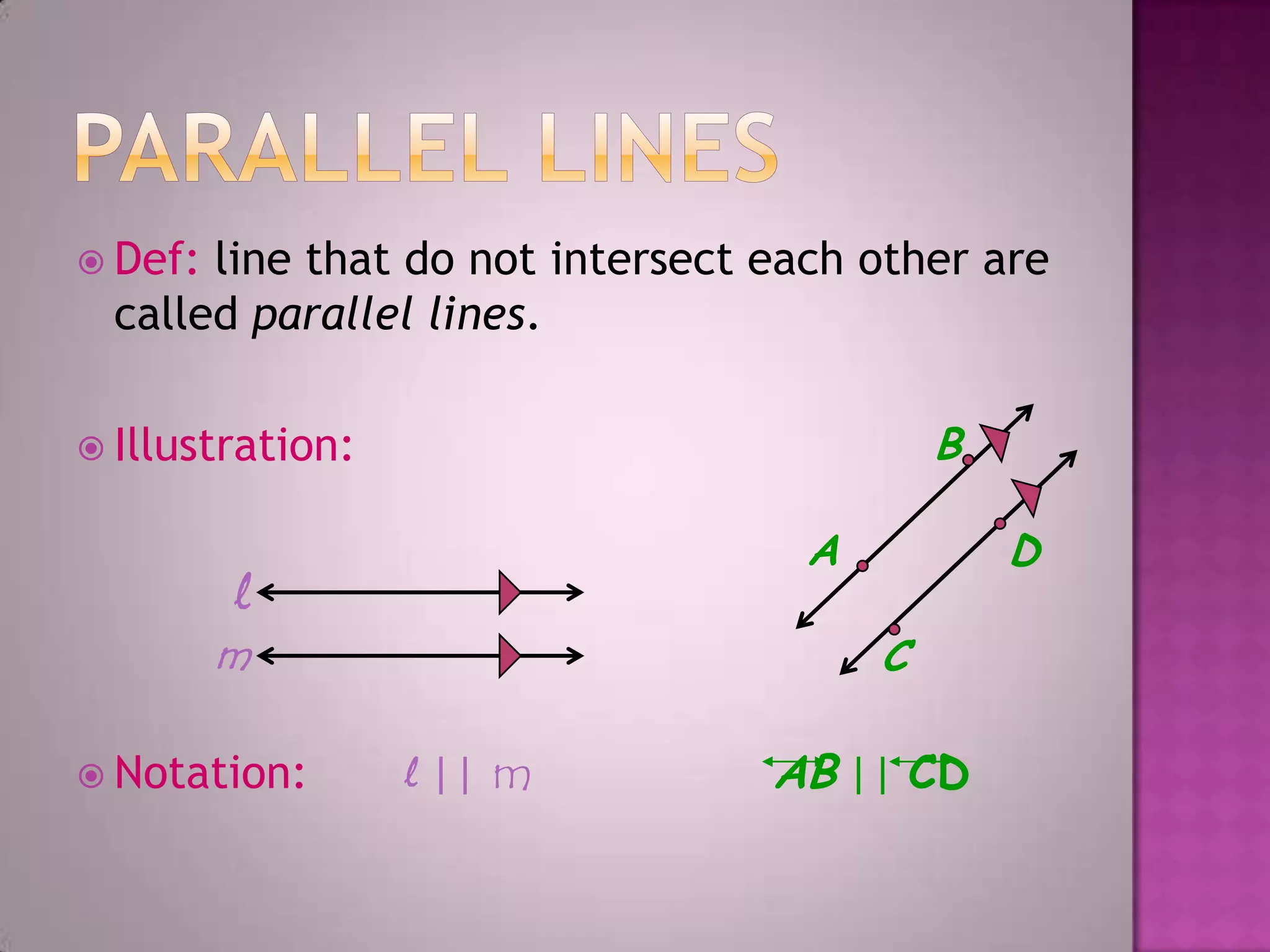
 Def: line that do not intersect each other are
  called parallel lines.

 Illustration:                             B

                                    A           D
         l
         m                              C

 Notation:       l || m          AB || CD
Examples of Parallel Lines
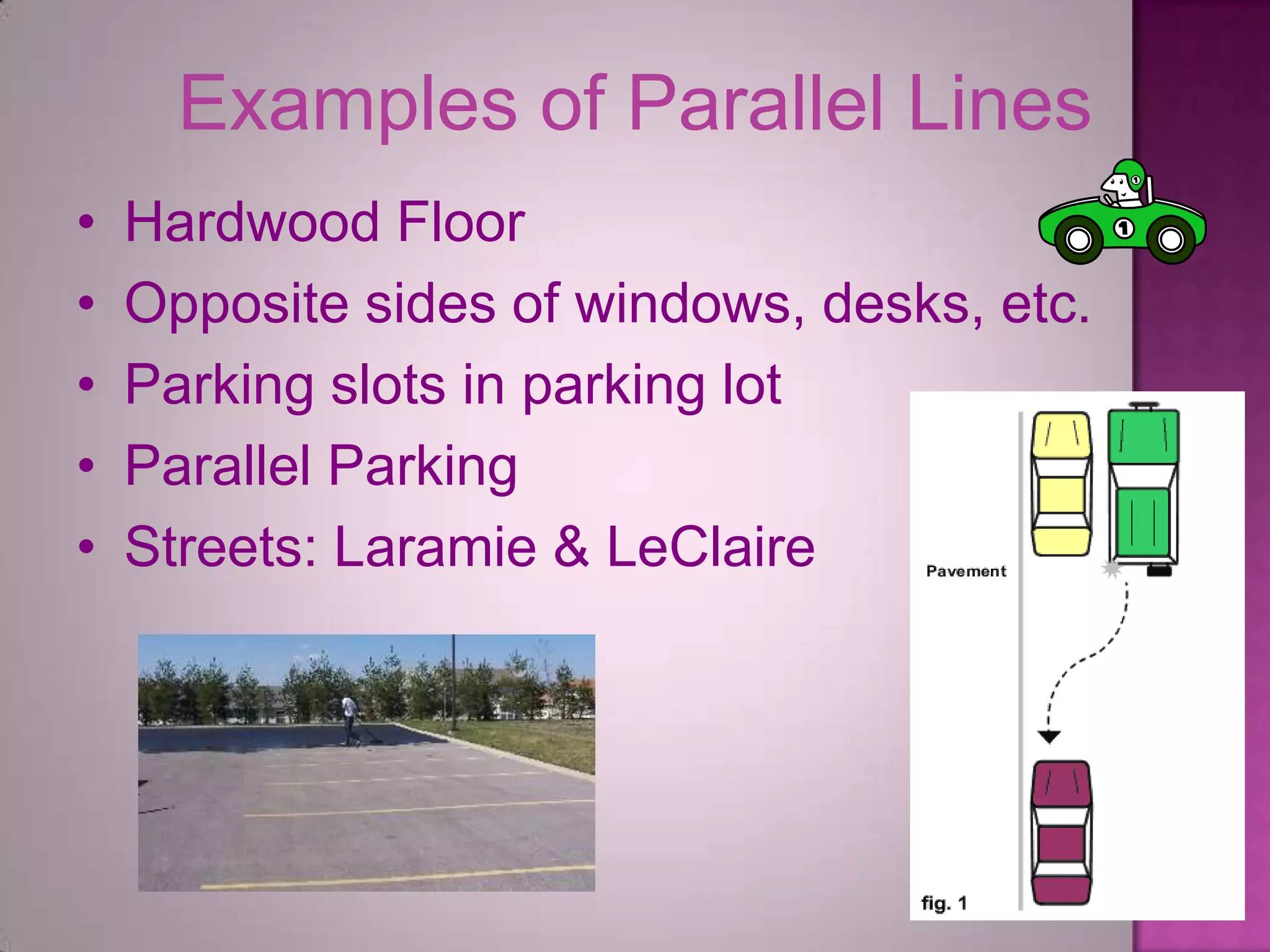
•   Hardwood Floor
•   Opposite sides of windows, desks, etc.
•   Parking slots in parking lot
•   Parallel Parking
•   Streets: Laramie & LeClaire
Examples of Parallel Lines
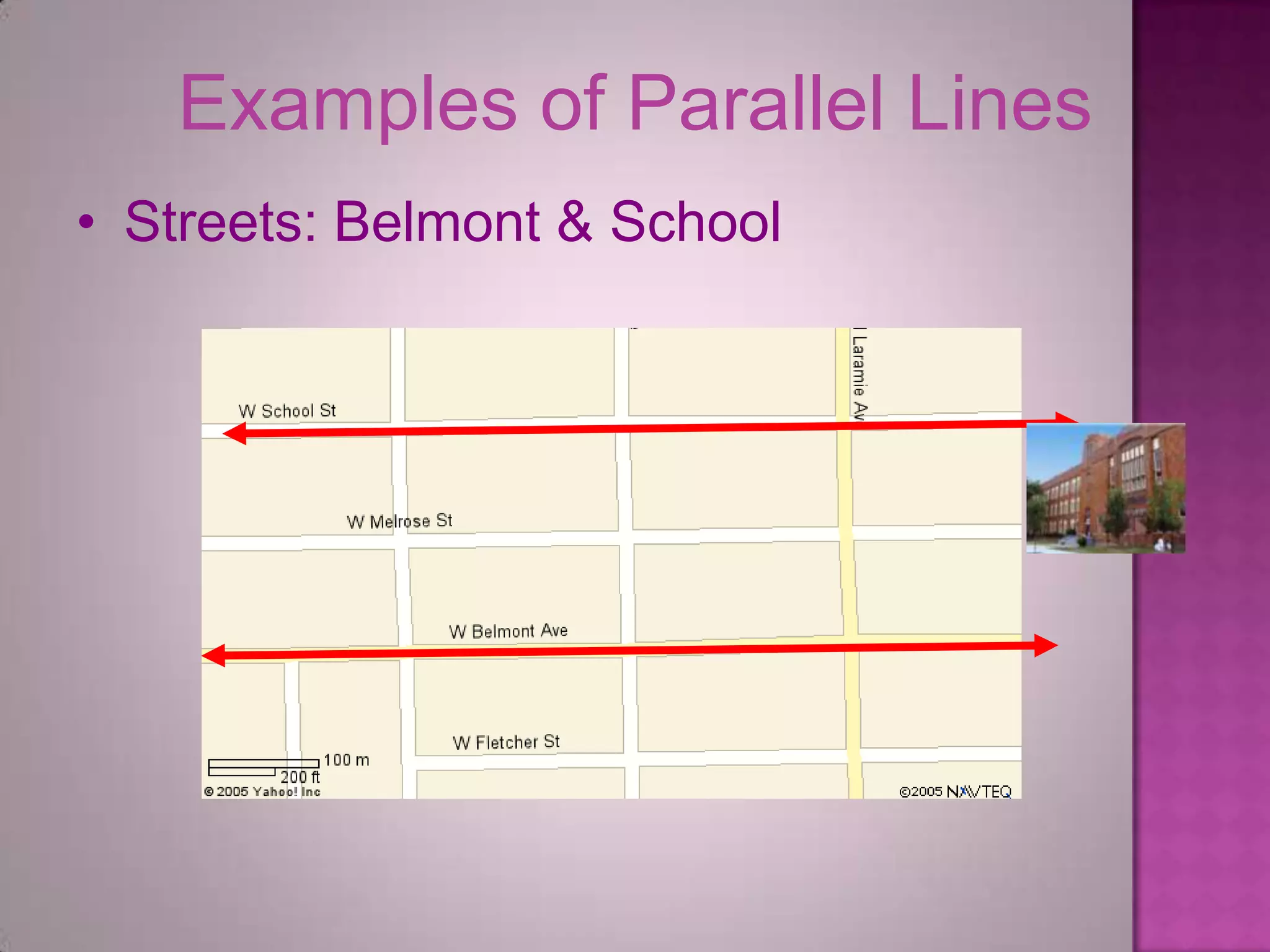
• Streets: Belmont & School
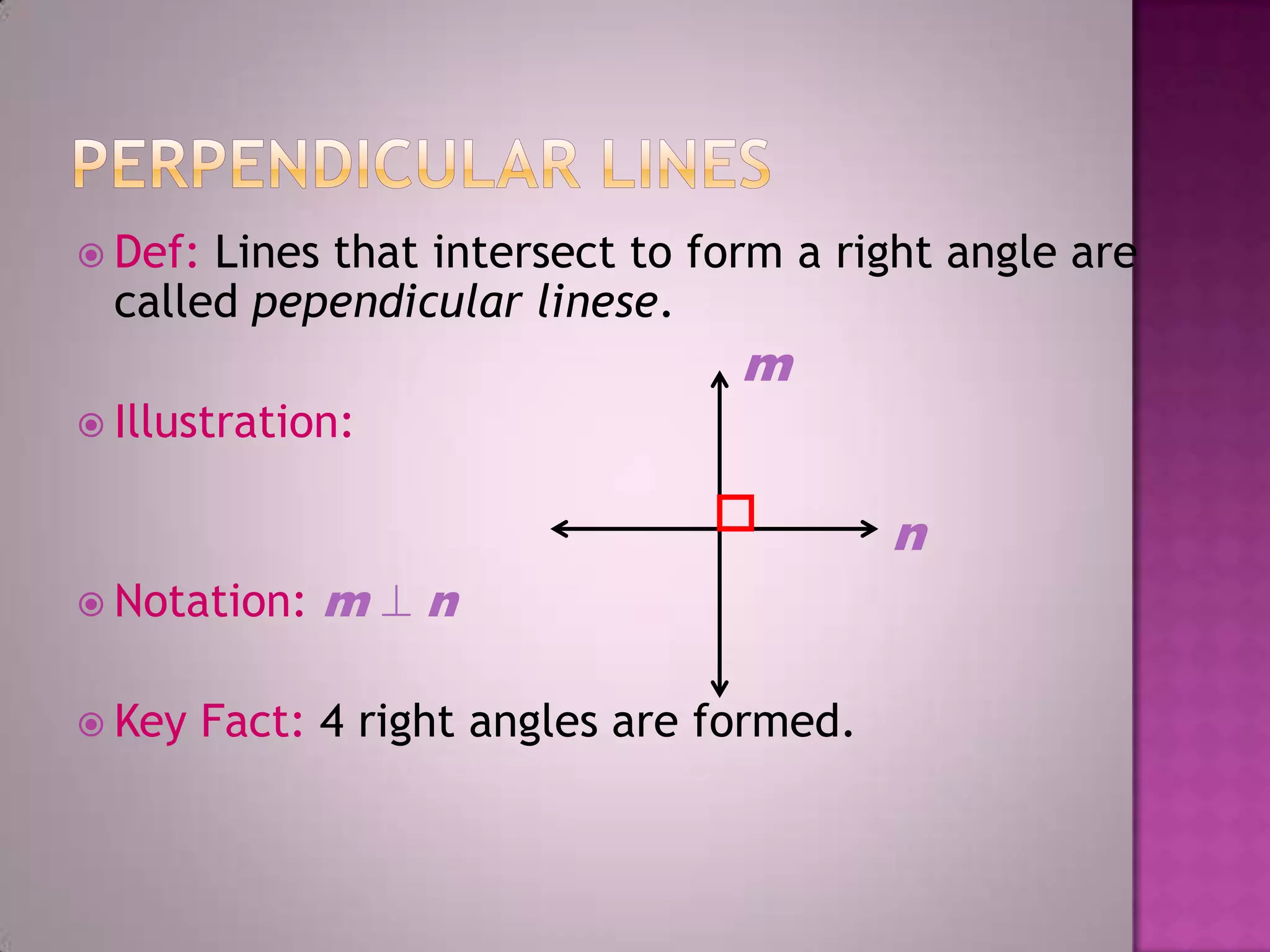
 Def: Lines that intersect to form a right angle are
  called pependicular linese.
                                  m
 Illustration:


                                           n
 Notation:   m   n

 Key   Fact: 4 right angles are formed.
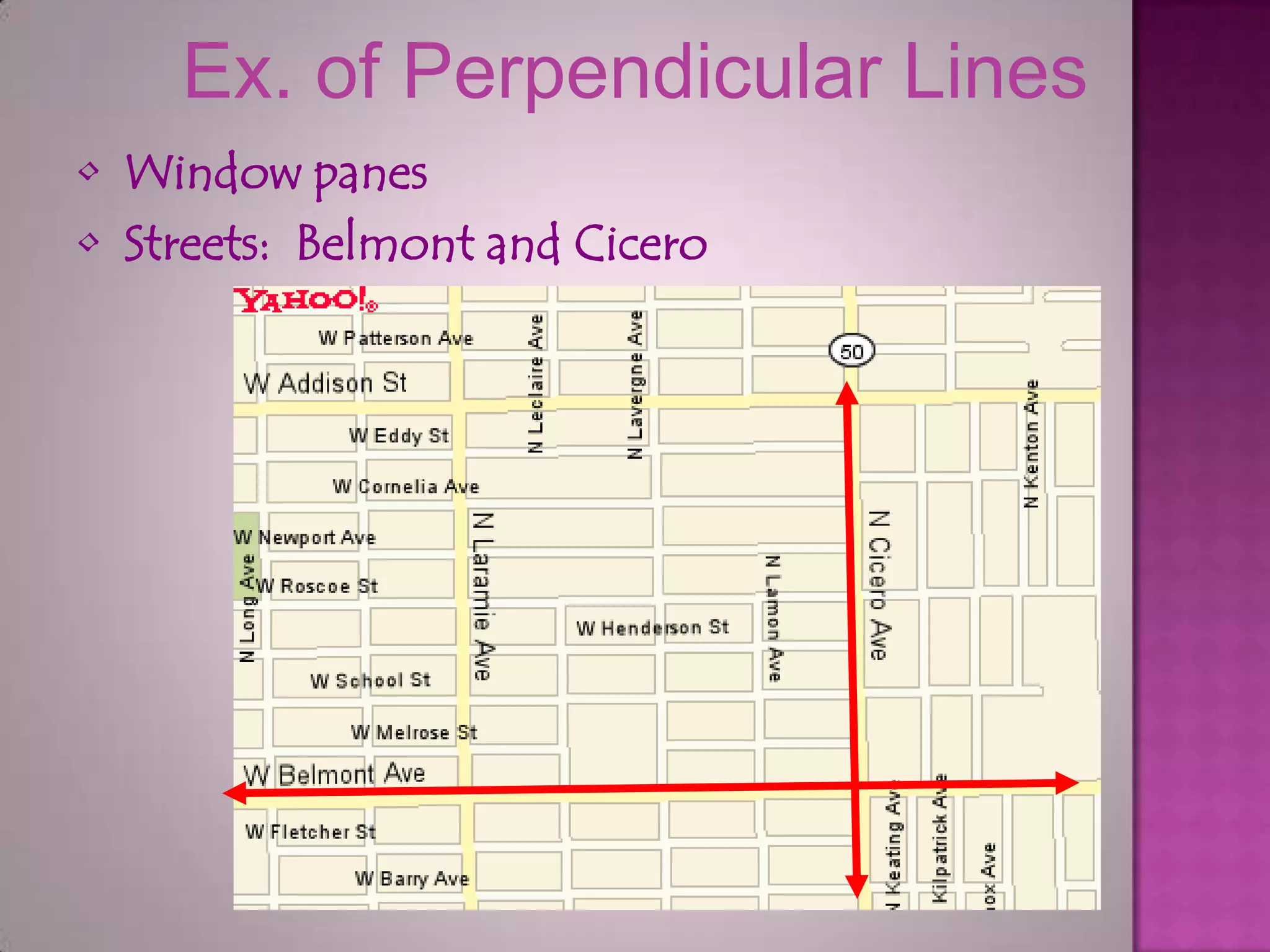
Ex. of Perpendicular Lines
• Window panes
• Streets: Belmont and Cicero
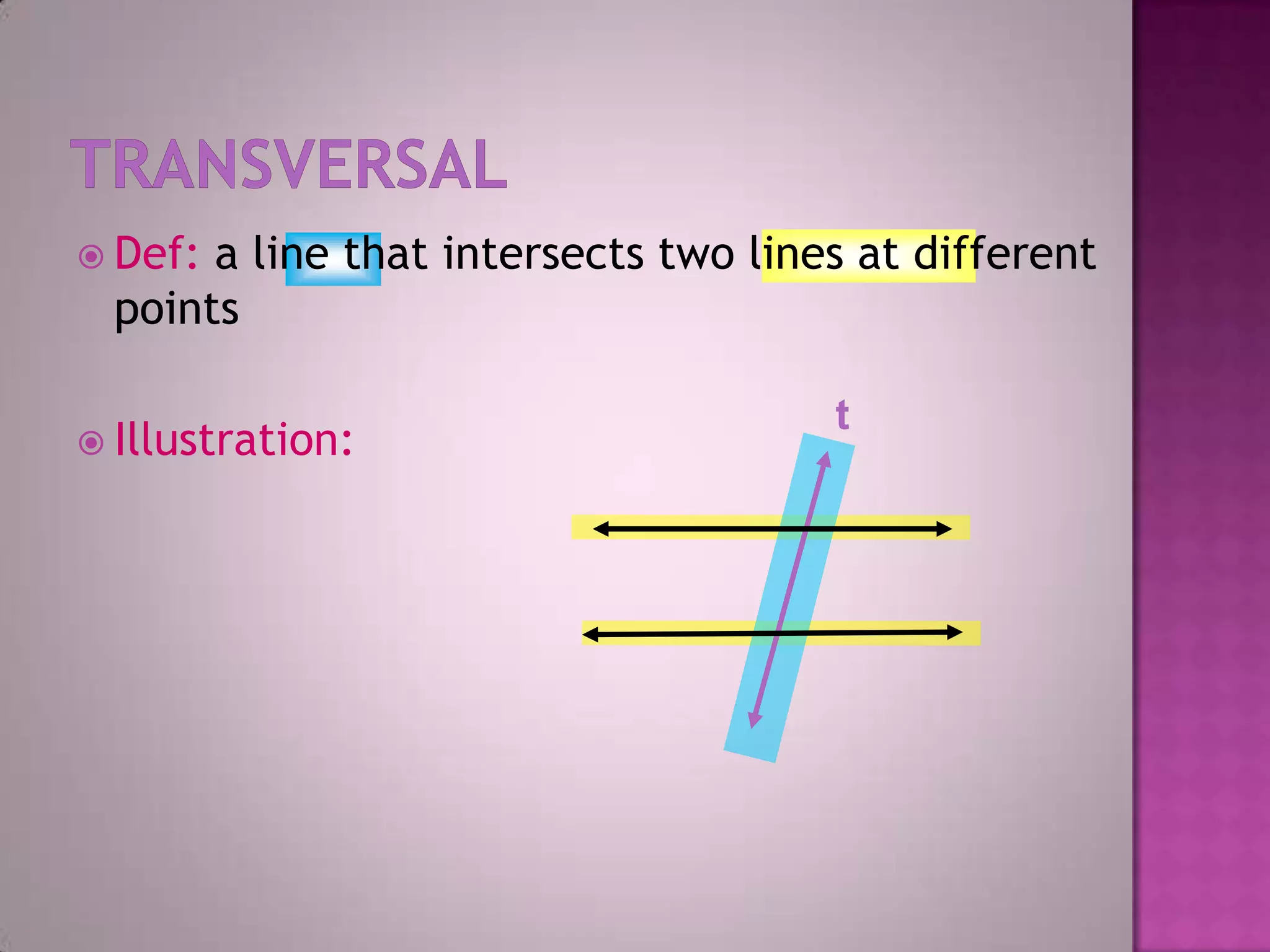
 Def: a line that intersects two lines at different
  points

                                      t
 Illustration:
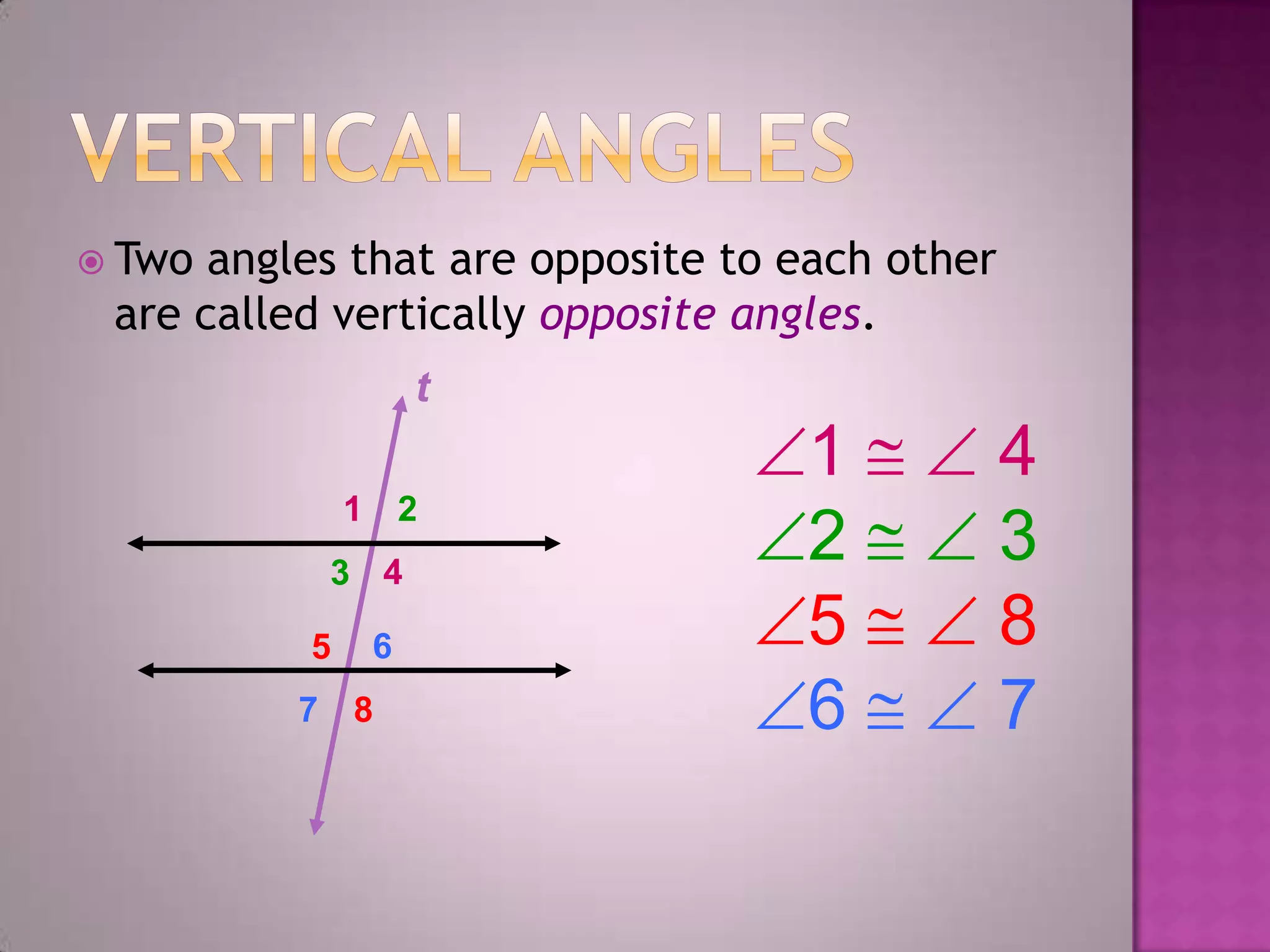
 Two angles that are opposite to each other
 are called vertically opposite angles.
                   t
                                  1            4
              1 2
             3 4
                                  2            3
          5    6                  5            8
         7    8                   6            7
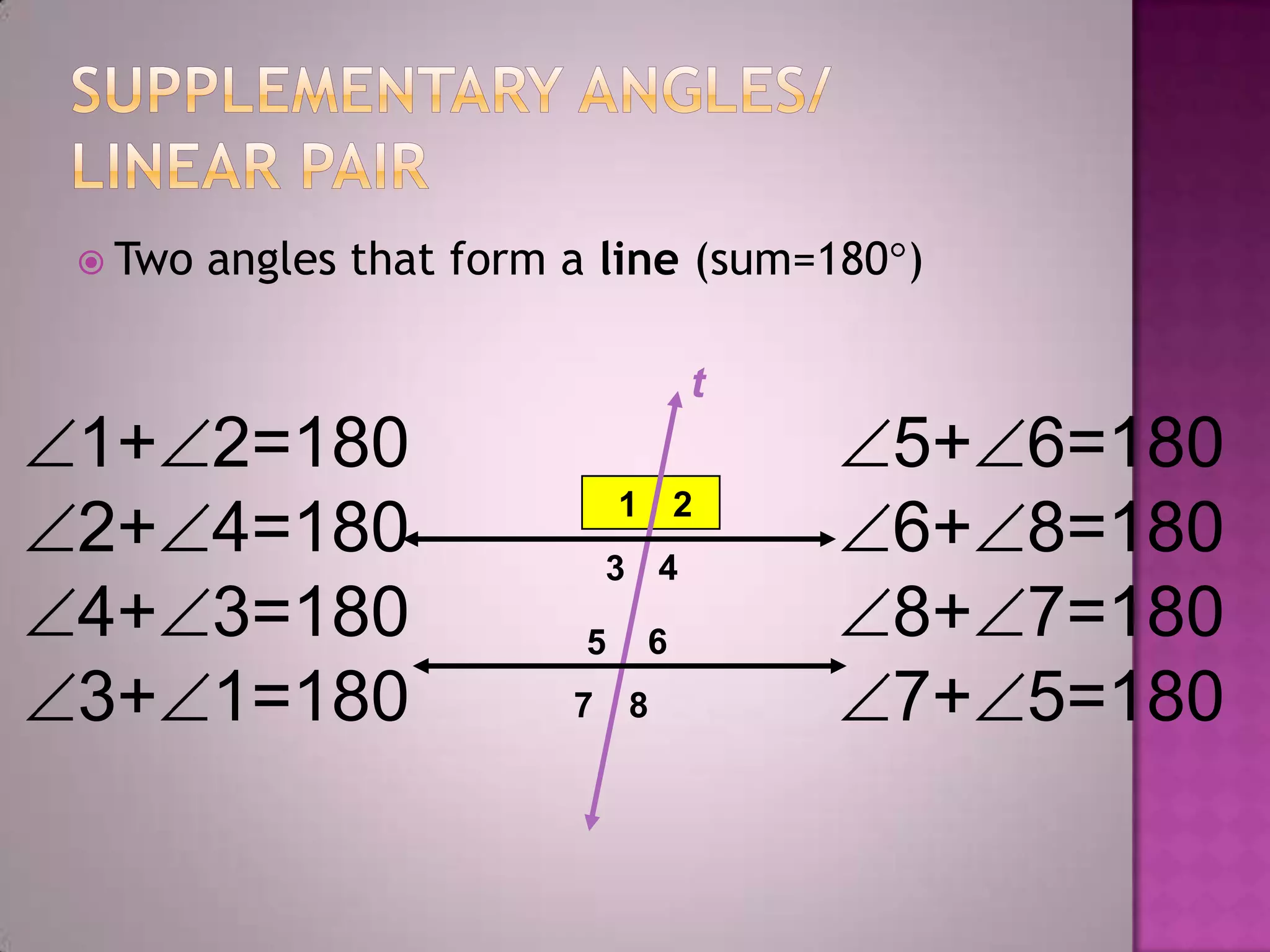
 Two   angles that form a line (sum=180 )

                                   t
1+      2=180                           5+   6=180
                             1 2
2+      4=180                3 4
                                        6+   8=180
4+      3=180            5    6
                                        8+   7=180
3+      1=180            7   8          7+   5=180
 A line segment has two end points.
 A ray has only one end point.
 A line has no end points on either side
 An angle is formed when two lines meet.
 A transversal is a line that intersect two or
    more lines at distinct points
 The various angles formed by a transversal are
1. Adjacent angles
2. Corresponding angles
3. Vertically opposite angles alternate angles
4. Linear pair
Lines and angles

Lines and angles

  • 1.
    LINES AND ANGLES
  • 2.
     Def: linethat do not intersect each other are called parallel lines.  Illustration: B A D l m C  Notation: l || m AB || CD
  • 3.
    Examples of ParallelLines • Hardwood Floor • Opposite sides of windows, desks, etc. • Parking slots in parking lot • Parallel Parking • Streets: Laramie & LeClaire
  • 4.
    Examples of ParallelLines • Streets: Belmont & School
  • 5.
     Def: Linesthat intersect to form a right angle are called pependicular linese. m  Illustration: n  Notation: m n  Key Fact: 4 right angles are formed.
  • 6.
    Ex. of PerpendicularLines • Window panes • Streets: Belmont and Cicero
  • 7.
     Def: aline that intersects two lines at different points t  Illustration:
  • 8.
     Two anglesthat are opposite to each other are called vertically opposite angles. t 1 4 1 2 3 4 2 3 5 6 5 8 7 8 6 7
  • 9.
     Two angles that form a line (sum=180 ) t 1+ 2=180 5+ 6=180 1 2 2+ 4=180 3 4 6+ 8=180 4+ 3=180 5 6 8+ 7=180 3+ 1=180 7 8 7+ 5=180
  • 10.
     A linesegment has two end points.  A ray has only one end point.  A line has no end points on either side  An angle is formed when two lines meet.  A transversal is a line that intersect two or more lines at distinct points  The various angles formed by a transversal are 1. Adjacent angles 2. Corresponding angles 3. Vertically opposite angles alternate angles 4. Linear pair