Real numbers include all the numbers in our
numbering system – decimals, fractions,
negative, positive and even funny or odd
numbers like Pi or imaginary numbers whose
square would be less than zero (an example
would be -1 or ).
They are called real because they show the
value of something real.
Numbers are grouped together or organized
according to their type.
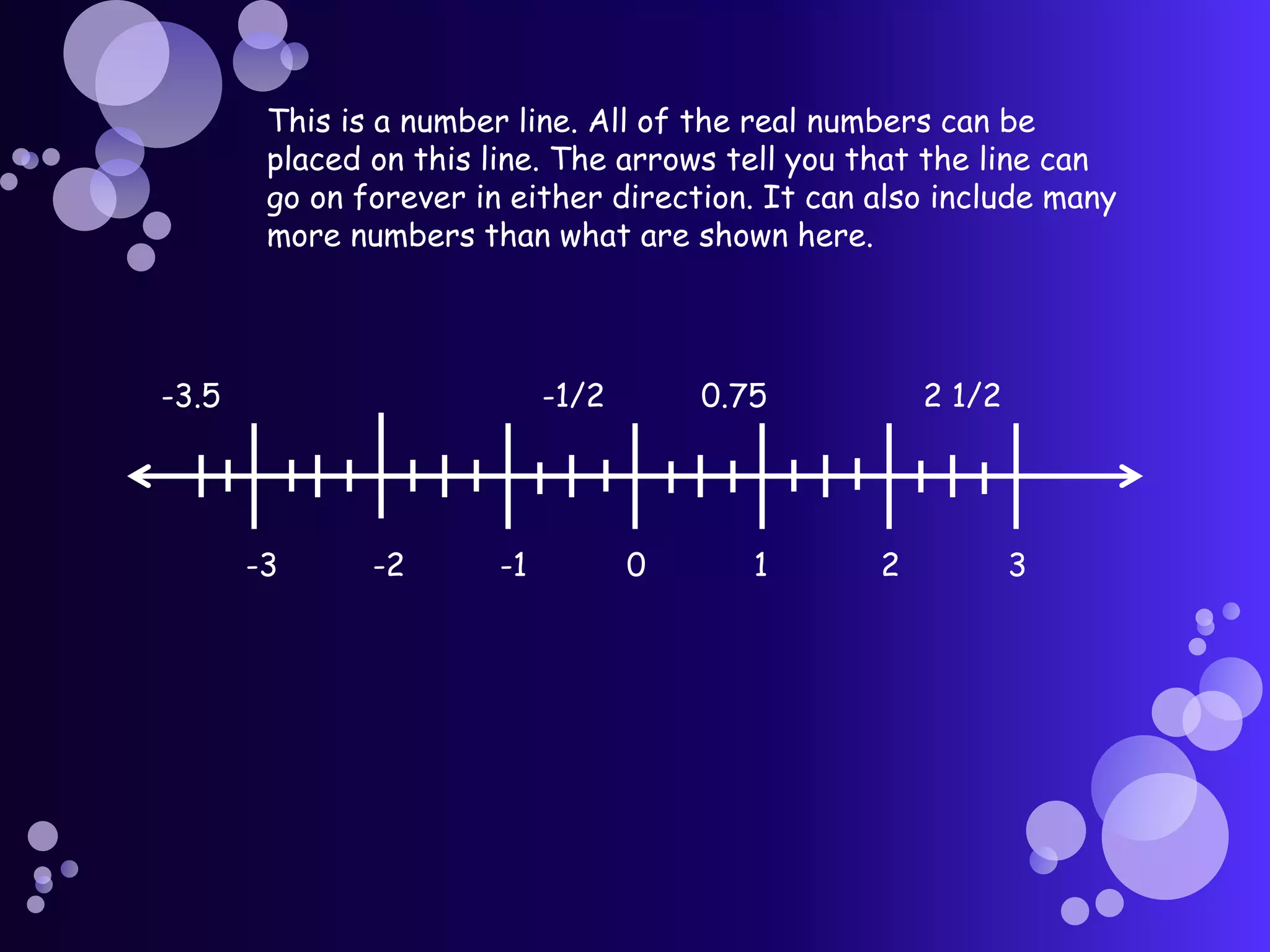
-3 -2 -1 0 1 2 3
-3.5 -1/2 0.75 2 1/2
This is a number line. All of the real numbers can be
placed on this line. The arrows tell you that the line can
go on forever in either direction. It can also include many
more numbers than what are shown here.
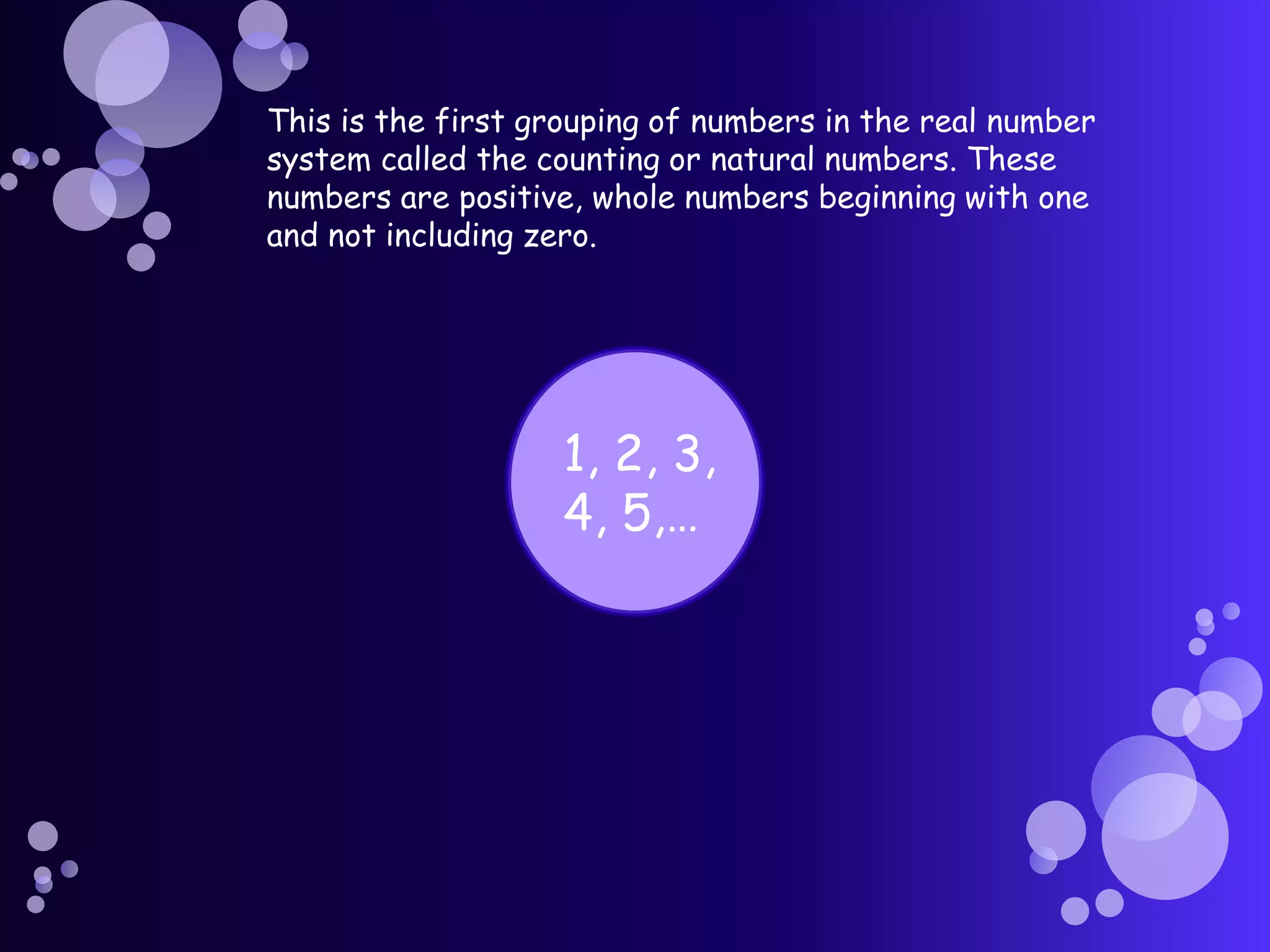
This is the first grouping of numbers in the real number
system called the counting or natural numbers. These
numbers are positive, whole numbers beginning with one
and not including zero.
1, 2, 3,
4, 5,…
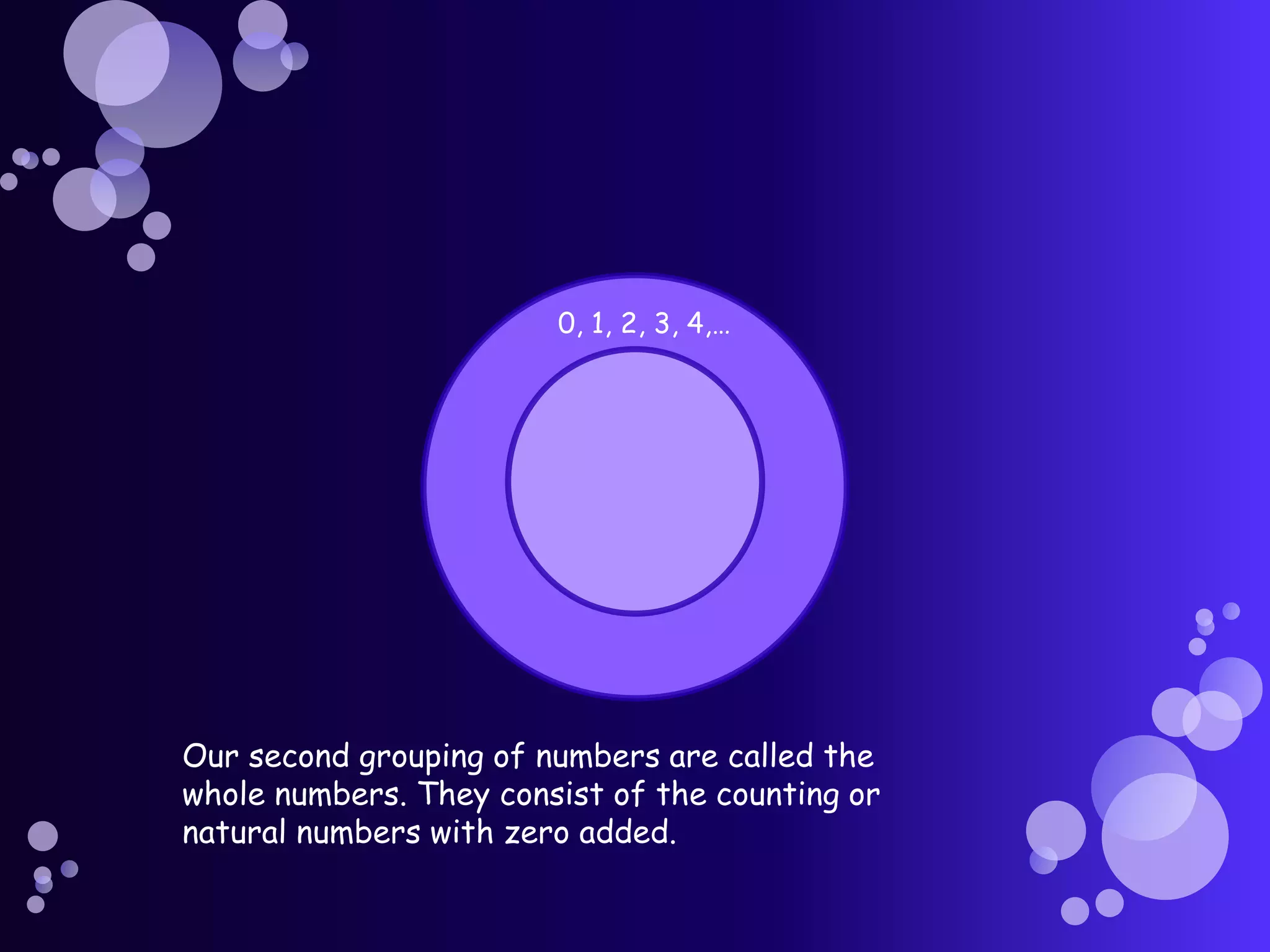
Our second grouping of numbers are called the
whole numbers. They consist of the counting or
natural numbers with zero added.
0, 1, 2, 3, 4,…
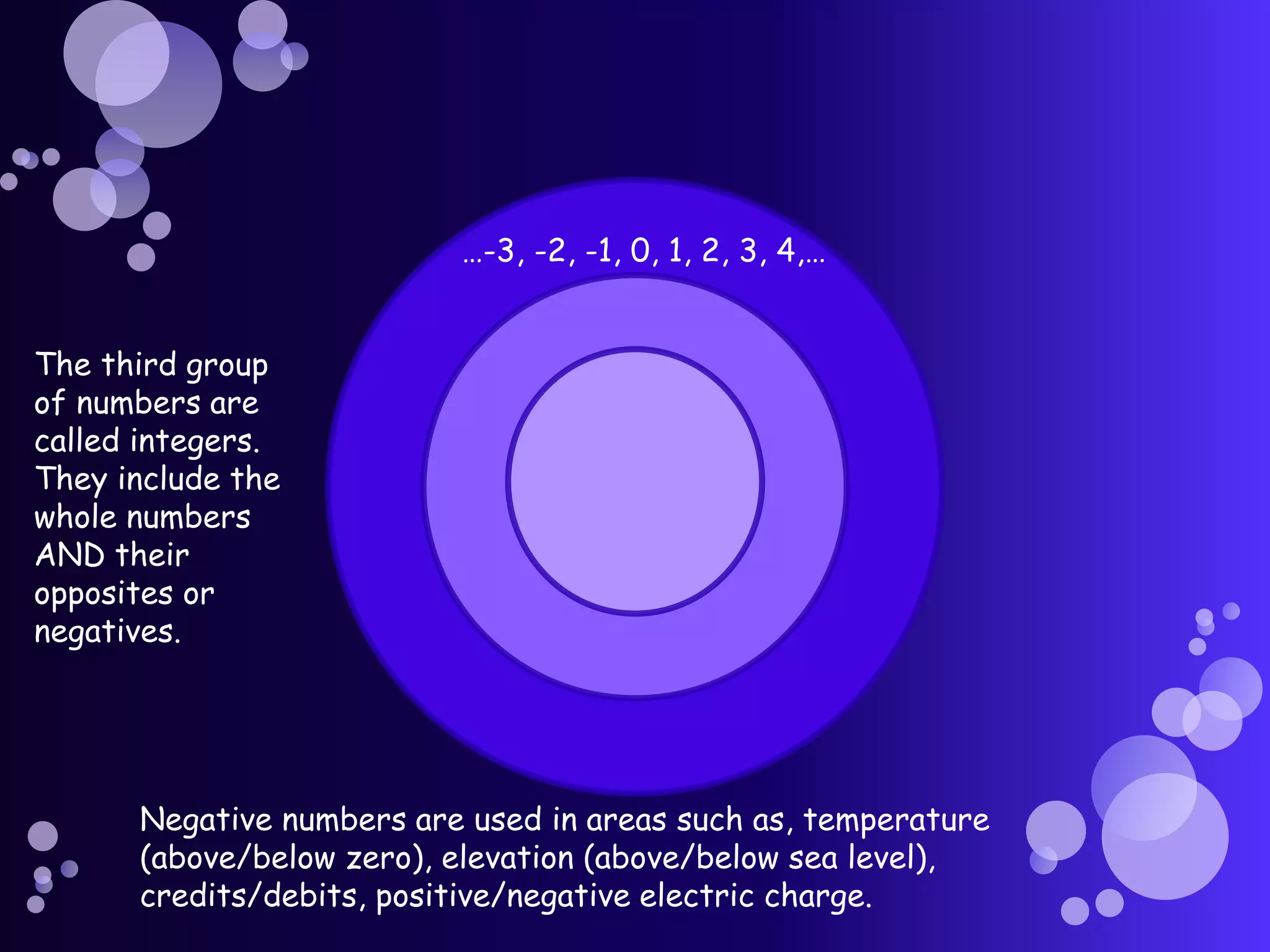
The third group
of numbers are
called integers.
They include the
whole numbers
AND their
opposites or
negatives.
…-3, -2, -1, 0, 1, 2, 3, 4,…
Negative numbers are used in areas such as, temperature
(above/below zero), elevation (above/below sea level),
credits/debits, positive/negative electric charge.
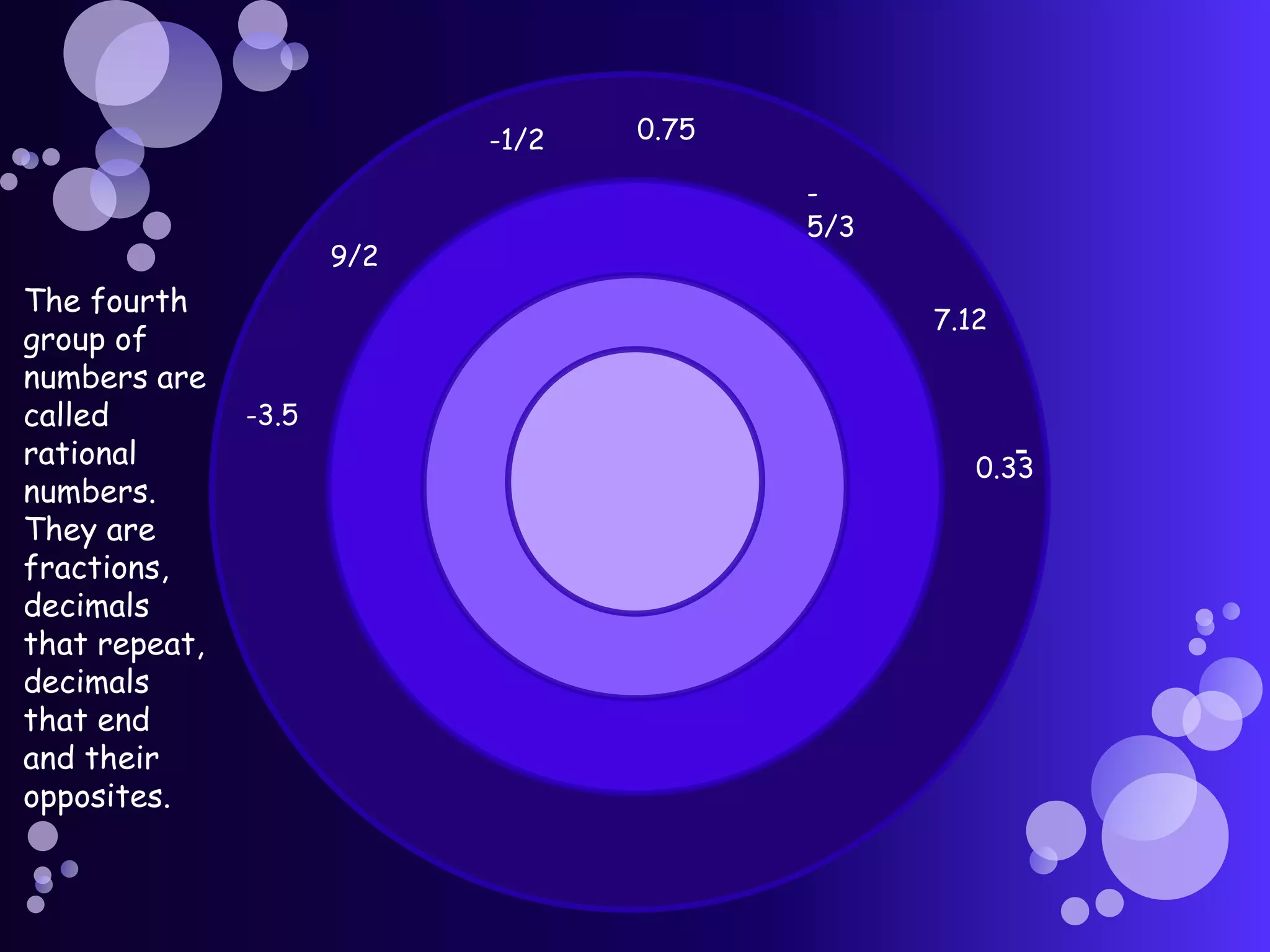
The fourth
group of
numbers are
called
rational
numbers.
They are
fractions,
decimals
that repeat,
decimals
that end
and their
opposites.
-1/2
-3.5
0.75
7.12
9/2
-
5/3
0.33
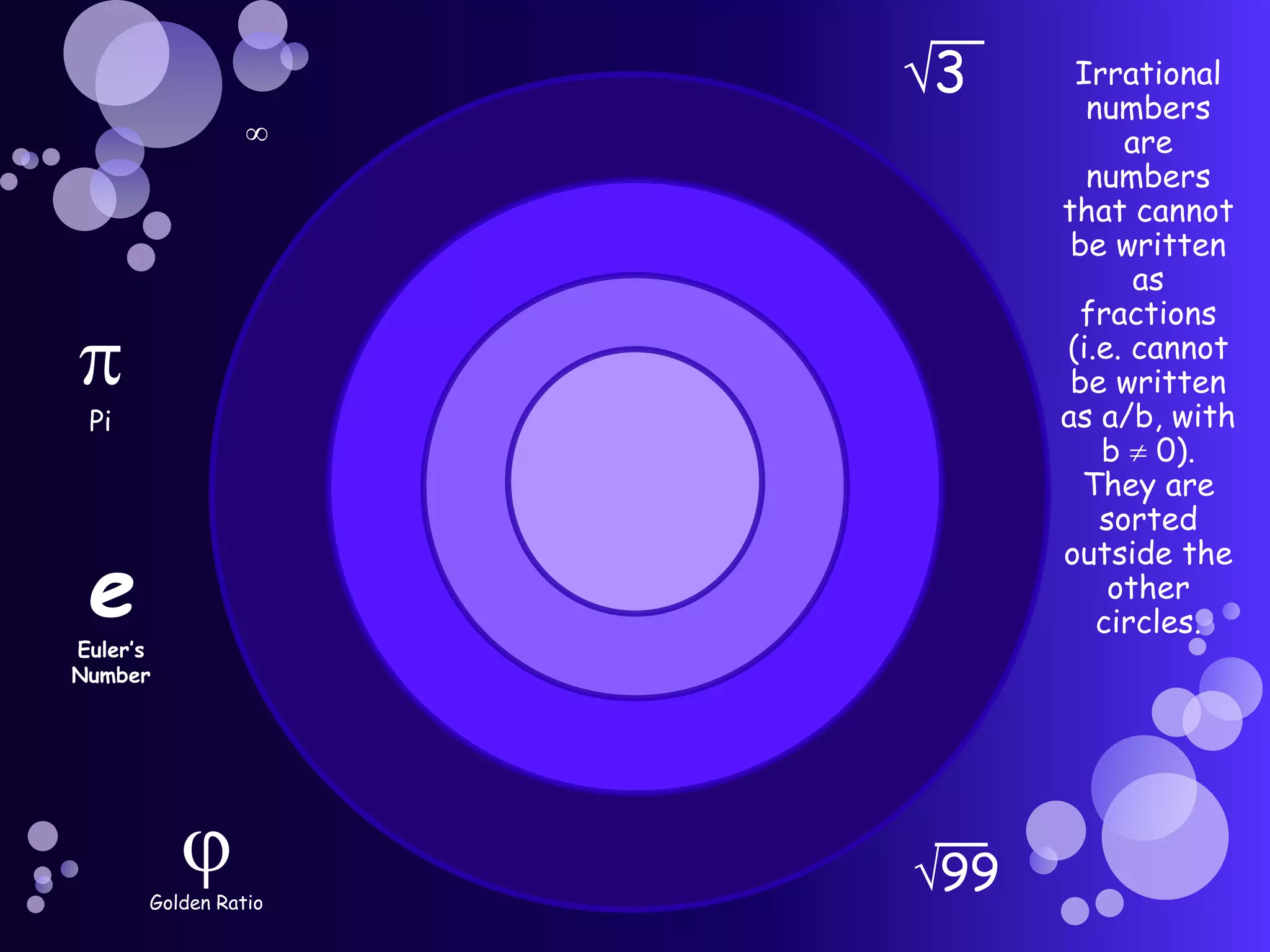
Irrational
numbers
are
numbers
that cannot
be written
as
fractions
(i.e. cannot
be written
as a/b, with
b  0).
They are
sorted
outside the
other
circles.

Pi
3
Golden Ratio

eEuler’s
Number
99
1, 2, 3, 4,…
Counting numbers,
also called natural
numbers are the
positive, whole
numbers without zero
that are used to count
0, 1, 2, 3, 4,…
Whole numbers are
counting or natural
numbers with zero
included
Integers are the whole
numbers with their opposites
-1/2
-3.5
0.75
7.12
9/2
-
5/3
Irrational
numbers are
numbers that
cannot be
written as
fractions
(cannot be
written as a/b,
with b  0).
They are
sorted outside
the other
circles.
3
Rational numbers are integers, common
fractions and their opposites without the
denominator equaling zero, including
decimals that repeat themselves or that
just end

Pi
Golden Ratio
eEuler’s
Number
99
…-3, -2, -1, 0, 1, 2, 3, 4,…
The Real Number System
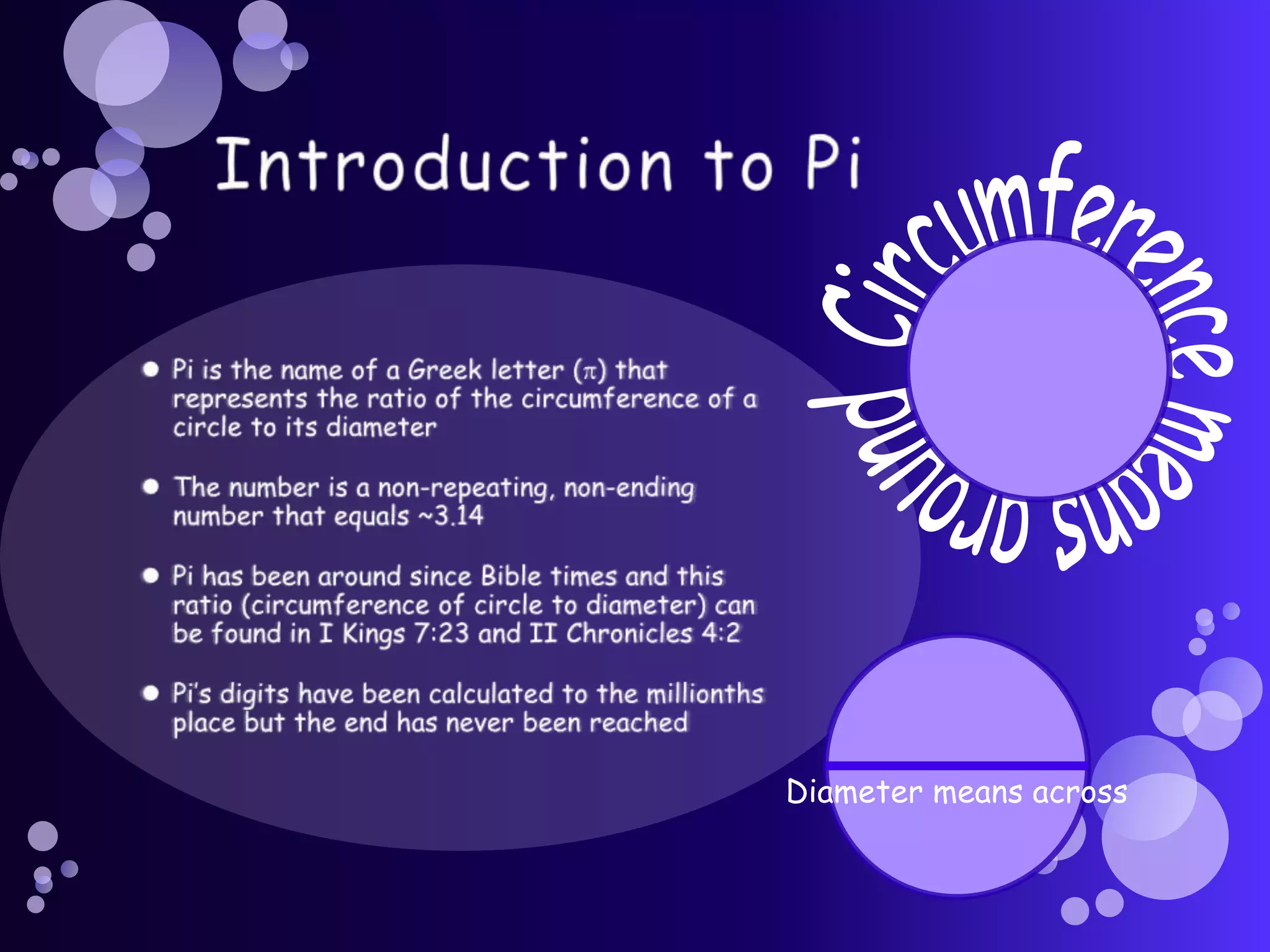
Diameter means across
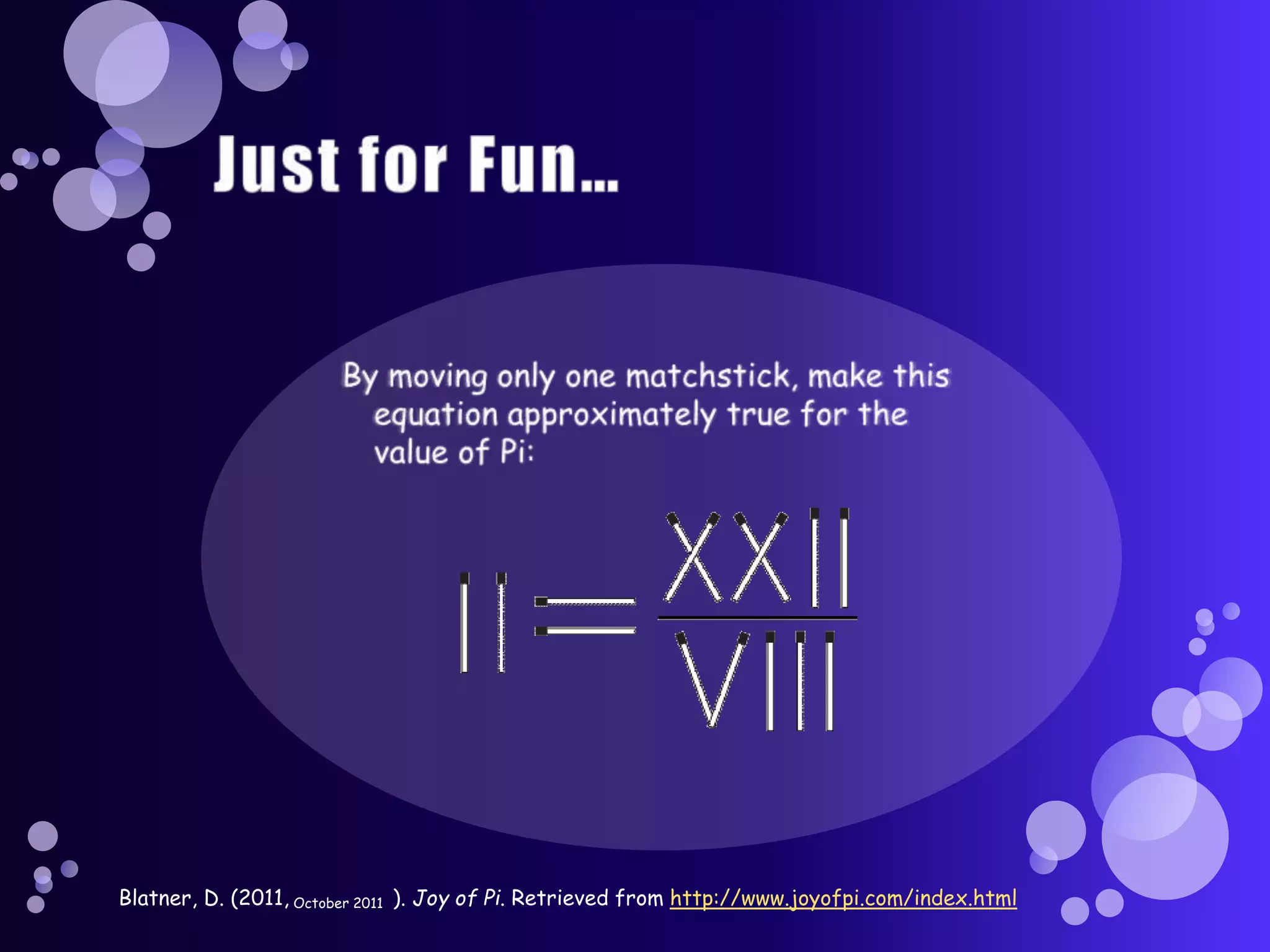
Blatner, D. (2011, October 2011 ). Joy of Pi. Retrieved from http://www.joyofpi.com/index.html

Real numbers system

  • 1.
    Real numbers includeall the numbers in our numbering system – decimals, fractions, negative, positive and even funny or odd numbers like Pi or imaginary numbers whose square would be less than zero (an example would be -1 or ). They are called real because they show the value of something real. Numbers are grouped together or organized according to their type.
  • 2.
    -3 -2 -10 1 2 3 -3.5 -1/2 0.75 2 1/2 This is a number line. All of the real numbers can be placed on this line. The arrows tell you that the line can go on forever in either direction. It can also include many more numbers than what are shown here.
  • 3.
    This is thefirst grouping of numbers in the real number system called the counting or natural numbers. These numbers are positive, whole numbers beginning with one and not including zero. 1, 2, 3, 4, 5,…
  • 4.
    Our second groupingof numbers are called the whole numbers. They consist of the counting or natural numbers with zero added. 0, 1, 2, 3, 4,…
  • 5.
    The third group ofnumbers are called integers. They include the whole numbers AND their opposites or negatives. …-3, -2, -1, 0, 1, 2, 3, 4,… Negative numbers are used in areas such as, temperature (above/below zero), elevation (above/below sea level), credits/debits, positive/negative electric charge.
  • 6.
    The fourth group of numbersare called rational numbers. They are fractions, decimals that repeat, decimals that end and their opposites. -1/2 -3.5 0.75 7.12 9/2 - 5/3 0.33
  • 7.
    Irrational numbers are numbers that cannot be written as fractions (i.e.cannot be written as a/b, with b  0). They are sorted outside the other circles.  Pi 3 Golden Ratio  eEuler’s Number 99
  • 8.
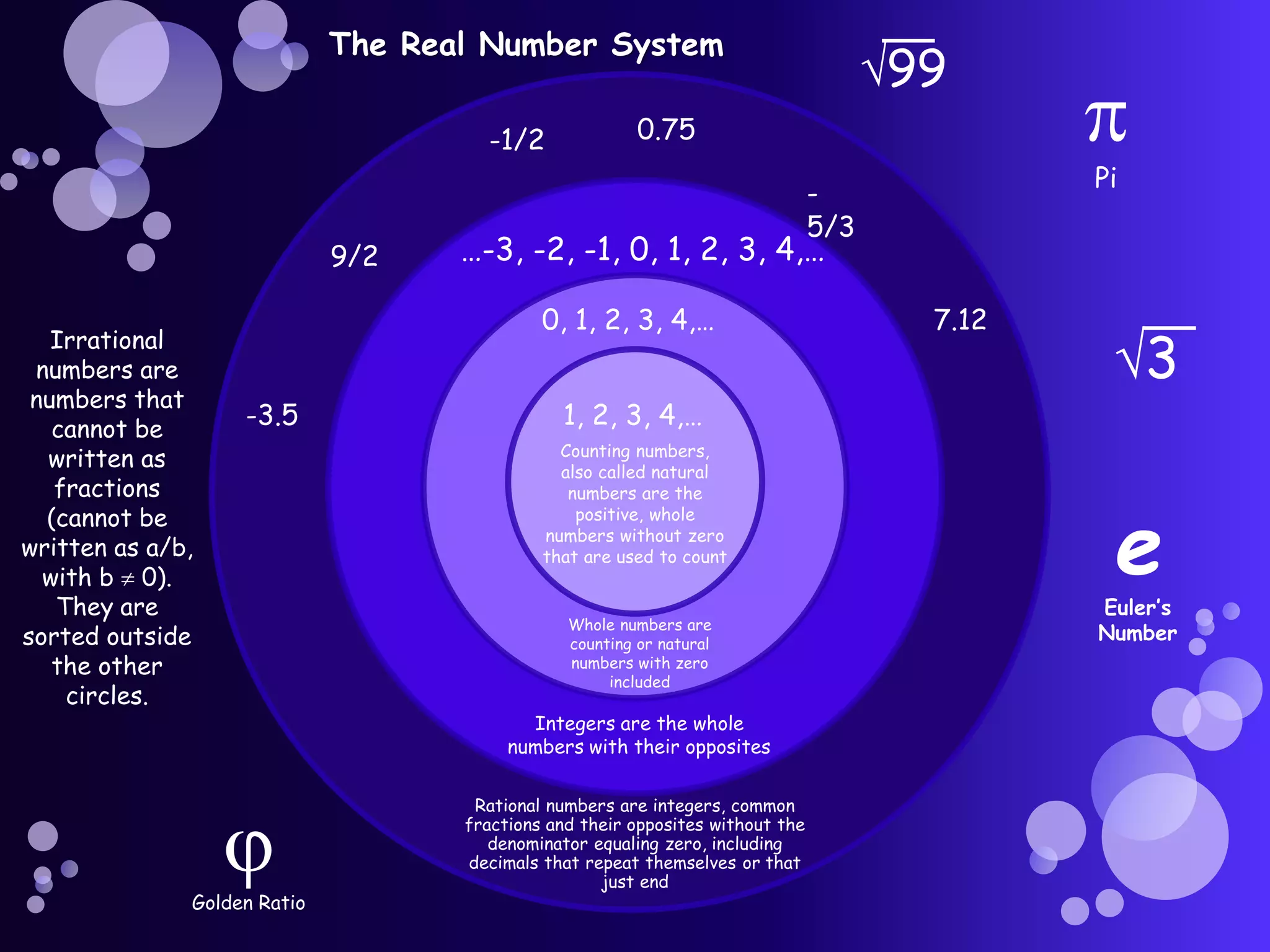
    1, 2, 3,4,… Counting numbers, also called natural numbers are the positive, whole numbers without zero that are used to count 0, 1, 2, 3, 4,… Whole numbers are counting or natural numbers with zero included Integers are the whole numbers with their opposites -1/2 -3.5 0.75 7.12 9/2 - 5/3 Irrational numbers are numbers that cannot be written as fractions (cannot be written as a/b, with b  0). They are sorted outside the other circles. 3 Rational numbers are integers, common fractions and their opposites without the denominator equaling zero, including decimals that repeat themselves or that just end  Pi Golden Ratio eEuler’s Number 99 …-3, -2, -1, 0, 1, 2, 3, 4,… The Real Number System
  • 9.
  • 13.
    Blatner, D. (2011,October 2011 ). Joy of Pi. Retrieved from http://www.joyofpi.com/index.html

Editor's Notes

  • #7 Rational numbers can be written as fractions or as a/b as long as b  0.
  • #8 The reason these numbers cannot be written as fractions is because their decimals do not repeat and never end.
  • #9 You should have a picture similar to this in your math workbooks.
  • #10 Night at the Museum II had a reference to Pi. Larry Daley was sent on a quest to find was at the heart of Pharaoh's tomb. He needed a number so the evil Pharaoh could unlock his domain. After talking with the Einstein bobble-headed dolls, Emilia Earhart exclaimed that the answer was Pi. The Einsteins rattled off Pi as being 3.14159265.
  • #14 Remove one of the bottom matchsticks from the Roman numeral 8 (VIII) to make it 7 (VII) then move it to the other side of the equation to make Roman numeral 2 (II) a Roman numeral 3 (III).