Ms. Johnson 8th Grade math
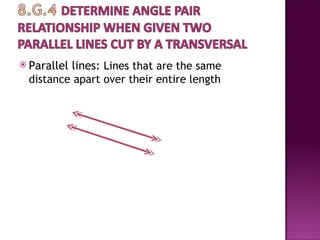
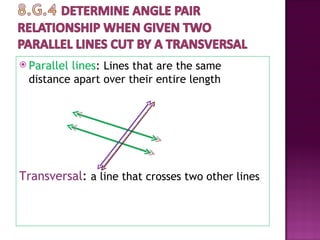
 Parallel
         lines: Lines that are the same
 distance apart over their entire length
 Parallel
         lines: Lines that are the same
 distance apart over their entire length


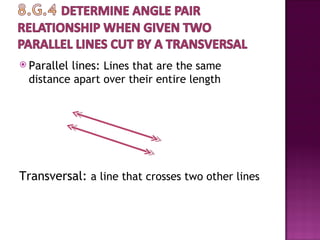
Transversal: a line that crosses two other lines
 Parallel
         lines: Lines that are the same
 distance apart over their entire length


Transversal: a line that crosses two other lines
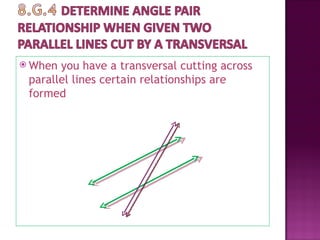
 When you have a transversal cutting across
 parallel lines certain relationships are
 formed
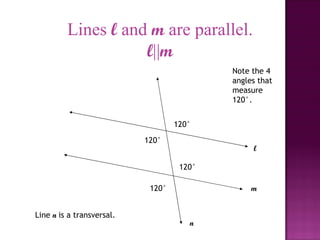
Lines l and m are parallel.
                    l||m
                                           Note the 4
                                           angles that
                                           measure
                                           120°.


                                   120°

                           120°
                                                l

                                    120°

                            120°                m


Line n is a transversal.
                                      n
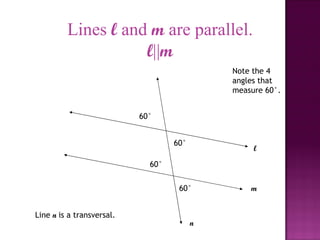
Lines l and m are parallel.
                    l||m
                                             Note the 4
                                             angles that
                                             measure 60°.


                           60°


                                   60°
                                                  l

                             60°


                                    60°          m


Line n is a transversal.
                                         n
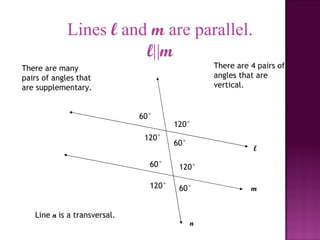
Lines l and m are parallel.
                       l||m
There are many                                   There are 4 pairs of
pairs of angles that                             angles that are
are supplementary.                               vertical.


                              60°
                                       120°
                               120°
                                       60°
                                                            l

                                60°     120°

                                120°    60°                m


   Line n is a transversal.
                                             n
Practice Time!
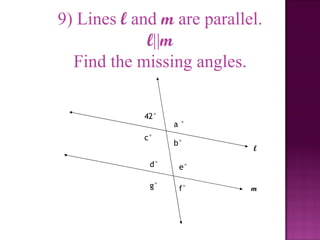
9) Lines l and m are parallel.
             l||m
  Find the missing angles.

            42°
                  a°
            c°
                  b°
                            l

             d°    e°

             g°    f°       m
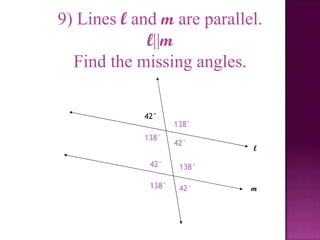
9) Lines l and m are parallel.
             l||m
  Find the missing angles.

            42°
                    138°
            138°
                    42°
                            l

             42°     138°

             138°    42°    m
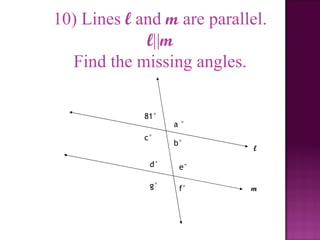
10) Lines l and m are parallel.
             l||m
  Find the missing angles.

             81°
                   a°
             c°
                   b°
                             l

              d°    e°

              g°    f°      m
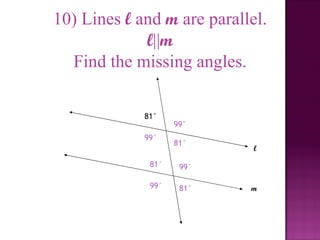
10) Lines l and m are parallel.
             l||m
  Find the missing angles.

             81°
                    99°
             99°
                    81°
                             l

              81°    99°

              99°    81°    m
 Sowe know that given a transversal cutting 2
 parallel lines, certain relationships are
 formed. Some of the angles are
 supplementary because they are on a
 straight line. And some angles are vertical
 and thus equal.
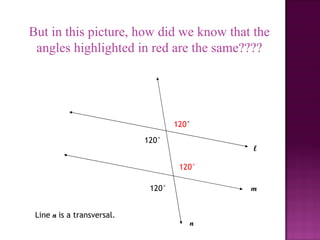
But in this picture, how did we know that the
 angles highlighted in red are the same????


                                    120°

                            120°
                                            l

                                     120°

                             120°           m


 Line n is a transversal.
                                       n
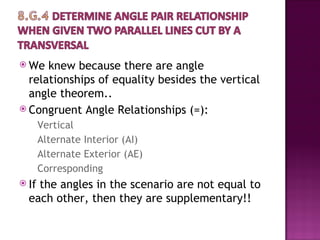
 We  knew because there are angle
  relationships of equality besides the vertical
  angle theorem..
 Congruent Angle Relationships (=):
   Vertical
   Alternate Interior (AI)
   Alternate Exterior (AE)
   Corresponding
 We  knew because there are angle
  relationships of equality besides the vertical
  angle theorem..
 Congruent Angle Relationships (=):
       Vertical
       Alternate Interior (AI)
       Alternate Exterior (AE)
       Corresponding
 Ifthe angles in the scenario are not equal to
  each other, then they are supplementary!!
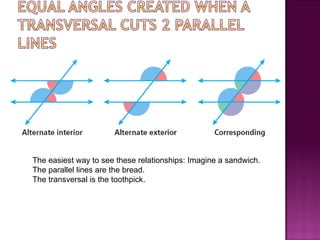
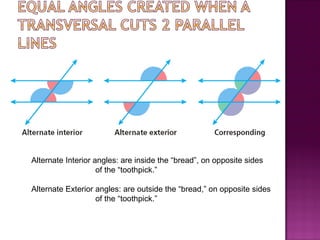
The easiest way to see these relationships: Imagine a sandwich.
The parallel lines are the bread.
The transversal is the toothpick.
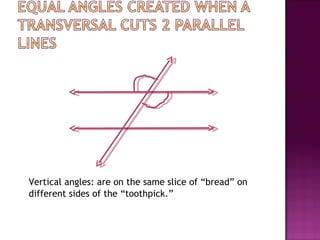
Vertical angles: are on the same slice of “bread” on
different sides of the “toothpick.”
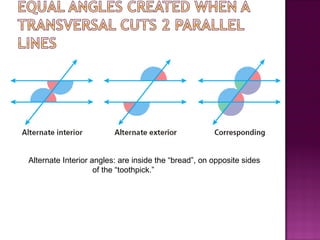
Alternate Interior angles: are inside the “bread”, on opposite sides
                    of the “toothpick.”
Alternate Interior angles: are inside the “bread”, on opposite sides
                    of the “toothpick.”

Alternate Exterior angles: are outside the “bread,” on opposite sides
                   of the “toothpick.”
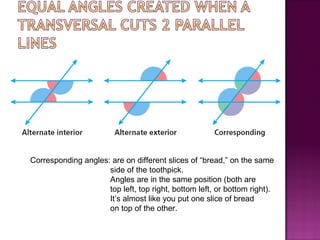
Corresponding angles: are on different slices of “bread,” on the same
                     side of the toothpick.
                     Angles are in the same position (both are
                     top left, top right, bottom left, or bottom right).
                     It’s almost like you put one slice of bread
                     on top of the other.
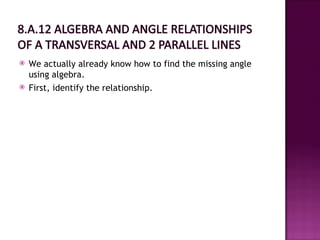
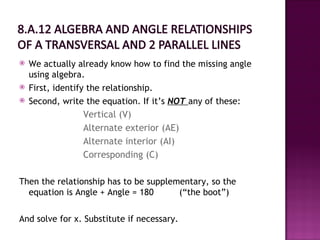
   We actually already know how to find the missing angle
    using algebra.
   First, identify the relationship.
   We actually already know how to find the missing angle
    using algebra.
   First, identify the relationship.
   Second, write the equation. If it’s any of these:
                   Vertical (V)
                 Alternate exterior (AE)
                 Alternate interior (AI)
                 Corresponding (C)

Then use the same equation you do for all equal
  relationships. Angle = Angle (the sneaker)
And solve for x. Substitute if necessary.
   We actually already know how to find the missing angle
    using algebra.
   First, identify the relationship.
   Second, write the equation. If it’s NOT any of these:
                   Vertical (V)
                 Alternate exterior (AE)
                 Alternate interior (AI)
                 Corresponding (C)

Then the relationship has to be supplementary, so the
  equation is Angle + Angle = 180      (“the boot”)

And solve for x. Substitute if necessary.
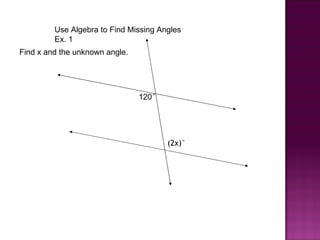
Use Algebra to Find Missing Angles
         Ex. 1
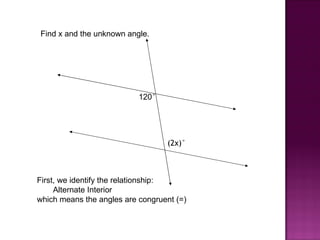
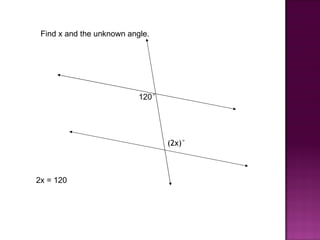
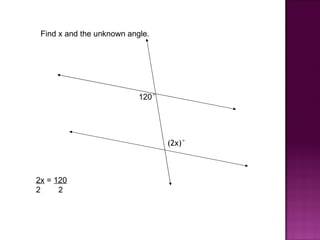
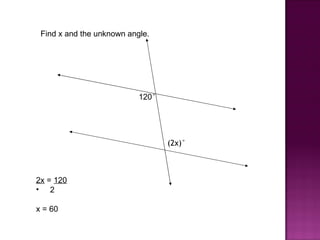
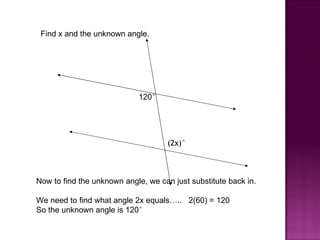
Find x and the unknown angle.


                                120°


                                       (2x)°
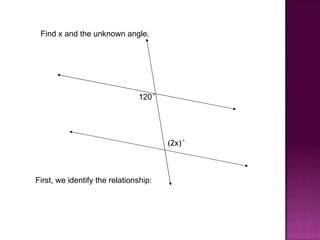
Find x and the unknown angle.


                               120°


                                       (2x)°


First, we identify the relationship:
Find x and the unknown angle.


                               120°


                                       (2x)°


First, we identify the relationship:
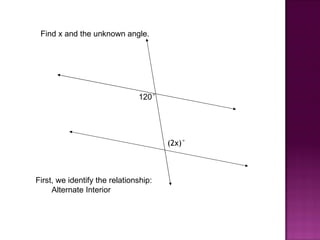
     Alternate Interior
Find x and the unknown angle.


                           120°


                                  (2x)°


First, we identify the relationship:
     Alternate Interior
which means the angles are congruent (=)
Find x and the unknown angle.


                           120°


                                  (2x)°


2x = 120
Find x and the unknown angle.


                           120°


                                  (2x)°


2x = 120
2     2
Find x and the unknown angle.


                           120°


                                  (2x)°


2x = 120
• 2

x = 60
Find x and the unknown angle.


                            120°


                                     (2x)°


Now to find the unknown angle, we can just substitute back in.

We need to find what angle 2x equals….. 2(60) = 120
So the unknown angle is 120°
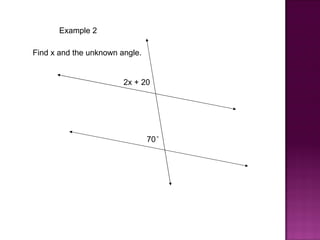
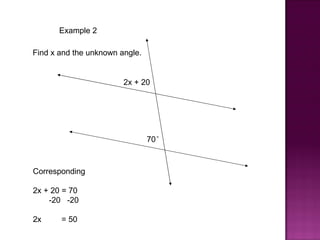
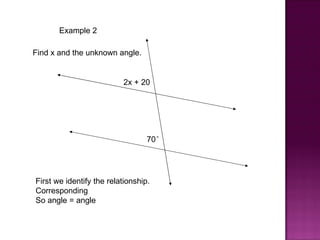
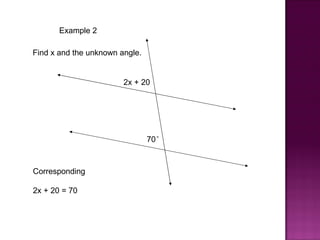
Example 2

Find x and the unknown angle.


                        2x + 20


                                70°
Example 2

Find x and the unknown angle.


                          2x + 20


                                  70°


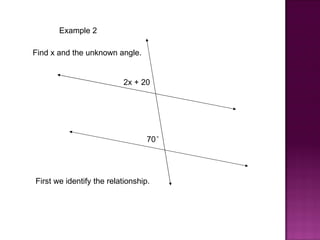
First we identify the relationship.
Example 2

Find x and the unknown angle.


                          2x + 20


                                  70°


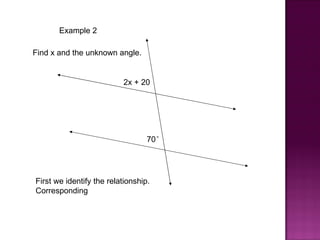
First we identify the relationship.
Corresponding
Example 2

Find x and the unknown angle.


                          2x + 20


                                  70°


First we identify the relationship.
Corresponding
So angle = angle
Example 2

Find x and the unknown angle.


                        2x + 20


                                70°


Corresponding

2x + 20 = 70
Example 2

Find x and the unknown angle.


                        2x + 20


                                70°


Corresponding

2x + 20 = 70
    -20 -20

2x     = 50
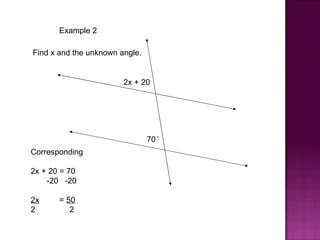
Example 2

Find x and the unknown angle.


                        2x + 20


                                70°
Corresponding

2x + 20 = 70
    -20 -20

2x     = 50
2         2
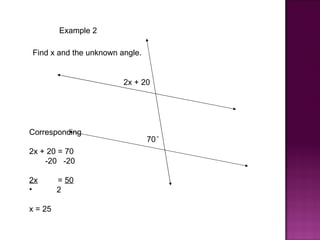
Example 2

Find x and the unknown angle.


                        2x + 20


Corresponding
                                70°
2x + 20 = 70
    -20 -20

2x       = 50
•        2

x = 25
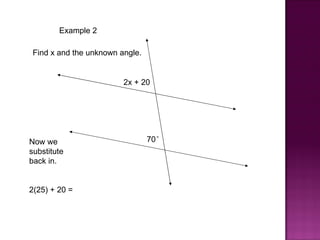
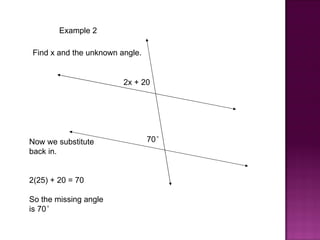
Example 2

 Find x and the unknown angle.


                         2x + 20


Now we                           70°
substitute
back in.


2(25) + 20 =
Example 2

Find x and the unknown angle.


                        2x + 20


Now we substitute               70°
back in.


2(25) + 20 = 70

So the missing angle
is 70°
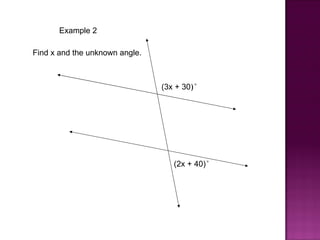
Example 2

Find x and the unknown angle.


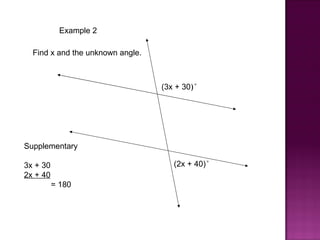
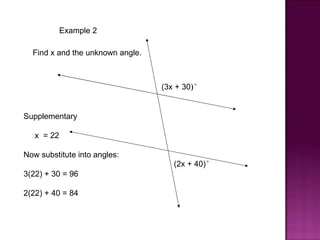
                                (3x + 30)°


                                   (2x + 40)°
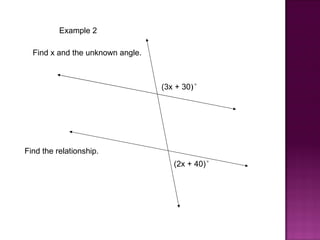
Example 2

  Find x and the unknown angle.


                                  (3x + 30)°


Find the relationship.
                                     (2x + 40)°
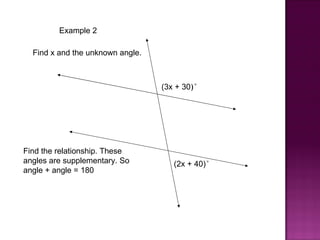
Example 2

  Find x and the unknown angle.


                                  (3x + 30)°


Find the relationship. These
angles are supplementary. So         (2x + 40)°
angle + angle = 180
Example 2

  Find x and the unknown angle.


                                  (3x + 30)°


Supplementary

3x + 30                              (2x + 40)°
2x + 40
          = 180
Example 2

  Find x and the unknown angle.


                                  (3x + 30)°


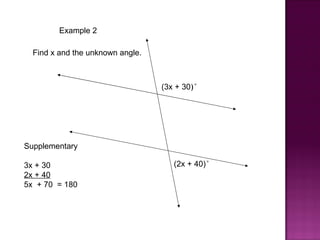
Supplementary

3x + 30                              (2x + 40)°
2x + 40
5x + 70 = 180
Example 2

     Find x and the unknown angle.


                                     (3x + 30)°


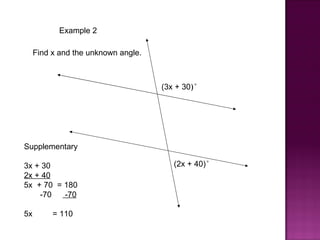
Supplementary

3x + 30                                 (2x + 40)°
2x + 40
5x + 70 = 180
    -70   -70

5x        = 110
Example 2

     Find x and the unknown angle.


                                     (3x + 30)°


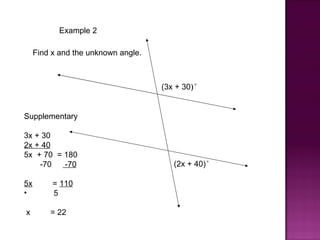
Supplementary

3x + 30
2x + 40
5x + 70 = 180
    -70   -70                           (2x + 40)°

5x        = 110
•         5

x        = 22
Example 2

  Find x and the unknown angle.


                                  (3x + 30)°


Supplementary

   x = 22

Now substitute into angles:
                                     (2x + 40)°
3(22) + 30 = 96

2(22) + 40 = 84
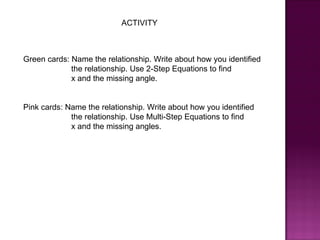
ACTIVITY


Green cards: Name the relationship. Write about how you identified
             the relationship. Use 2-Step Equations to find
             x and the missing angle.


Pink cards: Name the relationship. Write about how you identified
             the relationship. Use Multi-Step Equations to find
             x and the missing angles.

Angles created by transversal and paralle

  • 1.
    Ms. Johnson 8thGrade math
  • 2.
     Parallel lines: Lines that are the same distance apart over their entire length
  • 3.
     Parallel lines: Lines that are the same distance apart over their entire length Transversal: a line that crosses two other lines
  • 4.
     Parallel lines: Lines that are the same distance apart over their entire length Transversal: a line that crosses two other lines
  • 5.
     When youhave a transversal cutting across parallel lines certain relationships are formed
  • 6.
    Lines l andm are parallel. l||m Note the 4 angles that measure 120°. 120° 120° l 120° 120° m Line n is a transversal. n
  • 7.
    Lines l andm are parallel. l||m Note the 4 angles that measure 60°. 60° 60° l 60° 60° m Line n is a transversal. n
  • 8.
    Lines l andm are parallel. l||m There are many There are 4 pairs of pairs of angles that angles that are are supplementary. vertical. 60° 120° 120° 60° l 60° 120° 120° 60° m Line n is a transversal. n
  • 9.
  • 10.
    9) Lines land m are parallel. l||m Find the missing angles. 42° a° c° b° l d° e° g° f° m
  • 11.
    9) Lines land m are parallel. l||m Find the missing angles. 42° 138° 138° 42° l 42° 138° 138° 42° m
  • 12.
    10) Lines land m are parallel. l||m Find the missing angles. 81° a° c° b° l d° e° g° f° m
  • 13.
    10) Lines land m are parallel. l||m Find the missing angles. 81° 99° 99° 81° l 81° 99° 99° 81° m
  • 14.
     Sowe knowthat given a transversal cutting 2 parallel lines, certain relationships are formed. Some of the angles are supplementary because they are on a straight line. And some angles are vertical and thus equal.
  • 15.
    But in thispicture, how did we know that the angles highlighted in red are the same???? 120° 120° l 120° 120° m Line n is a transversal. n
  • 16.
     We knew because there are angle relationships of equality besides the vertical angle theorem..  Congruent Angle Relationships (=): Vertical Alternate Interior (AI) Alternate Exterior (AE) Corresponding
  • 17.
     We knew because there are angle relationships of equality besides the vertical angle theorem..  Congruent Angle Relationships (=): Vertical Alternate Interior (AI) Alternate Exterior (AE) Corresponding  Ifthe angles in the scenario are not equal to each other, then they are supplementary!!
  • 18.
    The easiest wayto see these relationships: Imagine a sandwich. The parallel lines are the bread. The transversal is the toothpick.
  • 19.
    Vertical angles: areon the same slice of “bread” on different sides of the “toothpick.”
  • 20.
    Alternate Interior angles:are inside the “bread”, on opposite sides of the “toothpick.”
  • 21.
    Alternate Interior angles:are inside the “bread”, on opposite sides of the “toothpick.” Alternate Exterior angles: are outside the “bread,” on opposite sides of the “toothpick.”
  • 22.
    Corresponding angles: areon different slices of “bread,” on the same side of the toothpick. Angles are in the same position (both are top left, top right, bottom left, or bottom right). It’s almost like you put one slice of bread on top of the other.
  • 23.
    We actually already know how to find the missing angle using algebra.  First, identify the relationship.
  • 24.
    We actually already know how to find the missing angle using algebra.  First, identify the relationship.  Second, write the equation. If it’s any of these: Vertical (V) Alternate exterior (AE) Alternate interior (AI) Corresponding (C) Then use the same equation you do for all equal relationships. Angle = Angle (the sneaker) And solve for x. Substitute if necessary.
  • 25.
    We actually already know how to find the missing angle using algebra.  First, identify the relationship.  Second, write the equation. If it’s NOT any of these: Vertical (V) Alternate exterior (AE) Alternate interior (AI) Corresponding (C) Then the relationship has to be supplementary, so the equation is Angle + Angle = 180 (“the boot”) And solve for x. Substitute if necessary.
  • 26.
    Use Algebra toFind Missing Angles Ex. 1 Find x and the unknown angle. 120° (2x)°
  • 27.
    Find x andthe unknown angle. 120° (2x)° First, we identify the relationship:
  • 28.
    Find x andthe unknown angle. 120° (2x)° First, we identify the relationship: Alternate Interior
  • 29.
    Find x andthe unknown angle. 120° (2x)° First, we identify the relationship: Alternate Interior which means the angles are congruent (=)
  • 30.
    Find x andthe unknown angle. 120° (2x)° 2x = 120
  • 31.
    Find x andthe unknown angle. 120° (2x)° 2x = 120 2 2
  • 32.
    Find x andthe unknown angle. 120° (2x)° 2x = 120 • 2 x = 60
  • 33.
    Find x andthe unknown angle. 120° (2x)° Now to find the unknown angle, we can just substitute back in. We need to find what angle 2x equals….. 2(60) = 120 So the unknown angle is 120°
  • 34.
    Example 2 Find xand the unknown angle. 2x + 20 70°
  • 35.
    Example 2 Find xand the unknown angle. 2x + 20 70° First we identify the relationship.
  • 36.
    Example 2 Find xand the unknown angle. 2x + 20 70° First we identify the relationship. Corresponding
  • 37.
    Example 2 Find xand the unknown angle. 2x + 20 70° First we identify the relationship. Corresponding So angle = angle
  • 38.
    Example 2 Find xand the unknown angle. 2x + 20 70° Corresponding 2x + 20 = 70
  • 39.
    Example 2 Find xand the unknown angle. 2x + 20 70° Corresponding 2x + 20 = 70 -20 -20 2x = 50
  • 40.
    Example 2 Find xand the unknown angle. 2x + 20 70° Corresponding 2x + 20 = 70 -20 -20 2x = 50 2 2
  • 41.
    Example 2 Find xand the unknown angle. 2x + 20 Corresponding 70° 2x + 20 = 70 -20 -20 2x = 50 • 2 x = 25
  • 42.
    Example 2 Findx and the unknown angle. 2x + 20 Now we 70° substitute back in. 2(25) + 20 =
  • 43.
    Example 2 Find xand the unknown angle. 2x + 20 Now we substitute 70° back in. 2(25) + 20 = 70 So the missing angle is 70°
  • 44.
    Example 2 Find xand the unknown angle. (3x + 30)° (2x + 40)°
  • 45.
    Example 2 Find x and the unknown angle. (3x + 30)° Find the relationship. (2x + 40)°
  • 46.
    Example 2 Find x and the unknown angle. (3x + 30)° Find the relationship. These angles are supplementary. So (2x + 40)° angle + angle = 180
  • 47.
    Example 2 Find x and the unknown angle. (3x + 30)° Supplementary 3x + 30 (2x + 40)° 2x + 40 = 180
  • 48.
    Example 2 Find x and the unknown angle. (3x + 30)° Supplementary 3x + 30 (2x + 40)° 2x + 40 5x + 70 = 180
  • 49.
    Example 2 Find x and the unknown angle. (3x + 30)° Supplementary 3x + 30 (2x + 40)° 2x + 40 5x + 70 = 180 -70 -70 5x = 110
  • 50.
    Example 2 Find x and the unknown angle. (3x + 30)° Supplementary 3x + 30 2x + 40 5x + 70 = 180 -70 -70 (2x + 40)° 5x = 110 • 5 x = 22
  • 51.
    Example 2 Find x and the unknown angle. (3x + 30)° Supplementary x = 22 Now substitute into angles: (2x + 40)° 3(22) + 30 = 96 2(22) + 40 = 84
  • 52.
    ACTIVITY Green cards: Namethe relationship. Write about how you identified the relationship. Use 2-Step Equations to find x and the missing angle. Pink cards: Name the relationship. Write about how you identified the relationship. Use Multi-Step Equations to find x and the missing angles.